Do We Need God For Happiness?

Timothy Larsen at Marginalia Review:
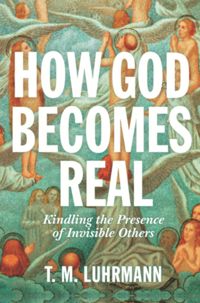
How God Becomes Real is an ethnographically-informed study focused on the development of a person’s relationship with God, including the ways in which they come to hear God speak to them. What is bracketed is the question of whether or not they are really hearing from God—or even whether or not God really exists.  Whether or not God exists is an important question, of course, but it is primarily another kind of question – philosophical or theological, perhaps – rather than an anthropological one.  How do believers foster a relationship with this divine, invisible other? that is the question addressed here.  The research for this project was overwhelmingly done by studying Christians, but in her reflections and analysis Luhrmann supplements this occasionally with work she has done with adherents from other traditions, including Buddhism and Judaism.

Some unbelievers might chafe at the way that Luhrmann sees relating to God as not only widespread and normal, but even as a pathway to human flourishing.  Some believers, on the other hand, might become suspicious when she starts referring to the “imagination” and the “play frame” and the like.  Everyone, however, might learn something if they are only willing to dial down their apologetic and polemical priorities for just long enough to consider on its own (anthropological) terms the evidence and analysis on display in this thoughtful work.

more here.
The History Of The Asterisk

Claire Cock-Starkey at Lapham’s Quarterly:

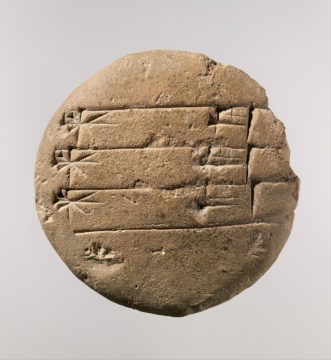
http://www.metmuseum.org/art/collection/search/321878

Sumerian pictographic writing includes a sign for “star” that looks like a modern asterisk. These early writings from five thousand years ago are the first known depiction of an asterisk; however, it seems unlikely that these pictograms are the forerunner of the symbol we use today. Palaeographers know that Aristarchus of Samothrace (220–143 bc) used an asterisk symbol when editing Homer in the second century bc, because later scholars wrote about him doing so. Physical examples of Aristarchus’ asterisks have not survived, so we cannot know their physical shape, but as the word asterisk derives from the Greek asteriskos, meaning “little star,” an assumption has been made that they resembled a small star. Aristarchus used the symbols to mark places in Homer’s text that he was copying where he thought passages were from another source. By the third century Origen of Alexandria had adopted the asterisk when compiling the Hexapla—a Greek translation of the Jewish scriptures, the Septuagint.

more here.

Orwellian Hellscape v. Neoliberal Caretakers: American Politics in the “Post-Trump” Era

Anthony Dimaggio in Counterpunch:

Trump may be out of office, but American politics seem more crisis laden than ever between the caretaker neoliberalism of the Democrats and the creeping totalitarianism of the Republicans. On the Democratic front, although the progressive Sanders-Warren-AOC wing of the party continues to push for liberal reforms, we’ve seen “more of the same” establishment-friendly politics from the neoliberal Biden wing that’s dominated the party for decades. This will come as no shock to those of us who have lamented the plutocratic biases of the Democrats during the Obama years and before.

Disappointing Their Base: Neoliberal Democrats Rise Again

It shouldn’t come as a surprise that the Biden wing of the party has disappointed liberals. They campaigned on politically empowering the poor and people of color, on implementing a $15 minimum wage, on expanding access to health care through a public option, on providing relief on the student loan front, and combating the steadily intensifying climate crisis. Thus far, there has been little by way of delivery. The “For the People Act,” which is meant to combat Republican efforts to suppress voting among the poor and poor people of color, has passed the House by 220-210 votes, but remains stalled in the Senate by a few conservative Democratic holdouts – Senators Joe Manchin and Krysten Sinema. The party hasn’t acted on passing a $15 minimum wage due to resistance from these senators and a few others who have also blocked action. Biden has refused to prioritize action on student loan debt relief, claiming he doesn’t have executive authority to grant it, and only calling for $10,000 in forgiveness for each federal borrower. On health care, Biden has proposed $200 billion to expand the Affordable Care Act’s subsidies, but failed to put forward as promised a proposal for a “public option,” and his opposition to Medicare for All is well known.

On foreign policy, the Biden administration delivered more of the same on Israel Palestine, granting continued military support for a settler colonial government that’s been conducting an illegal occupation for more than a half century, which is responsible for ethnic cleansing, maintaining an apartheid state, and pursues massive violence that has produced asymmetrical deaths in the latest round of the “conflict” (May 2021), with 12 Israeli civilians killed compared to 212 Palestinians – or an imbalance of more than 17:1. The U.S. has continued its support for Israel’s settler colonialism over the decades, despite this asymmetry, with 87 percent of the deaths falling on the Palestinian side in the 2000s and 2010s. None of this seemed to matter much to the Democrats – Obama or Biden – who have continued to enable the bloodshed.

More here.

Aim at a Happy Mean

From Lapham’s Quarterly:

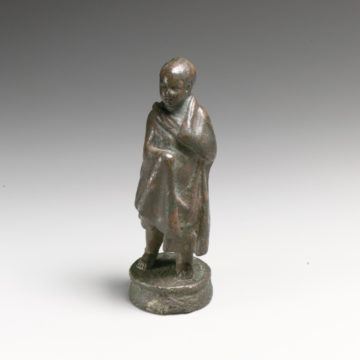
http://www.metmuseum.org/art/collection/search/251145 Greek, Bronze statuette of a boy in the pose of an orator, 3rd?2nd century B.C., Bronze, H.: 4 1/2 in. (11.4 cm). The Metropolitan Museum of Art, New York. Rogers Fund, 1921 (21.88.173)

John Stuart Mill’s early childhood education prioritized the basics—ancient Greek and Roman history, tomes on arithmetic, Don Quixote for dessert. It wasn’t until the age of twelve, armed with years of reading, that he dove into serious works of rhetoric and logic. (For those skeptical that any of the aforementioned texts have much to offer someone who had lived so little, the philosopher admits in his Autobiography that “most of these reflections were beyond my capacity of full comprehension at the time, but they left seed behind, which germinated in due season.”) One of the thinkers he read for the first time at the age of twelve was Quintilian.

Owing to his obscure style and to the scholastic details of which many parts of his treatise are made up, [he] is little read and seldom sufficiently appreciated. His book is a kind of encyclopedia of the thoughts of the ancients on the whole field of education and culture, and I have retained through life many valuable ideas which I can distinctly trace to my reading of him, even at that early age.

Quintilian taught rhetoric in Rome, later collecting his thoughts on the pedagogy of his beloved subject in his Institutio Oratoria, published in 95 and read for many centuries thereafter by budding orators such as Mill. In the final section of the book, Quintilian, speaking to potential practitioners of politics and law, considers the question of the best age to start practicing the art of rhetoric. Was Mill’s father right about the benefits of early training? Are recent college graduates primed to beat their elders at convincing speechifying? Does the tradition of the wise commencement speaker win approval from our ancient arbiter? Regardless of the correct answer—if there is one—Quintilian believed that a good teacher, speaking to crowds large and small, will win the affection of those hoping to learn from them: “It is scarcely possible to say how much more readily we imitate those whom we like.”

More here.

Friday Poem

I’d Once Left

—Excerpt from The Recorder

I’d once have left
brown behind
having already
left the tribe behind
and her tongue
and the garb that made me
theirs behind because it felt
like leaving hoi polloi behind
to finally put behind the chola
in my mother’s tongue
lingering in quiet deep vowels
behind meant I could leave
behind inferiority complex
not really but in theory

I tried to leave my eden-dreams
behind but they stuck to my shoe

because of my anarchic spirit
I leave behind dignity
so the angel inside me
stays behind me too
along with my poison pen

never mind I’ll need that

anger was my primary breathing
apparatus for so long
what a mixed blessing when it worked
I’ve learned the most from the cracked
once I broke into pieces
now I break into wholes


by Carmen Giménez Smith
from Smith College Poetry Center


Thursday, June 24, 2021

A Response to Malcolm Gladwell’s Love Letter to American Air Power

David Fedman and Cary Karacas in the Los Angeles Review of Books:

THERE’S A RICH IRONY that Malcolm Gladwell’s new book is spun off from episodes of his Revisionist History podcast. Ostensibly a meditation on the morality of bombing civilians during World War II, The Bomber Mafia is anything but revisionist. It’s indeed hard to imagine a more conventional account of the air war against Japan. In the questions it asks, the sources it uses, and the voices it amplifies, The Bomber Mafia offers an account virtually indistinguishable from the consensus position on the firebombings of urban Japan. It takes some of the most oft-repeated fallacies about the shift to area bombing and wraps them in a shiny new package.

The Bomber Mafia turns on a dramatic day in January 1945, when two protagonists “[square] off in the jungles of Guam.” Waiting on the tarmac as a B-29 bomber approaches for landing is Haywood Hansell, a career soldier unshakable in his faith in precision bombing, a man unwilling to bend his morals to the pressures of war. Stepping off the plane moments later is Curtis LeMay, his replacement. A ruthless pragmatist and brilliant tactician, LeMay has arrived to achieve what Hansell could not: bring the war in the Pacific to an end, even if it means destroying by fire every Japanese city, large and small.

More here.

Defying the Data Priests

Matthew B. Crawford in The New Atlantis:

I have no expertise in antitrust. I come to you as a student of the history of political thought.
The convenience of the smart home may be worth the price; that’s for each of us to decide. But to do so with open eyes, one has to understand what the price is. After all, you don’t pay a monthly fee for Alexa, or Google Assistant.

The Sleep Number bed is typical of smart home devices, as Harvard business school professor Shoshana Zuboff describes in The Age of Surveillance Capitalism. It comes with an app, of course, which you’ll need to install to get the full benefits. Benefits for whom? Well, to know that you would need to spend some time with the sixteen-page privacy policy that comes with the bed. There you’ll read about third-party sharing, analytics partners, targeted advertising, and much else. Meanwhile, the user agreement specifies that the company can share or exploit your personal information even “after you deactivate or cancel” your Sleep Number account. You are unilaterally informed that the firm does not honor “Do Not Track” notifications. By the way, its privacy policy once stated that the bed would also transmit “audio in your room.” (I am not making this up.)

More here.

Podcast with Namit Arora, author of “Indians: A Brief History of a Civilization”

Nicholas Gordon in the Asian Review of Books:

We can sometimes forget that “India”—or the idea of a single unified entity—is not a very old concept. Indian history is complicated and convoluted: different societies, polities and cultures rise and fall, ebb and flow, as the political makeup of South Asia changes.
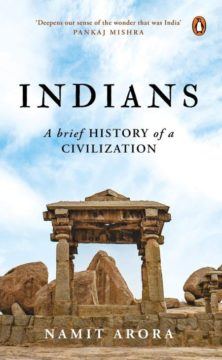
Namit Arora, author of Indians: A Brief History of a Civilization, details some of these changing cultures. From the early Harappans, to the Buddhist centers of Nagarjunakonda and Nalanda, and ending at Varanasi, Arora takes his readers on a journey through South Asia’s rich and diverse history.

Namit Arora chose a life of reading and writing after cutting short his career in the Internet industry. Raised in the Hindi belt of India, he lived in Louisiana, the San Francisco Bay Area and Western Europe, and traveled in scores of countries before returning to India over two decades later in 2013.

More here.

Wittgenstein And The Kids

Ryan Ruby at The Believer:

What exactly did Wittgenstein learn from his students? More than a few answers lie in Wörterbuch für Volksschulen (Word book for elementary schools), a curious artifact from his schoolmaster years. Wittgenstein was dissatisfied with existing spelling books, which were expensive and bulky and therefore scarce. One of the tasks in his classroom was for his students to create their own vocabulary list copied from what he wrote on the chalkboard. But production was time-consuming, and the quality was hard to control. If every student had their own slim wordbook, though, they could correct their own errors. These issues with the standard ways of making vocabulary lists led Wittgenstein to write the Wörterbuch, which was published in 1926, the year he quit teaching. For a few years it was used in Austrian village schools, and then it went out of print.

On the face of it, the Wörterbuch is just that: a list of words. But its features are worth paying attention to, as they prefigure the radical change in Wittgenstein’s philosophy, which began in earnest upon his return to Cambridge in 1929.

more here.

An Orkney Tapestry

John Burnside at Literary Review:

‘Art, considered as the expression of any people as a whole, is the response they make in various mediums to the impact that the totality of their experience makes upon them, and there is no sort of experience that works so constantly and subtly upon man as his regional environment,’ wrote Mary Austin in The English Journal in 1932.  ‘It orders and determines all the direct, practical ways of his getting up and lying down, of staying in and going out, of housing and clothing and food-getting; it arranges by its progressions of seed times and harvest, its rain and wind and burning suns, the rhythms of his work and amusements. It is the thing always before his eye, always at his ear, always underfoot.’
In this short article, one of the most precise definitions of regionalism ever written, Austin was talking specifically about American fiction, but her reasoning could just as easily be applied to George Mackay Brown, whose work, throughout a long and varied career, not only captures the totality of Orcadian life but also draws from that life a humane vision of creaturely dwelling, of man’s symbiotic relationship with the land and its history that, to his mind, was becoming dangerously eroded by the treacherous mythologising of ‘progress’.

more here.

Free Malala

Rafia Zakaria in The Baffler:

MALALA YOUSAFZAI IS FREAKING OUT about the future. The now twenty-three year old says so in an interview given to British Vogue, which has featured her clad in a blood-red outfit with matching headscarf on its July cover. Inside is a luscious photo spread and the kind of cutesy confessions that one would expect from a woman sentenced to being a girl forever: she was not chosen as head girl at school, she confesses; she loved being at Oxford and ordering takeout whenever she pleased. In this interview, as in most others of the thousands she has given, the interviewer emphasizes her ordinariness; Malala likes to take selfies, we learn, and her standing order at McDonalds is a sweet chili chicken wrap and a caramel frappe. In these revelations is the assurance that Malala Yousafzai, the girl wonder who fought the Taliban, is still the innocent and monochromatic figure the world needs her to be.

An exception to this assessment, which may be worse, can be found in Pakistan. Over there, the need to counter the country’s reputation as the site of Malala’s cruel militant mauling in 2012 has produced a vicious desire to police her life and movements abroad. When a photo of Malala wearing skinny jeans made the rounds on social media a few years ago, the Pakistani right was only too willing to list in great detail all the ways in which she had failed her faith/country/tribe and so on. If the West wishes to see Malala as the perpetual brave girl, the Pakistani religious right wants to present her as a crafty woman, and an errant one at that. It makes sense, then, that Malala has not chosen, at least at the moment, to live in Pakistan, where her scars remind everyone of their shameful inability to protect a young girl who spoke out for girls’ rights to education.

Pakistan is in Malala’s past. The celebrity world of international renown, red carpets, and millions and millions of dollars for her Malala Fund NGO are her current reality. It’s the flip side of Pakistan, a realm that is particularly attuned to the framework of her story as a young Muslim girl shot in the head by rabid and bloodthirsty Muslim men. As the scholar Shenila Khoja-Moolji has noted, the enduring and all-encompassing strength of this narrative is such that the individual, even Malala herself, is erased from it.

More here.

Gray Hair Can Return to Its Original Color—and Stress Is Involved, of Course

Diana Kwon in Scientific American:

Few harbingers of old age are clearer than the sight of gray hair. As we grow older, black, brown, blonde or red strands lose their youthful hue. Although this may seem like a permanent change, new research reveals that the graying process can be undone—at least temporarily. Hints that gray hairs could spontaneously regain color have existed as isolated case studies within the scientific literature for decades. In one 1972 paper, the late dermatologist Stanley Comaish reported an encounter with a 38-year-old man who had what he described as a “most unusual feature.” Although the vast majority of the individual’s hairs were either all black or all white, three strands were light near the ends but dark near the roots. This signaled a reversal in the normal graying process, which begins at the root.

In a study published today in eLife, a group of researchers provide the most robust evidence of this phenomenon to date in hair from around a dozen people of various ages, ethnicities and sexes. It also aligns patterns of graying and reversal to periods of stress, which implies that this aging-related process is closely associated with our psychological well-being. These findings suggest “that there is a window of opportunity during which graying is probably much more reversible than had been thought for a long time,” says study co-author Ralf Paus, a dermatologist at the University of Miami.

More here.

Thursday Poem

The Fish

I caught a tremendous fish
and held him beside the boat
half out of water, with my hook
fast in a corner of his mouth.
He didn’t fight.
He hadn’t fought at all.
He hung a grunting weight,
battered and venerable
and homely. Here and there
his brown skin hung in strips
like ancient wallpaper,
and its pattern of darker brown
was like wallpaper:
shapes like full-blown roses
stained and lost through age.
He was speckled with barnacles,
fine rosettes of lime,
and infested
with tiny white sea-lice,
and underneath two or three
rags of green weed hung down.
While his gills were breathing in
the terrible oxygen
—the frightening gills,
fresh and crisp with blood,
that can cut so badly—
I thought of the coarse white flesh
packed in like feathers,
the big bones and the little bones,
the dramatic reds and blacks
of his shiny entrails,
and the pink swim-bladder
like a big peony.
I looked into his eyes
Read more »

Wednesday, June 23, 2021

We Know How to Fix the Police

David Byrne in Reasons to be Cheerful:

My impression is that the police in New York have tempered their initially confrontational approach to the protesters. There were no barricades or cars set up to entrap and enclose marchers. It seemed to me that, slowly, some lessons are being learned. But not everywhere — in Atlanta, Rayshard Brooks was murdered, shot in the back as I write this. In many places, nothing has changed.

We talked (distanced) as we rode. We asked each other: What next? What changes can be instituted? (New York is banning chokeholds.) Are the changes being considered enough? And maybe, most importantly, are there policies that have shown documented success in stopping the killings, combating systemic racism and fostering better relationships between neighborhoods and the police?

The answer is: Yes, there are changes that have been proven to work.

There are two types of policies: Ones that reduce the risk of violence during an encounter between a citizen and the police, and ones that reduce the number and kinds of encounters altogether. I’ll start with what happens during an encounter.

More here.

Smelling in stereo – the real reason snakes have flicking, forked tongues

Kurt Schwenk in The Conversation:

As dinosaurs lumbered through the humid cycad forests of ancient South America 180 million years ago, primeval lizards scurried, unnoticed, beneath their feet. Perhaps to avoid being trampled by their giant kin, some of these early lizards sought refuge underground.

Here they evolved long, slender bodies and reduced limbs to negotiate the narrow nooks and crevices beneath the surface. Without light, their vision faded, but to take its place, an especially acute sense of smell evolved.

It was during this period that these proto-snakes evolved one of their most iconic traits – a long, flicking, forked tongue. These reptiles eventually returned to the surface, but it wasn’t until the extinction of dinosaurs many millions of years later that they diversified into myriad types of modern snakes.

As an evolutionary biologist, I am fascinated by these bizarre tongues – and the role they have played in snakes’ success.

More here.

A Review of “The Constitution of Knowledge: A Defense of Truth,” by Jonathan Rauch

Robert Tracinski in his Substack Newsletter:

The signature of our current debate about free speech is that it is not primarily about protecting speech from the government. Rather, it is about the “culture of free speech.” It’s about intellectual openness and diversity as a cultural norm to be embraced by private individuals and private institutions.

Symposium held a recent discussion about what this culture of free speech means, and over at Discourse, I have made my own effort to define it more exactly. But in his new book, Jonathan Rauch has taken on this issue from a far broader perspective, not merely defending the culture of free speech but defining its institutional architecture and giving it a grander and more useful name: The Constitution of Knowledge.

The fundamental arguments for freedom of speech have always been epistemological, that is, relating to the basic requirements of thinking. The freedom to doubt, question, argue, and consider alternative hypotheses is necessary to discover the truth and to debunk error. Rauch describes how this gives rise to a whole implicit system governed by an unwritten constitution.

More here.