
Rachel Cooke in The Guardian:
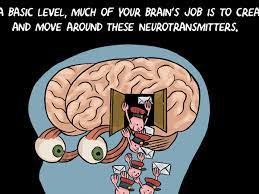 This extraordinary comic is a collaboration between the neuroscientists Uta and Chris Frith, their writer son, Alex, and the artist and graphic novelist Daniel Locke. Have I ever read anything like it before? No, I’m certain that I haven’t. Each page is a visual delight: as colourful and as joyful as a book for children. It’s extremely easy to read and often very funny. And yet you finish it with your mind blown. Simply by virtue of the fact that it makes some pretty cutting-edge brain science seem almost straightforward, it subtly expands the world of the reader. Afterwards, I wasn’t only more attentive to my own thought processes (hmm, I thought, as I watched my hand reach for the bottle of sauvignon); armed with a bit more insight into the way people around me might be thinking, it’s possible that it may also have liberated me, just a little, from some all too human anxieties (what are they thinking? Doesn’t she like me? Why hasn’t he called me?).
Uta Frith, an emeritus professor of cognitive development at the Institute of Cognitive Neuroscience at University College London, and Chris Frith, emeritus professor at the Wellcome Trust Centre for Neuroimaging at University College London, are not only two of the most distinguished academics in Britain; they have also been married for 50 years.
More here.
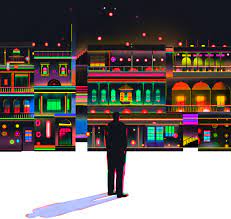 The vacuum where consequences should be is the setting of Aamina Ahmad’s quietly stunning debut novel, “The Return of Faraz Ali” — stunning not only on account of the writer’s talent, of which there is clearly plenty, but also in its humanity, in how a book this unflinching in its depiction of class and institutional injustice can still feel so tender.
 I’m almost fifty, and over the course of my adult life, the evolution has already been amazing. I grew up in a world where feminists were just a few strange women, always mad, and not to be trusted. Feminism was so unpopular. Now, it’s extraordinary the way young women behave—they don’t want to please men at all costs—and I admire that very much. I was raised to please men and be an “acceptable” woman, to not be angry, or too demanding. I see how young women push that, and push men to evolve and understand things about them. This social blackmail—that if you’re not a “nice” girl, you’ll never be loved—today, they don’t care! My hope is that men will be forced to evolve and be interested in women’s experiences. But it’s a big struggle. In France, I’m really struck by the violent reaction against this. Many men are resisting this evolution with all their strength, because they’ve been living in a world that is so comfortable. It’s really about including your experience of the other in your vision of the world. And many men are not willing to do that.
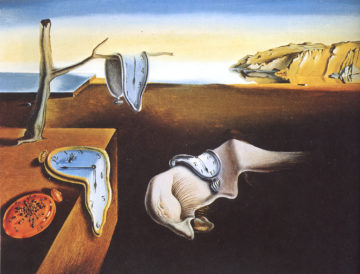 Despite some intriguing speculation, scientists haven’t yet come up with a clear, satisfying answer to the question of why we dream. Part of the reason is doubtless because, as any time spent studying neuroscience will show you, our knowledge of the brain is in its infancy. And part of it is due to the special limitations of dream research. Animal studies—sometimes referred to as the gold standard of neuroscientific research (think of the things one can do to rat brains that one can’t do to humans)—are of no help here. Like many pet owners, I believe that my dog dreams. But when I see her lying on the couch, muttering and growling with her eyes moving behind closed lids, I can’t wake her and ask her what she saw. When I spoke about the state of the field with the dream researcher Erin Wamsley, she described a kind of disappointment, a sense that the breakthrough insights into the nature of dreaming that seemed imminent a decade or two ago haven’t materialized.
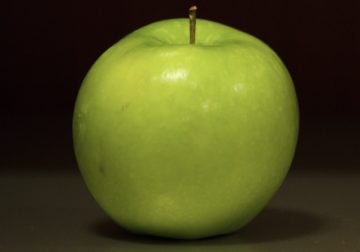 While I was reading Magritte: A Life, I started to notice apples everywhere. I’d be on the train, learning about
 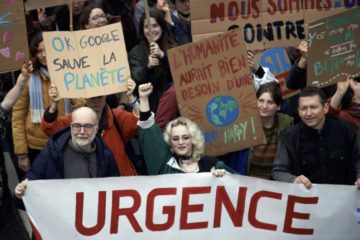 The newest Intergovernmental Panel on Climate Change’s (IPCC) Sixth Assessment Report released in late February paints a bleak picture of the global and local effects of climate change in coming decades, and of the challenges that governments and citizens face as they work to address the problems that will arise due to human induced global warming.
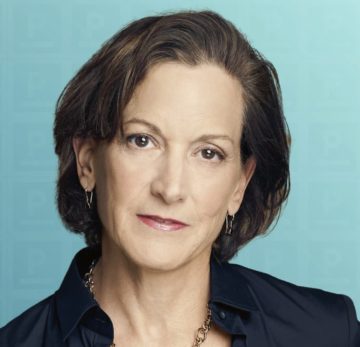 Anne Applebaum: We know exactly what the Russians expected four weeks ago. We know because the US Defense Department had a leak of some kind. There was a very specific battle plan, which involved the taking of Kiev in three to four days, and then the conquest of all of Ukraine (including Western Ukraine, all the way up to the Polish border) within four to six weeks. We know that after three or four days, already there were articles written celebrating the conquest of Ukraine and the reunification of Russia, Belarus and Ukraine,
  At the height of the British Empire, just after the First World War, an island smaller than Kansas controlled roughly a quarter of the world’s population and landmass. To the architects of this colossus, the largest empire in history, each conquest was a moral achievement. Imperial tutelage, often imparted through the barrel of an Enfield, was delivering benighted peoples from the errors of their ways—child marriage, widow immolation, headhunting. Among the edifiers was a Devonshire-born rector’s son named Henry Hugh Tudor. Hughie, as he was known to Winston Churchill and his other chums, pops up so reliably in colonial outposts with outsized body counts that his story can seem a “Where’s Waldo?” of empire.
 A week has gone by and I’m still aghast. Still astonished. Still absorbing what Ginni Thomas said in
 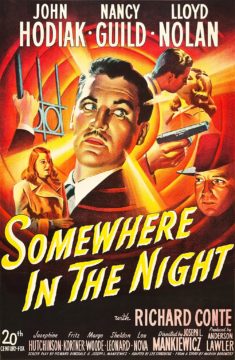 Bunker Hill was film noir’s favorite neighborhood. In the 1940s and ’50s, the once-exclusive area of downtown LA, with its rambling Victorian mansions, was attractively seedy and decaying, and supremely photogenic. The steep streets create natural Dutch angles, and the long stairways slice diagonally across the screen, vertiginous and crooked like something in a bad dream. Angels Flight, a whimsical funicular railway, is an instantly recognizable landmark. The houses have tall, narrow stoops with cagelike porch railings and flaking scrollwork, stained-glass transoms, and other emblems of scuffed and dingy grandeur. Most are cheap rooming houses, with sour, suspicious landladies and tenants whose faces and fortunes sag like the buildings. “Bunker Hill is old town, lost town, shabby town, crook town,” Raymond Chandler writes in his 1942 novel The High Window. Its tawdry charms lend flavor to Cry Danger (1951), Chicago Calling (1951), and The Turning Point (1952). In Robert Siodmak’s Criss Cross (1949), Burt Lancaster returns to his mother’s Hill Street home, convinced he has finally gotten over his ex-wife, only to immediately tumble back into the gravitational pull of their bruising relationship.
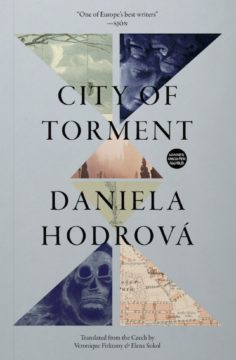 Hodrová was never associated with the dissident movement in the former Czechoslovakia, and none of her writing was published in the underground but half-tolerated samizdat form. As a scholarly woman writing in a rather recondite literary tradition, she probably wasn’t taken very seriously by more “political” (male) authors, and she didn’t really care for them either, it seems. As it turns out, all this has stood her in good stead. The many “banned authors” of the ’60s, ’70s, and ’80s were finally published in the early 1990s — and then the world basically lost interest in them, paving the way for “new voices” to emerge, including Hodrová’s. After she was awarded the Kafka Prize, whose winners include the likes of Harold Pinter and Margaret Atwood, Hodrová has even been proposed a few times to the Nobel Committee.
 THE ACT OF
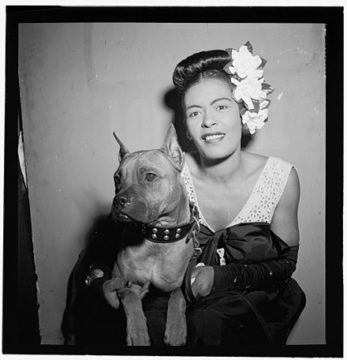 Legendary jazz singer Billie Holiday’s autobiography is considered an American classic. Co-written with author and journalist William Dufty at a point when much had already been written about her, it is titled Lady Sings the Blues.