by Akim Reinhardt
Historian 
Jennings became disgusted and quit. Despite having small children, he abandoned a safe, established career and began pursuing a Ph.D. in history at the University of Pennsylvania. It took more than a decade, but he finally earned his doctorate in 1965 at the age of 47.
It would take another decade for Jennings to establish himself in academia. He could not immediately translate his hard-won Ivy League pedigree into any prestigious appointments. Instead, he taught at little known schools like Moore College of Art and Cedar Crest College.
Jennings finally arrived on the scene in a way that could not be ignored in 1975 after publishing his first book at the age of 57. The very title was a shot across the bow of America’s received history: The Invasion of America.
The book defied many academic conventions, not to mention popular, mainstream history. It disputed the romantic notion of the European “discovery” of America, redefining it as an invasion and recasting North America’s hearty pioneers as the brutal agents of colonial conquest.
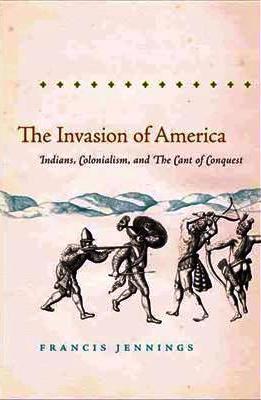
To overturn that mythology and reinterpret the colonial invasions, Jennings relied on French historian Marc Bloch’s theories of feudalism. For Jennings, the dull thud of feudal butchery and elitism explained much about European attitudes and actions in North America during the 17th century. The European invaders were a product of their times, and their times were decidedly feudal. They would arrive in America striving to be lords (if they weren’t already), and seeking to reduce the Indigenous population into vassalage.