by Leanne Ogasawara
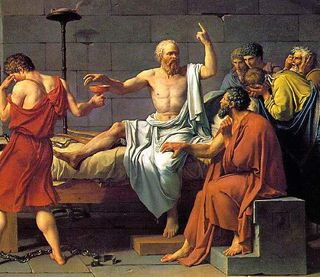
Sacrifice. Whether understood in the traditional ritual do ut des terms familiar throughout much of Asia; or in the liturgical terms of the Eucharist; or even in the grisly terms of ancient Mediterranean polytheism–I wonder whether these acts haven't served to help to lead us away from the dangers of self-deification (even if it leads to other perils).
Binding the individual in communion with others, ancestors, and gods: this call to transcendence was certainly what was behind Guru Dreyfus and Kelly's book, All Shining Things. For as Heidegger famously said, “Only a god can save us.”
Life is more sterile now, anyway.
My own interest in this topic goes back to Carthage. Always and forever dreaming of time-travel, ancient Carthage was for a long-time my top choice destination. Hannibal-obsessed, I thought Carthage would be an interesting place to see. That is, until a friend re-minded me that the Phoenician custom of child sacrifice was practiced notoriously in Carthage. (I only have one son, after all!)
Stanford University professor and archaeologist extraordinaire Patrick Hunt is also pretty obsessed with Carthage. He is yet another great man in a long line of great men in search of Hannibal's route across the Alps.(That is John Hoyte crossing on elephant in the picture below). In Hunt's Carthage lectures he talks about the Carthiginian god Ba'al Hammon. This Baal was the same Baal known in the Bible as Ba‘al Zəbûb. Translated as “Lord of the Flies,” Hunt says this word is a visual image depicting the innumerable flies attracted to the massive amount of offerings of raw meat that were sacrificed to the statues of Ba'al in Can'an. It was all so long ago, and yet no matter what sources you read, whether Biblical or Roman historical– it seems conclusive that the Canaanite religions centered around sacrifice –sometimes human. And this was notoriously so at Carthage.