by Sue Hubbard
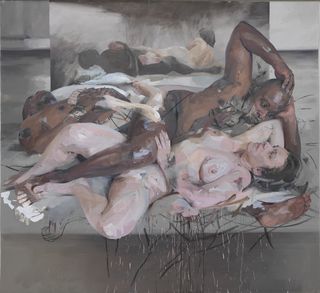
Jenny Saville. Oxyrhynchus. Gagosian, 6-24 Britannia Street, London WC1X9JD. June 13 – July 26, 2014
Celia Paul. Victoria Miro, 16 Wharf Road, London, N1 7RW. 12 June – 2 August 2014
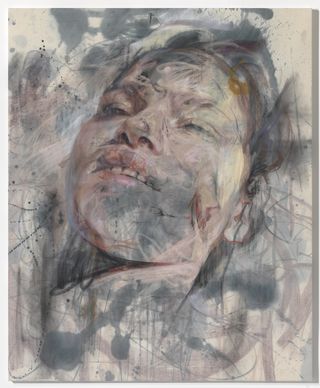

by Sue Hubbard
Jenny Saville. Oxyrhynchus. Gagosian, 6-24 Britannia Street, London WC1X9JD. June 13 – July 26, 2014
Celia Paul. Victoria Miro, 16 Wharf Road, London, N1 7RW. 12 June – 2 August 2014
by Prashant Keshavmurthy
In the face of his wife Marianne's objections – they have been married less than a year – Jim volunteers to go to war out of a citizenly sense of duty to the Allied cause. The voluntary character of this decision places the novel in a modern tradition of war novels all of whose protagonists enter the fray out of a sense of righteous duty. Among these is Paul Bäumer of Eric Maria Remarque's 1929 All Quiet on the Western Front and Robert Jordan, the protagonist of Ernest Hemmingway's For Whom the Bell Tolls (1940). Hemmingway's famously bleak recreations of machinegun slaughter are the ancestors of Murphy's dense descriptions of war machines and wounding.
As both these canonical examples attest, the modern war novel has been an anti-war novel. I prefer to identify Jim McFarlane, not as a soldier, but – despite the archaism of the term – as a warrior. Doing so places Jim in an older lineage of epic heroes (Beowulf, Tristan and Faraydun and Rustam come to mind) each of whom chooses to go to war with an enemy of his people. In so doing, he battles monsters (Beowulf with Grendel; Tristan with Morold; Faraydun and Rustam with a variety of demons) by destroying whose gigantic bodies he defines himself as his people's ideal and marks out a land as his people's homeland. This, at any rate, is the epic norm.
by Hari Balasubramanian
After the road trip to the Turkey-Georgia border (see Part 1), I returned along with my friend Serhat to Erzurum on the third day. Serhat flew back to Istanbul that same evening. My plan was to travel solo to the town of Kars next morning by bus, spend two full days there before returning by flight to Istanbul. All this was in July 2013.
1.The minibus from Erzurum to Kars
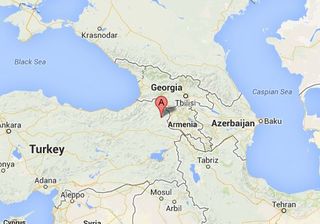
I had a more basic problem. I thought that finding a bus would be a simple task. In the morning I took a taxi to the gleaming and modern Otogar, the bus station, about 14 km from Erzurum Center. But after a frustrating hour of enquiries, I had made no progress. I expected buses to Kars to be frequent. But no one seemed to know where to find one; the private companies – there were no government buses – said they did not have service to Kars that day. I roamed around the well maintained bus station, asking at least ten people, moving in circles, not making any progress, gradually feeling amused at my travel predicament. The language barrier was a huge issue: I realized that even very basic English words and phrases weren't working.
Not knowing how to proceed, I returned to Erzurum Center, and spent some time in an internet café pondering my options. The café owner wanted to help; we used Google Translate to carry on a rudimentary conversation. He let me use his cell phone to call Serhat. Something was eventually arranged, I wasn't sure what; I simply waited. Ten minutes later, a car with a young man and a boy – both from a bus company – arrived to pick me up from the café. They were going to lead me to the bus to Kars. I rushed out with my baggage and left my personal diary next to the computer.
by Peter Unger
First off, I should tell readers that Amazon.com has done a pretty good job with the first swatches of the book: there, you can see what looks to be more than 40 of the book’s first 56 pages. In just a few moments, the relevance of that will be made quite striking.
A central thesis of the book, perhaps its most central thesis, is this: Contrary to what has been supposed by Anglophone academic philosophers, during the last five decades, there has been offered hardly any new thoughts whose truth, or whose untruth, makes or means any difference as to how anything ever is as concern concrete reality, except for ever so many perfectly parochial thoughts, ideas about nothing much more than which words are used by which people, and how various of these people use these words of theirs — and nothing any deeper than that. (And, if it be required that the newly offered non-parochial thoughts be credible idea – at least more credible than their negations, or their denials, then what’s been relevantly placed on offer, in all these years, goes from hardly anything to nothing at all.) Rather, even while brilliant thinkers have offered thoughts meant to cut lots of concrete mustard, what’s been newly placed on offer, with any credibility, are just so many thoughts empty of import for concrete reality, that is, just so many concretely empty ideas. And, each of these concretely empty ideas owes its emptiness to its being analytic, in a useful sense of that term, so, what’s more, each of the offered thoughts are thoughts that, at least when correct, are just so many analytically empty ideas, each on a par with, in that way, the thought that someone can remember her old college days only if she went to college.
All that is spelled out, at least pretty well, I think, in pages of the book that Amazon offers for your free inspection, especially in the freely available pages comprising almost all of chapter 1.
(And, should those pages leave you a little shy of a firm grasp of what I mean to convey, your grasp should be pretty firm, indeed, if you also read the next pages Amazon provides freely, pages comprising most of chapter 2 of Empty Ideas. For good measure, on Amazon you’ll also get, for free, a good running start on what’s in chapter 3 of the book.) As is my hope, many of those reading these words, will jump over there – right now – and get a good look at that material, doing that before proceeding with any more of this present short piece.
In line with all that material, and at all events, in the rest of this brief piece, I’ll aim to add just a bit more, providing some central material from the next chapter in the book, chapter 4. While this won’t do anything even remotely close to giving an adequate idea of all that goes on in Empty Ideas, a book comprising 9 dense chapters, it may well, I think, convey the flavor of what goes on in about half the book.
by Grace Boey
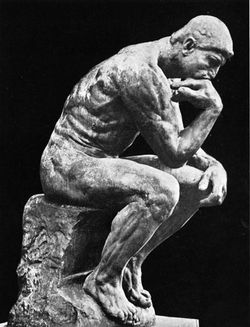
The aim of this follow-up piece is twofold. First, judging from some of the commentary, a brief clarification’s in order regarding the scope and nature of the book and interview (though Peter does much of that himself in his own piece today). Second, the interview has provoked a healthy online debate on the value of philosophical education and philosophy in general; as a young person just starting out in the field, I aim to add a little to this discussion.
About that interview…
One aim of the interview was, of course, for Peter and I to discuss his book. As the conversation turned out, the interview ended up covering a great deal of interesting things — but not representing the many specific and subtle arguments Peter makes in Empty Ideas. A better description of the interview might be that some of it makes for part of a terribly informal prologue (or epilogue) to the book. I encourage interested readers to take a look at Peter’s guest column today on 3 Quarks Daily — A Taste of Some Empty Ideas — to get a better feel of, and engage with, the book.
Next: much of the internet commentary invoked the value of philosophical fields such as moral and social philosophy. While I think this is a great debate, which I'll address shortly, it’s important to note the scope of Peter’s general critique: that is, mainstream Anglophone analytic philosophy. As he expresses in Empty Ideas, normative domains are off the hook:
I do not mean to say much about what’s been going on lately in absolutely every area of terribly respectable philosophical activity. To help you appreciate the range of my argumentation, I say that it’s aimed at what’s recently and currently regarded as analytic philosophy’s core: Certainly metaphysics, and also the most general and metaphysical-seeming parts of, or aspects of, philosophy of mind, philosophy of language, and epistemology. By contrast, my argumentation won’t concern anything that’s deeply normative, or fully evaluative, or anything of the ilk.
On the value of philosophy
Now that that's been taken care of: one debate that the interview addressed obliquely, or at any rate happened to spark off online, was about the value (or non-value) of philosophical study in general. My own reflections, as someone who's just graduated with an MA in philosophy, will be a take on this issue. As a young person just starting out, should I quit while I still can, or should I stay? Will I have anything to offer if I choose the latter?
Future Self
I imagine my inner working
will be more playful then than now,
less attention to survival paid,
finally getting to the sparkling black hole of day,
a moment of arrival: of at-once knowing and
unknowing Tao
.
I was told by a monk who’d kept silence for years
of when his inner dialog disappeared,
when his chattering selves came to accord
and all that buzzing skull talk
finished, fading, trailed off like
the tail of a fifties forty-five
spiral to infinity as if an engineer
were dialing down the gain,
spinning duality to mum mutuality:
the end of fire and rain
.
and what then, I said,
what was it like?
nothing to be said,
he said,
nothing
to be like
.
.
by Jim Culleny
6/28/14
by Jalees Rehman
We often laud intellectual diversity of a scientific research group because we hope that the multitude of opinions can help point out flaws and improve the quality of research long before it is finalized and written up as a manuscript. The recent events surrounding the research in one of the world's most famous stem cell research laboratories at Harvard shows us the disastrous effects of suppressing diverse and dissenting opinions.
The infamous “Orlic paper” was a landmark research article published in the prestigious scientific journal Nature in 2001, which showed that stem cells contained in the bone marrow could be converted into functional heart cells. After a heart attack, injections of bone marrow cells reversed much of the heart attack damage by creating new heart cells and restoring heart function. It was called the “Orlic paper” because the first author of the paper was Donald Orlic, but the lead investigator of the study was Piero Anversa, a professor and highly respected scientist at New York Medical College.
Anversa had established himself as one of the world's leading experts on the survival and death of heart muscle cells in the 1980s and 1990s, but with the start of the new millennium, Anversa shifted his laboratory's focus towards the emerging field of stem cell biology and its role in cardiovascular regeneration. The Orlic paper was just one of several highly influential stem cell papers to come out of Anversa's lab at the onset of the new millenium. A 2002 Anversa paper in the New England Journal of Medicine – the world's most highly cited academic journal –investigated the hearts of human organ transplant recipients. This study showed that up to 10% of the cells in the transplanted heart were derived from the recipient's own body. The only conceivable explanation was that after a patient received another person's heart, the recipient's own cells began maintaining the health of the transplanted organ. The Orlic paper had shown the regenerative power of bone marrow cells in mouse hearts, but this new paper now offered the more tantalizing suggestion that even human hearts could be regenerated by circulating stem cells in their blood stream.
by Bill Benzon

…though many don’t think of it as art at all, but as crime. After all graffiti – by which I mean the styles that originated in New York City and Philadelphia in the late 1960s and early 1970s – was born when kids and young adults began spray-canning their names on other people’s walls without permission. They were committing crimes, and some of them did time for it. Still do.
Art? Crime? Art? Crime? The question isn’t a real or least not a very deep one. Why can’t graffiti be both artistic and criminal?
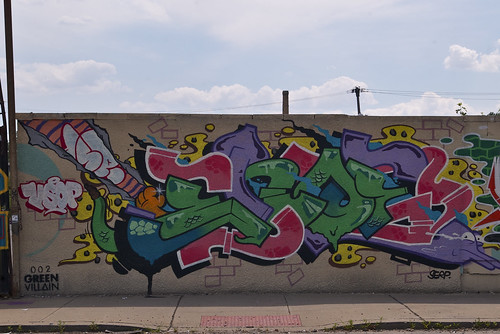
Enoe
Such mythical, but nonetheless real historical, figures as Taki 183 and Cornbread weren’t trying to make art. It’s safe to say that many of the early writers had never been inside the Guggenheim, the Met, or the Barnes and had never taken Art History 101 in college. They just wanted to get their names up, to be noticed. Not their real names, that is, the names on their birth certificates. But names they assumed for purposes of getting fame; names that had one significance within graffiti culture but that simultaneously were opaque and provocative to the outside world, names that told of another society walking the streets and claiming the walls.
by Leanne Ogasawara
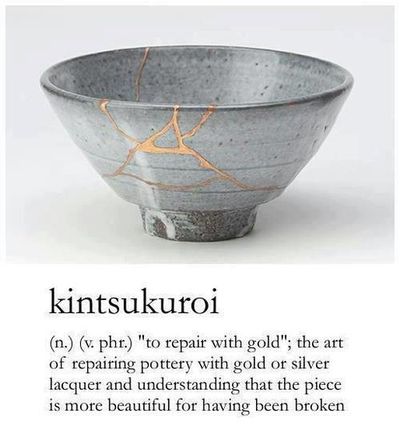
日本文化の根底に、草木国土悉皆成仏があります。人間だけでなくすべてに心があるということ。これが大切やね。(At the root of Japanese culture is the idea that everything is on the path to becoming a Buddha. Not just sentient life but everything is on the path to Buddhahood.~~Rough translation, other possible translations welcome).
This idea (草木国土悉皆成仏) is from the Nirvana Sutra, and argues that even things like trees, rocks and other inanimate objects also have a Buddha-nature — and therefore all things are precious.
It was exactly a year ago that I posted this 3Quarks daily piece about the enchantment of things and China's legendary Nine Bronze Tripods 九鼎.
From Xia to Shang
And from Shang to Zhou….
You know the story: Nine bronze tripods– cast back in the mists of great antiquity– were treasured by ancient Chinese Kings as a symbol of their right to rule.
Passed down from dynasty to dynasty– for nearly 2,000 years (or so the story goes) until the time when the First Emperor, Shihuangdi, finally toppled the last Zhou King– and rather than see their transfer to Shihuangdi’s new dynasty– the last Chu King flung the nine bronzes forever into the River Si
Given their symbolic significance, Shihuangdi actively attempted to dredge up the sacred bronzes from the river, but it was to no avail; and scholars of later dynasties saw this as further evidence of the lack of moral virtue of the First Emperor.
I wondered if things have the power to move us in this way anymore? I mean, there was a time (the time Umberto Eco likes to write about) when people were obsessed by fantastical maps and with great quests for objects that held much power. Like mountains, certain objects had the power to draw people in. Relics, for example, were big business. Think of Sainte-Chappele, built to house the Crown of Thorns or recall the mystery surrounding the quests for the Holy Grail. Eco's Baudolino is almost entirely taken up with the relic trade and the role played by faith (faith in the fragrance of these relics–where it is the perfume that is true– not necessarily the relic itself). This kind of devotion to relics is famously practiced by Catholics and Buddhists, and probably harkens back to an ancient propensity for becoming enchanted by things.
It is also a commitment to remember, right? (Poor, dear Henri Fontal!)
by Brooks Riley

In many ways, I never was. I’m more interested in dendrites than dentists, bosons than Botox, solar energy than SPF factors, cosmology than cosmetics, physics than fitness, Leibniz than Lagerfeld. On the other hand, I’m enough of a girl that if I do watch a sport, it’s with the same bewilderment that a homeowner greets an intruder: Where did you come from?
Maybe I’m the wrong girl to write about a World Cup.
When I first moved to Europe, I was peripherally aware of the game we call soccer: It was all those short guys running around in their boxer shorts, trying to engender as much dexterity with their feet as they might have with their forbidden metacarpi–a preternatural challenge that could only end in heartbreak, or so it seemed. I even bought into the cliché that the game is boring (but never as boring, even for a reluctant neophyte like me, as American football, a stop-start time-waster where full-metal hulks huddle longer than they play, in a version of rugby for sissies). What did I know?
In the meantime, I’ve learned that the rest of the world grows up training their lower extremities to be as precise as a violinist’s fingers on a fingerboard. And like violinists, they start early enough, so that by the time they reach the teenage years, talking with their feet comes naturally.
Like all games, soccer is a form of dramatic narrative, with a beginning, a middle, and an end. The climaxes come at strange times, though, not according to classic Aristotelian or Freytagian itineraries, but in breathtaking combinations of movement that were not even imaginable seconds earlier. Hubris and hamartia are teammates, equally responsible for goals and missed goals. Aesthetics comes into play: How often has the word ‘beautiful’ been used to describe a kick, a save, a pass, the game?
by Akim Reinhardt

There are many obstacles to soccer becoming substantially more prominent in the U.S. marketplace beyond the World Cup. But I believe most of them can be overcome, and the key is better marketing.
Several factors are often cited as major roadblocks to soccer becoming a major spectator sport in the United States. Some of them are indeed daunting, but some are misunderstood and not as obstructionist as commonly perceived. Regardless, they can all be overcome to one degree or another. The key is understanding that soccer, like all spectator sports, is a cultural product. And cultural products demand relevant marketing.
Let me begin by briefly listing the perceived major obstacles to soccer's popularity as a spectator sport.
After briefly assessing each of these obstacles, I will make a case that they can be overcome with better marketing to American consumers.
by Matt McKenna
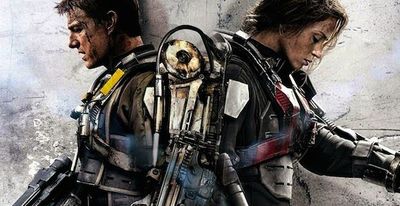
Tom Cruise plays Private Cage, a demoted military PR sleaze ball who is press-ganged into active military service for reasons that aren’t particularly clear to me. Against his will, Cage joins the front lines of a counteroffensive designed to repel the ongoing alien invasion that has steadily been conquering Europe. Naturally, Cage's public relations background has left him unprepared for intricacies of alien combat, and he subsequently dies mere moments after his boots make contact with the beach. Fortunately for Cage, a splash of alien blood finds it's way onto his grimacing, five o'clock shadowed face, imbuing him with the handiest sci-fi trope of them all–time travel. With his newfound power at the ready, each time Cage dies, he immediately wakes up the previous morning with the memory of his deathday still intact. And so the plot unfolds predictably: Cage relives the same day over and over until he finally has a perfect memory of the battle and the skill required to destroy the alien horde.
Clearly, the parallels between Edge of Tomorrow’s plot and American politics are strong, even if the film’s ending is a bit optimistic. Most obviously, Cage's attempts to survive the day and break his time loop represents the United States' attempt to break free from the tight grip of its national politics, itself a cycle in which even if the political party in charge changes, the partisan hackery and divisive rhetoric never do. Whereas Cage is shot, crushed, and blown up during each iteration of his hellish day, Americans are bombarded by political ads, hoodwinked into watching trite political bickering on television, and even conned into giving money to the political parties that perpetuate this terrible national distraction. Director Doug Liman deftly utilizes this parallel to make the point that the United States is desperately mired in its current political environment, and the only way for it to extricate itself from this environment would be for the American electorate to have an eidetic memory of previous elections and therefore not to succumb to the tired political tactics that arise during each election cycle.
by Brooks Riley
by Eric Byrd
Perhaps unique among France's many colonies, possessions, dependencies and departments outré-mer, Lisle has no foothold on the French Parnassus. Baudelaire's “dame creole” was Mauritian. Leger was born under the palms of Pointe-à-Pitre. And this mulatto isle never produced a polemicist of Négritude – we're obvious bastards, dark enough for chains but not black enough for pride. Lisle's sole literary monument is the work of the American Charles Wharburton, author of Alphonsine; or, The Siege of Saint-Christophe (1846). Wharburton was a didactic novelist of pastoral dilemma, of scrupulous parsons. Following a tour of the Antilles he published Alphonsine, his only novel set outside New England, assembled from notes, and from the Romantic demonism that lay all about his era. Wharburton's readers were affrighted and doubtless titillated by this tale of a Protestant missionary stranded on the nightmare isle, where he and the titular ward, dusky but redeemable, are caught between the bloodthirsty maroons and the depraved Creoles, between savage idolatry and the complicit Catholic church, with its gleaming black saints. Wharburton's surrogate desires only Alphonsine's salvation, deplores the mixing of races, and denounces plaçage as “a foul practice that supports a languid class of concubines in attitudes compounded of Gallic hauteur and Negroid indolence.”
Such silly, bigoted old books are easy to come by, and help me to travel in time. I can see in Wharburton's half-novelized notes the exhibitory balls and parasoled promenades of quadroon courtesans: they're slow-moving, pouty, spoiled – and bred for pleasure as horses are bred for racing. Lisleans are now said – are proclaimed! – to have evolved beyond the béke and his Black Venus; are supposedly “overjoyed” – emotion for murals! – to abide as sexlessly interchangeable comrades in a puritanical police state ruled by a fatigue-clad guerilla chieftain. El Caudillo is decades removed from comradely struggle, displays a vestigial sidearm amid praetorian Kalashnikovs. For a time I was keeper of his looted pictures. He billeted his fighters in palaces whose fleeing owners had carried away nothing but trifles – a string of pearls, a monogrammed cigarette case destined for the pawnbrokers of pauperish exile. Soon the sensibility of imperiled revenue interrupted the desecration. Merciful Mehmed called off the pillage, and rescued or confiscated the private galleries. He sold abroad the great collections, as well as my father's modest, incipient portfolio of eighteenth century dessins (the heads of young girls and the lute-strumming fingers, disembodied, delighted one by the economy of their manifestation, the few swift strokes of their being). The strictly regional remainder, a rump gallery of touristic sunsets and forgotten worthies, was grandly christened the Musée Lisle. I was its curator before I was a conscript, a deserter, and a fugitive.
by Kathleen Goodwin

As Fritz explains, “the joke is evident” but while the site is obviously tongue in cheek, it deserves a bit of analysis. Is the gag how bizarre the captions read, where the accomplishments and intelligence of the woman in the spotlight take a backburner to her accessory choices and the cut of her pantsuit? When a woman is a world famous writer, head of a global organization, or an elected official; is it pertinent to comment on her color coordination? The joke is truly multi-layered in its absurdity, because it reveals a reality. Regardless of their career choice, all women in the public eye are subject to discussions of things that have nothing to do with their jobs and responsibilities. In the Author's Note of Hillary Clinton's recently released memoir she writes, “I considered a number of titles…My favorite was 'The Scrunchie Chronicles: 112 Countries and It's Still All about My Hair.'”
Powerful women are held under a microscope for their appearance and behavior in a way that men are not, giving the media and the public endless source material to scrutinize, and deflecting attention away from truly critical matters. Yet when women try to eschew the rigid expectations of femininity and assume typical masculine attitudes and practices, they face an equally strong backlash. The result of this obvious double standard is what I'd characterize as a “can't win” dilemma that all women, regardless of their recognizability, contend with on a daily basis. Women are regularly criticized for being both “too masculine” and “too feminine” and conversely also face criticism for not acting feminine enough or not adopting sufficiently masculine characteristics.
by Jonathan Kujawa
On “How Not to be Wrong” by Jordan Ellenberg.
I have to admit something. When I travel I cringe on the inside when the person sitting next to me asks what I do for a living. The arc of the conversation invariably follows one of a few paths. On the very rare occasion I am pleasantly surprised to find myself talking to someone with a genuine interest and curiosity in mathematics. Far more commonly we immediately head into “I hate math” or “I was never good at math”. Their general feeling is some mixture of fear, dislike, and bewilderment. I've learned that decades of bad experiences with math won't be overcome by our brief conversation. I must confess that I usually dive out the side door of the still moving conversation in a tuck-and-roll position and hope to tumble my way into sports, religion, Middle East politics, or some other more pleasant topic.
Math has a PR problem and it's mostly self inflicted. Most math curriculum is tedious, dull, confusing, and disconnected from everyday life. And any hope of turning things around is sabotaged by teachers and parents who themselves have unpleasant feelings about math. When asked, most people will say that math is important and useful but in ways which were never made clear despite years of math classes. They certainly won't say it's fun, thought provoking, or moving. And the “applications” they remember are those awful word problems involving circular ponds in square gardens, five workers making ten widgets every two hours, and other obviously fictional nonsense.

Fortunately there are folks making the effort to show the beautiful, exciting, engaging, and useful sides of math. One of those is Jordan Ellenberg. He is a well-regarded mathematician at the University of Wisconsin. Before turning to fulltime math, Ellenberg earned a master’s degree in fiction writing and wrote a novel (“The Grasshopper King”). Nowadays he has a blog on “Math, Madison, food, the Orioles, books, my kids”, and he writes occasional articles on math for Slate, the New York Times, and other media. As you can tell, he's the perfect guy to write a popular book about math. And he has! His book, “How Not to Be Wrong: The Power of Mathematical Thinking” has just come out and deserves to be on everyone's summer reading list. The title of this post is from Ellenberg's book and captures its spirit perfectly.
by Tamuira Reid
I. Theresa
He hit her, not the other way around.
Thought it was a deer, she told the police. Same kind of thud, thick and heavy. It was raining but not too hard. The impact dented the hood, busted the window, the glass splintered and folded in on itself.
Killed a man with her car. It wasn't her fault but still.
It was dark. The road was long. Oldies played on the radio. The kind of music people dance to when they think no one is watching and there is still that chance of something good happening.
The paper runs his photo with details for a memorial service at the Y on Harrisburg Street. He was nineteen, worked weekends at a Ford dealership.
She folds the story into a square and hides it under her mattress. Sometimes she feels him breathing but doesn't tell anyone.
A television crackles from a corner of the room where his two little sisters sleep, arms and legs locking. Waiting. The last thing he saw was the glare of headlights.
Silk blouse and Penny's slacks with the pleats down the front. They go into the washer with extra Woolite and she studies the water for signs of death but it's all over at this point. She lets the lid down slowly, disappears into the kitchen for another cigarette.
II. Luna
The day Luna went mad her mother thought, finally. The signs had been there, hanging around at the dinner table, in the bathroom where she ironed her hair.
It had waited patiently in the corner of a room, under a chair, in the oven with the bread. Now they wouldn't need to wonder when it would all fall apart because it just had.
The day Luna went mad she was wearing pink lipstick. Her legs were waxed and smoothed down with cocoa butter because she was religious about that kind of thing. Never know who you're gonna see, she'd say, sliding a gold hoop through each ear.
It happened slowly and over a period of time. Shop closed. Her mind just closed-up on her. Went out of business.
“For the last twenty years neither matter
nor space nor time has been what it was.”
~ Paul Valéry, 1931
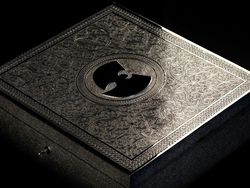
Earlier this spring, we received a candidate answer from the venerable hip hop outfit Wu-Tang Clan. The Wu-Tang have been secretly recording a new double album for several years, an event that would commonly be greeted with much rejoicing by their legions of fans. However, the zinger is that only one copy of the album will be made, destined to be sold to the highest bidder. Even more interesting is the fact that, prior to the auction, the record will tour “festivals, museums, exhibition spaces and galleries for the public as a one off [sic] experience.” (Imagine the stringency of the security that will be required to keep this particular cat in its bag; I am already anticipating the Twittersphere lighting up in outrage as museum staff shine flashlights into people's ear canals, conduct full body cavity searches, and generally out-TSA the TSA.)
Of course, such acts of conceptual brazenness are usually (and usually regrettably) accompanied by a manifesto, and Wu-Tang does not disappoint…
by Madhu Kaza
These are the tears of things, and our mortality cuts to the heart.
–Virgil, The Aeneid
A few weeks ago I spent an afternoon at a friend's apartment while she held a moving sale. I went primarily to keep her company, and I spent hours in the room where she had neatly arrayed books, jewelry, film and camera equipment, exercise machines, clothes, pottery and various knick-knacks. Every sale was accompanied by the story of the object – how she had acquired it, what it meant to her, and what a great deal the customer was getting. The longer I stayed the more I could feel a tinge of sadness in the room, but her friends and neighbors lapped the stuff up, seemingly unaware of the melancholy. When one of my friend's neighbors invited me to visit her apartment upstairs, I left the sale for a while and walked into a large, bright, cluttered apartment. I sat at a dining room table strewn with books, wires, a computer, cookie cutters, takeout containers and piles of papers and thought, what a relief to be in the middle of things. What I meant was: what a relief not to be at the beginning or the end. The room was a mess but the objects carried no self-consciousness. They were at home and settled into the ongoing-ness of days.
I wrote previously about things, but I hadn't really touched upon their sadness, which is to say our sadness towards them. Recently, though, I've been thinking about the Japanese idea of “mono no aware” or “the pathos of things.” The sensitivity to impermanence at the heart of mono no aware is exemplified in this extract from the poet Kenko's 14th century “Essays in Idleness”:
When I sit down in quiet meditation, the one emotion hardest to fight against is a longing in all things for the past. After the others have gone to bed, I pass the time on a long autumn's night by putting in order whatever belongings are at hand. As I tear up scraps of old correspondence I should prefer not to leave behind, I sometimes find among them samples of the calligraphy of a friend who has died, or pictures he drew for his own amusement, and I feel exactly as I did at the time. Even with letters written by friends who are still alive I try, when it has been long since we met, to remember the circumstances, the year. What a moving experience that is! It is sad to think that a man's familiar possessions, indifferent to his death, should remain unaltered long after he is gone.
Because we invest our belongings with memories they inhabit time with us in peculiar ways. They become our companions through life and when we lose them or give them away we feel bereft not merely of the object, but of some span in our own lives that they marked.