The Short Bus

by Tamuira Reid

51yojzlJvkL._SY300_Oliver, take your binky out.

Uh-uh.

Now.

Nope.

He wriggles free from my grasp and stands under a small television haphazardly jetting out from the waiting room wall. I hate waiting rooms. You're always waiting for something bad to happen.

A woman appears, says she is The Doctor, and begins to watch television with my two year-old son. He notices her but doesn't acknowledge her, a habit he's picked up.

What are you looking at, Oliver?

He grunts. Shrugs.

I asked, what do you see up there?

Without turning his head, he answers, It Nemo.

Close. It is a show about some burly fishermen in Alaska.

In her office, I'm told to take a seat in the corner and not to participate. I stuff my hands in my coat pockets. Unstuff them. Cross and uncross my legs.

They play cars. Look at books. Count blocks. She scribbles on a legal pad, glasses sliding down the bridge of her nose.

Eventually Oliver takes to a corner, rolls around on the carpet, and disengages except to push a tiny toy motorcycle with his finger. He looks bored.

I have some questions for you, she says, facing me.

Okay.

When did you first notice…

And it happens. I crack. She is so shrink-y and I really need shrink-y. I tell her all of our secrets in rapid-fire sentences, the weird little things that only Oliver and I know about. How he arranges everything into long rows. How he doesn't always answer when I call his name. How he can scream for hours, like he's trying to fight off a piece of himself. But I don't tell her how he pees in the houseplants. That one is mine.

Read more »

The Means Justify the Ends, or, Mathematicians are Sherlocks and Physicists are Mycrofts

by Jonathan Kujawa

A few weeks ago the Numberphile website posted a short video. The video discussed an “astounding” sum and got considerable press (the video has 1,523,719 views so far). It appeared on both Slate and 3QD. The sum? It's:

Sumnaturals

3QD included links to the firestorm the video created (I know, I know, I too was shocked that the Internet was up in arms over something). But I was surprised by the kerfuffle. The Numberphile videos I had seen featured James Grime giving well thought out discussions of interesting bits of math. I am happy to recommend them to anyone.

This video, however, is complete rubbish [1]. The hosts cram a remarkable number of mathematical outrages into 8 minutes. But they all come from a single anthropological source:

Mathematicians are Sherlocks and physicists are Mycrofts.

Both Sherlock and Mycroft Holmes are brilliant, devoted to reason, socially awkward, and sometimes downright unpleasant. But just the same we appreciate and even sometimes like them. Where they differ is in means versus ends.

Sherlock follows his reasoning wherever it leads. He never hesitates along the path of reason no matter the final outcome. As he says, “when you have excluded the impossible, whatever remains, however improbable, must be the truth.'' Sherlock believes that he serves only The Truth. The means justify the ends.

Sherlock's brother, on the other hand, is perfectly willing commit all manner of sins as long as the end result is the desired one. The ends justify the means. In the TV series at least, Mycroft serves Queen and Country. He has the luxury of an ultimate authority to judge what is right and what is wrong.

Just so, physicists have Mother Nature. They are free to commit all manner of (mathematical) abuses because they know at the end of the day Mother Nature will judge their work as right or wrong. All sins are forgiven if they give an answer which matches experimental data. Indeed, less than a minute into the Numberphile video the hosts show our seemingly ridiculous sum on page 24 of a standard reference on string theory. And indeed it's true that this sum is used in string theory, quantum physics, etc.

It is entirely reasonable for physicists to take this view. By playing fast and loose they travel farther and see more. They can do this safe in the knowledge that Mother Nature will eventually catch them if they go too far. And it should certainly be said that physics has always been a rich source of new ideas and insights for mathematics.

Read more »

Can Wine Be Sexy?

by Dwight Furrow

AKADAMA_sweet_wine_poster2

An advertising poster of “AKADAMA Port Wine” for Suntory Limited. Creative Commons License

Valentine's Day is fast approaching; it's time to think about which wine will precisely calibrate the proper mood. But why wine? Why not a nice craft beer or a glass of orange juice? Why is wine the beverage that signals romance?

I would imagine wine and romance have been linked since our ancestors first discovered the benefits of moderate inebriation. The loss of inhibition and gain in confidence make wine a natural ally in games of seduction. But the relaxing of inhibitions is not the only benefit that wine confers on the amorous. Romance requires illusion. We fall in love with an idealized version of the beloved, believing he/she has all the virtues we admire and none of the negative traits we shun. Evolution has designed us to drop the skepticism when presented with the promise of procreation.

The Roman poet Ovid, in his 17 A.D. work “The Art of Love” says of wine that, “It warms the blood, adds luster to the eyes, and wine and love have ever been allies”. Given the paltry proportion of “beautiful people” to ordinary shlubs, adding “luster to the eyes” may be the most significant contribution wine has made to human existence. But, in fact, scientists have demonstrated this effect with beer as well—it has come to be known as “beer goggles”. Inebriation cannot explain the connection between wine and romance since any alcohol would suffice—yet, a can of “bud” just doesn't have the same meaning as a bottle of Dom Perignon. There must be something else about wine that connects it to romance.

Is there something inherently and uniquely amorous about fermented grape juice? In fact the history of wine as an aphrodisiac is as lengthy as that of food. It gets a less-than-enthusiastic mention in the Talmud and a much more enthusiastic discussion in the Roman historian Pliny's 1st Century Natural History, where he recommends wine be mixed with the muzzle and feet of a lizard or the right testicle of a donkey to cure a reluctant libido. Are you feeling the romance yet?

Read more »

The AAP Rising: What Can the U.S. Learn from Indian Politics?

by Kathleen Goodwin

Usa_india_flag_by_raza786It goes without saying, yet, we keep saying it anyways, that the United States government has had its share of problems in recent months. From the federal shutdown to the Affordable Care Act fiasco, it hasn't been a period to build confidence or pride in the American government. Still, many Americans would find it preposterous if someone were to suggest that the U.S. should turn its gaze eastward in order to learn a thing or two about how a democracy should work. Specifically, to the only other democracy on the planet with more citizens than the U.S. itself. While India and the U.S. may be the world's largest democracies, the similarities may just about end there. The U.S. approaches nearly 250 years as a democracy, and almost a century as a global superpower, while India has yet to achieve seven decades of democratic independence and is unanimously labeled the next world power or the next abysmal failure, depending on the prevailing sentiment any given week. Yes, we in the U.S. may be floundering when it comes to democratic legitimacy and trust in the government, but in India the situation must be infinitely more corrupt, more complicated and just, overall, worse. What could the older, wealthier and more socially progressive United States possibly learn from India? As 2014 gets underway, the two countries are preoccupied with very different political debates and controversies…or so it may appear.

As the momentum builds towards a national election in India this spring, it is clear that Indian politics is facing a turning point where the established co-dominance of the incumbent Congress and its long time right-wing rival, the Bharatiya Janata Party (BJP), faces a challenge not just from regional parties, as in the past, but from a new national party that plans to contest the national election.

Read more »

Monday, January 27, 2014

Pakistan’s War – Part II

by Ahmed Humayun

(This is the second post on Pakistan's struggle against militancy. Part I is here).

Drone11111111-133298-133842-640x480To prevail against an insurrection, a state must fight on many fronts. It must construct a comprehensive military and political strategy, strengthen its institutional capacity to fight an internal war, and mobilize public support for a protracted struggle. Above all, an insurgency is a contest between the state and its challengers over legitimacy and credibility. In this clash of narratives, the state must persuade the population that its actions are those of a representative, duly constituted government attempting to restore its control even as the rebels repudiate the fundamental legitimacy of the state.

So far in Pakistan the militant groups are winning the war of narrative. As I wrote last time, the Pakistani Taliban is by no means a monolith but its different factions do come together around a clear strategic story. Insurgent propaganda states that the rebellion's goal is to replace an illegitimate, un-Islamic government subservient to Washington with an Islamic state. Their war is defensive—for Islam and against America. The state, on the other hand, speaks in contradictory voices. Some say that the state must fight until the rebels lay down their arms, forswear the use of violence, and respect the rule of law, while others insist on immediate, unconditional negotiations. The truth is that ending the turmoil within Pakistan requires some adroit combination of fighting and talking—but only if they are aspects of an integrated strategy that has as its aim the restoration of state control and that realistically accounts for the ambitions of the rebels, which are revolutionary, and which they have pursued from the mountains in the tribal areas to major urban centers across the heartland.

Yet advocates of negotiation —including leading politicians, retired generals, and influential pundits—blame the state and its alliance with Washington rather than the militants for fomenting the violence. As a result it is widely believed in Pakistan that the war against militancy has been foisted on the country by the United States; that insurgent violence is merely retaliation for Pakistani military aggression and American drone strikes in the tribal areas; and that conflict will cease when these operations end. The result is that formula recited by many: ‘This is not our war.' This dominant narrative has had a negative effect on the legitimacy of the state in the eyes of the public, created demoralization in the country's army and police forces, and emboldened the insurgents.

Read more »

Monday Poem

What God Says

I place before you a bowl of evidence
but will never make you eat

Chance is what you’re up against,
and the only is of me you’ll meet

You can pray until your tongue expires
and never know my heart’s desire

I roll the future out mysteriously,
you trace my trail of crumbs through mires

You profusely write of who I am
as if I were like you a man

You cannot know the I of me
unless you crack the I of thee

In the light and in the gloom
I beat a drum and hum your tune
.

by Jim Culleny
1/24/14

Kelvin, Rutherford, and the Age of the Earth: I, The Myth

by Paul Braterman

File:Lord Kelvin photograph.jpg

Lord Kelvin (Smithsoinian Instituion Libraries collection)

Kelvin calculated that the Earth was probably around 24 million years old, from how fast it is cooling. Rutherford believed that Kelvin’s calculation was wrong because of the heat generated by radioactivity. Kelvin was wrong, but so was Rutherford. The Earth is indeed many times older than Kelvin had calculated, but for completely different reasons, and the heat generated by radioactive decay has nothing to do with it.

Disclosure: in my introduction to the Scientific American Classic, Determining the Age of the Earth, and elsewhere, I have like many other authors repeated Rutherford’s argument with approval, without paying attention to Rutherford’s own warning that qualitative is but poor quantitative, and without bothering to check whether the amount of heat generated by radioactivity is enough to do the job. He thought it was but we now know it isn’t. It was only when chatting online (about one of the few claims in the creationist literature that is even worth discussing) that I discovered the error of my ways.

On the face of it, things could not be plainer. Kelvin had calculated the age of the Earth from how fast heat was flowing through its surface layers. An initially red hot body would have started losing heat very quickly, but over geological time the process would have slowed, as a relatively cool outer crust formed. His latest and most confident answer, reached in 1897 after more than 50 years of study, was in the range of around 24 million years.[1]

Read more »

Pleasure of Fragments/Pleasure of Wholes

by Mara Jebsen

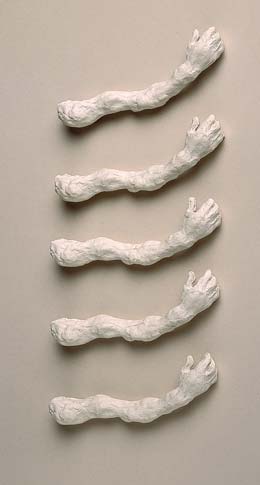
3450_635f83216353f8eRodin was famous for his fragments, and, in his era, hotly defended the choice to sculpt just a hand, or a torso, or a foot melting back into its original rock. The character Bernard, in Virginia Woolf's experimental “The Waves” seems to have revealed something about Woolf's thoughts on the unfinished, as he goes about talking, story-spinning, and worrying about the way life seems to accumulate more than culminate, so that all we get is phrases, bits. While coherence–in story, in body–provides a comforting pleasure for the audience, artists who know how to make wholes sometimes get weary of the falseness that an orderly whole brings with it–and take a pleasure in the fragment, the seemingly unfinished, strangely perfect, part.

I know, from my work as a writing teacher, that almost any student can produce a promising fragment, but very few can manage a coherent whole–in terms of idea, or story– without a great deal of coaxing, insistance, and endless re-writing. The work of a beginner is to complete the fragment. But perhaps the work of a master is to let the fragment be.

As a beginning storyteller myself, I find that whole tales are elusive, and the images arrive like little shards of a broken mirror. What to make of them–that's the hard part. What follows is the first piece of a tiny “novel” that is all pieces, inspired by a Sufi tale I heard three years ago, and subsequently garbled in my mind. In it, a man is visited by three different messengers, all strangers, each of whom require that he leap violently away from the life he is leading, and begin again. In the third phase of the man's life, he begins to show signs of spiritual enlightenment, and he ends as a mystic. The story, for some reason, made dozens of images–partial ones stuck in angled mirror-shards–arrive in my head for two years. In my version, the eventual mystic is a girl. She is young, wealthy, blank.

Read more »

Poem

TODAY WINDY THEN SHOWERS

Gold-plated heels
On heart-shaped leaves
Calf-highs below
Slim band of flesh
Flirty pleats creased
Above naked knees
Ruby clutch releases
Jangling of keys
Wanton cornrows unbraided
In last night's storm

In last night's storm
Wanton cornrows unbraided
Jangling of Keys
Ruby Clutch releases
Above naked knees
Flirty Pleats creased
Slim band of flesh
Below calf-highs
On heart-shaped leaves
Gold-plated heels

By Rafiq Kathwari

Days of Glory

by Lisa Lieberman

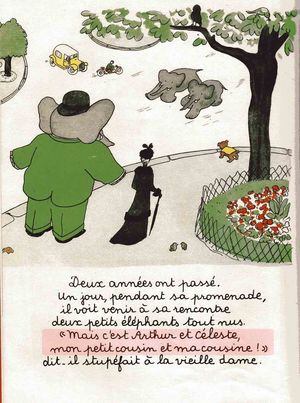
I used to teach a course on French colonialism, from the Napoleonic Wars of the early nineteenth century through the Algerian War of Independence (1954-1962). On the first day of class, we read Jean de Brunhoff's classic children's book, The Story of Babar. De Brunhoff's story can be viewed as “an allegory of French colonization, as seen by the complacent colonizers,” to quote New Yorker writer Adam Gopnik:

Encountering Arthur and Celeste

the naked African natives, represented by the “good” elephants, are brought to the imperial capital, acculturated, and then sent back to their homeland on a civilizing mission. The elephants that have assimilated to the ways of the metropolis dominate those which have not. The true condition of the animals—to be naked, on all fours, in the jungle—is made shameful to them, while to become an imitation human, dressed and upright, is to be given the right to rule.

Gopnik, I should add, distances himself from such political readings of the book. He sees Babar as both a manifestation of the French national character, circa 1930 (when de Brunhoff's wife first came up with the tale, which she told to the couple's young sons as a bedtime story) and a gentle parody of it, “an affectionate, closeup caricature of an idealized French society.”

I remember enjoying the book as a child, and I've read it to my own children, but for all its charm, I'm not willing to let Babar off the hook quite so easily. The business of the civilizing mission—the “native” elephants adopting the values and behavior of the humans who inhabit the city—is cringe-inducing enough, but what really troubles me is de Brunhoff's ending. Here the fantasies of French nativists come true. The elephants come and immediately assimilate, recognizing the superiority of the mother country, hang around long enough to entertain their hosts with anecdotes about their exotic origins, and then they go home.

Read more »

Monday, January 20, 2014

Some thoughts on the science of queueing

by Hari Balasubramanian

ScreenHunter_464 Jan. 20 11.10In Spring 2003, as a first year doctoral student at Arizona State University, I took a class on queuing theory. This refers to the science that has its focus on reducing delays, irrespective of where they may be experienced: at a traffic signal; over the phone to speak to a representative (music and ads playing in the background); or, more critically, in a virtual queue of hundreds of patients, each waiting for an organ transplant.

My class required each student to do a hands-on project in a real setting. I chose mine to be the nearest supermarket, a busy metropolitan Safeway store. Broadly speaking, the two big pieces in any queueing study are: (1) how quickly people/requests arrive, and (2) how quickly they are serviced. The interplay of these determines the probability of delays. So for my project at Safeway, I decided to focus primarily on collecting data on customer arrivals and checkout times.

I talked to the store manager, Scott, about my plan. He was a tall, blond man, dressed formally, gentle but with a clear sense of authority. He was immediately worried and didn't get what I was up to. I tried to convince him by suggesting that my data might be useful. Scott was (quite rightly) skeptical, but I got some sort of an affirmation from him. You can't ask customers any questions, he said sternly, and I promised him that.

Read more »

Do Good Books Improve Us?

by Emrys Westacott

ScreenHunter_465 Jan. 20 11.14Does reading good literature make us better people? The idea that exposure to good art is morally beneficial goes back at least to Plato. Although he was famously suspicious of the effects that tragic and epic poetry might have on the youth, Plato takes it for granted that art of the right kind can be edifying and that therein lies its primary value. Most educators from Plato's time to the present have made similar assumptions, even though they may disagree over what sort of effects are desirable and therefore which sort of books should be read. In the past a lot of powerful art has glorified tradition, upheld religion, celebrated national identity, and helped foster social cohesion. This is the sort of art that often appeals to conservatives. Today, by contrast, much more emphasis is placed on art's critical function, its capacity to make us more informed, aware, self-aware, thoughtful and questioning, particularly in relation to aspects of contemporary culture that the artist finds troubling.

Obviously, no one expects every important work of fiction to precipitate some great moral awakening or social reform after the fashion of Uncle Tom's Cabin. Nor do we expect to see patrons of a New York literary festival dispensing cash to street people as they wait for their cabs after a reading. The moral and social benefits of art identified by critics are usually more subtle. Typical academic commentary on fiction, for instance, will see its importance as lying in the way it enlarges our moral imagination, helps us to grasp another's point of view, sensitizes us to another's feelings or sufferings, warns us against certain kinds of illusion, exposes insidious forms of cruelty, shows us how to avoid self-deception, impresses on us some profound truth, strengthens our sense of self, and so on. This approach receives theoretical support in works such as Richard Rorty's Contingency, Irony, and Solidarity, Martha Nussbaum's Love's Knowledge, and John Carey's What Good are the Arts?

A huge amount of literary criticism is of this sort, and it can certainly be interesting, insightful, and entertaining to read. But I also believe that it might be useful, for once, to meet it with a robust, even vulgar skepticism. I would not deny that literary works are sometimes capable of having desirable effects of the kind just mentioned on individuals and society. But I believe that in most cases, such benefits are either negligible, or short-lived or non-existent. They certainly provide a rather flimsy reason for valuing the works. Compared to the much more obvious good of the enjoyment we derive from reading fiction and poetry, their value as instruments of edification is like the light of stars against the light of a full moon.

Read more »

Industrial Township-ness or How I learnt to be Bourgeois

by Mathangi Krishamurthy

Sometime this year of 2014, my father will retire, ending thirty odd years of service tending and minding a chemical factory. We will also concurrently end what I consider my foundational era, and will have to stop inhabiting a particular vision of the Indian nation-state.

IMG_0791

Rasayani, Circa 2013.

For years, my answer to that most ubiquitous question, “Where are you from?” used to be a really long sentence. “On the National Highway Number Four from Bombay to Pune”, I would begin, “somewhere between New Bombay and Lonavala”, I would continue, “…it's a two-pony town”, I would cautiously insert before ending with, “Rasayani; I'm sure you haven't heard of it.”

My one important memory of Rasayani – the place named after the word ‘chemical' in Hindi, “Rasayan” – is of snakes. I remember waking up one morning, being called out to excitedly by many voices, one distinctly my mother's. And I cautiously stepped outside, to see a man hurling a snake by its tail into the distance. Some kind of pioneering and slightly mad community we must have seemed in my newly anointed Rasayanic head.

I was four or five and we were a bunch of young families, newly imported to one more example of the nation-building spirit of the pre-1991 Indian nation-state, the industrial township. Or in other words, as literature across the world calls it, the company town.

The sociologists Rex Lucas and Lorne Tepperman in their groundbreaking 1971 study “Minetown, Milltown, Railtown”, define company towns as “closed communities owned and administered by the industrial employer” and as a place where everyone, and ominously, the company, knows everyone. Rasayani is a many-company town harboring competing closed communities. Or as we called them, colonies.

Read more »

Six Dreams

by Randolyn Zinn

Dali_meditative_rose

Meditative Rose by Salvador Dali

Owen

He walks into a millinery shop in Back Bay, looking for a straw Panama.

“Do you have any Persian lamb Papakhas?” he asks, just for the hell of it.

“We don’t work with skins,” the milliner replies, coiling a cloth measuring tape between his fingers. In the back workroom, a hot iron hisses as held by a red-faced girl with chubby arms, who yawns as she presses a piece of striped ribbon.

“Do you know,” Owen says, eager to impress the shopkeeper, “that President Karzai’s Afghan Karacul hat is made from the downy fur of aborted lamb fetuses?”

The milliner sniffs. “Is there something I can help you with, sir?”

Owen tries on every hat in the store. The porkpie is too retro. The Basque beret a bit better, and in the gray Fedora with a white grosgrain ribbon band, he’s a dead ringer for a 1920’s Chicago gunrunner. Not good.

“I’ll take this one in straw,” he says, fingering a Borsalino. “How much?”

“Only in felt, sir. We only deal in felt. And wool.”

Owen’s neck reddens and puffs out like the feathers on a parrot. “How idiotic,” he spits. “Aren’t you a hat store? I want a hat.”

He storms out of the shop and a little bell at the top of the door jangles like an angry fairy when it closes behind him. He knows he’s been unreasonable, but can’t help himself. He’s inconsolable.

Neighbors pushing grocery carts or sitting on benches look up as he passes, the violence of his exit a palpable disturbance to their calm.

Read more »

Locating Value in the Natural World

by Michael Lopresto

404px-Alice_Humpty_Dumpty

The idea of objective value has come into disrepute in some quarters. We have an image of the natural world, well defined by physics—a world of mostly empty space filled sparsely with unimaginably tiny objects (an umbrella term for particles, fields and waves) that are governed in law-like ways. Indeed, this world, given precise definition and overwhelming empirical support, is often thought to be radically different to the world we know from experience—the world of vibrant colours and sounds, tastes and smells. The fact that our perception of the world seems to be so profoundly impoverished has led many to despair at the prospects of genuine knowledge of the world. So, this line of reasoning goes, the natural world given to us by physics has absolutely no room for objective values, as pure “atoms in the void” exhaust all of reality.

I think this line of reasoning is wrong, and shows the desperate need for philosophers to make sense of the natural world as defined by physics, with our place as human beings firmly as part of that natural world. To use a term from Wilfrid Sellars, it's the job of philosophers to navigate the way between the scientific image and the manifest image of the world. The scientific image is the “atoms in the void” picture of reality, where ordinary objects like tables and chairs are really just near-empty lattice like structures of atoms. The manifest image is what is presented to us in experience, where tables and chairs are solid objects, we have rich conscious experiences of music that touches us deeply, and, as I'll be focusing on in the remainder of this essay, objective values that bind on us whether we like it or not.

In his superb book, From Metaphysics to Ethics: A Defence of Conceptual Analysis (1998), the Australian philosopher Frank Jackson develops some tools for navigating our way between the scientific image and the manifest image.

Read more »

Epic Malaise, Bro! How ‘epic’ lost its meaning — and what it means for the fate of humanity

by Ben Schreckinger

This past November, they held the sixth annual EPIC Summit in Toledo. As the name implies, it was “a day of career-enhancing training and networking.” Epic!Hubert_Maurer_-_Circe_und_Odysseus

Use of the word “epic” has exploded in recent years, but the incidence of actual epic things has not. Now, as likely as not, “epic” refers to the quotidian, the small, and the mundane Need proof? Take the actual first result in my Twitter search for #EpicFail: “Just realised I forgot to buy crumpets for breakfast in the morning….so no toasted buttery crumpets for me!! Boo! #epicfail.” Some of my friends work for a company called Epic Systems. It does health care IT. I’ve been eating at a food hall in Dublin that advertises its epic club sandwich. It’s no wonder the top definition of epic on Urban Dictionary calls it “the most overused word ever… Everything is epic now.” Something has gone terribly wrong.

It’s past time to add “epic” to the sad list of words that have come to mean what they don’t mean. The Oxford English Dictionary caused an uproar this summer when the press discovered it had expanded its definition of “literally” to also mean figuratively — because that’s how people now use it. That redefinition was a defeat for language purists in their battle against sloppy usage. But the bastardization of epic signals something far graver: the inescapable malaise of post-industrial existence.

The world of the true epic is one of famine and feast, terrifying monsters and awesome deities. It conveys the mysteries of the wild unknown and the joy of emerging from it to rediscover the comforts of hearth and home. The epic’s grand scale reflects the awe with which its characters view a world whose grandeur they can’t contemplate. In other words, the world of the epic is the opposite of New York City, where the diners stay open 24 hours and the drug dealers deliver. The epic hero is the opposite of the modern knowledge worker, for whom the closest thing to an existential struggle is a battle for market share. After the sack of Troy, Odysseus was lost for 20 years before he returned home to Ithaka. Now we have GPS. It’s hard to imagine The Odyssey with iPhones.

Odysseus: Hey babe, I totally killed the presentation enemy today. Looks like I’ll be home late though. Google Maps is showing some traffic on the Aegean.

Penelope: Pls hurry! These suitors are making me nervous.

Odysseus: Umm, uninstall Tinder? LOL.

Read more »

The dangers of ethical thought experiments

by Carl Pierer

159999773“Yes, I would let the five people die.”

To philosophers, and I mean to include all people interested in philosophical questions, this is a pretty standard response to a pretty well-known thought experiment: The Trolley Problem. But it is not only in philosophy that you get very uncanny scenarios when trying to clarify an idea by applying it theoretically. These thought experiments play an important role in fields as diverse as physics and arts, mathematics and literature, but the most infamous ones are probably to be found in philosophy, and in ethics particularly. Not only are they notorious, but in fact they face two challenges, which easily turn into dangers should we ignore them and base our argument on them.

First of all, thought experiments have to be distinguished from metaphors, since they serve different purposes. At first sight it might seem that they are poles apart. However, Dennett writes: “If you look at the history of philosophy, you see that all the great and influential stuff has been technically full of holes but utterly memorable and vivid. They are (…) lovely thought experiments. Like Plato's cave, and Descartes's evil demon, and Hobbes' vision of the state of nature and the social contract, and even Kant's idea of the categorical imperative.” Dennett here conflates a variety of famous philosophical scenarios under the heading “thought experiments”. Yet the structure of Plato's cave is completely different from Descartes's evil demon. In Plato's case there is no new knowledge gained. It is not a hypothetical scenario of how the world might be, but rather a more literary expression of how it actually is. The philosopher's ascent from the cave is figurative and an it does not serve the purpose of drawing some conclusion from this view, but rather to embrace the general idea that this is the philosophers' condition. It is a picture, an illustration of his idea rather than a method to develop a new belief. Descartes, on the other hand, imagines an evil demon who brings about a very sophisticated illusion of reality, making us think that all our experiences are real while they are merely his creations. It is an application of radical scepticism. Once we hypothetically accept this scenario Descartes asks whether any of our pre-demonic knowledge still stands. The difference between Plato's cave and Descartes's demon is that the former is a mere illustration of an idea. The latter, in contrast, serves to provide some new insight. Therefore, I propose to distinguish between thought experiments and metaphors. The purpose of the former has to be a more rigid one than that of the latter. We use thought experiments to test what happens if we apply our theoretical ideas. Its similarity to actual experiments should not be ignored. We peruse those hypothetical results, and only if we can accept them are we ready to accept a theory.

However, more often than not, thought experiments are used the other way round. Hypothetical scenarios are invented in such a way that our theories fail to deliver what is expected of them.

Read more »