by Eric Byrd
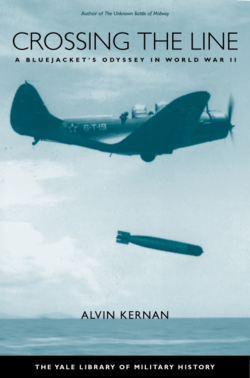 There's a subgenre of military memoirs produced by elderly emeriti, the crew-cut close readers of postwar English departments, who in late career published personal recollections of they and the other terrified teenagers who mostly fought World War Two. Alvin Kernan (Shakespeare editor, torpedo bomber crewman) is like Paul Fussell (Johnsonian, infantry officer) and Samuel Hynes (Auden biographer, Marine aviator). Seventeen year-old Kernan joined the Navy before the war, to escape the bleakness of Depression Wyoming: Ma and Pa down on the ranch, hard winters and harder times. Kernan's mother had a representatively difficult life. She killed herself while he was at sea. Home on leave, he inspects her grave “already collapsing and pocked with gopher holes”:
The World War I generation to which she, born in 1900, belonged was the first to leave the land, and with a little education, she married a soldier, moved to town, went to Florida, lost the money from the sale of her father's farm in the land boom, had a child, divorced, and began wandering—Chicago, Memphis, a ranch in Wyoming. She remarried, became a Catholic, and put a determined face on it all, but she was part of the first generation of really rootless modern Americans, moving restlessly by car about the country, emancipated socially and intellectually to a modest degree, but lost, really, without the supporting ethos and family that had protected people in the years when the continent was being settled. Alienation was the familiar state of my generation of Depression and another world war, but the old people had few defenses against it when it appeared.
Hemingway, Fitzgerald, and Dos Passos are the favorite writers of young Seaman Kernan. He could be one of their characters. As with Hemingway's Nick Adams, death-shaded excursions in the American wilds precede and forebode initiation overseas. And Kernan must have recognized his family in Dos Passos' panorama of the wandering and the unmoored, the war-mobilized, the desperately migratory. The down but not out, bumming the freights, going to sea, following work; displaced but for all that able to dream of landing somewhere better:
Returning from out baseball game, we came alongside the ship and began to send sailors up the gangway. At that moment another landing craft came up carrying officers, including the executive officer of the Suwanee—a small, dark, mean man—who stood up in the bow, dead drunk, shouting in a loud voice to the officer-of-the-deck, “Get those fucking enlisted men out of there and get us aboard.” Protocol was that officers always take precedence in landing, and our boat shoved off immediately, circling while the officers staggered up the gangway after their afternoon drinking in the officers' club. The gap between enlisted men and officers in the American navy during WWII was medieval. Enlisted men accepted the division as a necessary part of military life, but it never occurred to us that it in any way diminished our status as freeborn citizens who, because of a run of bad luck and some unfortunate circumstances like the Depression, just happened to be down for a brief time. “When we get rich” were still words deep in everybody's psyche. But the exec's words, “those fucking enlisted men,” spoke of deep and permanent divisions. He obviously really disliked us, and his words made shockingly clear that he, and maybe the other officers he represented, had no sense that we had shared great danger and won great victories together.
Dos Passos' Three Soldiers, in a paragraph.
Beyond the charm of the Lost Generation atmosphere, the virtues of Crossing the Line are its swift pace and concision of evocation. No episode lasts longer than is necessary to make the essential impressions—usually Kernan's fear and awe (at times laced with boyish glee) before the military juggernauts whose savage collisions he is witnessing. Kernan did not set out to reconstruct the birth of his literary consciousness, or find the boy in the vitae. Quite the opposite. Seaman Kernan is a small animal in a world of threats. He thinks with his gut, senses through the soles of his feet.
Read more »