by Charlie Huenemann
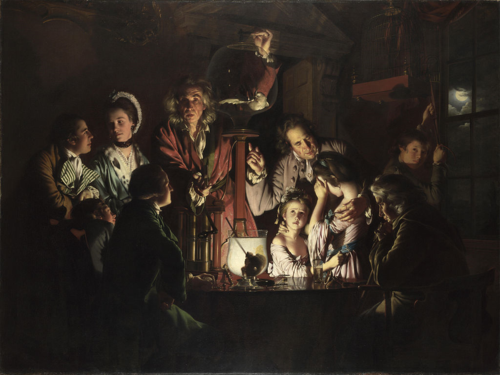
Sometime in the late 1650s, Robert Boyle built an apparatus that removed the air from within a glass dome. The members of the newly-formed Royal Society promptly set about devising all manner of experiments to perform with the newfangled device. They placed candles, mercury barometers, and then – just as one might expect of unsupervised boys – living mice within the dome and watched what happened as a piston systematically drained the air away. (It is probably a good thing for the local fauna that the experimenters did not have a bigger air pump at their disposal.)
The effects of these experiments were easily seen, but controversies raged nonetheless over what was really going on. Did the device truly empty everything from the dome? Thomas Hobbes, Henry More, and others insisted that a pure vacuum is impossible, and that some sort of rarified matter must remain in the dome. Their reasons for asserting this so confidently are various. Some found the suggestion of a specific volume attached to no material thing unintelligible. Others found it ridiculous to believe that as Boyle expelled the air out of the dome, and nothing took its place, the volume of the universe would necessarily inflate by just that amount.
In his “Physical Dialogue on the Nature of Air,” Thomas Hobbes offered his own view of what the air pump was doing. Hobbes and Boyle both denied that there is any real qualitative difference between fluids and piles of particles: the differences in their behaviors were the result of the sizes and shapes of their constituent particles. Fluids consist of slippery, eel-like particles that easily slide past one another in a liquid way, and piles consist of blockier particles whose shapes prevent such easy motion. From this fact, Hobbes went on to explain that when the piston of a so-called “vacuum” pump withdraws from the chamber, the piston pushes upon the sea of particles outside the chamber, with the result that very, very tiny eel-like particles forcibly squirm their way back into the chamber (for they are the only ones that can slither through the very, very tiny pores of the chamber's glass walls). The pond of particles inside the chamber is thus made increasingly pure and light – and this is what these fellows meant by the aether. This aether is a real, material thing, they said, but is not sufficiently rich to sustain the life of a flame or a mouse. Furthermore, Hobbes's theory explained why a very great force would be required to withdraw the piston, since there ends up being a particle traffic jam around the chamber's tiny pores.