In Part I of this series, we looked at how the concept of information brought communication and computation together. Claude Shannon and the other pioneers of information theory showed that discrete symbols could be used to encode and transmit almost any sort of message, and that binary digits were the simplest possible symbols. Meanwhile Alan Turing and the computer scientists demonstrated that strings of symbols could serve as the inputs to simple machines that could transform them into new and useful output strings.
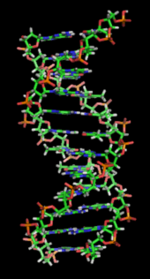
Information theory arose from the question of how best to transmit discrete signals from point A to point B, with little to say about the purpose of the signals. Computability theory was born of a complementary quest: the study of how to transform and manipulate symbols in the service of some purpose. The birth of modern genetics reveals a similar complementary relationship. Two broad research questions arose in the tumult of 19th century biology: the question of how hereditary information was communicated from one generation to the next, and the question of how an organism develops, starting from the moment of conception. The first question gave rise to transmission genetics, while the second gave rise to developmental biology. These questions proved to be intimately related: progress in answering one was often contingent on developments in answering the other. The overlap between the answers to these questions was recognized in the twin roles of the DNA molecule: it has been described as both the vector of hereditary transmission, and the bearer of a developmental program that 'specifies' or even 'computes' the organism. We will now follow the path that led to the DNA molecule, a path that emerged from the confluence of evolutionary theory, cell biology, and biochemistry. [1]
The nature of heredity
An awareness of hereditary inheritance must have arisen very early in human culture. It can't have been very difficult to realize that the properties of an organism — its traits — tend to reappear in its offspring. Children typically share many features with their parents. Ancient peoples clearly recognized inheritance of characteristics in plants and animals too. Humans have been selectively breeding plants and animals since prehistoric times, gradually amplifying useful traits with every generation. The dog is believed to have been domesticated from a wolf-like ancestor between 11 and 16 thousand years ago. And rice and wheat were domesticated between 8 and 13 thousand years ago. The ability to make use of hereditary inheritance precedes the dawn of civilization.