by Brooks Riley


by Brooks Riley
by Shadab Zeest Hashmi
 “You start with a scarf…each 90-by-90-centimeter silk carré, printed in Lyon on twill made from thread created by the label’s own silkworms, holds a story. Since 1937, almost 2,500 original artworks have been produced, such as a 19th-century street scene from Ruedu Faubourg St.-Honore, the company’s home since 1880. The flora and fauna of Texas. A beach in Spain’s Basque country” –- this is a fragment from an advertisement article for Hermès in this month’s issue of a luxury magazine. The article is called “The Silk Road.” Does it refer to the “Silk Road” in any way that justifies the title, beyond the allure of legend? No. Does it mention that the first scarves created for this very label, in 1937, were made with raw silk from China? No. Not necessary, not relevant to the target reader. In fact, the less we mention the “East” while trying to sell such luxury designer items, the better, aiming as we are for the rich collector, the global consumer of fashion (whether belonging to the East or West) willing to spend hundreds of dollars on a small square of silk, and more likely to associate such status symbols with Western Europe rather than with the “underdeveloped,” impoverished, overpopulated, conflict-ridden East.
While silk has always been a coveted item, a symbol of wealth and power for millennia in many cultures around the world, the detailed, de-mythologized, accurate history of what we have come to know as the “Silk Road” is not only of little interest but has been deliberately suppressed in the West. Besides a vague connection with Marco Polo, most people usually draw a blank at its mention. During the many years that I have been working on (and presenting from) a trilogy of poetry manuscripts based on aspects of this history, I have come across few readers (including writers and academics) in the US who have a clear idea of the regions that have been, since antiquity, a part of these trade routes we call the Silk Road (or “’Seidenstrasse,” a term coined by the German historian Ferdinand von Richthofen in 1877) to define a network of land and sea routes of central and continuous importance to global trade as well as civilizational influences and the shifts in geographical borders around the world: a history that has been shaping not only how the world map looks from time to time, but how attitudes, knowledge, goods, technology, weapons, fashions, and even diseases and cures have been spreading across the continents and through the centuries. Read more »
by Nickolas Calabrese
 A few months back my boss and I had lunch with the person who, wearing a t-shirt that read “black death spectacle”, stood in protest in front of a painting of Emmett Till by Dana Schutz called Open Casket at the last Whitney Biennial. Shortly after his gesture another artist penned an open letter about how Schutz’s painting uses “black pain” as a medium, and how this use by non-Black artists needs to go. I’m not sure what the ethical verdict is (of whether or not Schutz made a gravely racist error), or whether the artist’s letter voiced an instance of over-reaching aesthetic censorship, nor will I make any attempt at trying to resolve that issue here; it would take far more space than what is available and is not my aim. Consider reading Aruna D’Souza’s recent book Whitewalling: Art, Race & Protest in 3 Acts for a thorough treatment (which, not so incidentally, the above mentioned protestor provided images for).
What I am interested in, however, is the broader idea of pain as a medium. That pain can be an aestheticized form is completely fascinating, and yet it has been employed since at least the Bible. We’re talking here about both physical and mental pains. How does one explain the benefits of painful aesthetics – of horror, of discomfort, of terror, of anything undesirable in real life; generally speaking, of pain – if pain is intrinsically undesirable for most people? Well I understand pain to be valuable as a tool for education and experience because pain, more than pleasure, has the tendency to traumatize the people who suffer it. In other words, it makes a lasting impression. Pleasure leaves an impression too, but it doesn’t traumatize, and that seems relevant to this discussion. Read more »
by Lexi Lerner
“All the greatest hits from the past forty years have the same four chords,” Axis of Awesome taught us a decade ago. “You can take those four chords, repeat them, and pump out every pop song ever.”
The band has since released multiple versions of its famous four chord medley, cataloguing more than 80 chart-toppers that follow pretty much the exact same structure. Amongst them: “Let It Be” by the Beatles, “Can You Feel the Love Tonight” by Elton John, and “Under the Bridge” by the Red Hot Chili Peppers.
While they may have lifted the veil for some lay listeners, Axis of Awesome did not invent the music theory behind the four chord song. In fact, that progression has served as the backbone of popular music since the thirties, and its prevalence has only increased with time.
Recall such recent four chorders as “Despacito” by Luis Fonsi with Daddy Yankee, “Edge of Glory” by Lady Gaga, “Someone Like You” by Adele, “Call Me Maybe” by Carly Rae Jepsen, and “We Are Never Ever Getting Back Together” by Taylor Swift. Roll your eyes if you must, but these were seminal to the Billboard Top 100 when they came out. The trend has its fingers in far more pies than just pop music; there are four chord songs as indie folk as “The Sounds of Silence” by Simon and Garfunkel, “In the Aeroplane Over the Sea” by Neutral Milk Hotel, and “Lying to You” by Keaton Henson.
Music wasn’t always like this; Brahms and Wagner and Strauss would all sob at what earns airplay these days. So when the permutations, instrumentation, length, and knowledge of music are more boundless than ever, why do we settle for the same four chords? And if most songs are built on that, what makes certain ones destined for mixtapes and wedding dances and long car rides and summer soundtracks? Why do we consider anything to be special? Read more »
by Pranab Bardhan
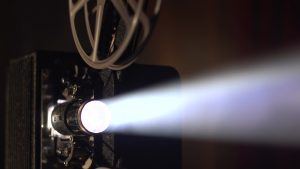 Ever since my childhood I have been excited, even electrified, by movies. In my college days in Calcutta, in search of alternate experience beyond Indian and Hollywood movies, I used to frequent the local Film Society events, showing some commercially unavailable European fare. Short of funds these Film Society outfits mainly went for movies they could procure at low cost. The East European consulates in the city were particularly generous in making available films from their countries.
Most of them involved grim, but occasionally gripping, stories of life struggles under Nazi occupation and oppression, laced with heart-warming episodes of small triumphs or tragic acts of heroism. It was only much later that I realized that some of these stories were also muffled and indirect protests of the directors against the then Soviet domination in their countries. This was the case, for example, in some of the films of the great Polish director, Andrzej Wajda (whose early films like Kanal and Ashes and Diamonds I had seen several times in Calcutta). His father was among the thousands of Polish officers killed in Katyn forest by Stalin’s secret police in 1940. (Wajda finally made a film about the Katyn massacre much later in his life, when he was in his 80s).
After Calcutta, when I went to Cambridge, England, as a student, for the first time I was exposed to what can be called an ‘abundanza’ of European art films. To borrow the words of the Irish writer John Banville, for me it was an “opulent pleasure garden where I sipped and sucked, dazed as a bumblebee in full-blown summer” (Banville had used these words to describe his ecstatic exploration of his lover’s female body). A couple of movie halls in Cambridge used to specialize in arranging retrospectives of these art films. Read more »
by Adele A Wilby
 Many decades ago, I packed my bags and left the shores of Australia and headed to the United Kingdom (UK). My secondary years of education had taught me to believe that my journey to the UK would amount to a ‘return’ to the ‘motherland’. A ‘return to the motherland’? Really? That says more about the education system I was exposed to, than just how naïve I was. However, having learned after my arrival that the UK was not, in fact, my ‘motherland’, I did discern that it had more to offer in terms of being ‘in’ the world than the distant shores of Australia, and I decided to stay. Thus, after many years resident in the UK, I considered myself as someone familiar with the country, until, that is, a change in my life circumstances provided me the opportunity to know the UK, or more specifically, England, in a totally different way.
Acting on the advice of a friend concerned with what he considered to be my solitary life following the death of my husband, I joined the Ramblers’ Association in the UK. Involvement with activities of the Ramblers didn’t last too long; group walking was not my thing. I did learn however, that walking was something I relished; it literally, put a spring in my step. The more regularly I walked the more the country opened up to me, an England loaded with complexity, diversity, mystery, and an alluring, limitless beauty: the English countryside.
In many ways, the countryside is how England can be: cold and aloof, requiring time to get to know; a place where one can feel a sojourner in its midst; a place where its nuances and secrets take time to understand. But it is too a place that tolerates your presence, and, as long as you remain respectful, it will allow you to saunter and relish the attributes that it has to offer, undisturbed and secure. That, to me, is fair enough; I don’t ask for more. I have no wish to disturb its existence, or indeed, undermine any aspect of its life.
The UK is exceptional for its network of public footways and bridleways; walking routes where ramblers are permitted to cross farmers’ property, to pass through private driveways and gardens and around farm buildings, if that is where the public right of way takes its direction. Read more »
by Gabrielle C. Durham
 We can agree that a verb in the present tense means that action is occurring now. What about the present progressive, which I used in the previous statement? That apparently confounds non-native English speakers because it means that an action is in the middle of happening. Friends have asked me, “What is the difference between I am playing tennis and I play tennis?” That example is actually a softball because the present progressive indicates that the first person is in the middle of playing a game and the simple present indicates the playing of the sport in general.
This feeling of verbal instability perhaps approaches the bewilderment I still feel with some verbs in Russian when deciding whether to use perfect versus imperfect (honestly, not that common an occurrence, put play along with me, please). I understand when Misha went by train to Novgorod yesterday, no sweat. It’s when he ate a 3-day feast beforehand that I start getting itchy palms. Yes, the verb is in the perfect, or completed, past tense, but that piggish boy just kept engaging in the activity for 72 hours. Would you use the perfect or imperfect past? You could make a persuasive argument for either. According to the Oxford Dictionary, we can break this use of tense down to aspect, which would be either continuous or perfect.
So what does tense tell us? Verb tense refers to when a subject performed an activity (the verb). Easy, peasy, right? Not really if you start talking about other things that happened in relation to that time. That’s where pluperfects and subjunctives, among other infernal entities, come into play. Read more »
by Mary Hrovat
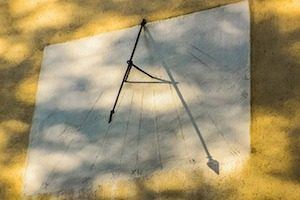 Before the second was defined in terms of the characteristics of the cesium atom, before leap seconds or leap days or Julian dates or the Gregorian calendar, before clocks, even before the sundial and the hourglass, there were sunrise, sunset, and shadows.
I’ve been thinking about timekeeping using shadows because a tulip tree in my backyard casts a shadow that traces a semicircle over the lawn on sunny days and moonlit nights, like the hand of a clock. The shadow is longest and most noticeable at this time of year, when the sun crosses the sky low in the south, and on summer nights around full moon. (The full moon crosses the sky low in the south in the summer, when the sun is riding high in the north.) However, I can see it year-round, given adequate sunlight or moonlight, although its appearance varies depending on the position of the sun or moon. I enjoy seeing this subtle demonstration of daily and seasonal cycles.
The gnomon on a sundial (the part that casts a shadow) was probably inspired by natural objects like this tree that cast useful shadows and roughly indicate the time of day. The first human-made gnomons were vertical poles or towers. For example, Egyptian obelisks, in addition to being tributes to gods or markers celebrating a ruler’s achievements, acted as gnomons, and their shadows marked the time of day for a city.
Sundials of various types were developed as these early timekeepers were refined by aligning the gnomon with Earth’s rotational axis and adding a dial that marks divisions in time. In addition, the natural or solar hours, which vary in length throughout the year if you’re not near the equator, were eventually replaced by hours of equal length. Thus was timekeeping made more useful but also distanced somewhat from its roots in solar time, particularly when clock time had to be coordinated across different regions and eventually across the globe. Read more »
by Ashutosh Jogalekar
 The fall turned colors faster than ever before. The streets never saw any activity. The whole gambit of Prometheus hinged on a mere coin flip. Richard Albrook gingerly closed his book and took a look around.
The café was almost deserted, college students and startup founders struggling to meet last minute deadlines, their faces a picture of desperate concentration. The baristas and their blues, the coffee with its vitriolic flavors. It seemed like the uneasy middle of time. Had not the soothsayer spoken with gusto and evident admiration for the march of destiny, he might have almost been forgiven for having a sense of whimsy.
Albrook had been languishing in this carved out area of spacetime until his visceral emotions had gotten the better of him. His friends had warned him that too much time with a speakeasy kind of permissive feeling would mark his doom. Not that feelings of doom had never crossed his mind, but this time it seemed all too real. Lost love, the convolutions of Clifford algebras and dandy details of daffodil pollination had always been seemingly on the verge of materializing in a cloud of abject reality, but the effect had been subtle at best.
It was this rather susceptible mix of preternaturally wholesome unification that Albrook was mulling over when the wizard walked in. Read more »
Whirling
Hebrew Home
The Bronx
Mother sobs
in short bursts
I lean over
brush my cheek
against hers
on the pillow
“What’s wrong?”
“Look at Tarek”
she wails
“he’s drowning
For the love of Allah
save my son.
Look, my bayta
he’s whirling”
I’m curious
how she knows
Tarek’s been swept away
by a rip tide
in Goa
The sea yielded
his corpse
a day later
We hid
the news
from Mother
She’d be beyond grief
for Tarek
youngest of six
even if 62
was her baby
I wonder
voices
she’s been hearing
since I was a kid
is this where poetry
comes from?
by Rafiq Kathwari / @brownpundit
NOTE: “bayta” in Urdu means son
by Thomas O’Dwyer

Now that the hundred years have passed, can we wrap up World War I, stick a label on it and dispatch it to the archives of dead history? Otherwise, it’s going to be with us forever. If you are old enough to remember the 1968 events for the 50th anniversary, then you’ve lived to see them happen all over again. The only difference this November has been the absence of interviews with living survivors – there are none left. Harry Patch, the last surviving man to have fought in the trenches at Passchendaele, died in Britain in 2009, aged 111. The last German veteran, Franz Künstler, died in 2008, aged 107. The last veteran from any country, Florence Green from England, who had been in the Women’s Royal Air Force, died in 2012, aged 110.
A notable British film came out around the 50th anniversary – Oh! What a Lovely War, directed by Richard Attenborough. It was a parade of stars – Maggie Smith, Dirk Bogarde, John Gielgud, John Mills, Kenneth More, Laurence Olivier, Jack Hawkins, and three Redgraves (Corin, Michael and Vanessa). They romped through two hours of popular songs parodying the war. It progressed from jingoistic optimism, through the stupidity of the generals and incomprehension of the soldiers, to a vast panorama of white crosses at the end. Attenborough nailed the pointless evil essence of the war (on the Western Front) with touching grandeur and sadness. In background shots, cricket scoreboards tallied the rising death toll in the “great game.”
Is it possible that in 100 years time the world will continue to stand in silence for the war dead on the 11th hour of the 11th day of the 11th month? Read more »
by Jeroen Bouterse
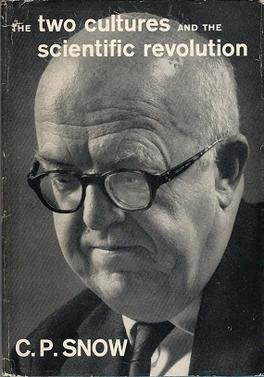 It is a commonplace to say that a divide has occurred in modern academia between the sciences and the humanities. In the anglophone world, this diagnosis is often traced back to a lecture by the British scientist-novelist Charles Snow, who pointed out in 1959 what he saw as a lamentable gap between ‘two cultures’: the literary and the scientific culture. Snow’s Rede lecture has become the main point of reference for later commentators, who often sigh in frustration that in spite of Snow’s warnings, the divide has deepened or widened.
That we have grown so used to the ‘Two Cultures’ framework is unfortunate, however, for multiple reasons. For one, Snow’s lecture wasn’t about the sciences and the humanities. (He never even uses the term ‘humanities’ in the Rede lecture.) His worries were about literature, about certain writers who got their views on ethics and literature all wrong; not so much about liberal arts or humanistic scholarship. That’s not to say that literature and the humanities are unrelated, of course; but they are not always the same thing either, which is why Snow has little to offer us by way of explanation of the sciences-humanities divide. That, in fact, is a second reason why Snow is a less-than-ideal key witness: there is a lot of lamentation and exhortation in his lecture, and very little definition and analysis.
A third reason, and I would say the most important one, is that whatever the virtues and shortcomings of Snow’s model, the omnipresence of the ‘two cultures’ framework comes at the cost of a richer historical perspective. (That is a typical humanistic concern, of course.) People did think seriously about the relationship between the sciences and the humanities before and after Snow, and collapsing all the results of that thinking into the category of the ‘two cultures’ means giving yourself over to an unselfconscious cliché about the modern intellectual landscape. Read more »
by Joshua Wilbur
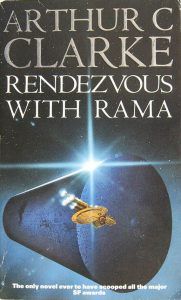
I first encountered a Big Dumb Object (“BDO”) in an underfunded school library in rural East Texas. Sitting cross-legged on the carpeted floor, I held a battered paperback just a few inches from my face, periodically turning it over to inspect the image on the book’s cover.
Rama.
I was twelve years old—“the real golden age of science-fiction”—and Arthur C. Clarke’s Rendezvous with Rama captivated my imagination. The novel’s premise is simple: an alien starship, a massive cylinder of unknown origin and construction, has entered the solar system, and a crew of scientists must investigate. Thin on plot (and even thinner on characterization), Rama lingers in my memory not for what’s hidden within the vessel but for what’s kindled from without, from the mere suggestion of a colossus come from the stars. It stirred in me what sci-fi critics have called the “sense of wonder,” a feeling of awe that courses through the heart of the genre.
Nothing better epitomizes this sense of wonder than “Big Dumb Objects,” a term coined by Roz Kaveney and lovingly adopted by fans of the science fiction genre. BDOs, as you’ll have guessed, are really big, dumb in the old sense of “mute, silent, refraining from speaking,” and usually serve as a focal point for narrative action. Mysterious thing is discovered; mysterious thing is explored. In a Weird Things column for The Guardian, Damien Walter defines the BDO:
“ … the Big Dumb Object (BDO) is a unique selling point of the sci-fi genre. It can be a broad term – usually, they’re alien architectures, ranging from the man-sized to the planetary. BDOs either look extreme or unusual, and can often do extreme or unusual things: everything from lurking on a horizon to creating worlds. Usually, BDOs are plonked into plots to awe us with their majesty and mystery – really, they’re science fiction’s equivalent of a MacGuffin.” Read more »
by Brooks Riley
by Carol A Westbrook
“Drive east 6 blocks and then turn right, and you’ll be there,” I told my son.
He answered, “Forget it. I don’t know which way is east. I’ll just use my GPS.”
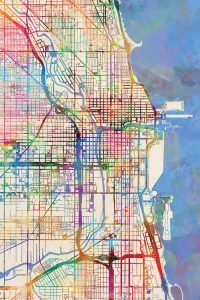
I was incredulous. How could any native Chicagoan not know where east is located–toward Lake Michigan, of course! How could he not be able to find his way without GPS directions? After all, Chicago is merely a grid, as you can see on the map below. The streets are straight lines, oriented north-south and east-west, with 8 blocks to a mile. The street numbers increase by 100 every block, with the zero-zero point being downtown, at State and Madison. Give me the coordinates and I can locate you precisely and find my way there using the map in my head (except for those baffling diagonal streets). And if you prefer to use a compass, rest easy, because the compass declination in Chicago is close to zero
I shouldn’t be surprised that my son, like most younger adults, prefers his GPS. A recent survey showed that four out of five 18 to 30-year olds can’t navigate without electronic guidance, whereas more than half of people over 60 were very comfortable with maps. Myself, I prefer a map. If find my GPS is distracting when I’m driving, and if I follow it blindly I lose my place on my mental map.
Yes, I carry a map of Chicago in my head, or any other place I’m staying for more than a few days–including a hotel room. (It’s a handy way to get to the bathroom in the dark.) Most people have mental maps of their immediate vicinity and the areas where they normally travel; how they use those maps is another story. Read more »
by Max Sirak
Recently I embarked on an unexpected and enlightening adventure.
I went to Las Vegas with four of my oldest friends to see some music. The band, Phish, was playing for a four night run at the MGM Grand’s Garden Arena and we decided to meet up and attend. It also happened to be over Halloween.
For those unfamiliar, Phish is a four-piece band that owes its legacy to the Grateful Dead. Their fans are fiercely loyal and regularly tour with the band, traveling from location to location and seeing as many concerts as they can. This is because Phish shows are fun
They’re equal parts concert and carnival. Beach balls and balloons bounce around the room when the band plays. The fans are engaged. They dress up in costumes. They make signs in hopes of encouraging the group to play certain songs. At a peak musical moment, the crowd spontaneously begins throwing hundreds, if not thousands, of Glow Sticks around the venue. This is called a “Glow Stick War.”
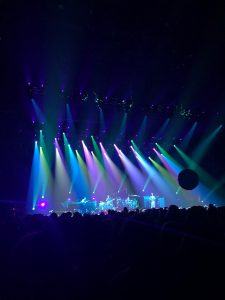
The concerts are between three and four hours. There’s no opening act and always a set-break (intermission). The music is largely instrumental and is accompanied by one of the best light shows in the business.
In preparation for the trip, a group text emerged. There were all sorts of details to hash out. Flight times, hotel reservations, and Halloween costumes were all discussed. It was quickly decided we’d dress up differently for each evening. Read more »
by Christopher Bacas

I stayed out late the night before I left for college, saying goodbye to friends whose future included institutions even more punitive than mine. My parents packed my belongings in two long, green army duffel bags purchased at “Sunny’s Surplus”, where you could buy Afro picks with folding handles, decommissioned grenades and a “knuckle knife”.
At Baltimore-Washington airport, I watched a young man carrying a black-leather trumpet case unload his luggage from a Rolls Royce. My parents thought he might be going to school with me. I doubted them. My throat burnt by cheap Mexican weed, trumpet kid looked as sullen as I felt. He boarded with me and we flew southwest. At Dallas-Fort Worth, we both headed to the baggage carousels, still avoiding eye contact. The area gradually cleared, leaving a cluster of freshman music students. A saxophonist unpacked a gleaming Yamaha alto and played scales with a windup, wooden metronome. He began them slowly and evenly, a proper music lesson, and ended each with a monsoon of notes whose velocity propelled his body backwards, a cephalopod in flight.
A few of us took out the letters promising shuttle bus service to our dorm in Denton. At the curb, unmarked vans pulled in, waited and left, sometimes without picking up passengers. They drove through a lattice of Texas sun and graphite shadow. It was one-hundred and fourteen degrees. Read more »
by Abigail Akavia
November 9th was the 80th anniversary of Kristallnacht. In Leipzig, where I live, as all over Germany, a series of events took place to commemorate the victims of that night of Nazi-led pogroms.
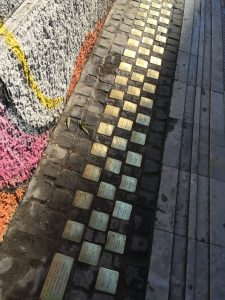
The western part of Leipzig is a former industrial wasteland. Now rapidly gentrifying, it is still home to those who wear their counter-culture cred on their sleeve, sometimes literally—punks, students, artists, and dreadlocked parents walking the streets barefoot with toddlers strapped on their backs. Here, on the trendy Karl-Heine boulevard, on the night of November 9th, “Stolpersteine” became little ground-level shrines. Stolpersteine are small square brass plates inscribed with the names and life-dates of victims of Nazi extermination or prosecution, installed on the sidewalk where these victims last lived or worked. To raise public awareness of Kristallnacht, flowers and candles were placed on the Stolpersteine, drawing attention to their presence as memorials, their normally subdued existence. A private initiative led by German artist Gunter Demnig since 1992, Stolpersteine can be found in towns throughout Germany and Europe.
Some in the Jewish community have objected to this form of commemoration, viewing as disrespectful the notion that remembrance plaques are placed where they can be treaded on—indeed, the reality and explicit purpose of Stolpersteine. The long grid in Thessaloniki shown above seems the exception rather than the rule, for in most cases, Stolpersteine are not aesthetically prominent. On regular days here in Leipzig, Stolpersteine do not command much attention. This kind of incessant yet unobtrusive, subliminal reminder of the horrors of the Nazi regime seems like an apt counterpoint to the way many Israelis (such as myself) view their relationship with Germany. In the last two decades or so, more and more Israeli Jews have moved to Germany, to work or permanently live here, including those whose ancestors were direct victims of the Nazis. Our relationship with the past seems reflected in the kind of commemoration the Stolpersteine enact: the Holocaust is a fact. It happened right here. Sometimes, we pause, the mere thought of it knocking the wind out of us. But most of the time, we move on. Read more »
by Emrys Westacott
 “Beware of literature!” This warning occurs in Jean-Paul Sartre’s 1938 novel Nausea as an entry in the diary of the narrator, Antoine Roquentin. In context, it concerns the way that literary narratives falsify our experience of events by investing them with an organization and structure that our experiences in themselves, as we live them, do not have. When Bilbo Baggins finds the ring in The Hobbit, Tolkein tells us that although Bilbo didn’t realize it at the time, this would turn out to be a turning point in his life. When married couples recall their first meeting, their account inevitably packages the event as a “beginning,” even though they may have had no inkling of this at the time.
There is, of course, some self-conscious irony in the fact that the warning to “beware of literature” appears in the middle of a literary work. Shades of the liar paradox, in fact. If we should be suspicious of literature, then we must be suspicious of the work that tells us to beware of literature: in which case we should perhaps trust literature, including works that advise us not to…..and so on.
The warning goes against an idea often touted that literature is a vehicle for expressing and revealing Truth. Perhaps not truth of the scientific variety, but some sort of insight, wisdom, or moral lesson concerning human nature, human relationships, and the human condition, that is best communicated through art rather than by means of discursive argument, and which resists reduction to a simple formula. This idea is naturally appealing to the literati, especially at a time when the onus seems to be on anyone not working in STEM fields to justify their existence, or at least their salary.
Recently, though, I have been struck by a particular problem with such claims, at least insofar as they pertain to fiction. Read more »