
by Michael Liss
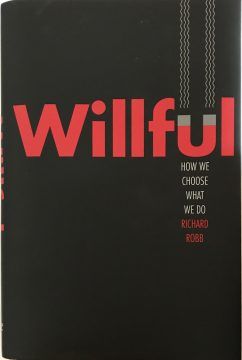 Economics. The dismal science. All those numbers and graphs, formulas and derivations, tombstone-sized copies of Paul Samuelson and William Nordhaus’s Macroeconomics (now apparently in its 19th edition), and memories of the detritus that came with them: half-filled coffee cups and overfilled ashtrays, mechanical pencils and HP-45s.
As you might imagine, with that as background, I approached Willful: How We Choose What We Do with a bit of primal trepidation, something deep inside my limbic system. To add to my anxiety, I had just seen a review of the latest Piketty missive under the ominous headline “Thomas Piketty’s new War and Peace-sized book…” and wondered what kind of dense read I was getting myself into.
I was wrong. Once Mr. Robb’s book was in my hands, I realized that I was looking at an entirely different animal, one that didn’t scream at or lecture you, but, in calm, measured tones laid out a fairly remarkable thesis—that existing, accepted theories of why we do things (such as the redoubtable “Rational Choice”) don’t tell the whole story. We aren’t all calculating machines all the time, either consciously or subconsciously doing the math to maximize the return from each transaction. Rather, as humans, we can be motivated by individual, personal factors that have meaning and value to us beyond just what a rational choice analysis might direct. These factors go into the process of what Mr. Robb calls “For-Itself Choice.” Read more »


 The opening lines to the French philosopher and mathematician René Descartes’ classic philosophical text, the
  The blog post screams: “If you think 2 + 2 always equals 4, you’re a racist oppressor.”
 “I don’t like Polish people,” he says, and raises an eyebrow suggesting “How could anybody, really?”
  are suitable to it. The computer is ontologically ambiguous. Can it think, or only calculate? Is it a brain or only a machine?
 Last year we drove across the country. We had one cassette tape to listen to on the entire trip. I don’t remember what it was. —Steven Wright
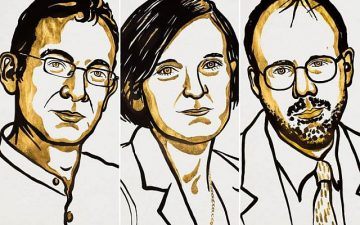 As a development economist I am celebrating, along with my co-professionals, the award of the Nobel Prize this year to three of our best development economists, Abhijit Banerjee, Esther Duflo and Michael Kremer. Even though the brilliance of these three economists has illuminated a whole range of subjects in our discipline, invariably, the write-ups in the media have referred to their great service to the cause of tackling global poverty, with their experimental approach, particularly the use of Randomized Control Trial (RCT).
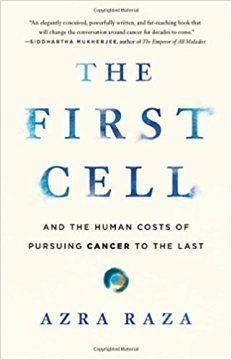 When I was a young attending surgeon on the faculty in the Division of Cardiothoracic Surgery, one of the things I got frequently called for was management of malignant pleural or pericardial effusions. Once a patient develops malignant pleural or pericardial effusion the median survival is only two months, so I would do things that would relieve the acute symptoms and perhaps try to prevent fluid from reaccumulating, but nothing drastic or major. One evening in late October, one of the nurses who had known me called to say that her father was being treated for lung cancer but had to be admitted with a large pleural effusion and that she and her father’s Oncologist would like me to manage it. I met the fine 72-year old retired banker, and while he was short of breath even as he talked, he was in a very upbeat mood. I decided to insert a chest tube to drain the pleural fluid and relieve his symptoms. As I was doing the procedure at the bedside the patient mentioned to me that his oncologist has assured him that once his fluid is out he will start him on a new regimen of chemotherapy and he should expect to live for a few more years. I was disturbed to hear the false hope he was being given.
 These energetic lines open Moon and Sun: Rumi’s Rubaiyat, Zara Houshmand’s brilliant translation of selected ruba’iyat – quatrains – by Molana Jalaluddin Rumi, and set the tone for an inspiring and exhilarating sojourn through the passions of the peerless Sage of Konya.