by Christopher Horner
If you want to deserve Hell, you need only stay in bed. The world is iniquity; if you accept it, you are an accomplice, if you change it you are an executioner. —Jean-Paul Sartre
We need to learn, or re-learn, how to build comradeship and solidarity instead of doing capital’s work for it by condemning and abusing each other. —Mark Fisher
Hell is other people —Jean Paul Sartre

Politics is difficult. Doing politics, that is. The boring meetings, the leafleting, the marching in the wind and rain (if you can leave your house), the arguments, the confrontations and the blank incomprehension, the ad hominem attacks and much more. But the largest problem by far is other people. Some are the unconvinced, some are the apathetic and then there are the hostile, those you are opposing. More problematic, though, can be those who are supposed to be on your side. They can be difficult to endure. How many of them would you want to meet if you had the choice? Too often, in my experience, it is only a few, as the sheer hard work of trying to arrive at something like a collective will wears everyone out and tries everyone’s patience. Not all politics is like that of course: there can be the sense of comradeship from working with others one wouldn’t otherwise get to know. The experience of making a difference and working for a meaningful goal can be a wonderful thing.
This is hard to sustain though, when we experience defeat and frustration. The bitter moment in which one realises that for now (for how long?) the other side has the day. This has been a recent and bitter experience for the UK Labour Party supporters of Jeremy Corbyn in 2019, and of the many in the USA who marched and canvassed for Bernie Sanders in 2020, only to see him him stopped in the primaries. And quite apart from one’s official enemies, there have been real battles within those parties. With failure comes the temptation to have done, to walk away, either into inaction or in order find another, and inevitably smaller, group of like-minded activists. This latter has been a reliable feature of left politics for as long as anyone can remember: an addiction to splitting. After all, if the others aren’t part of the solution, they must be part of the problem, right? Read more »


 Our society needs virologists. Heeding their advice is valuable and consequential. In the Coronavirus pandemic, German politicians listened to the virologists, and Germany is doing relatively well. Other political leaders have (too long) ignored the virologists, and their citizenry is paying a high price.



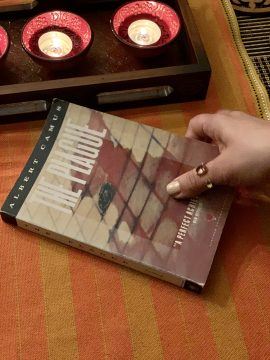
 In contrast with other genres in literature, in crime fiction, which mainly started in the mid-19th century, women writers (and even women sleuths) became active around the same time as male writers and sleuths in their stories. By some accounts around the middle of 1860’s, both the first modern detective novels (by female as well as male writers in US, UK and France) and the first professional female detectives in them (one Mrs. G— in one case, Mrs. Paschal in another, both working for the British police) appeared. Most of us, of course, are more familiar with characters in the Golden Age of crime fiction of the 1920’s and the 1930’s, particularly, Agatha Christie’s Miss Jane Marple and Dorothy Sayers’ Harriet Vane. The number of female writers and sleuths has proliferated in recent decades. It goes without saying that not all of the female crime novelists come out as feminists, and that some male writers can do feminist crime novels quite well.

 Sughra Raza. Untitled; Arnold Arboretum, Boston, March, 2020.
 The “Consequence Argument” is a powerful argument for the conclusion that, if determinism is true, then we have no control over what we do or will do. The argument is straightforward and simple (as given in the Stanford Encyclopedia of Philosophy):
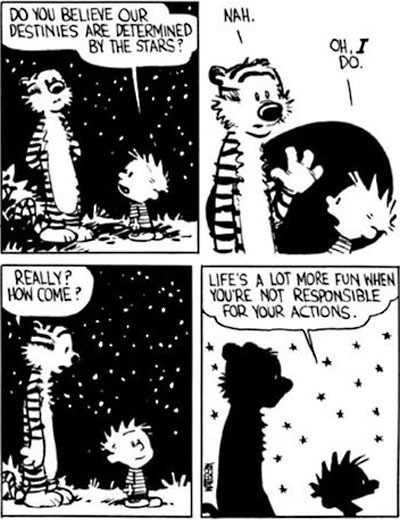 What can I make of these decisions emerging out of the blue, which I appear to act upon “freely?” What are the consequences of how I choose to react to them? Although these are vague philosophical musings, let’s look instead at the science of it all. I’m a layman, neither scientist nor philosopher, but as we are rediscovering, scientists are a less fuzzy lot than philosophers. I’m more likely to ask the woman with the medical degree about the true meaning of my dry cough than to ask philosopher

 For the same reason as large parts of the world, I spend even more time indoors these days than I already would. One thing I have been doing is rereading the Harry Potter books – or paying Stephen Fry to read them to me.