Reimagining Public Education

by Eric J. Weiner

In the wake of the pandemic, many people sense an opportunity to reimagine and rewrite public education so that it aligns with their particular political agendas. Progressives sense an opportunity to reassert the critical capacities of a democratic education. From the religious right, there is an attempt to blur the lines between secular and religious goals and needs. Neoliberals sense an opportunity to further privatize public education and align learning to the needs of capital. Democratic socialists sense an opportunity to recreate a system that can equitably distribute opportunity across race, class and gender. Technologists see the potential to create a techno-utopia of learning that is no longer constrained by terrestrial notions of time and space. Neoconservatives want to reclaim public education as the engine of white nationalism and free-market capitalism through the curricular standardization of “core” knowledge. What they all can agree on is the essential political nature of public education; it has always been a mirror that reflects the best and worst impulses of our nation. If you want to get a sense of a nation’s health, just look at its public education system. From the good and the bad to the downright ugly, our schools have always represented who we have been, who we are, and who we hope to be.

As the pandemic continues to rip back the curtain on economic and political inequality in the United States, it also has highlighted the nation’s failure to provide meaningful and equitable educational opportunities to all of our school-age children. With this in mind, I’ve provided a very brief and admittedly incomplete blueprint that might help at a foundational level guide all of those people–some more qualified than others–who are now sensing an opportunity to reimagine public education. Read more »
Liberty and Disunion

by Michael Liss

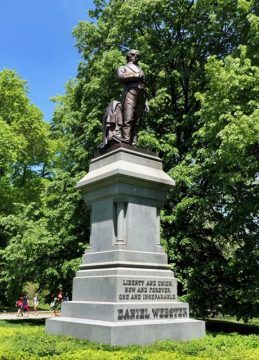
There is a statue of Daniel Webster in Central Park. It is tucked in at the intersection of West and Bethesda Drives, massive and unmoving, implacable and forbidding. Despite its size, it goes largely unnoticed, except as a meeting point.
Just a few hundred feet to the west of Webster is The Dakota, where John Lennon lived and died, and Strawberry Fields, a small memorial inside the Park dedicated to Lennon’s memory. In non-viral times, buses line up near The Dakota, and platoons of tourists pause there for pictures, then walk to Strawberry Fields, then across to Bethesda Fountain. If you happen to be jogging, they will wait until you pass, many with bemused looks at the strange beings who inhabit this odd corner of the universe. Occasionally, a guided tour will take brief note of Webster, but most move on. Such is fame. 

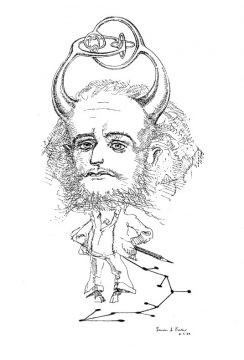
It wasn’t always this way. There was a time when Daniel Webster was seen as a giant, one of the foremost statesmen of the first half of the 19th Century. He, along with Kentucky’s Henry Clay and South Carolina’s John C. Calhoun, were known as the Great Triumvirate of the Senate. All three also served as Secretary of State; all three ached for the Presidency and never quite got there; all three were antagonists, rivals, and sometimes collaborators. Clay was the Great Compromiser. Of Calhoun, the historian Richard Hofstadter said he was “probably the last American statesman to do any primary political thinking.” Webster was an orator so esteemed that Stephen Vincent Benét had him besting the Devil himself.  

These qualities all came together in one of the most fascinating and consequential debates in our history, South Carolina’s drive for Nullification, and, eventually, its assertion that it had the right to leave the Union. William F. Freehling called it a “Prelude to Civil War” (in a book of the same title) and, in its issues and its sectional animosities, one can see why. It certainly had high drama—florid speeches, torchlight parades, marching and mass rallies, dueling, armed militias drilling, and the glowering presence of the biggest personality of all, Andrew Jackson. Read more »

Notes on the Academy During the Time of Covid

by Akim Reinhardt

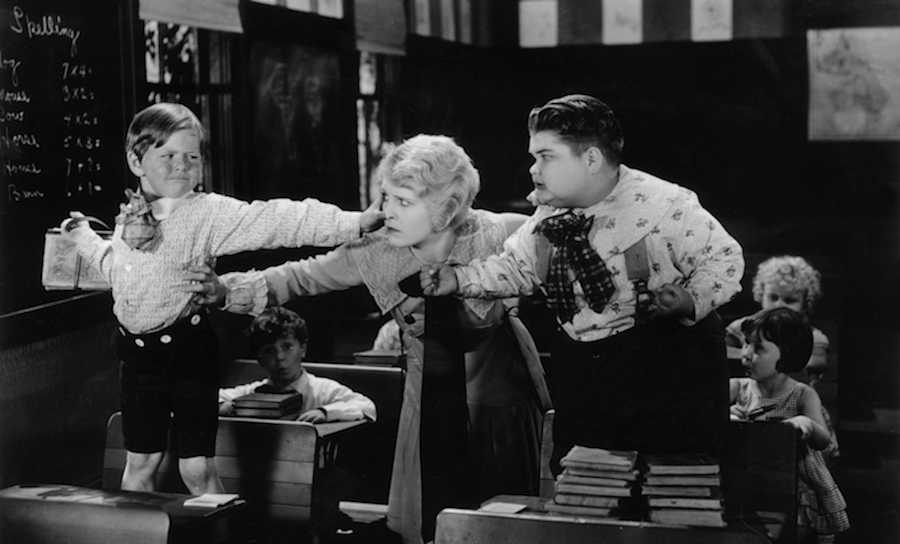
Miss Crabtree (June Marlowe), "Our Gang" | TV and Movie Teachers ...I’ve taught shittily these last two months. That’s nothing a teacher ever wants to admit and normally has no excuse for, but these are not normal times.
I work at a public university in Maryland. There are multiple layers of bureaucracy, not all of it always terribly efficient. Maryland is a border state, and a senior colleague once described these university administrative processes as Northern bureaucracy meets Southern efficiency.

So you just knew that figuring out what to do about coronavirus was going to take a while. In all, there were two false starts before the final reckoning.

First they told us school was closed for the three days leading into Spring Break, but we would be back after that. Then, shortly before we were to return from the break, they told us the first two weeks back would not actually be “back”; instead, we would be teaching online. Some time thereafter, the third and final edict came down: we would be online for the rest of the semester.

I had spent my Spring Break planning to adapt my three different courses for two weeks of online teaching. I dove into it, coming up with the best plan I could for a limited disruption. Then, with not much time to adapt, I had to extend that two weeks into seven and a half. What to do? Read more »

Visual Histories: Ranu Mukherjee

by Timothy Don

The current economic crisis is crushing artists, museums, and galleries everywhere. In the San Francisco Bay Area, where I live, an exorbitant rental market made maintaining a practice difficult before this crisis hit. It’s even harder now. With 3QD’s permission, I’m going to use this column to talk about the work of some of the artists and art professionals I have met in the Bay Area. I ask you to support artists wherever you find them and however you can.

“Breach”, from the “Extracted Trilogy,” by Ranu Mukherjee, 2015. Single-channel video, 4 minutes.

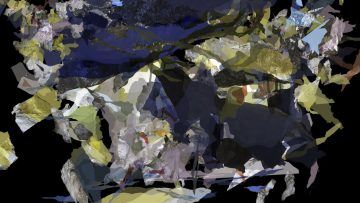
An explosion has occurred; a cave at the mouth of a prospecting site has been blown apart. Surfaces and shards of color and rock float in undefined space. Lonely, fragmented, incoherent, they seem to be searching for an order in which to gather, a language that would speak their place and purpose in creation. Guided by forces unseen, they look for hinges, sympathies, and affinities. Everything is present, yet nothing makes sense—until a coalescence transpires. Rhythm and energy emerge. With almost gravitational intention, shapes find their place, nestle together, and are transfigured, returning to themselves and becoming once more glowing rock, moving stream, dark cave. The entire experience transpires in a mere four minutes.

Astrophysicists tell us that at the moment of creation, when the universe gave birth to itself with explosive and ever-expanding energy, everything that exists now was present then in an infinitely dense point. A singularity. A black hole. A primordial cave. Breach, which records the image of a cave being blasted apart and then reassembling itself back into a cave, suggests that the universe is best imagined as a kind of cosmic cavern. The universe gave birth to itself from a cave, and as it cools and condenses, it becomes a cave. Read more »

The injured bird – Conversations with a member of Wittgenstein’s ‘Swansea School’

by John Hartley

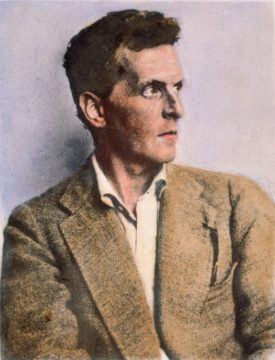
Ludwig Wittgenstein

One wet January I happened to attend a meeting of the Newman Association – a Catholic group concerned with ecumenism. Long tailbacks on the motorway meant the guest speaker, making his way from Birmingham, was delayed. When Archbishop Bernard finally appeared an hour later, I was deep in conversation with my neighbour, a slightly built octogenarian with dishevelled white hair and a brown blazer.

David Ieuan Lloyd, I learnt, had studied and taught alongside Rush Rhees, Peter Winch and R F Holland, Howard Mounce and D Z Phillips, Dick Beardsmore and David Cockburn, in what was known as the ‘Swansea school’. The Philosophy department of Swansea University first cropped up on my radar some years earlier, when İlham Dilman’s treatise on Free Will singlehandedly side-tracked my undergraduate dissertation!

“Yes, I knew İlham well,” Ieuan reflected.

“What’s the big deal with Wittgenstein,” I finally asked, “It just seems like a load of nonsense!”

Ieuan gave a wry smile and what followed led to a series of semi-regular coffee shop conversations. Our inaugural meeting was a Pandora’s Box of maxims, rabbit holes and tangents, of which Ieuan later reflected “I hope the time today was of some use. I wondered when walking back that I stayed too long on the scepticism matter. More positively, would it be an idea when we next meet that you write a short menu on what you would like to discuss.”

Over the course of eighteen months I came to understand something of the ‘Swansea School’, from the many second-hand stories of someone who lived and breathed it, long after its cessation. Ieuan once recalled a story Rush Rhees had told. Read more »

Po Mo No Go

by Denis Robinson

Some philosophers I know seem to be engaging in a “this is what I work on in no long words” meme game. I’m retired and I don’t think I could have done it anyway. But in 2005 there was a wee game of that ilk, in which the aim was just to write some philosophy in words of one syllable. I wrote some thoughts I had had: short words but a long piece. I’ve taken this opportunity to make a couple of improvements I’ve long thought of. Here is the whole thing:

Some say it’s all just text and what it means must be as may be, no neat or sharp thoughts or claims which mean just what they say, no grand tales we can know to be true, just a mix of words which shift as we look at them or speak them or hear them some way or not, say “yes” or “no” to them, or play our word games with them just as we play our life games, fight our word wars with them as we fight our life wars, and so on and on and all this and that. If it takes text to say what text means, and then yet more text to say what that text means, and so on, how can it end but in text? At least in France.

But I say this. You can think of words as like tools.

So let’s think of tools for a bit. Stone age folks had a few rough tools, which would do a few rough jobs – split a rock, or a tree, or a skull, crush a nut, spear or skin a fish or a deer, store an egg or some seeds, light a fire, but all no more than fair for what few things they had to do. You might think a lot of rough tools could just make more rough tools at best. Not so. We now have lots of good fine sharp tools, which cut and draw and rule straight and true, we can make a neat screw bolt with a nut to fit tight on it, we can weigh a small wee bit of an ounce or a gram, we can build a plane or a ship or a great big house or mall or hall or bridge, we can see things much too small for the eye to see on its own, we can make small hard drives which store gigs and gigs of stuff, we can surf the net and phone some place on the far side of the world while still on line. We have tools which each do their own jobs well, just as we wish them to, more or less, and each new lot of tools lets us make the next lot yet more fine and use them for yet more things.

I say, so it went with words. It may be that once we had just rough blunt words as tools to speak our speech and think our thoughts. It may be that back then our thoughts, or at least our words and what they meant, were vague, not clear, a mix, like things seen in dreams. Our words would not add all that much to our ways of life, just help us share a bit, work a bit, play a bit, each with each, but all vague, each like a broad dim patch, not a bright spot or dot in the great field of things we might think or mean. But just as you can start with blunt tools and make tools that are sharp, you can start with dim thoughts and make thoughts that are clear, start with vague words and make words that mean things sharp and true, words that do well to state just what you mean and such that each one who knows those words knows what you mean when you say them. Read more »

On the Road: Field Notes from the Wreckage of Tourism

by Bill Murray

News from the leisure travel world is worse than grim. More than half of the 16 million travel industry jobs in the United States have been lost. On 14 April last year the TSA processed 2,208,688 air travelers. This year that number was 87,534. 

It’s the same everywhere. Da Nang saw a 98.5 percent year on year drop in visitors over Vietnam’s four day Reunification Day holiday. Ninety nine point nine percent fewer foreign visitors entered Japan in April than a year earlier. Planes are parked and ships are docked.

They outfit the American cruise ship industry in a low key shipbuilding town on the Bay of Bothnia in Finland. Turku shipyards built the world’s biggest floating petri dishes, the 360 meter long ships Oasis of the Seas and Allure of the Seas, for Royal Caribbean International.

Seventy seven thousand employees, Royal Caribbean had, until a virus as unfriendly to people as plastic to the sea torpedoed its heart, soul and balance sheet in three months flat. Maybe Turku can save its shipyard jobs by building hospital ships; Royal Caribbean may tread choppy water forevermore. Read more »

When the Real World turns Virtual…the new reality of office life?

by Sarah Firisen

Two months ago, COVID lockdown was still new; in the US it was horrific that 3,000 people had died and  I wrote about some possible longer-term technology innovation that might come out of  this crisis.  Fast forward to today and the US has just passed an unimaginable, grim milestone, 100,000 dead. And while states are starting to emerge, some slowly, some too quickly, from the most extreme aspects of the lockdown, it’s becoming very clear that some things may be changed permanently, or at least for a very long time to come. 
Back in March, I wrote about the resistance to telecommuting that I used to face from bosses and colleagues who questioned what I was really doing if I wasn’t sitting in the same space as them all day. One of the answers I’ve given over the years is that unless you’re sitting next to me all day long and looking over my shoulder at my computer, you don’t know what I’m doing most of the time anyway. Instead, you should judge me on my output.  Famously Marissa Mayer, on taking over Yahoo, banned telecommuting, “Speed and quality are often sacrificed when we work from home,” the company’s human resources director told employees.” But the truth is, we all know how much time can get frittered away in offices with water cooler chatter and coffee break flirtations, endless seemingly pointless meetings and “quick” breaks to pop out and buy something.

Two months ago, though it seems like so much longer, I said, “we’ve all been thrust into a great social experiment to see just how productive, perhaps more rather than less even, the entire workforce will be working remotely.” Well, it’s Memorial Day weekend and the verdict is in: turns out, we’re all pretty productive, even more so than we were before in fact. We’re using the time that we used to spend showering and commuting to sit down with a cup of coffee and start responding to emails at 7 am. Even with the distractions of home schooling and sharing our spaces with partners and pets, it turns out that most people don’t need even the illusion of managerial constant monitoring of their physical selves to get them to do their jobs. And a lot of companies have taken note. More than that, they’ve realized just how much money they’ve saved as they’ve stopped paying for WeWork space, dropped pricey office leases and T&E has basically plummeted to almost nothing as we’ve all realized that we didn’t need to fly across the country for that one hour client meeting after all and instead could have conducted it on Zoom all along. Corporate America’s conclusion: if we can all be just as productive, maybe more so, sitting on our sofas AND they can save millions in expenditure, then let’s just keep doing this. Read more »

In His Malady’s Service 

by Maniza Naqvi 

Today will mark the death of at least one hundred thousand Americans because of COVID. The science was clear. Lockdown. Stop movement. Distance. This would have stopped large numbers of people dying. In short, stopping the virus from becoming a pandemic meant pausing the profit principle.


The pandemic has laid bare the cruel and clear fact that pausing for people is not possible for capitalism. If the accumulation of capital is the primary principle, then humans in comparison to this hegemon are only inputs for its expansion and its accumulation—humans are interchangeable and dispensable while the hegemon of capitalism is supreme. And all else are in the service of ‘his’ malady.

Those who should have acted and acted fast and done everything they could, did not.  Even though they knew what the science was saying early on. All of them. Their Intelligence services were surely telling them what was going on in China? Or were they only focused on maximizing the sales of weapons?  A war on Iran?  If the Intelligence Services knew then why did lockdowns not happen earlier? Read more »

A Fantasia on Irises

by Bill Benzon

When I was a child I sought out the first blossoms of spring. The forsythia bushes were first. Then tulips perhaps? I don’t really remember. I’m guessing, though the guess is not groundless. Daffodils, yes daffodils, yellow and white.

But I DO remember the irises. Not vividly, for it was a long time ago and, as I sit here running through memories while typing these lines, none of them are vivid. But distinct. I even remember bowing down to see them more clearly. This memory is kinesthetic.

David Anstiss, 2015, CCA BY-SA 4.0

And I remember my mother kneeling in front of the flower bed. Brown slacks. Heavy gloves. She was breaking up the ground and weeding the bed. Her flowers.

She loved the irises. At least I think she did. I know I did. Why? They were tall flowers, the tallest in the bed. Was that it? Perhaps, in part, height brought the blossoms closer to the yes. Was it the color? They were colorful. It was only much later that I would learn how many different colors and colorways found homes on irises. These irises were what I have come to think of as “canonical” or “standard” irises – light blue, deep purple, white, flecks of yellow on the beards.

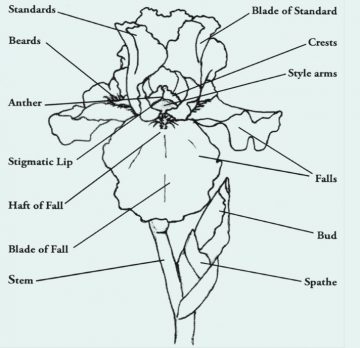
Yes, that’s what they’re called,  at least colloquially, those fuzzy yellow things radiating from the center – beards. The more or less vertical petals are called standards; the droopy ones are called falls. And that complicated stuff in the center – anther, crests, stigmatic lips (stigmatic!?). It’s all so complicated. Read more »

Jon Hassell tribute, part 1: Jon and his collaborators

by Dave Maier

Jon Hassell is one of America’s musical treasures, and I’ve been listening to his music for forty years, so when I heard he needed help for his medical care, I decided to make a mix of his music. This mix actually grew into two mixes, so look for another one next month. This one features Jon playing with other musicians, and part two will feature other musicians whom Jon has influenced (and a bit more from Jon himself).

Here’s the link to his gofundme page (https://www.gofundme.com/f/jon-hassell-fund). As of 5/24/20, 1100+ people have donated ~$75,000, but the listed goal is $200,000, and we all know how expensive medical care can be. Please do what you can.

Here’s the mix (direct link: https://www.mixcloud.com/duckrabbit/jon-hassell-tribute-pt-1-jon-and-his-collaborators/):

Read more »

Monday, May 18, 2020

On War and Sports Metaphors for Argument

by Scott F. Aikin and Robert B. Talisse

The vocabularies of sports and war feel natural for describing arguments and their performances. From battle, we describe arguments as swords, as they may have a thrust, may cut both ways, and may be parried. A case, further, can be a full-frontal assault, and we may rush once more unto the breach. There are defensive positions and rear-guard actions. One’s best arguments are one’s heavy artillery, and one may lay siege to viewpoints. And one may, on the sports model, score points or score own goals with successful or unsuccessful arguments, respectively. One may play soft- or hardball. Powerful arguments are slam dunks or home runs, and good rebuttals are counterattacks. Or one may change the subject with a punt. There’s no doubt that our vocabulary for describing what happens when we argue is thick with this metaphorical idiom. The question is whether it is a good thing or not – does the vocabulary of adversarial contest distort our relationship with argument? We hold it need not, but there are some concerns that must be addressed.

The first concern is that sport and war metaphors are misplaced because they presuppose (and seem to endorse) hostility between arguers, and this hostility has objectionable consequences. One’s objective in a game and in a war is to win, to defeat the adversary. As the saying goes, all is fair in love and war, so (leaving love aside) when we turn to the context of argumentation, the metaphors make it difficult to see what would be wrong with using all available means to win in argument. However, unlike in a war, successful argument depends upon arguers following the rules. Further, when one loses an argument, one nevertheless learns something about one’s views. And one may change one’s mind for the better. Losing an argument can be beneficial to the loser. The war and sport metaphors, so the objection goes, fail to recognize this complex of features of argument; for that reason, they are inapt. Read more »

On the Passing of John Conway

by Jonathan Kujawa

According to Johns Hopkins University, as of this writing, 315,023 people worldwide have died from Covid-19. One of those 315,023 was the incomparable John H. Conway.

John Conway

At the age of 82 and with health issues, Conway was well within what the CDC euphemistically describes as “people who are at higher risk”. It was perhaps not unexpected that someday soon he would no longer be with us, but it was a shock to the mathematical world, nonetheless. Conway’s mathematical powers, irreverent style, and forceful personality made him a well-known and seemingly permanent feature of the mathematical community for more than sixty years.

When I was a graduate student twenty or so years ago, John Conway came to my university to give a series of lectures. Like many math departments, we had an endowed fund to bring in eminent visitors who were well regarded as both researchers and speakers. In our case, the standard format was for two talks: one for undergraduates and one for the faculty. In truth, this more often ended up being one for graduate students and faculty, and one for specialists. Not surprisingly, many mathematicians aren’t the greatest at making their talks accessible.

As the OG mathemagician, Conway had no trouble being accessible, interesting, and entertaining. That said, I must confess that I have only the dimmest recollection of the talks themselves. But I do remember the talks for a quintessentially Conway reason.

At the time the department had an honorary T-shirt which was given to speakers as part of the introductory activities. Nearly every speaker made the same joke. Without fail they would chuckle and ask if they were to put the T-shirt on immediately. We would politely laugh as if we hadn’t heard the same joke told by the previous week’s speaker.

Conway being Conway, he skipped right to the punchline and beyond. Conway stripped off his shirt, strode barechested across the stage in front the entire math department, pulled the T-shirt on, and dove straight into the beginning of his first lecture. Read more »

How to Avoid Paradoxes While Traveling Thru Time

by Tim Sommers

Stuck inside? Unable to travel? Have you considered traveling through time instead of space? Time travel is impossible, you say? Wrong. We are, each and every one of us, time travelers, traveling forward second by second, hour by hour, day by day into the future.

Why not consider traveling in the other direction? If you are afraid of traveling to the past because you fear paradoxes – killing your own grandfather, stepping on a butterfly while fleeing from a dinosaur, etc. – I have great news for you. My new theory of time travel will allow you to travel into the past without creating any paradoxes – guaranteed! (Time machine not included.)

Let’s not go straight to the big payoff. Let’s work our way up to it. Hannibal Buress has pointed out that when people go through something rough in life, they sometimes say, “I’m taking it one day at a time.” Hannibal says, “Yeah. So is everybody. That’s not a philosophy. That’s how time works. If there’s a way to go faster, let me know?”

I am here to help. You can move through time more quickly than your friends and family (that is, travel to the future faster than they do). Here’s how. Either go very fast or stand close to something really massive.

You might say, Tim, I know that it follows from Einstein’s general theory of relativity that there is no universal “now”, that simultaneity is an illusion, and that we all travel through time at different rates depending on our speed and proximity to extremely massive objects, but do you have any empirical evidence that this actually, really happens in the real world?

I’m glad you asked. Read more »

Sighs and whispers

by Brooks Riley

Something has happened in the last forty days. The planet has gone quiet, a vast, reverberating, gesticulating global chorus suddenly muted by something wee and invisible which is borne across continents, streets and rooms by friends and strangers. Mass extinction, once the whispered woe of a distant future, suddenly sounds louder and doable in the here and now. The world is compelled to gaze at its own mortality.

When the coronavirus forced us to retreat from daily life, the blanket of silence that fell was like the muffled air after a fresh snowfall—eerie, familiar, cozy even, and not entirely unwelcome. We are not the only beneficiaries of the newfound hush. Birds who have had to compete with our noise to sing to mates are suddenly alone on stage, ready for their seldom solos.

As a species, we are a noisy bunch, our decibels swelling with our need to grab attention where only the most aggressive bring home the prizes. We attach ourselves to machines that make even more noise than we do—cars, buses, trucks, trains, airplanes, bulldozers, amplifiers. And we fill the spaces in between with idle chatter, raised voices, music turned up high, leaf blowers, and hair dryers. Most are idle now, even cries behind closed doors are muffled. The soundtracks of our lives have moved into the adagio phase—softer, interim, slower. Read more »