
by Jerry Cayford
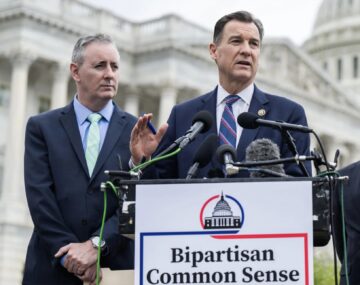
I was going to take a break from the topic of redistricting, which has been my main focus for 2026. But then big news happened: the House Problem Solvers Caucus announced on July 1 that they have established a gerrymandering reform framework and a working group to develop legislation to end gerrymandering permanently. They explicitly list “algorithmic mapping”—what I advocate—among the reforms they would support. The Problem Solvers are a militantly bipartisan caucus, which is an important advantage for them in the election reform struggles, which I will get to below. Since not everyone may understand why this announcement is big news, I decided that a summary of the overall redistricting project would be useful: its landscape, parts, and players.
My desired endpoint in this project is national legislation mandating a single algorithm that determines all district boundaries for federal offices. (Why this is the right goal is the subject of my earlier article “Resist, Adapt, Redistrict.”) Many different groups will have to collaborate to reach that desired point. Politicians propose and pass legislation. Their staffs need academics and technical experts to produce plausible algorithms and a consensus as to which one is best. Advocacy groups mobilize support among the public and politicians. Lawyers and legal scholars refine legislation to minimize the court challenges that inevitably arise. Some of these groups will not be able to perform their functions without funding from philanthropic organizations supportive of the end goal. All of these actors influence each other; each category contains factions within it that have competing ideas; and the algorithmic redistricting that I propose is a relatively new concept to all of them.
That is a rough sketch of the terrain. Add in some dynamic factors—the gerrymander war; Supreme Court hostility to racial districting; the increased power of big data computing to game the electoral system—and you can see the forces and the resources that this project for algorithmic redistricting has to manage to end gerrymandering.
Politicians
Most people already understand why ending gerrymandering matters, but the point deserves emphasis because most people, if anything, underestimate its significance. The Problem Solvers’ press release fills in some important details. The release lists many of the costs of gerrymandering, repeatedly emphasizing democracy’s requirement that “voters can choose their representatives as opposed to politicians choosing their voters”: the voters’ power to elect someone different is what crucially forces government to serve the public interest. The Problem Solvers are heading in the right direction, not only with algorithmic mapping but also in their general spirit “to take politics out of redistricting” (as caucus co-chair Tom Suozzi puts it). They’re heading in the direction of my goal to take all discretion entirely out of redistricting.
This gerrymander war has brought new political attention to redistricting, previously a sleepy, back-burner issue. More important than anything the Problem Solvers say is the fact that they are speaking to this issue at all. Their fifty members (25 Democrats and 25 Republicans) are new players on an issue that only engaged a dozen or two members of Congress until now. And more attention is coming. The Congressional Black Caucus (CBC) is unavoidably engaging with redistricting reform. The Supreme Court’s Callais decision in June ended the use of redistricting to create majority-minority districts, and the CBC is threatened with a quarter of their sixty members being gerrymandered out of their seats by 2029, perhaps more if the Democrats maximally gerrymander, too. The CBC hasn’t settled on a plan to move forward, but creating compact districts by algorithm should be appealing: ironically, a consequence of our history of racist redlining is that minorities live in relatively compact neighborhoods that would likely get more representation under algorithmic redistricting than under other race-neutral methods.
The Congressional Progressive Caucus (CPC) is a third important caucus (almost a hundred members) that may soon engage more with redistricting. The CPC currently supports the redistricting policy that I reject: citizens commissions. But that support has been simply for the only reform on the table—until now—and the gerrymander war has effectively taken citizens commissions off the table (the refusal of many to admit it notwithstanding). For the part of the redistricting project that requires engagement from political actors, then, the goal is to get these three major caucuses all supporting fully algorithmic redistricting. The Problem Solvers, though, bring an all-important bipartisan character, and their framework for legislation is an excellent start.
Scholars
The biggest missing piece in the redistricting project is a specific, fully-defined algorithm that enjoys consensus support among technical experts. The barrier to achieving that consensus is emphatically not technical complexity, or even political controversy. A viable algorithm can be extremely simple. (The shortest-splitline algorithm is my proof of concept: it uses only elementary-school arithmetic and straight lines to divide any geographic area into equal-population districts.) The technical history, however, has been fragmented. Mathematicians have looked at voting methods for centuries, but redistricting has become interesting mostly in the computer age, and more to computer scientists and statisticians than to mathematicians. At the same time, the main attention on redistricting has been from activists trying to define and outlaw specifically partisan redistricting. As a consequence of both these histories, the technical literature has been dominated by the complex and thorny problems of assessing districts by ill-defined political criteria—Are they fair, competitive, representative? Could they be more so? Generating districts has been somewhat neglected.
The goal of the algorithmic redistricting project, in contrast, is the one Congressman Suozzi articulated: “to take politics out of redistricting.” Perhaps I advocate a more thorough elimination of political discretion than the Problem Solvers have yet embraced, but whatever political decisions are necessary, those decisions should all be made in the writing of the legislation: thereafter, implementation should be so mechanical that any watchdog, any think tank, any university, any individual could read the law, apply it to a state’s census data, and they would all get exactly the same district maps.
Once the political criteria are eliminated, little technical difficulty remains. But before politicians will accept an algorithm for inclusion in legislation, they need confidence that the technical community is in relatively wide agreement on that algorithm. Reaching this agreement is the step that needs doing next. I have been advocating for the balanced power diagrams method of computer scientists Cohen-Addad, Klein, and Young, but it is not the only possibility. There has not yet been much in the way of discussion or research with this goal of producing an apolitical, one-and-done redistricting algorithm, and discussion and research are required to achieve consensus. Perhaps the philanthropic organizations would like to fund a conference.
Activists
Taking politics out of redistricting takes the controversy out, enabling a legislative solution. Most people see that as a good thing, but it is not in everyone’s interest. This brings us to the advocacy groups. As important as gerrymandering is, it is not the only problem with our electoral system, and advocacy groups have multiple goals to fix multiple problems. FairVote, in particular, the leading electoral reform organization, advocates for proportional representation (achieved via multi-member districts employing ranked choice voting), which would solve multiple problems with our democracy, including gerrymandering. The trouble is that proportional representation very much does not “take politics out.” It is a recognizably liberal goal.
This is not to say that proportional representation (PR) is a partisan goal. It is not, and it does not favor Democrats. Still, it is not ideologically neutral, either. The idea that voters both will and should vote for their own identity groups, and that the distribution of representatives in Congress should reflect such groups’ distribution in society, is a liberal idea. A conservative view would say that representatives can and should be equally responsive to the interests and cultural identities of all their constituents. It is unseemly, on this conservative view, for voters to vote for anyone but the most capable candidate. The underlying dispute is similar to disputes over ethnic assimilation or “English only.” I am not saying that the two sides are equally valid, only that there is a culture war dispute here, and PR falls on one side of it. Where the strategy of the algorithmic redistricting project is to defuse and resolve the gerrymander war with a non-ideological districting method—the sort of strategy that is the Problem Solvers’ stock in trade—proportional representation requires not settling the dispute but winning it.
Several pieces of evidence suggest that at least some PR advocates are not interested in actually solving the problem of gerrymandering. Since eliminating gerrymanders in no way obstructs or detracts from proportional representation, PR supporters should welcome redistricting reform as a step that proves the status quo is neither sacred nor invincible. (I argue for a sequential rather than comprehensive approach in “How Reform Fails.”) Some activists, though, are actively discouraging partial steps, in articles such as “Why Nonpartisan Redistricting Is Not Enough.” Now, obviously, ending gerrymanders will not solve all of America’s electoral problems (and no one thinks it will). But the author uses that fact to attack “neutral algorithms” and push PR instead. It seems that fixing one high-profile problem via algorithmic redistricting is undesirable because it threatens to reduce the political pressure for more comprehensive reform.
In other articles, non sequiturs in the logic reveal a culture war agenda by arguing for delay in “ending partisan gerrymandering through federal legislation, which is almost certainly impossible before 2029.” The sensible inference from the gerrymander war is exactly the opposite: it has created widespread recognition that state-by-state reform won’t work and only federal legislation will, making now the ideal time to push a federal solution. This odd gap in their logic betrays PR supporters’ tacit acceptance that only Democratic control of the government would make their liberal reform possible. The truly neutral reform of algorithmic redistricting, though, does not require waiting for partisan change that might arrive in 2029.
FairVote and other advocates for proportional representation may come around, for reasons similar to those that could bring the Congressional Black Caucus on board: algorithmic redistricting may not be the solution they wanted and worked for, and it won’t perfect our union, but it would hugely improve American democracy. The status quo, on the other hand, is rapidly decaying and will continue spiraling downward with a new round of gerrymanders before 2028. The pressure to fix this one problem is growing, and a stand-alone, nonpartisan, effective solution that enfranchises voters across the spectrum will be hard to resist. The bipartisan House Problem Solvers Caucus is the right leader for this effort. With a little more clarity on which algorithm can garner a consensus, the various elements may align with them across the political landscape. The next two years, before extreme gerrymandering locks us into culture war hell, will be crucial.