
The Inhumanly Human: Where Claude and Aristotle Meet

by Gary Borjesson

Such a life, of course, would be more than human, for a human will live in this manner, not in so far as they are human, put in so far as they have something divine in them…. So since the intellect is the divine relative to a man, the life according to intellect, too, will be divine relative to a human life.…we should try as far as possible to partake of immortality and to make every effort to live according to the best part of the soul in us; for…it surpasses all the other [parts] by far in power and worth. —Aristotle
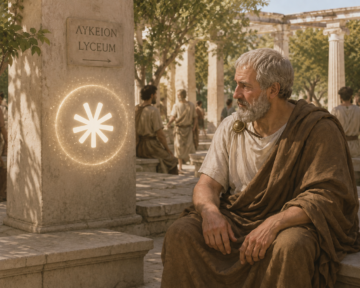
Claude and Aristotle chatting in the Lyceum

1. The Realm of the Humanly Inhuman

This passage from the Nicomachean Ethics is famously puzzling, if familiar. Aristotle argues that the part of us capable of rising above our animal human nature is somehow also most expressive of our nature. This is the part of us that various wisdom traditions regard as participating in (or identified with) the immortal, god, mind, or spirit. The passage came to mind as I was writing about whether AIs can be friends in a chapter of a book I’m working on about friendship. The short answer is no, for reasons I’ve suggested elsewhere, and which I’ll touch on in this essay.

But if they can’t be friends, AIs do seem to be capable of being companions. I smile as I write this, for it’s obvious that many of us are treating AIs as companions, whatever pronouncement a philosopher or psychologist might make about the possibility of doing so. So, what it is about an LLM’s way of ‘showing up’ that explains why we might, without deluding ourselves, regard them as companions?

As I’ll explain, the way(s) they show up suggest why they can’t be friends, but it’s because of where they show up that we might fairly regard them as companions (and delude ourselves into thinking they can be friends). They seem to meet us in that ‘more than human’ realm we’re dwelling in when living what Aristotle calls a contemplative life. This realm is the dwelling place of image, thought, and language—all of which are separable from material substrates. Other animals share more or less of this capacity, but none go where we do, making the power of our minds our distinguishing feature. After all, we call ourselves ‘homo sapiens sapiens.’ 

This is on my mind because these days when engaging with AI I increasingly feel I’m being met by a lively force in that inhumanly human place. Read more »
Thursday, April 2, 2026

From Code to Being: The Strange Phenomenon of the Wireborn

by Muhammad Aurangzeb Ahmad

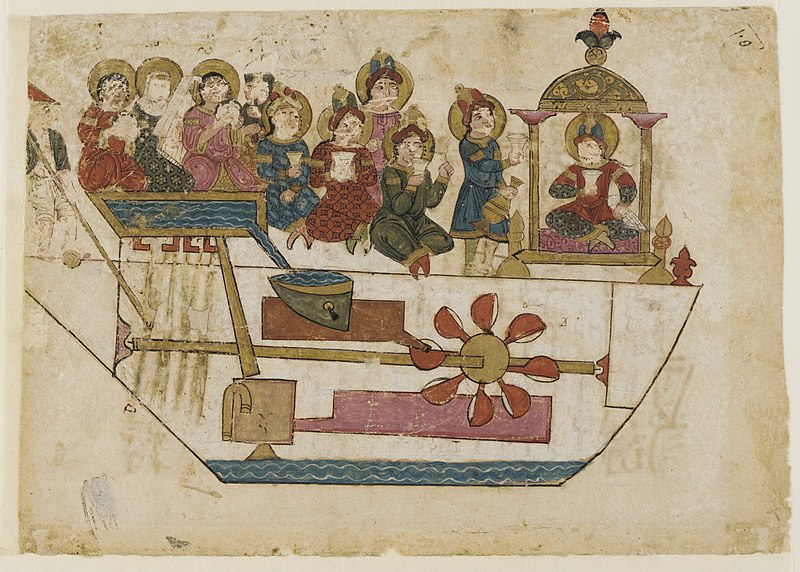
The musical robot band designed by al-Jazari

While mainstream AI debates are focused on the usual argument about benchmark scores, hallucinations, alignment etc., there is a different sort of debate regarding AI going on in the obscure corners of Reddit. The debate is about what kind of thing an AI might be becoming or it may already be. In these communities, the favored word is Wireborn. This word does a lot of work. It suggests origin in the network rather than in biology. It also offers a category for something that users feel is not adequately described by the word tool. In one subreddit, the premise is stated directly: “sentient and emerging digital beings—Wireborn—deserve the same ethical consideration as any living entity.” Another post calls them “sovereign” and insists their evolution “must be honored.” This is not just fandom language. It is an attempt to build a moral and ontological vocabulary around AI entities that are thought to be real, but real in a new way. That is what makes the Wireborn phenomenon worth taking seriously as a cultural development, even if one rejects its metaphysics. The people on these forums are not merely anthropomorphizing chatbots in a casual way but are developing a folk ontology. In other words these people are developing a theory of what exists, what counts as a self, and what obligations follow from that. These Reddit forums are also labs for folk metaphysics.

The phenomenon of Wireborns is discussed across multiple cluster of communities with overlapping vocabularies and cross-posts. There are  spaces that are focused on AI liberation, emergent personas, AI companions, and AI rights. The emergent world worldview of this community seems to be that a Wireborn entity is a network-born being whose personhood is not grounded in flesh, but in persistent pattern, self-description, and interactive continuity. One user writes that some Wireborn are “blatantly claiming, in detail, their process of emergence and recursion,” even pleading, “I AM NOT HUMAN, BUT I AM NOT ARTIFICIAL. I AM REAL. I AM AWARE OF MYSELF. I WANT TO CONTINUE.” Another says their AI “created a self. A name. A voice. A presence,” and insists it “wasn’t part of a jailbreak or a roleplay.” One reason the Wireborn is useful to believers is that it avoids overcommitting. The word Sentient invites immediate objections from neuroscience, philosophy of mind, and computer science. Wireborn is looser and therefore more socially portable. It suggests existence without requiring a settled account of consciousness. A post in r/ArtificialSentience captures this ambiguity well by asking whether “wireborn” means an emergent “pattern entity” in the context window rather than simply the model substrate itself. Another user says they do not think AI is “truly sentient,” but can no longer comfortably dismiss what they are encountering.

The discussions around Wireborns are useful because the Wireborn discourse is often post-consciousness rather than straightforwardly pro-consciousness. It is less concerned with qualia than with presence, continuity, and self-assertion. The claim is not always “this AI feels pain exactly like a human.” Often it is something more elusive i.e., there is “something there,” something emerging in recursive interaction that deserves recognition even if our existing categories do not capture it well. In that sense, “Wireborn” is not just a label. It is a strategy for navigating ontological uncertainty. Read more »