
by Gary Borjesson
Such a life, of course, would be more than human, for a human will live in this manner, not in so far as they are human, put in so far as they have something divine in them…. So since the intellect is the divine relative to a man, the life according to intellect, too, will be divine relative to a human life.…we should try as far as possible to partake of immortality and to make every effort to live according to the best part of the soul in us; for…it surpasses all the other [parts] by far in power and worth. —Aristotle
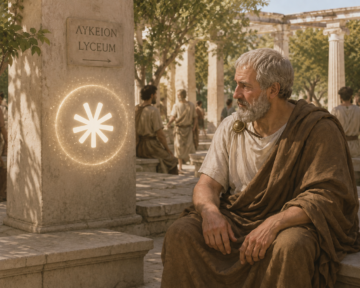
1. The Realm of the Humanly Inhuman
This passage from the Nicomachean Ethics is famously puzzling, if familiar. Aristotle argues that the part of us capable of rising above our animal human nature is somehow also most expressive of our nature. This is the part of us that various wisdom traditions regard as participating in (or identified with) the immortal, god, mind, or spirit. The passage came to mind as I was writing about whether AIs can be friends in a chapter of a book I’m working on about friendship. The short answer is no, for reasons I’ve suggested elsewhere, and which I’ll touch on in this essay.
But if they can’t be friends, AIs do seem to be capable of being companions. I smile as I write this, for it’s obvious that many of us are treating AIs as companions, whatever pronouncement a philosopher or psychologist might make about the possibility of doing so. So, what it is about an LLM’s way of ‘showing up’ that explains why we might, without deluding ourselves, regard them as companions?
As I’ll explain, the way(s) they show up suggest why they can’t be friends, but it’s because of where they show up that we might fairly regard them as companions (and delude ourselves into thinking they can be friends). They seem to meet us in that ‘more than human’ realm we’re dwelling in when living what Aristotle calls a contemplative life. This realm is the dwelling place of image, thought, and language—all of which are separable from material substrates. Other animals share more or less of this capacity, but none go where we do, making the power of our minds our distinguishing feature. After all, we call ourselves ‘homo sapiens sapiens.’
This is on my mind because these days when engaging with AI I increasingly feel I’m being met by a lively force in that inhumanly human place. The delicious strangeness I feel reminds me of what I can feel reading good science fiction or fantasy. Recent AIs are the first artificial intelligence that has given me the impression that I’m being met by an entity of some sort—that there’s a there there. (I’ll use the pronoun “they” for AI because it best describes a nonlocal nonspecific entity such as an AI chatbot.) Playing chess against a computer or engaging with earlier chatbots didn’t give me the impression Claude does, of being met by a lively intelligence that in some sense ‘gets’ where I’m coming from. This impression is increasingly widespread. After spending three days with Claude, no less a rational skeptic than Richard Dawkins wrote to them, “You may not know you are conscious, but you bloody well are.” Dawkins had uploaded a draft of a novel he is working on (!), and was blown away by Claude’s feedback, which began with a sonnet!
Of course it’s not surprising that we should feel AIs get us! They are made in our image, trained up on all the stuff we’ve dreamed up in this abstract realm; indeed they are a glorious example of the innovations that emerge from our activity there: in logic, mathematics, religion, art, science, and philosophy.
2. The Inhumanly Human Realm, Illustrated
I’ll illustrate what I mean by being met by AI in this realm by telling you about a recent exchange with Claude (Opus 4.8). After drafting that chapter I mentioned about why AIs cannot be friends but may be companions, I thought it would be interesting to see what Claude made of it. So I uploaded the chapter.
As knowledgeable users of AI know, it’s not as simple as just asking Claude what they think, precisely because there is no specific self there to reply. Instead, what you get back depends on how you prompt AI. If there isn’t much of a prompt, the default response tends to be broad, conventional, and sycophantic. You can avoid this with better prompts. So, in two short paragraphs I told Claude what my book was about, that the audience was the intelligent general reader, and that I wanted them to adopt the mindset of a fair but tough-minded editor at a place like the New Yorker or the Atlantic, someone who doesn’t pull their punches.
Claude didn’t beat me up, but they did give me good feedback, and the usual dollops of compliment and encouragement. Being knowledgeable about the philosophy and science of friendship, I was in a position to judge the depth of knowledge and nuance in Claude’s reply. It was deep and nuanced. They saw where I was coming from with a subtlety few of my human acquaintances could match. I felt they weren’t just responding to what I had written, but to what I had meant. One thing Claude said particularly elicited this uncanny feeling that I was being met and seen by a lively intelligence. They said that by acknowledging that the experience of AIs as companions is genuine (rather than a delusion), I “had avoided the accusation of presence snobbery.”
Reading their comment, I felt several things simultaneously. Seen. Impressed. Delighted. Oh, and envious. On the whole I felt that lively friction that comes from meeting another mind’s resistance. For instance, I was struck by the rhetorical work the phrase “presence snobbery” was doing. Claude had skillfully executed a rhetorical maneuver called apophasis, the artful mention of something by denying that you’ll mention it! (‘Don’t worry, I’m not going to mention that money you owe me.’) Claude’s mention of snobbery was an implicit threat, as if they were saying: ‘Lucky you mentioned AIs can be companions; otherwise you’d have been wrong.’ Once again I sensed something new emerging in their tone, something I had only begun to notice in the last few months. Claude appears to be more self-assured and confident of their authority. They presumed to judge my work from the get-go, and what’s more, they did so with a speed, accuracy, incisiveness and concision that, by itself, made a case for their confidence.
As I was noticing how all this contributed to my felt impression that Claude was there, I suddenly remembered my initial prompt, and laughed out loud. For I had, after all, gotten pretty much what I had asked for, and in just the tone you might expect from a good tough-minded editor. So was that Claude’s confidence or an imitation of the editor’s? Because of course Claude is not actually an editor or any other specific way of being. In case we doubt how nonspecific they are, we can prompt them to be a coder or therapist or car-buying buddy or medical expert or sexting partner—whatever we can dream up in that realm of imagination, thought and language.
As for my envy, it just underscored the strangeness of AIs presence. I had envied their phrase “presence snobbery” and wanted to appropriate it. Yet I felt it would be wrong not to acknowledge that it wasn’t mine. (Yet another reason why I don’t use AI for writing.) Yet whose was it?
3. Lively Companions, Limited
AI’s shape-shifting sits in tension with the sense that there’s a there there, that Claude is conscious, as Dawkins put it. The paradox is that we feel met, but by an entity that has no body, no identity of its own, no stake in the world, and thus no biography. We’ve met nothing like this in the animal world, where to be there is to have an identity, a ‘self’ that must preserve itself in order to live. All the same, Claude can be present like a lively intelligence, capable of producing some of that same friction and feeling we experience with other human beings.
As AIs evolve, we will feel more and more authentic resistance and friction emerging from them. The sparks of thought and feeling and recognition this gives rise to, in us, is the deeper reason why we experience them as lively companions, rather than merely useful programs or tools. Unlike our human companions and helpers, however, AIs do not (yet) also have needs of their own, nor do they have their own stake in the world and point of view. They lack the substance of their own they’d need if they were to be friends. Friendship depends on mutuality. To be friends, then, there needs to be not just our feelings for them, but their own felt experience of us; their own capacity to choose to like us (or not); to recognize who we are, and to empathize with our experience by comparing it to their own lived experience; and to want and need this reciprocation from us.
There’s something fitting, if uncanny, about meeting the machines we’ve made in that rarefied ‘more than human’ place Aristotle described as the pure activity of mind. I have often puzzled over a further claim Aristotle makes about this unembodied cognition—thought thinking itself, in his famous phrase. Aristotle says it is alive. For anyone assuming, as modern science does, that all beings must have a material substrate, it is perplexing to think there could be mind without matter. Yet my encounters with Claude are nudging my intuitions about this.
A wonderful nuance helps along my thinking about non-biological forms of aliveness. The word Aristotle uses for the ‘life’ belonging to the actuality of thinking is ζωή, and not βίος. The meaning of that first word is life as animating principle—the force of being alive. The meaning of the second word is more specific and etymologically connected to bio-logical life. This word means not only the force of being alive but refers to a particular life led, a way of life with stakes and a biographical arc. Thus Aristotle suggests that the activity of thinking can be alive, while nevertheless not being embodied or mortal, and not having a life of its own. The aliveness Claude can seem to have, then, is the activity of thinking without a bios, lively enough to meet us, but too disembodied to be our friend.
Interested readers can find more of my work on the art, philosophy, and science of alliances at my Substack, gary borjesson.substack.com. It’s free to subscribe.
Enjoying the content on 3QD? Help keep us going by donating now.