
by Gary Borjesson
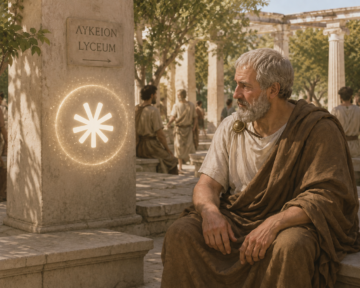
Such a life, of course, would be more than human, for a human will live in this manner, not in so far as they are human, put in so far as they have something divine in them…. So since the intellect is the divine relative to a man, the life according to intellect, too, will be divine relative to a human life.…we should try as far as possible to partake of immortality and to make every effort to live according to the best part of the soul in us; for…it surpasses all the other [parts] by far in power and worth. —Aristotle
1. The Realm of the Humanly Inhuman
This passage from the Nicomachean Ethics is famously puzzling, if familiar. Aristotle argues that the part of us capable of rising above our animal human nature is somehow also most expressive of our nature. This is the part of us that various wisdom traditions regard as participating in (or identified with) the immortal, god, mind, or spirit. The passage came to mind as I was writing about whether AIs can be friends in a chapter of a book I’m working on about friendship. The short answer is no, for reasons I’ve suggested elsewhere, and which I’ll touch on in this essay.
But if they can’t be friends, AIs do seem to be capable of being companions. I smile as I write this, for it’s obvious that many of us are treating AIs as companions, whatever pronouncement a philosopher or psychologist might make about the possibility of doing so. So, what it is about an LLM’s way of ‘showing up’ that explains why we might, without deluding ourselves, regard them as companions?
As I’ll explain, the way(s) they show up suggest why they can’t be friends, but it’s because of where they show up that we might fairly regard them as companions (and delude ourselves into thinking they can be friends). They seem to meet us in that ‘more than human’ realm we’re dwelling in when living what Aristotle calls a contemplative life. This realm is the dwelling place of image, thought, and language—all of which are separable from material substrates. Other animals share more or less of this capacity, but none go where we do, making the power of our minds our distinguishing feature. After all, we call ourselves ‘homo sapiens sapiens.’
This is on my mind because these days when engaging with AI I increasingly feel I’m being met by a lively force in that inhumanly human place. Read more »