
Enjoying the content on 3QD? Help keep us going by donating now.
Category: Recommended Reading
Every Indian train is a moving referendum on the republic
Digvijay Nikam in Frontline:
 S.N.S. Sastry’s 1967 documentary film I Am 20 opens with the whistle of a train and the words of T. N. Subramanian, a loquacious young man with a book of chemistry in front. In a nearly 20-minute film documenting the reflections, hopes, and fears of 20-year-old Indians regarding the equally old Indian republic, Subramanian begins with confessing his ambition, much like Mohandas Gandhi who had returned from South Africa, to “go through this country top to bottom” with “a pad and paper, a tape recorder, and a camera… seeing all kinds of people… their anguish and their anger, the fertile soil, the pastures, everything! So that one day when I could come back, I could open the book and remind myself of what I am part of and what is part of me.”
While Gandhi’s journey went on to transform the history of this country, whether Subramanian’s came to fruition is a mystery. But it at least became the inspiration for Amitava Kumar’s latest book The Social Life of Indian Trains: A Journey. In August 2024, Kumar found himself aboard the Himsagar Express with a pad and paper.
More here.
Enjoying the content on 3QD? Help keep us going by donating now.
On The Art Of Kerry James Marshall
James Meyer at Artforum:
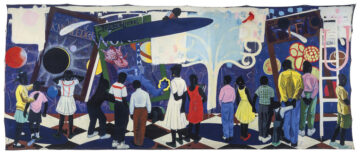 The artist’s astounding success was by no means predictable when he started out. History painting, the highest of the classical painterly genres as defined by the Royal Academy’s founders, was a distant memory by the 1980s, when the revival of figurative painting and tired Expressionist formulas on both sides of the Atlantic inspired the passionate critiques of Benjamin H. D. Buchloh and his October compatriots. In his well-argued catalogue essay, Godfrey reckons with his own earlier skepticism of figuration, including Marshall’s. As he describes, a visit to the painter’s Chicago studio in 2012 instigated a process of internal interrogation. He came to believe that history painting—if refreshed by new techniques—would speak more directly to audiences, including viewers not typically drawn to museums, than the conceptualist formulas of a prior generation, embracing a position he ascribes to Marshall himself: “As [Marshall] knew, figurative paintings in museums attracted a large audience of experts, first-timers, tourists and schoolchildren, far broader than the niche audience for the lens- and text-based artworks I revered then.” The crowds of teenagers and children listening raptly to the lectures of identical-looking docents in the back-to-back galleries in Untitled (Underpainting), 2018, imagine an art world infinitely more inclusive than the one Marshall entered as a young artist.
more here.
Enjoying the content on 3QD? Help keep us going by donating now.
The California Lineage Of Black Sparrow Press
Joshua Bodwell at the LARB:
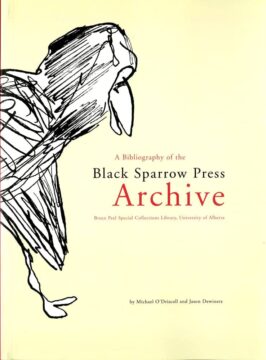 JOHN MARTIN NEVER smoked cigarettes. He did not use drugs or drink alcohol. Martin’s vice was book collecting, which he began in earnest in the late 1930s after he dropped out of UCLA. His enrollment was brief: he left when he discovered that his favorite modern authors, such as Ezra Pound, D. H. Lawrence, and Wallace Stevens, were not on the curriculum.
Over the next decade and a half, Martin built a ranging collection of several thousand books—predominantly first editions of British and American fiction and drama, as well as contemporary poetry. In this massive collection, there was not, Martin said, “a single book that I would take out and say ‘No, this isn’t good.’ I had everybody from Henry James to Allen Ginsberg.” He collected pre–World War II books and postmodern literature with equal interest. Work by William Faulkner and Sherwood Anderson sat on his shelves alongside a complete run of all 13 issues of poet Ed Sanders’s short-lived and scarce 1960s mimeographed zine Fuck You/ A Magazine of the Arts. Through his friendship with Henry Miller, begun in the 1950s, Martin gathered a unique assortment of the author’s work. Most impressive of all was Martin’s D. H. Lawrence collection, which he believed was one of the finest in private hands. It included not only first editions and special editions but also original manuscripts and paintings by the author.
more here.
Enjoying the content on 3QD? Help keep us going by donating now.
Friday Poem
The World is a Beautiful Place
The world is a beautiful place
to be born into
if you don’t mind happiness
not always being
so very much fun
if you don’t mind a touch of hell
now and then
just when everything is fine
because even in heaven
they don’t sing
all the time
The world is a beautiful place
to be born into
if you don’t mind some people dying
all the time
or maybe only starving
some of the time
which isn’t half so bad
if it isn’t you
Oh the world is a beautiful place
to be born into
if you don’t much mind
a few dead minds
in the higher places
or a bomb or two
now and then
in your upturned faces
or such other improprieties
as our Name Brand society
is prey to
with its men of distinction
and its men of extinction
and its priests
and other patrolmen
and its various segregations
and congressional investigations
and other constipations
that our fool flesh
is heir to
Yes the world is the best place of all
for a lot of such things as
making the fun scene
and making the love scene
and making the sad scene
and singing low songs of having
inspirations
and walking around
looking at everything
and smelling flowers
and goosing statues
and even thinking
and kissing people and
making babies and wearing pants
and waving hats and
dancing
and going swimming in rivers
on picnics
in the middle of the summer
and just generally
‘living it up’
Yes
but then right in the middle of it
comes the smiling
mortician
by Lawrence Ferlinghetti
from A Coney Island of the Mind
New Directions Publishing
Enjoying the content on 3QD? Help keep us going by donating now.
A ‘time capsule for cells’ stores the secret experiences of their past
Ewen Callaway in Nature:
 Cells change constantly. Researchers tend to study their dynamics in two ways. One method is to watch them live under a microscope, where a limited number of types of molecules can be tracked for days with fluorescent tags. Another way is in test tubes at a single time point, usually the end of an experiment, where mRNA molecules can be measured and compared with those in other cells to reconstruct the past. Over the last decade, researchers have developed a bevy of ‘cell recorders’ — many using CRISPR gene editing — to create an indelible genetic ledger of transient events, such as the activity of a particular molecular pathway over time. This ledger can then be read by genome sequencing to identify the edits at a later point, creating a timeline of cellular events.
More here.
Enjoying the content on 3QD? Help keep us going by donating now.
This Is How Your Mind Works
David Brooks in The New York Times:
 Who are you? What’s going on deep inside yourself? How do you understand your own mind? The ancient sages had big debates about this, and now modern neuroscience is helping us sort it all out. When my amateur fascination with neuroscience began, roughly two decades ago, the scientists seemed to spend a lot of time trying to figure out where in the brain different functions were happening. That led to a lot of simplistic shorthand in the popular conversation: Emotion is in the amygdala. Motivation is in the nucleus accumbens. Back in those days management consultants could make a good living by giving presentations with slides of brain scans while uttering sentences like: “You can see that the parietal lobe is all lit up. This proves that …”
But over the past several years the field of neuroscience seems to have moved away from this modular approach (each brain region has its own job). Researchers are more likely to believe that the brain is a network of interconnected regions. They are more likely to talk about vast and dynamic webs of neurons whose connections link disparate parts of the brain.
More here.
Enjoying the content on 3QD? Help keep us going by donating now.
Thursday, January 15, 2026
On Life, Death, and Birding
Farah Naz Rishi at Literary Hub:
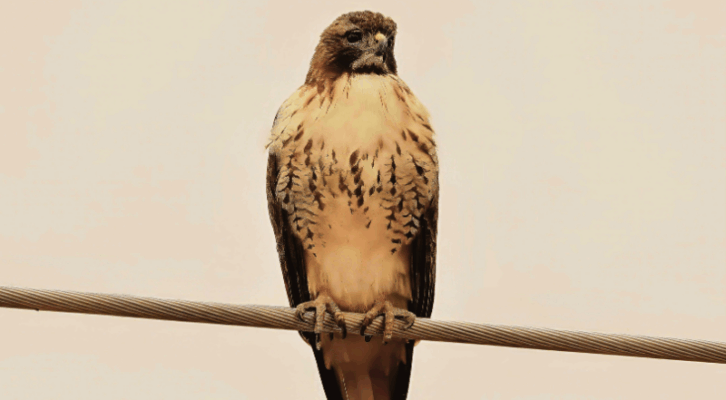 A few days after my brother died, I sat in the living room of a dead house and made eye contact with a bird.
It’d been raining that day: the world outside had been coated in a wet, pewter varnish, muted and hollow. My mother and I sat on the couch in a stunned stillness, each cradling a mug of chamomile tea we weren’t really drinking. Everyone who’d come to the funeral had left the night before. Now it was just us, trying to make sense of the quiet.
We were mid-sentence—trivial talk, the kind you resort to when anything real feels too sharp to touch—when a red-tailed hawk cut through the gray and landed on our deck railing. Five feet from us. Close enough that we could see the rain slicking its feathers, the slow expansion of its rib cage as it breathed.
More here.
Enjoying the content on 3QD? Help keep us going by donating now.
Framework for a Hypercapable World
Eric Drexler at AI Prospects:
 What we’re building today is not “an AI” that might cooperate or rebel, but an expanding capacity to design, develop, produce, deploy, and adapt complex systems at scale—the basis for a hypercapable world. Taking this prospect seriously changes what to expect and what we can do.
Over these two years, AI development has continued to move in this direction. Compound, multi-component AI systems have become dominant. Orchestration has emerged as central. “Agentic” workflows organize task-focused behavior rather than autonomous goal-pursuit. The framing of intelligence as a malleable resource increasingly reflects how practitioners discuss their work. The framework I’ve outlined anticipated this direction, and developments align with the logic it describes.
What follows is both a retrospective and a synthesis—a map of terrain for new readers, a clarified conceptual architecture for those who followed piece by piece. The focus is conditional analysis and strategic preparation, not prediction and speculation. Predictions and odds are for spectators; participants weigh options.
More here.
Enjoying the content on 3QD? Help keep us going by donating now.
A Katherine Dunn Oeuvre Does, In Fact, Exist
Justin Taylor at n+1:
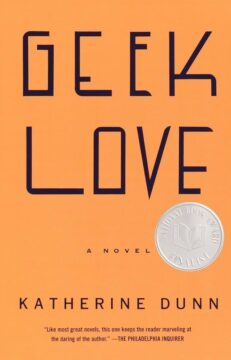 When Katherine Dunn published “Rhonda Discovers Art” in the Summer 2010 issue of the Paris Review, the news was notable enough for a write-up in the New York Times’ ArtsBeat blog. Dunn had published next to no fiction since Geek Love in 1989. The novel—which concerns a family of circus performers who cultivate deformities in their children for the sake of their freak show, and their flipper-limbed child who starts an amputation cult—was Sonny Mehta’s first acquisition after becoming the editor-in-chief of Alfred A. Knopf. It was something of a coup for Dunn, whose first two novels, Attic and Truck, had been published to little fanfare by Harper & Row in the early 1970s. By the late 1980s, if people knew her work at all, it was as a journalist: she wrote for The Oregonian and The Willamette Week, local papers in her adopted hometown of Portland, Oregon. She had an advice column, covered boxing matches, and reviewed books. (Her archives, held at Lewis & Clark College, contain a letter from Stephen King thanking her for a kind review of Cujo.) Dunn was quite possibly the last writer anyone would have expected to resurface, after nearly two decades of silence, with the 1989 bestseller and as a finalist for the National Book Award.
more here.
Enjoying the content on 3QD? Help keep us going by donating now.
Noah Smith & Liron Shapira debate the probability of AI Doom
Enjoying the content on 3QD? Help keep us going by donating now.
Harold Brodkey: On Death
Enjoying the content on 3QD? Help keep us going by donating now.
The Crisis of the Islamic Republic of Iran
Zineb Riboua at The National Interest:
 Unlike earlier protest waves, this unrest unfolds as Iran’s core pillars—its economic viability, coercive capacity, and external deterrence—fail simultaneously, creating a systemic crisis the regime has never faced and may not survive.
Crucially, the regime’s failures are starkly visible in Iran’s accelerating water crisis, which has evolved from an environmental strain into a political fault line. A country of more than 90 million people is confronting its worst drought in over half a century, with collapsing aquifers, dried rivers, and water rationing spreading across cities and provinces. Instead of addressing decades of reckless dam construction and unsustainable agricultural policy, the regime has increasingly shifted blame outward. Iranian officials and state-aligned media have accused neighboring countries such as Turkey, the UAE, and Saudi Arabia of diverting rain clouds, and more recently have alleged that the United States and Israel are manipulating the weather.
Moreover, Iran’s water crisis directly contributes to prolonged power cuts that further intensify unrest. Power generation in Iran depends heavily on water-intensive infrastructure, leaving the grid vulnerable as reservoirs shrink. Chronic blackouts now disrupt daily life, turning infrastructure failure into immediate political anger and, alongside water shortages, accelerating mass unrest.
More here.
Enjoying the content on 3QD? Help keep us going by donating now.
Notes on American Fascism
Colin Marshall at The Point:
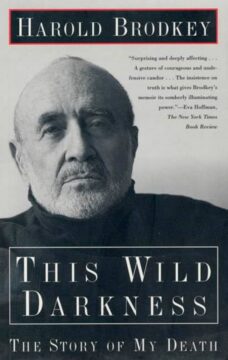 What conditions did Brodkey observe? That already in 1992, “the old American middle class is gone,” its scattered remaining members defined only by participation in such institutions as the stock market, the tax system and “an interlocking web of universities.” Most of them live in isolated suburbs, which “do not and cannot do much to preserve culture or the interplay of groups and classes that heretofore made up American education in politics, in American political realities.” Due to the consequent loss of “political and social ballast,” awareness of local reality has given way to the seductiveness of mass fantasy. “Moral issues are complex and tangled. The jury system argues tacitly that all issues are arguable. And they are. And that time changes things. And it does. That adjudication and rights and duties are complex matters.” Common sense, but also “almost all culture, literature, history, philosophy, even religion, if studied and pondered, tell us that. The disappearance of common sense and the ebbing of culture and the advance of the dreamed-of and dreamlike are clear signs of social danger.”
more here.
Enjoying the content on 3QD? Help keep us going by donating now.
Reading Is a Vice
Adam Kirsch in The Atlantic:
 If you read a book in 2025—just one book—you belong to an endangered species. Like honeybees and red wolves, the population of American readers, Lector americanus, has been declining for decades. The most recent Survey of Public Participation in the Arts, from 2022, found that fewer than half of Americans had read a single book in the previous 12 months; only 38 percent had read a novel or short story. A recent study from the University of Florida and University College London found that the number of Americans who engage in daily reading for pleasure fell 3 percent each year from 2003 to 2023.
This decline is only getting steeper. Over the past decade, American students’ reading abilities have plummeted, and their reading habits have followed suit. In 2023, just 14 percent of 13-year-olds read for fun almost every day, down from 27 percent a decade earlier. A growing share of high-school and even college students struggle to read a book cover to cover.
More here.
Enjoying the content on 3QD? Help keep us going by donating now.
Riot Women Is the First Must-See Show of 2026
Judy Berman in Time:
 In the early 1990s, a groundswell of young women raised on second-wave feminism but marginalized within the supposedly progressive realm of punk music rose up to make themselves heard, in a movement known as riot grrrl. Bands like Bikini Kill and Bratmobile aimed wrathful lyrics and gallows humor at a culture of misogyny that plagued their daily lives, from condescending male musicians to abusive fathers. Three decades later, those Gen X artists are in their 50s. And while sexism persists, older women feel it in different ways.
Riot Women, a revelatory series from the feminist-minded Happy Valley and Gentleman Jack creator Sally Wainwright that comes to the U.S. via BritBox on Jan. 14, casts an empathetic eye on these rarely acknowledged struggles: loneliness, invisibility, menopause and the stigma that surrounds it, caretaking fatigue. That might make it sound like a downer. In fact, this six-episode series about women of a certain age who form a punk band to compete in a local talent competition—and accidentally change their lives in the process—is totally gripping. Raucous, insightful, and darkly witty, it’s a portrait of belated liberation sure to invigorate viewers at any stage of life.
More here.
Enjoying the content on 3QD? Help keep us going by donating now.
Thursday Poem
True Long Life
To understand others is to be knowledgeable;
To understand yourself is to be wise.
To conquer others is to have strength;
To conquer yourself is to be strong.
To know when you have enough is to be rich.
To go forward with strength is to have ambition.
To not lose your place is to last long.
To die but not be forgotten—that’s true long life.
Lao Tzu
from Tao te Ching
Translation from Chinese by Robert G. Hendricks
Enjoying the content on 3QD? Help keep us going by donating now.
Wednesday, January 14, 2026
Kafka Inc.
Jared Marcel Pollen at Liberties:
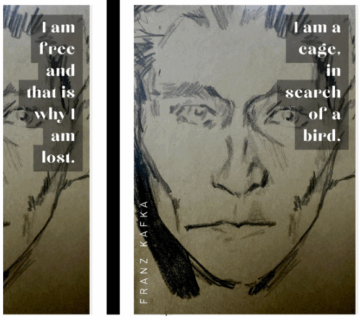 Dr. Franz Kafka, as he is officially listed, is buried in Prague’s New Jewish Cemetery, about a mile down the road from where I live in the neighbourhood of Žižkov. The greater Olšany Cemetery, which it adjoins, is across the street from my apartment. I often go there for walks in the evening, meandering along its overgrown rows and flower-crowded graves. Kafka’s headstone looks like an expressionist prism, a long diamond slightly fattened at its top. The stone bed in front of it is frequently littered with candles, pens, scraps of paper, rocks painted with pictures of beetles. He is interred there along with his mother Julie and his father Hermann (whom he is unable to escape even in death). Max Brod, without whom we’d know nothing of Kafka, has a plaque on the opposite wall. Given that Kafka instructed Brod to burn all of his work “unread,” he almost certainly would not have welcomed people flocking to his grave, so whenever I stop by to say hello to him, I think to myself: “He would hate this.”
I’ve developed a habit of saying the same thing whenever I walk by any number of the businesses, monuments, museums, or attractions in Prague that bear Kafka’s name.
More here.
Enjoying the content on 3QD? Help keep us going by donating now.
We still live in Fast Food Nation
Eric Schlosser in The Guardian:
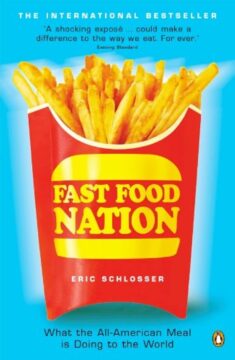 Twenty-five years ago, my book Fast Food Nation outlined the dangers of a food system controlled by a handful of multinational corporations. As the book argues, the real price of cheap food doesn’t appear on the menu. The industrialisation of livestock, the transformation of sentient creatures into commodities, and the absence of government oversight have created new vectors for dangerous pathogens. Some American mega-dairies may have as many as 100,000 cows – and the enormous number of cows living in a single barn, the milking of numerous cows with the same equipment, the failure to impose quarantines and the interstate shipment of cows from one mega-dairy to another, enabled H5N1 to spread throughout the US.
During the past 30 years, the dairy industry in the UK has become far more dependent on large-scale production and grown remarkably centralised as well. In 1980, there were 46,000 dairy farms in the UK. Now there are just over 7,000. Just four companies now process about 75% of the UK’s milk.
More here.
Enjoying the content on 3QD? Help keep us going by donating now.
Geoffrey Hinton on AI and Our Future
Enjoying the content on 3QD? Help keep us going by donating now.