
Shelly Fan in Singularity Hub:
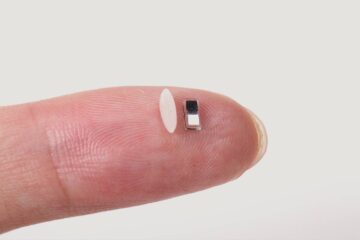 Scientists just unveiled the world’s tiniest pacemaker. Smaller than a grain of rice and controlled by light shone through the skin, the pacemaker generates power and squeezes the heart’s muscles after injection through a stint. The device showed it could steadily orchestrate healthy heart rhythms in rat, dog, and human hearts in a newly published study. It’s also biocompatible and eventually broken down by the body after temporary use. Over 23 times smaller than previous bioabsorbable pacemakers, the device opens the door to minimally invasive implants that wirelessly monitor heart health after extensive surgery or other heart problems.
“The extremely small sizes of these devices enable minimally invasive implantation,” the authors, led by John Rogers at Northwestern University, wrote. Paired with a wireless controller on the skin’s surface, the system automatically detected irregular heartbeats and targeted electrical zaps to different regions of the heart.
More here.
Enjoying the content on 3QD? Help keep us going by donating now.
 Yesterday on Warren Street, Richard and I bumped into our friend Jake. If you are recognized on Warren Street, it answers many questions for the rest of the day. I said to Jake, “I love you.” I said, “Richard and I both love you.” Jake owns a shop and sees you in the way Godot would see you if he ever showed up. No one on Warren Street is waiting for Godot. If anything, we are waiting for Godot to leave. Jake said he had bottles of scented oil and he would give me some. It’s one of those offers You have to weigh to yourself, if you are going to remind him. People can be more generous than they bargain for.
 I
I For 23 years, A.O. Scott was a film critic for the New York Times. For the past five months, he has been the nation’s most prominent poetry critic, writing a monthly column that uses the Times’ interactive technology to analyze a single poem at a time. Scott isn’t coming to poetry as a true outsider. He finished all the coursework and exams for a Ph.D. in literature, and he was a literary critic before he started writing about movies. But when most writing about poetry is done by poets and lifelong academics, many of whom seem to view other poets and academics as their primary audience, that still makes Scott an unusual and welcome presence.
 In the beginning there was agony. Under the empires of old, the strong did what they willed and the weak suffered what they must. But over the centuries, people built the sinews of civilization: Constitutions to restrain power, international alliances to promote peace, legal systems to peacefully settle disputes, scientific institutions to cure disease, news outlets to advance public understanding, charitable organizations to ease suffering, businesses to build wealth and spread prosperity, and universities to preserve, transmit and advance the glories of our way of life. These institutions make our lives sweet, loving and creative, rather than nasty, brutish and short.
 When
When 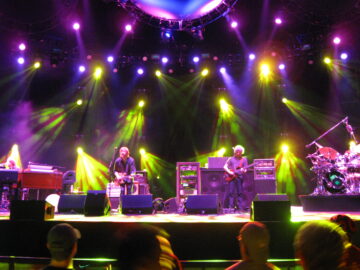 Last August, Phish hosted a four-day music festival at a racetrack in Dover, Delaware. It was called Mondegreen—the word for a misheard lyric or phrase—and it was the band’s first festival since 2015. Phish—the singer and guitarist Trey Anastasio, the keyboardist Page McConnell, the bassist Mike Gordon, and the drummer Jon Fishman—was scheduled to play at least two sets a night for four nights in a row. No other bands were on the bill.
 Steve Bannon, Trump’s first term whisperer, once described himself as a