
Kyle Chan over at his Substack High Capacity:
The ”China Shock” paper (actually a set of papers)1 sent shockwaves through the US political world when it was first released by a team of high-profile economists in January 2016. It estimated the US lost nearly 1 million manufacturing jobs from 1999 to 2011 due to a surge in Chinese imports starting around the time of China’s accession to the WTO in 2001.
The paper seemed to provide support for a growing narrative that trade—and specifically trade with China—was to blame for the decline of American manufacturing jobs. While this is not what the paper actually argued, its more nuanced findings were lost in much of the political debate. In November of that year, Donald Trump won the US presidential election for the first time and the rest is history.
Many American manufacturing jobs have indeed been lost to China. And many American families and communities have been devastated by the losses of these jobs. But the paper’s impact went far beyond its intended scope and illustrates the dangers of how research can be oversimplified and misused in public debates.
Even if you accept the paper’s estimate of nearly 1 million US manufacturing jobs lost to Chinese imports, this needs to be seen in the context of a much bigger structural shift in the US economy that has been taking place since the end of World War II. For decades, the US has been moving away from manufacturing jobs and toward service sector jobs. While rising Chinese imports did contribute to the loss of some US manufacturing jobs, it was far from the main cause.
More here.
Enjoying the content on 3QD? Help keep us going by donating now.
 T
T THE world is angry — and in most places, women bear the brunt of this anger. This International Women’s Day, the
  In our culture, music is most often written about in terms of sales, streams and chart positions. That is, of course, the least intelligent way to think about or talk about music.
 I have loved bees
 The question that leaders of research universities must grapple with is this: How can we preserve and enhance what is uniquely valuable about the research university? To do that, we must begin by defining what is “uniquely valuable”—that is, what research universities do better than any other existing institution, and without which society would suffer badly. I take those uniquely valuable attributes to be: (a) the creation of highly well-trained experts; (b) path-breaking knowledge creation; and, crucially, though often ignored or even denigrated, (c) knowledge preservation and transmission.
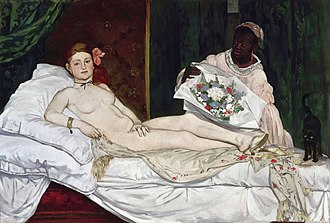 When Édouard Manet exhibited Olympia in the Salon of 1865, it unleashed a firestorm. Viewers were shocked by the subject matter—the sheer nakedness of the sitter—and by his formal treatment of the subject: critics lamented the lack of finish, the sharp contrast between light and dark, and, above all, the starkness of the model’s outward look at the viewer. For critics at the time, Manet’s shocking way with form went hand in hand with a sense of moral outrage, around gender and class. Olympia subtly but powerfully broke all the unspoken rules about the nude in painting and set the standard for a new form of revolutionary modern art.
 If you are a leading woman in a Pedro Almodóvar film, your life will not be frictionless. You will have a terminal illness. Or if you don’t have one, you will be grieving the one that someone very close to you has. You will be a single mother or mother-to-be. You will have very intimate female friendships, but you won’t always be faithful, or act selflessly. You will work a creative career, such as writing or acting or photographing products for advertisements. You won’t care too much about traditional values even though your Catholic family or community does. You will smoke cigarettes and pop pills when you’re stressed. You might have paid a pretty penny for your breasts, or have been naturally endowed. You will be unconventionally, or maybe conventionally, beautiful, and always expressive. You will be middle-aged. You will have a romantic Castilian accent. You might be Penélope Cruz.
 About two millennia ago, the Greek physicians Hippocrates and Galen suggested that melancholia — depression brought on by an excess of “black bile” in the body — contributed to cancer. Since then, scores of researchers have investigated the association between cancer and the mind, with some going as far as to suggest that some people have a cancer-prone or “Type C” personality.
 O
O Dr. Garcia is part of a leading lab, run by toxicologist Matthew Campen, that is studying how tiny particles known as microplastics accumulate in our bodies. The researchers’