Benjamin Taylor in The Atlantic:
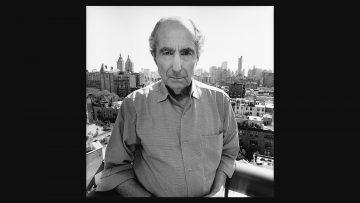 Delirious near the end, he said, “We’re going to the Savoy!”—surely the jauntiest dying words on record. But it was Riverside Memorial Chapel, the Jewish funeral parlor at Amsterdam and 76th, that we were bound for. I was obliged to reidentify the body once we arrived there from New York–Presbyterian Hospital. An undertaker pointed the way to the viewing room and said, “You may stay for as long as you like. But do not touch him.” Duly draped, Philip looked serene on his plinth—like a Roman emperor, one of the good ones. I pulled up a chair and managed to say, “Here we are.” Here we are at the promised end. A phrase from The Human Stain came to me: “the dignity of an elderly gentleman free from desire who behaves correctly.” I wanted to tell him that he was doing fine, that he was a champ at being dead, bringing to it all the professionalism he’d brought to previous tasks. To talk daily with someone of such gifts had been a salvation. There was no dramatic arc to our life together. It was not like a marriage, still less like a love affair. It was as plotless as friendship ought to be. We spent thousands of hours in each other’s company. I’m not who I would have been without him. “We’ve laughed so hard,” he said to me some years ago. “Maybe write a book about our friendship.”
Our conversation was about everything—novels, politics, families, dreams, sex, baseball, food, ex-friends, ex-lovers. Philip’s inner life was gargantuan. Insatiable emotional appetites—for rage as for love—led him down paths where he seethed with loathing or desire. “There’s too much of you, Philip. All your emotions are outsize,” I once said to him. “I’ve written in order not to die of them,” he replied. But our keynote was American history, for which Philip was ravenous, consuming one big scholarly book after another. He became a great writer over the course of the 1980s and especially the ’90s, when his novels became history-haunted. In the American trilogy—American Pastoral, I Married a Communist, and The Human Stain—the heroes, Swede Levov, Ira Ringold, and Coleman Silk, are solid men torn to pieces when the blindsiding force of history comes to call. Such was Philip’s mature theme: the unpredictable brutalities at large in the world and the illusoriness of ever being safe from them. He never stopped marveling at how contingently a fate is made. For him, that was most basic to storytelling: the happenstance that in retrospect turns epic.
More here.

 For John Berger, who began not as a dreamer of the maelstrom but a campaigner for tradition, the very concept of the total transformation, sudden and exhilarating, was something he came to only later, after his hopes for postwar unity had dissolved. His early taste of political disappointment was in this sense unusual. It was not that the revolution of his youth had gone wrong or failed to come, but that the revolutions that did come, whether cultural (from America) or political (in the Eastern bloc), were of the wrong kind, from the wrong quarters. Meanwhile, the artistic New Deal he tried to encourage, as if brick-by-brick, was buckling under the weight of its own ambition. Like a rising tide, middle-class prosperity brought with it a host of new attitudes and aspirations: so-called “ad-mass” culture, “never had it so good” Macmillanism, the Americanized cult of cool.
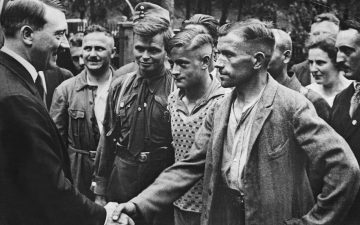
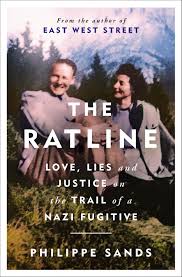 The Ratline traces the life of Otto von Wächter, an Austrian aristocrat who served as governor of the district of Kraków in Nazi-occupied Poland, then later, handpicked by Hitler, as governor of the district of Galicia, in present-day Ukraine. Wächter was complicit in myriad atrocities, including the virtual eradication of Galicia’s Jewish population; less than 3 per cent survived. Wächter also collected art, attended concerts and held elegant soirées with his wife, Charlotte. He played chess with Hans Frank, who was later hanged at Nuremberg for his central role in the Holocaust. He socialised with the Himmler family. The SS Reichsführer inscribed a book he gave to Wächter, ‘With my best wishes on your birthday – H Himmler, 8 July 1944’. Hitler welcomed Wächter’s initiative to form the Waffen-SS Galicia Division, and in 1944 the Führer granted his forty-something governor life tenure as a civil servant with full pension rights.
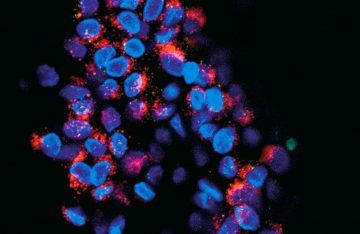 The treatment was never going to work. Ryan Corcoran, an oncologist at Massachusetts General Hospital, Boston, didn’t realize this when he began treating his patient’s colorectal cancer in 2014. His team picked a therapy on the basis of genetic testing of a portion of the person’s cancer, and initially the treatment performed well. But before long, it faltered amid overwhelming tumour resistance. It was only when the person had a liquid biopsy, a test based on analysis of stray tumour DNA in the blood, that Corcoran learnt why the treatment the team had selected was doomed to failure. “There was a mutation known to cause resistance to that drug, which wasn’t present in the tissue biopsy but was fairly abundant in the blood sample,” he says. “If we had just biopsied a different lesion, we might’ve picked an entirely different therapy.” The experience demonstrated the benefits of searching the blood for answers. Now, blood-based biopsies are commonplace at his hospital, and are increasingly used in cancer centres around the world.
 The past decade delivered powerful lessons of what not to do in an economic crisis. Many countries pursued, or had imposed on them, austerity policies. That is, cutting government spending when the economy tanks in order to balance the books. The idea is that with less spending now, taxes will be lower later on, which will make people feel more confident now, thereby shortening the recession. It’s a nice idea. But it actually makes things worse.
 Books, like people, have their unique fates—their zodiac. Written in one context, they arrive in another, and every now and then a special convergence takes place. Like now. A book that in some other time would be read as a quiet reflection on the general state of things—how it is with us—delivers its messages with an unexpected force.
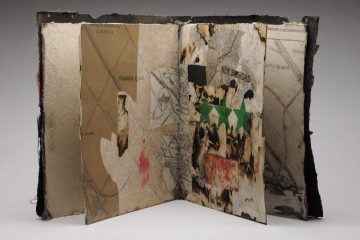 The smallest works spoke volumes at “Theater of Operations,” MoMA PS1’s monumental art exhibition on the U.S. invasions of Iraq, which closed last month. In the immense Queens satellite of the name-brand New York institution, the comparatively miniature works of Iraqi artists offered a visual diary of life under siege. Glass cases of dafatir (notebooks, in Arabic) were spread around the exhibition halls. Produced by several artists, notably Dia Azzawi and Kareem Risan, some of the books were burnt or ripped; others were printed with Arabic calligraphy or capped with forms figurative or abstract; some expanded while others were painted shut, or were adorned with found objects—like barbed wire.
 O
O It was noticeable from the initial outbreak in Wuhan that Covid-19 was killing more men than women. By February,
 Jonathan Wolff in Aeon:
 John Cassidy in The New Yorker: