
Wayne Scott at Poets & Writers:
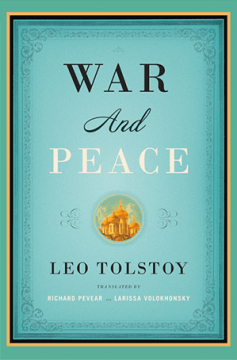 In the dark days of quarantine, I have a habit, born of a fretful insomnia, of rising before dawn. Descending the stairs from my attic room, passing second-floor bedrooms, I imagine I am an all-knowing god of some small universe, like Leo Tolstoy in War and Peace, and can peer into the dreams of my loved ones.
My wife, who works for a health insurance plan that takes care of low-income people, argues in her sleep (even in her dreams she is in meetings, grappling with the tattered safety net, so many sick and soon-to-be-sick people). My twenty-two-year-old daughter, who will be next to wake up to work on her senior thesis, consoles herself that she wasn’t enthusiastic about the graduation ceremony anyway. My seventeen-year-old son, who fell asleep a few hours ago, will sleep until afternoon. He misses his friends, even as he chides them on social media for their lax compliance with social distancing. He worries about having a lonely eighteenth birthday in two weeks.
One bedroom is empty. My twenty-year-old son, still at an English-speaking college in Berlin, convinced us he was safer to wait out the pandemic there, rather than undertake a risky journey home. On a Facetime call we agreed his plan was best. My wife cried; Berlin is five thousand miles away from us.
More here.
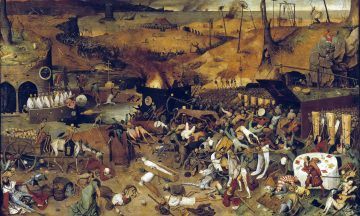 Twenty years ago, the US Department of Defense set out a clear warning: “Historians in the next millennium may find that the 20th century’s greatest fallacy was the belief that infectious diseases were nearing elimination. The resultant complacency has actually increased the threat.” Along with other western nations, federal and state governments in America had spent the previous decade or so dismantling public health programmes dealing with communicable diseases in order to concentrate funds on degenerative illnesses: diabetes, heart disease, cancer, stroke. Corporate investment in the development of new vaccines and antibiotics almost dried up, as if the battle that humans had waged over millennia against plague and pestilence had now been won – at least in the developed world. Michael Osterholm, the Minnesota state epidemiologist, informed US Congress in 1996: “I am here to bring you the sobering and unfortunate news that our ability to detect and monitor infectious disease threats to health in this country is in serious jeopardy. . . . For 12 of the states or territories, there is no one who is responsible for food or water-borne disease surveillance. You could sink the Titanic in their back yard and they would not know they had water.”
 In this half-life of quarantine, danger lurks in the unlikeliest of places: the touch of an elevator button, a store-bought carton of milk, my son’s sneeze. Insidious and cunning, death is everywhere around us.
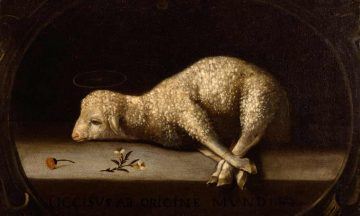 Stuart Jeffries in The Guardian:
 Tyler Cowen interviews Adam Tooze over at Medium: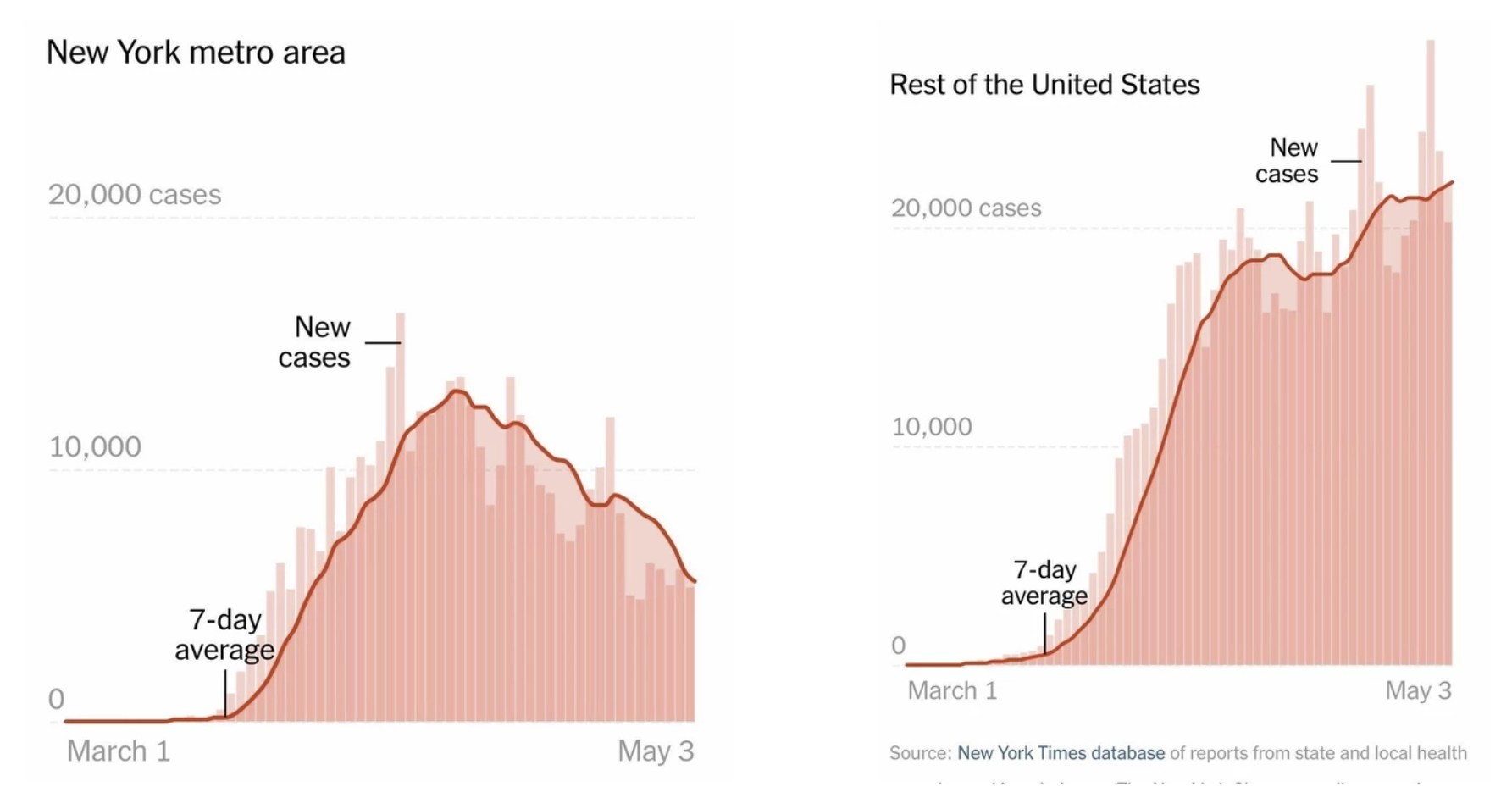
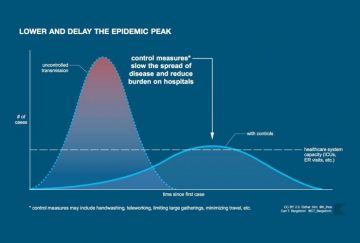 Jonathan Fuller in Boston Review:
 George Scialabba reviews Martha Nussbaum’s The Cosmopolitan Tradition: A Noble but Flawed Ideal in Inference:
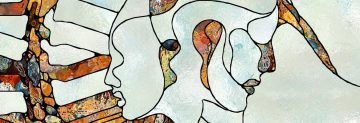 “[W]hat we experience in our dreams … is as much a part of the overall economy of our soul as anything we ‘really’ experience.”
 “The country Trump promised to make great again has never in its history seemed so pitiful,”
  “I spoke for you,” the qawwal said.
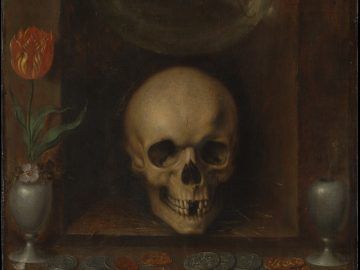 The skull in Vanitas Still Life, while undoubtedly grim, bears a wry, gapped grin—a grin missing four front teeth. Stripped of its flesh, our bone structure apparently discloses a faint, effortless smile. The skull’s stark, denuded presence signals gravity, but its blithe affect signals buoyancy. Perhaps this face of death reflects both the weeping Heraclitus and the laughing Democritus, pointing viewers back to Ecclesiastes: there is “a time to weep and a time to laugh.” Wisdom here comes lodged in apposition—pairs of apparent opposites, united by the word and: “a time to be born, and a time to die … a time to break down, and a time to build up … a time to cast away stones, and a time to gather stones together.” These lines in Ecclesiastes encourage readers to imagine a world in which the poles of existence create vibrant tension, in which life and death, gathering and releasing, embracing and refraining, weeping and laughing, do not negate each other but instead balance and enrich. There is aggregation and integration—even with loss, even in death.
 More and more young Christians, disillusioned by the political binaries, economic uncertainties and spiritual emptiness that have come to define modern America, are finding solace in a decidedly anti-modern vision of faith. As the coronavirus and the subsequent lockdowns throw the failures of the current social order into stark relief, old forms of religiosity offer a glimpse of the transcendent beyond the present.
 In the spring of 1822 an employee in one of the world’s first offices – that of the East India Company in London – sat down to write a letter to a friend. If the man was excited to be working in a building that was revolutionary, or thrilled to be part of a novel institution which would transform the world in the centuries that followed, he showed little sign of it. “You don’t know how wearisome it is”, wrote Charles Lamb, “to breathe the air of four pent walls, without relief, day after day, all the golden hours of the day between ten and four.” His letter grew ever-less enthusiastic, as he wished for “a few years between the grave and the desk”. No matter, he concluded, “they are the same.” The world that Lamb wrote from is now long gone. The infamous East India Company collapsed in ignominy in the 1850s. Its most famous legacy, British colonial rule in India, disintegrated a century later. But his letter resonates today, because, while other empires have fallen, the empire of the office has triumphed over modern professional life. The dimensions of this empire are awesome. Its population runs into hundreds of millions, drawn from every nation on Earth. It dominates the skylines of our cities – their tallest buildings are no longer cathedrals or temples but multi-storey vats filled with workers. It delineates much of our lives. If you are a hardworking citizen of this empire you will spend more waking hours with the irritating colleague to your left whose spare shoes invade your footwell than with your husband or wife, lover or children.
 One of the oldest vaccines could protect us against our newest infectious disease, COVID-19. The vaccine has been given to babies to protect them against tuberculosis for almost a century, but has been shown to shield them from other infections too, prompting scientists to investigate whether it can protect against the coronavirus. This Bacille Calmette-Guérin (BCG) vaccine, named after two French microbiologists, consists of a live weakened strain of Mycobacterium bovis, a cousin of M. tuberculosis, the bacterium that causes tuberculosis. BCG has been given to more than 4 billion individuals, making it the most widely administered vaccine globally. Because BCG protects babies against some viral infections in addition to TB, researchers decided to compare data from countries with and without mandatory BCG vaccination to see if immunization policies are linked to the number or severity of COVID-19 infections. A handful of preprint publications in the last two months noted that countries with an ongoing BCG vaccination program are experiencing lower death rates from COVID-19 than those without.
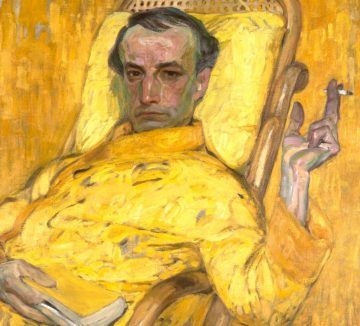 I’m not ashamed to say that I bought Joris-Karl Huysmans’s Against Nature because of the cover: Frantisek Kupka’s The Yellow Scale (Self-Portrait) from 1907 is an exhilarating study of the color yellow. Its human subject, slouched in a wicker armchair, a cigarette dangling from one hand while a single, louche finger marks the page of a book, could be the perfect image of Des Esseintes, the dissolute antihero of Huysmans’s novel. Strictly speaking, the painting is a self-portrait of the habitually mustached Kupka, but it bears more than a passing resemblance to Charles Baudelaire, who haunts almost every page of Against Nature. This novel, about a dyspeptic aesthete who “took pleasure in a life of studious decrepitude,” spends some two hundred pages luxuriating in excess and opulence while the hero cuts himself off from the rest of society.