
From The Christian Science Monitor:
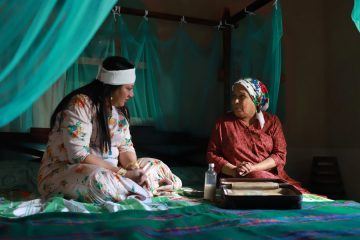 The people of the Middle East are quite used to the many attempts over decades to reconcile Jews and Arabs. Yet nothing has been tried on such a mass scale as a drama series being shown on one of the Arab world’s most popular TV channels during this year’s month of Ramadan. Since the series began to air in April over the Saudi-backed MBC station, it has dominated viewership ratings at a time when Arab families gather around a television in the evening. The drama “Um Haroun,” or “Mother of Aaron,” centers on a Jewish nurse living in an Arabian Gulf country in the 1940s. She and other Jews live peacefully in a village with Muslims and Christians as she lovingly brings health care to all. While the show has plenty of village intrigue, it depicts interreligious harmony before the 1948 creation of modern Israel and the later rise of intolerant Islamic groups such as Al Qaeda.
While the drama was filmed before the COVID-19 outbreak, its producers note its timely message: “Today, the world’s sentiment is no longer ‘us vs. them,’ but more ‘we are all in this together.’” Its popularity among Arab viewers coincides with current trends in the region that signal a desire to overcome the sectarian divides that have driven wars, corruption, and poverty. Last year’s youthful protests in Iraq and Lebanon, for example, were driven by calls to end government systems in which power is divvied up by religious groups. A survey of opinion in both countries revealed nearly three-quarters of people resent the use of religion for political advantage.
More here.
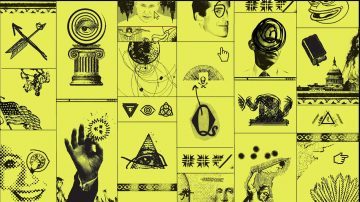 If you were an adherent, no one would be able to tell. You would look like any other American. You could be a mother, picking leftovers off your toddler’s plate. You could be the young man in headphones across the street. You could be a bookkeeper, a dentist, a grandmother icing cupcakes in her kitchen. You may well have an affiliation with an evangelical church. But you are hard to identify just from the way you look—which is good, because someday soon dark forces may try to track you down. You understand this sounds crazy, but you don’t care. You know that a small group of manipulators, operating in the shadows, pull the planet’s strings. You know that they are powerful enough to abuse children without fear of retribution. You know that the mainstream media are their handmaidens, in partnership with Hillary Clinton and the secretive denizens of the deep state. You know that only Donald Trump stands between you and a damned and ravaged world. You see plague and pestilence sweeping the planet, and understand that they are part of the plan. You know that a clash between good and evil cannot be avoided, and you yearn for the Great Awakening that is coming. And so you must be on guard at all times. You must shield your ears from the scorn of the ignorant. You must find those who are like you. And you must be prepared to fight.
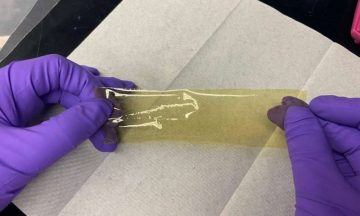 Scientists at the University of South Carolina and Columbia University have developed a faster way to design and make gas-filtering membranes that could cut greenhouse gas emissions and reduce pollution. Their new method, published today in Science Advances, mixes machine learning with
  According to the government, we are now supposed to be getting back to work. But what does “work” mean in the time of Covid-19? Amid the debates about how we might return to work, what is being forgotten is that work is a crucial part of what the 20th-century political philosopher Hannah Arendt called the human condition. The government’s Covid-19 recovery strategy, published on 11 May, states that people will be “eased back into work” as into a dentist chair: carefully, and with face masks.
 A revolutionary voice in her lifetime, Butler has only become more popular and influential since her death 14 years ago, at age 58. Her novels, including “Dawn,” “Kindred” and “Parable of the Sower,” sell more than 100,000 copies each year, according to her former literary and the manager of her estate, Merrillee Heifetz. Toshi Reagon has adapted “Parable of the Sower” into an opera, and Viola Davis and Ava DuVernay are among those working on streaming series based on her work. Grand Central Publishing is reissuing many of her novels this year and the Library of America welcomes her to the canon in 2021 with a volume of her fiction.
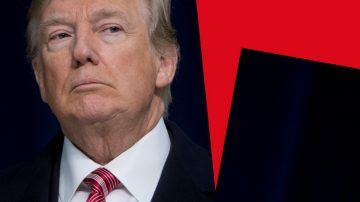 Edward Luce in the FT:
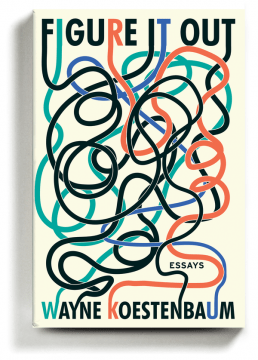 Our most ecstatic modern practitioner might be Wayne Koestenbaum, the polymathic poet and essayist. (He’s also a painter and pianist.) His work — rueful, cerebral, gloriously smutty — includes trance poetry and automatic writing. He has published sections of his notebooks, trippy discursions into his obsessions with opera (“The Queen’s Throat”) and Jacqueline Onassis (“Jackie Under My Skin”), a novel about a hotel where the guest services include having your certainties shredded (“Hotel Theory”). Whatever his subject — favorites include porn, punctuation and the poetry of Frank O’Hara — the goal is always to jigger logic and language free of its moorings. “The writer’s obligation,” he states in his new essay collection, “Figure It Out,” “is to play with words and to keep playing with them, not to deracinate or deplete them, but to use them as vehicles for discovering history, recovering wounds, reciting damage and awakening conscience.”
 Kevin Hartnett in Quanta Magazine:
 Thomas Meaney in The New Yorker:
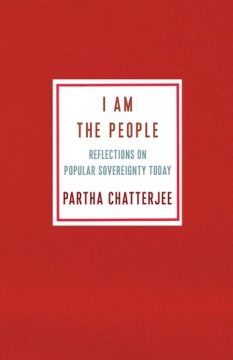 Rudrangshu Mukherjee reviews Partha K. Chatterjee’s I Am The People, in The India Forum:
 Alex Gourevitch and Corey Robin in Polity:
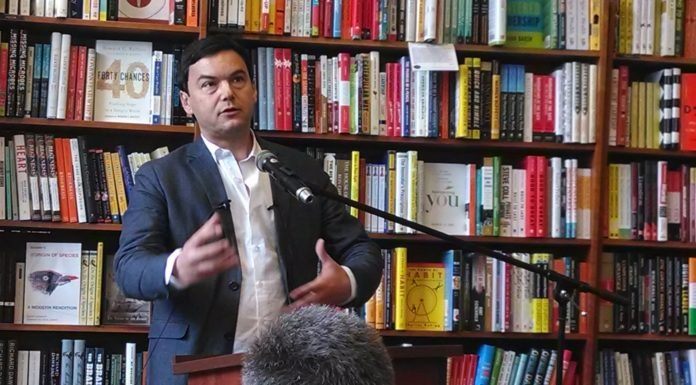 Inequality is neither economic nor technological; it is ideological and political.” Thomas Piketty’s latest book,
  How will we live, or be forced to live, after the pandemic? “I don’t know” is—
 Recently, the Federal Reserve announced that it would be loosening its lending guidelines so that more corporations, even those with massive pre-existing debts, could take part in the bailout feeding frenzy.
 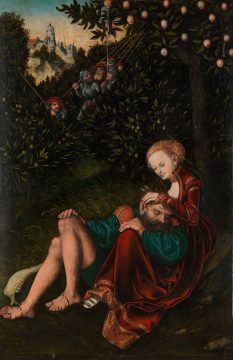 On a freezing December day in 1386, at an old priory in Paris that today is a museum of science and technology—a temple of human reason—an eager crowd of thousands gathered to watch two knights fight a duel to the death with lance and sword and dagger. A beautiful young noblewoman, dressed all in black and exposed to the crowd’s stares, anxiously awaited the outcome. The trial by combat would decide whether she had told the truth—and thus whether she would live or die. Like today, sexual assault and rape often went unpunished and even unreported in the Middle Ages. But a public accusation of rape, at the time a capital offense and often a cause for scandalous rumors endangering the honor of those involved, could have grave consequences for both accuser and accused, especially among the nobility.
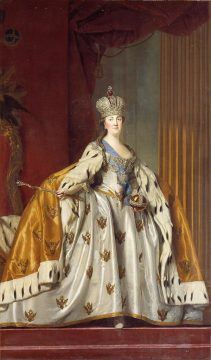 Catherine the Great is a monarch mired in misconception. Derided both in her day and in modern times as a hypocritical warmonger with an unnatural sexual appetite, Catherine was a woman of contradictions whose brazen exploits have long overshadowed the accomplishments that won her “the Great” moniker in the first place.