
Branson Wright in Cleveland.com:
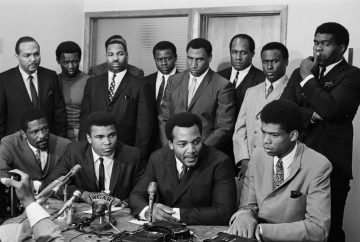 On a sunny Sunday afternoon in early June 1967, several hundred Clevelanders crowded outside the offices of the Negro Industrial Economic union in lower University Circle. None of those gathered, including a collection of the top black athletes of that time, realized the significance of what would happen in that building on this day. Muhammad Ali, the most polarizing figure in the country, was inside being grilled by the likes of Bill Russell, Jim Brown and Lew Alcindor, who would later change his name to Kareem Abdul-Jabbar. They weren’t interested in whether Ali was going to take his talents to South Beach or any other sports labor issues. They wanted to know just how strong Ali stood behind his convictions as a conscientious objector to the Vietnam War. The questions flew fast and furious. Ali’s answers would determine whether Brown and the other athletes would throw their support behind the heavyweight champion, who would have his title stripped from him later in the month for his refusal to enter the military.
On June 4, 1967 at 105-15 Euclid Ave. in Cleveland, a watershed moment occurred in the annals of both the civil rights movement and the protest against the Vietnam War. Every cultural force convulsing the nation came together – race, religion, politics, young vs. old, peace vs. war. This is the story about how such an extraordinary meeting developed. How it transpired in Cleveland. And of what that meeting means now, looking back through the lens of 45 years. “When I look at the situation in Florida [the Trayvon Martin case] and when I look through all my adult life, there’s always been a period where something happens that causes this country to struggle, be it racial or whatever,” said former Green Bay standout Willie Davis. “I look back and see that Ali Summit as one of those events. I’m very proud that I participated.”
More here. (Note: Throughout February, at least one post will honor The Black History Month. This year’s theme is “African Americans and the Vote.” Readers are encouraged to send in their suggestions)
 The week before Christmas, Richard Leakey, the Kenyan paleoanthropologist and conservationist, celebrated his seventy-fifth birthday. He is lucky to have reached the milestone. A tall man with the burned and scarred skin that results from a life lived outdoors, Leakey has survived two kidney transplants, one liver transplant, and a devastating airplane crash that cost him both of his legs below the knee. For the past quarter century, he has moved around on prosthetic limbs concealed beneath his trousers. In his home town of Nairobi, Leakey keeps an office in an unlikely sort of place—the annex building of a suburban shopping mall. His desk and chair fill most of his cubicle, which has a window that looks onto a parking lot.
 When you read an interview with William T. Vollmann you never quite know which William T. Vollmann you are going to get. Wild Bill Vollmann—the reckless journalist reporting on humanity’s crooked timber from the latest geopolitical hotspot? Billy the Kid—grinning nerd in flak jacket welcoming you into his creepy den of iniquities? William the Blunderer—concerned citizen quixotically laboring to save the world one lost soul at a time? Or maybe you’ll simply hang out with William Tell and shoot some guns of an afternoon, like French writer David Boratav did in 2004. None of these caricatures really do Vollmann justice, but if they help raise his profile and sell his books they’re doing their job. When in a 2010 interview with Carson Chan and Matthew Evans, Vollmann discusses the founding mythology of “American Ovidianism”—the ideal that you can change who you are—you understand that his commitment to transformation is not simply aesthetic, but ethical. His writing argues that each of us has the right to be who we are, and who we want to be.
 I experienced this in a fairly acute way at a Kiefer retrospective in London in 2014. Looking at one of his monumental paintings — “Black Flakes,” nearly 20 feet long and 10 feet tall, depicting a snow-covered field beneath an ashen sky, dark and apocalyptic, with rows of branches surrounding a thick book made of lead — all my thoughts seemed to be suspended, and only emotions remained. It wasn’t as if I was looking at a painting; the painting was enveloping me and filling me with its mood, which was impossible to escape. Everyone else who came into the room fell silent, too, as if they had suddenly been transported to another place within themselves. Kiefer’s pictures seemed to align with a gravity that we all knew but rarely acknowledged, a gravity that is solemn at times, horrifying at others.
 The young Swiss photographer Senta Simond shoots her subjects in natural light, but it’s the platonic-erotic bonds of close friendship that give them their particular glow. Simond credits the intimate, spontaneous mood of her portraits to her unfussy process: her subjects are women she knows, some of whom have been her models for a decade; she uses minimal equipment, in non-studio settings, and seeks out plain white backgrounds to position her subjects against. It’s familiarity and trust that produce her transfixing images—images that once upon a time might’ve been said to smack of the male gaze. The photos in her U.S. début, at Danziger Gallery (all from 2017–18), are “collaborative as opposed to voyeuristic,” the press release asserts, but this doesn’t quite ring true. They’re portraits of both obsession and self-possession. The exhibition’s fifteen black-and-white prints show women in deep thought and in varied states of undress, their mischievously—or lazily—uninhibited poses made thrilling by Simond’s bold camera angles, cropped compositions, and unmistakable fascination with the bodies before her.
 Robert Hockett in Forbes:
 Ian Sample in The Guardian:
 Patrick Blanchfield in n+1:
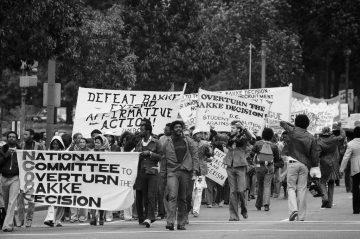 For two and a half centuries America enslaved its black population, whose labor was a critical source of the country’s capitalist modernization and prosperity. Upon the abolition of legal, interpersonal slavery, the exploitation and degradation of blacks continued in the neoslavery system of Jim Crow, a domestic terrorist regime fully sanctioned by the state and courts of the nation, and including Nazi-like instruments of ritualized human slaughter. Black harms and losses accrued to all whites, both to those directly exploiting them, and indirectly to all enjoying the enhanced prosperity their social exclusion and depressed earnings made possible. When white affirmative action was first developed on a large scale in the New Deal welfare and social programs, and later in the huge state subsidization of suburban housing — a major source of present white wealth — blacks, as
  The nuclear family is disintegrating—or so Americans might conclude from what they watch and read. The quintessential nuclear family consists of a married couple raising their children. But from Oscar-winning
 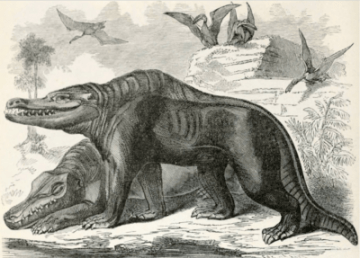 How long have dinosaurs been around? There is one obvious sense in which they ceased to exist 66 million years ago. There is another sense in which they began to exist only around the middle of the 19th century, when Richard Owen identified a “distinct tribe… of Saurian Reptiles” in 1842. Most animals have a long history of social salience before science comes along to tell us exactly where they belong in the order of nature. Not so with dinosaurs: they didn’t have any place in society at all until science informed us of their past existence, and from that point on their salience has been entirely wrapped up in cultural representations. These representations are anchored in something real, in a way that those of unicorns are not, but the fact that we have fossilised skulls and vertebrae to point to in the case of dinosaurs, while we do not have equine skulls with a horn in the middle to point to in the case of unicorns, only makes it more difficult, not less, to understand what we may expect the folk-categorical term “dinosaur” to do.
 It is a journalistic convention that any author who writes a doorstopper of a book with the word “capital” in the title must be the heir to Karl Marx, while any economist whose books sell in the hundreds of thousands is a “rock star”. Thomas Piketty’s 600-page, multi-million selling
 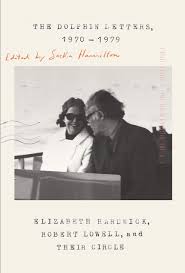 The Dolphin won the Pulitzer Prize, Lowell’s second, in 1974. It also sparked controversy, due not only to Lowell’s portrayal of Hardwick as the aggrieved, abandoned wife—the “Lizzie character,” as he called her—whom he unflatteringly contrasts throughout to the fecund Caroline character, variously imagined as dolphin, mermaid, and baby killer whale—but also due to his appropriation, and changing, of Hardwick’s letters into sonnets that voice the wife’s side of the story, whether as letter-poems or admonitory echoes that surface in the Lowell character’s head. The awkwardness here of referring to real people as characters reflects the inherent problem with Lowell’s book: the line between fact and fiction is stretched so thin—even to the point of “character” names corresponding to those of their real-life counterparts—that readers are led to assume that the book chronicles reality, not fiction, despite Lowell’s equivocal disclaimer in the final, title poem that the book is “half fiction.”
 Ninagawa would’ve hated being called my favorite self-Orientalist. He would’ve thrown an ashtray at me, if the stuff of legends is true. He did not brook critiques that hinted at his dabbling in the “Japanesque.” Ninagawa’s audience—his only audience, he maintained—was the Japanese, his aim “to produce a Shakespeare play that could be understood by ordinary people.” He said this with an air of finality, as if slamming a door shut, but I always wanted to jam a foot in before he did. I needed definitions—for “ordinary” and “Japanese”—his full-throated definitions, though he’d died before giving them. Because seeing his art had taught generations to stretch the bounds of those two words beyond imagining. No, here’s a more honest, selfish reason than that: I needed to know whether he was speaking to people who found them both comforting and troubling. I needed to know whether he was speaking to people like me.
 In October 1726 some ‘strange, but well attested’ news emerged from Godalming near Guildford. An ‘eminent’ surgeon, a male midwife, had delivered a poor woman called Mary Toft not of a child but of rabbits – a number of them, over a period of several weeks. None of the rabbits, not even a ‘perfect’ one, survived their birth, but the surgeon bottled them up and declared his intention to present them as specimens to the Royal Society. A report in the British Gazeteer furnished readers with the woman’s explanation. Some months earlier she and other women working in a field had chased a rabbit and failed to catch it. She was pregnant at the time and suffered a miscarriage. Thereafter, she pined to eat rabbit and had been unable to avoid thinking of rabbits.
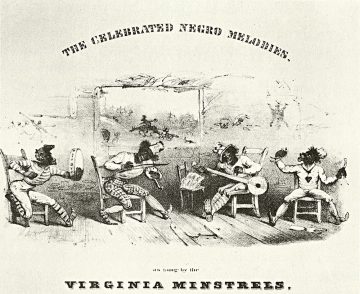 Minstrel shows, most often with white entertainers performing in blackface, were a highly racist phenomenon that were a pervasive form of entertainment in America for over 80 years through the 1800s and early 1900s. Yet as complicated and fundamentally offensive as they were, it was part of what led to a break with a purely European music tradition: “African Americans were leading the way in breaking with European musical tradition, and, strange as it might seem, this break had been anticipated, and maybe even urged, by the minstrel show, the first form of musical theater to reach the whole country. Its history is much longer than the eighty or so years that it is said to have lasted in the United States; its legacy is far more complicated than just a matter of white people copying black people, and even today questions about the sources of this music and its influence remain unsettled.