
Steve Paulson in Nautilus:
When he was a boy, Mark Solms obsessed over big existential questions. What happens when I die? What makes me who I am? He went on to study neuroscience but soon discovered that neuropsychology had no patience for such open-ended questions about the psyche. So Solms did something unheard of for a budding scientist. He reclaimed Freud as a founding father of neuroscience and launched a new field, neuropsychoanalysis. I reached Solms in Cape Town, South Africa, where he’s stayed during the COVID-19 lockdown. We talked about the brain-mind problem, the biases of neuropsychology and how a family trauma shaped the course of his life.
There are huge debates about the science of consciousness. Explaining the causal connection between brain and mind is one of the most difficult problems in all of science. On the one hand, there are the neurons and synaptic connections in the brain. And then there’s the immaterial world of thinking and feeling. It seems like they exist in two entirely separate domains. How do you approach this problem?
Subjective experience—consciousness—surely is part of nature because we are embodied creatures and we are experiencing subjects. So there are two ways in which you can look on the great problem you’ve just mentioned. You can either say it’s impossibly difficult to imagine how the physical organ becomes the experiencing subject, so they must belong to two different universes and therefore, the subjective experience is incomprehensible and outside of science. But it’s very hard for me to accept a view like that. The alternative is that it must somehow be possible to bridge that divide.
The major point of contention is whether consciousness can be reduced to the laws of physics or biology. The philosopher David Chalmers has speculated that consciousness is a fundamental property of nature that’s not reducible to any laws of nature.
I accept that, except for the word “fundamental.” I argue that consciousness is a property of nature, but it’s not a fundamental property. It’s quite easy to argue that there was a big bang very long ago and long after that, there was an emergence of life. If Chalmers’ view is that consciousness is a fundamental property of the universe, it must have preceded even the emergence of life. I know there are people who believe that. But as a scientist, when you look at the weight of the evidence, it’s just so much less plausible that there was already some sort of elementary form of consciousness even at the moment of the Big Bang. That’s basically the same as the idea of God. It’s not really grappling with the problem.
More here.
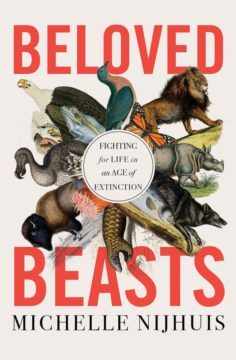 Today’s conservationists
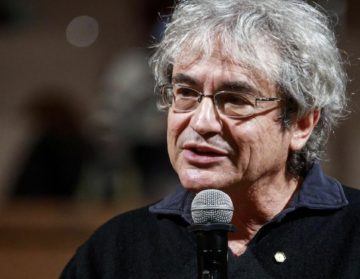 Rovelli has written a new book. Its title, Helgoland, refers to a barren island off the North Sea coast of Germany, where the 23-year-old physicist Werner Heisenberg (who would go on to work on the unrealised Nazi atomic bomb) retreated in June 1925. He was trying to make sense of recent atomic experiments, which had revealed an Alice in Wonderland submicroscopic realm where a single atom could be in two places at once; where events happened for no reason at all; and where atoms could influence each other instantaneously—even if on opposite sides of the universe.
 In the Himalayas and the Middle East, countries feud over water. In the African Sahel, farmers feud over cropland. In the melting Arctic, governments feud over seabed minerals. Climate change has provided bottomless inspiration for aspiring paperback novelists. But while thrillers must thrill and generals must fret, fears about the national security threats that climate change could present remain too vague to act on. The geopolitical reasons for a strong U.S. response to climate change lie not in what Americans might imagine about tomorrow’s world politics but in the global political relationships at stake today.
 Some proponents of an intelligence explosion argue that it’s possible to increase a system’s intelligence without fully understanding how the system works. They imply that intelligent systems, such as the human brain or an A.I. program, have one or more hidden “intelligence knobs,” and that we only need to be smart enough to find the knobs. I’m not sure that we currently have many good candidates for these knobs, so it’s hard to evaluate the reasonableness of this idea. Perhaps the most commonly suggested way to “turn up” artificial intelligence is to increase the speed of the hardware on which a program runs. Some have said that, once we create software that is as intelligent as a human being, running the software on a faster computer will effectively create superhuman intelligence. Would this lead to an intelligence explosion?
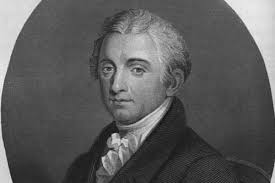 Morris’s writing took many forms. As well as maintaining a diary, he penned poems in multiple languages to the many women he seduced over the years in Europe and the United States (‘I know it to be wrong, but cannot help it’). He translated lines from Greek and Roman classics and produced pamphlets on finance and commerce. He also wrote the American constitution, quite literally. One of the fifty-odd delegates who met in Philadelphia over the summer of 1787 to draft this document, Morris chaired the constitutional convention’s ‘committee of style’ (the fact that a committee of this sort was judged desirable is suggestive). It was Morris, James Madison records, who was chiefly responsible for ‘the finish given to the style and arrangement’ of the American constitution. Most dramatically, it was he who replaced its initial matter-of-fact opening with one of the most influential phrases – and pieces of fiction – ever devised: ‘We the People of the United States…’
 About halfway through a recent episode of “
 A lot of worry has been triggered by discoveries that variants of the pandemic-causing coronavirus
  As we learn in The Tyranny of Merit, Michael Sandel’s view of meritocracy rests in part on the historical claim that it is grounded in the Calvinist understanding of predestination. “Combined with the idea that the elect must prove their election through work in a calling,” he writes, such a doctrine “leads to the notion that worldly success is a good indication of who is destined for salvation.” In this he follows Max Weber in The Protestant Ethic and the Spirit of Capitalism, but Sandel extends this thesis to the present moment, citing the evangelical idea of the “prosperity gospel” and the secular rationalizations of such well-known achievers as Lloyd Blankfein (CEO of Goldman Sachs) and John Mackey (founder of Whole Foods), who represent the understanding of health and wealth “as matters of praise and blame…a meritocratic way of looking at life.”
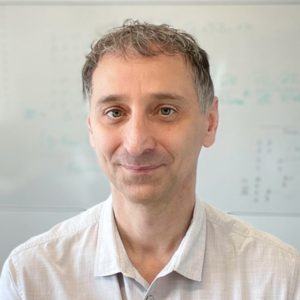 “Time” and “the brain” are two of those things that are somewhat mysterious, but it would be hard for us to live without. So just imagine how much fun it is to bring them together. Dean Buonomano is one of the leading neuroscientists studying how our brains perceive time, which is part of the bigger issue of how we construct models of the physical world around us. We talk about how the brain tells time very differently than the clocks that we’re used to, using different neuronal mechanisms for different timescales. This brings us to a very interesting conversation about the nature of time itself — Dean is a presentist, who believes that only the current moment qualifies as “real,” but we don’t hold that against him.
 The hardest thing about teaching someone how to drive a boat is that it’s not at all like driving a car. To steer a car, you turn the wheel until your nose is pointing where you want to go, then you straighten out and go there. This works because the car is attached to the road. It’s when the car itself is no longer attached to the road that things get weird. When you turn too hard, for example, the rubber in your tyres loses purchase on the street, and you are “in drift”. The normal rules no longer apply.
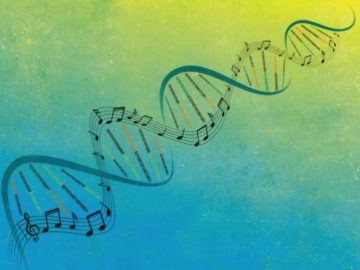 DIGITAL-DATA PRODUCTION
 Where do you place the boundary between “science” and “pseudoscience”? The question is more than academic. The answers we give have consequences—in part because, as health policy scholar Timothy Caulfield
  W
W