
Category: Recommended Reading
William Smith (1933 – 2021) actor
Byron Berline (1944 – 2021) fiddle player
The secret lives of Neanderthal children
Rebecca Sykes in BBC News:
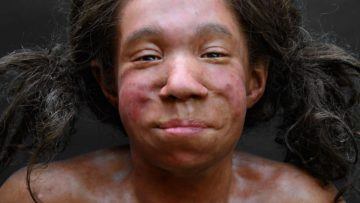 In any normal summer, Spain’s famous Playa de la Castilla – a perfect 20km (12 mile) long stretch of sand backed by the Doñana nature reserve and close to the resort of Matalascañas, Huelva – would have been covered by the footprints of visiting tourists. But in June 2020 with international flights banned due to Covid-19, the beach was uncharacteristically quiet. Two biologists – María Dolores Cobo and Ana Mateos – who were strolling along the peaceful beach, nonetheless found many footprints. These, however, were made by a very different kind of visitor.
As savage storms and then powerful spring tides earlier in the year had lashed Spain’s south-west coast, huge waves scoured away the sand at the base of 20m (65ft) dunes, revealing an enormous area of rock covering some 6,000 sq m (1.5 acres). Its surface was pocked with indentations which the pair of biologists recognised as footprints: a jumble of hooves, claws and paws preserved in the rock. But when the two women looked closer, among the criss-crossing animal tracks were other prints that looked startlingly human. What’s more, their position at the bottom of the cliff layers meant they had to have been left in the distant past.
More here.
Sunday Poem
Exit Strategy
Tell me there is a way to believe it all,
an exit strategy with groggy murmurs
of nothing but rest and a quiet universe.
All I can think of is my child, asleep
in bed, dealing with whatever birthright
his dreams afford his fears, waiting to wake.
Sometimes I feel like Kepler, poised to inherit
pages of wrinkled data, but grumbling,
What a holy-fucking mess Tycho left behind.
Under the surface of the crowd’s rumble
is a song. We could have danced, you know,
to the how-not-why of these perfect heartbeats.
It’s true. You’ve not been asked to understand.
You’ve been asked to listen, and work it out.
by George Murray
from The Rush to Here
Nightwood Editions, 2007
Saturday, July 17, 2021
We Don’t Know, But Let’s Try It
 Simon Torracinta in Boston Review:
This spring the United States embarked on a grand experiment. The American Rescue Plan, signed into law on March 11, appropriated $1.9 trillion in public spending—on top of $2.2 trillion for the CARES Act a year prior—to accelerate recovery from the dramatic economic shock of the pandemic. Combined, these measures amount to a fiscal stimulus of unprecedented scale.
Economists in the Biden administration and the Federal Reserve are bullish that this intervention will enable a rapid return to the boom times—or at least what passed for them—that preceded March 2020. They believe that running the economy “hot,” without much slack in unemployment, will extend the fruits of recovery to historically marginalized populations in the labor market and stimulate greater productive investment. Meanwhile, prominent skeptics like Larry Summers, himself a former Treasury secretary, have sounded the alarm about what they see as the significant risks and early signs of inflation, as existing capacity strains to meet the torrent of renewed demand. Implicitly, these admonitions conjure up the specter of the wage-price spirals of the 1970s.
Given the economic landscape since 2008—ultra-low interest rates, reduced worker power, low labor force participation rates—the prospects of this scenario seem rather dim. But the truth is that we don’t really know what will happen. The scale of the experiment and the sheer number of moving parts conspire to make forecasters even more uncertain than usual. Every new piece of economic data is scrutinized for augurs of the future, and entire news cycles turn on the finer points of microchip and lumber supply chains or used car sales.
Although uncertainty presents a persistent headache for central bankers and investors, it has a longstanding place in economic theory.
More here.
Economists for Inclusive Prosperity – A New Macroeconomics
A Miniaturist Goes Large
Molly Crabapple in the New York Review of Books:
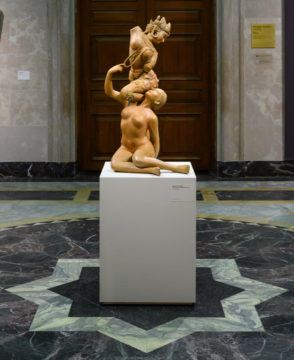
The first thing you see when you walk into “Extraordinary Realities,” Pakistani-American artist Shahzia Sikander’s major retrospective at the Morgan Library, is an Indian Devata dancer, gently resting her knee on the shoulder of Aphrodite. Cast in bronze, nearly life-sized, Promiscuous Intimacies (2020) is Sikander’s first sculpture, and her two women only have eyes for each other. Aphrodite toys with the Devata’s necklace. The Devata curves around Aphrodite like a snake.
The two sex bombs, archetypal respectively for East and West, expose the inanity of the categories. These avatars might be citizens of a single world—one where Alexander’s armies marched through the monsoon-soaked Punjab, where the inhabitants of the Indian city of Nysa claimed Dionysus as their founder, and where a statue of Lakshmi is hidden beneath the lava of Pompeii. Their separation only made sense according to the logic of newer empires. Here in the Morgan Library, they are wrapped together in love. Supremely self-confident and disdainful of all borders, the pair are the perfect guardians for a show in which Sikander blows open the form of miniature painting.
More here.
‘Walking the Invisible’ by Michael Stewart
Anita Sethi at The Guardian:
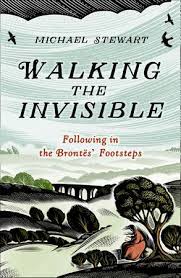 Stewart travels through the north of England, across moors and meadows, up mountains and through cities and villages and along coastal paths. He also voyages into the inner lives of the Brontës, showing how external place shaped their internal landscapes, how the wild fuelled their imagination.
He begins his walks in the Brontë birthplace, Thornton, in west Yorkshire, where Patrick spent his “happiest days” before the untimely death of his wife Maria and two eldest daughters. He also follows part of the Pennine Way to the ruin of Top Withens, thought to have inspired Emily’s farmhouse location of Wuthering Heights. He captures how for Emily “the moors were a place of awe and fascination. It was a land that was alive with a terrible destructive beauty.” These engaging present-tense walks include an excellent account of recreating the walk that Mr Earnshaw took in 1771 when he travelled from Wuthering Heights to Liverpool – Stewart ventures via Littleborough and Manchester with his dog Wolfie, and has some hair-raising wild camping experiences.
more here.
‘Pessoa’ Is Definitive And Sublime
Parul Sehgal at the NYT:
 He published a few books that went mostly unnoticed, but there were rumors of a trunk in his room stuffed with his true life’s work. After his death in 1935, the trunk was discovered, brimming with notes and jottings on calling cards and envelopes, whatever paper appeared to be handy. They were authored not only by Pessoa but by a flock of his personas (“heteronyms,” he called them): a doctor, a classicist, a bisexual poet, a monk, a lovesick teenage girl. Among his writings was a sheaf of papers that would become his masterpiece: “The Book of Disquiet,” a mock confession in sly, despairing aphorisms and false starts — “The active life has always struck me as the least comfortable of suicides.” In total, Pessoa created dozens of heteronyms, most complete with biographies, bodies of work, reviews and correspondence. He was awed, and a little afraid of his mind, its “overabundance.” What relation did it bear to a family history of nervous instability?
Mammoth, definitive and sublime, Richard Zenith’s new biography, “Pessoa,” gives us a group portrait of the writer and his cast of alternate selves — along with a perceptive reading of what it meant for Pessoa to multiply (or did he fracture?) like this.
more here.
What is the Doomsday Clock and why should we keep track of the time?
Ian Lowe in Kurzweil AI:
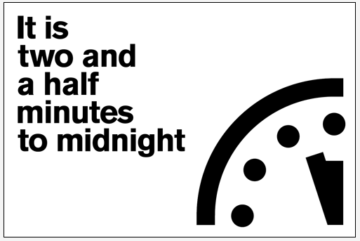 It made headlines recently when the Doomsday Clock was shifted on January 26, 2017 from three minutes to midnight to a new setting of two and a half minutes to midnight.* That is the nearest the clock has been to midnight for more than 50 years. The body responsible for the clock said the probability of global catastrophe is very high, and the actions needed to reduce the risks of disaster must be taken very soon. It should be an urgent warning to world leaders. The idea of a Doomsday Clock was conceived by the editorial staff of the Bulletin of the Atomic Scientists, which was founded by many of the scientists who worked on the Manhattan Project.
When that publication graduated from being an internal newsletter among the nuclear science community to being a formal magazine in 1947, the clock appeared on the cover. The magazine’s founders said the clock symbolised the urgency of the nuclear dangers that we — and the broader scientific community — are trying to convey to the public and political leaders around the world.
The clock was [initially] set at seven minutes to midnight. Two years later, with the news that a nuclear weapon had been tested by the USSR, the communist state centered on modern Russia, the clock was moved to 11.57. In 1953, the USA first tested the hydrogen bomb, a fusion weapon much more powerful than the fission bombs that had destroyed Hiroshima and Nagasaki. The USSR followed a few months later and the clock was advanced to 11.58 with a warning there was a real chance that from Moscow to Chicago, atomic explosions will strike midnight for Western civilization.
Then there was a period of modest progress. It gradually became apparent that the new weapons were so powerful that only a deranged leader would consider using them against a similarly armed enemy, given the inevitability of catastrophic retaliation. In 1963, after they had been continuously testing more and more deadly weapons, the USA and the USSR signed the Partial Test Ban Treaty, which prohibited atmospheric testing. The clock was moved back to 11.48.
It was a false dawn.
More here.
Gershom Scholem – The Religious Dimension of Judaism
A just and loving gaze
Deborah Casewell in aeon:
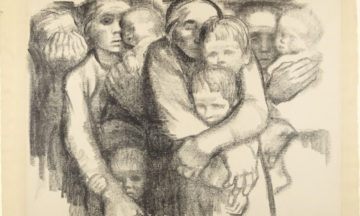 The short life of Simone Weil, the French philosopher, Christian mystic and political activist, was one of unrelenting self-sacrifice from her childhood to her death. At a very young age, she expressed an aversion to luxury. In an action that prefigured her death, while still a child, she refused to move until she was given a heavier burden to carry than her brother’s. Her death in Ashford in England in 1943, at just 34, is attributed to her apparent refusal to eat – an act of self-denial, in solidarity with starving citizens of occupied France, which she carried out despite suffering from tuberculosis. For her uncompromising ethical commitments, Albert Camus described her as ‘the only great spirit of our time’.
This is certainly more complimentary than her university nicknames of ‘the Red Virgin’, ‘the Categorical Imperative in Skirts’, and even ‘the Martian’. Indeed, Weil’s reported interactions with the other great spirits of those times further underline the force of her personality. Simone de Beauvoir, who attended the Sorbonne at the same time, came across her during their student days and described a conversation with Weil sparked by her response to the famine in China:
she declared in no uncertain tones that only one thing mattered in the world: the revolution which would feed all the starving people of the earth. I retorted, no less peremptorily, that the problem was not to make men happy, but to find the reason for their existence. She looked me up and down: ‘It’s easy to see you’ve never been hungry,’ she snapped.
Despite this put-down, Beauvoir admired Weil and her ‘heart that could beat right across the world’.
Weil took no prisoners in any debate. Although Leon Trotsky had recently excoriated her critique of Marxism, Weil arranged for the Marxist revolutionary to stay in her parents’ apartment in December 1933 and host an illicit political gathering. This did, however, come at the expense of a night-long, intense discussion with Weil. While she always argued softly and clearly, that did not prevent the discussion from being punctuated by violent shouts.
More here.
Saturday Poem
Epitaph
When I die give what’s left of me away
to children and old men that wait to die.
And if you need to cry,
cry for your brother walking the street beside you.
And when you need me, put your arms around anyone
and give them what you need to give to me.
I want to leave you something,
something better than words or sounds.
Look for me in the people I’ve known or loved,
and if you cannot give me away,
at least let me live on in your eyes and not your mind.
You can love me most by letting hands touch hands,
and by letting go of children that need to be free.
Love doesn’t die, people do.
So, when all that’s left of me is love,
give me away.
by Merrit Malloy
from Meditations Before Kaddish
Friday, July 16, 2021
The Endless Pursuit of Better
Elizabeth Currid-Halkett in The Hedgehog Review:
 You shall know them by their aspirations. Or so one might think, judging by the manifold ways in which Americans brand themselves by the things they seek to acquire and the ideals they seek to live by. Americans of all classes and identities aspire to various things, of course. The pursuit of happiness remains a central element of their national creed. But the meritocratic class has become the aspirational class par excellence. Aspiration connotes movement upward, and the meritocrat lives proudly and ostentatiously (some might even say overbearingly) in tireless pursuit of better. Little wonder that meritocrats come to think that what they and their offspring aspire to is manifestly and even morally superior to what others strive after.
For all of the well-intentioned idealism of today’s aspirational elite—their politically sensitive wokeness, their belief in hard work and education over birthright, their environmental awareness, their earnest suspicion of the excesses and injustices of capitalism—there is a dark side of meritocracy that is never fully concealed in the strivers’ displays and proclamations of goodwill. The simple fact is that most people—if we consider 90 percent of the country’s population “most”—do not learn piano from the age of five, do not attend private school, do not have SAT tutors (even if standardized tests are falling by the wayside), do not attend a “top twenty-five” school, or earn PhDs or MFAs. Laudable as these activities and achievements may be, they are underpinned by both wealth and cultural capital. While about 35 percent of Americans go to college, less than 0.5 percent graduate from Yale, Princeton, and their ilk. Harvard economist Raj Chetty and his colleagues have found that students whose parents are among the top one percent economically are seventy-seven times more likely to attend an Ivy League university than those with parents in the bottom quintile. In short, you have to have the money and, just as important, know what to spend it on.
More here.
On bottlenecks, crashes and what genetic diversity really looks like
Razib Khan in Unsupervised Learning:
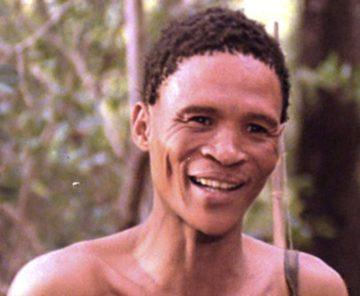 Now that Prometheus has basically granted every lowly lab tech superhuman powers, it’s like drinking from a data firehose if you love ancient DNA. And the more we know, the clearer it looks that genetically, all the humans on our planet group into basically three genetic types. You could think of them as 1. the very-diverse, 2. the not-very-diverse 3. the very-not-diverse (and if we’re being thorough: 4. a recent hybrid of 2 and 3.)
Do you know which you are? You don’t have to tell me anything else about you; by the very fact that you are reading this I can almost guarantee you are in group 2 or 3. Just based on the numbers, I’ll put my money on 3. Six to one odds. (And if you’re in group 1 and haven’t been genotyped but are interested in human genetics, DM me! I can help you get a spit kit. You’re genetically very unique!)
Here is how the groups break down:
- Scarcely half a million of us are very-diverse.
- 1.14 billion of us are not-very-diverse.
- 6.42 billion of us are very-not-diverse.
Alone on our planet today, those maybe half a million very-diverse souls hint at our species’ one-time amazing levels of genetic diversity. In our DNA, we all contain multitudes. But once, we all contained mega-multitudes. Only the very-diverse retain much of it today.
More here.
The Plight Of Twenty-First-Century Migrants
Mir Ali Hosseini in The Philosophical Salon:
 As a refugee from the war-stricken Old World, where ethnic homogeneity had remained the defining principle of every citizenry, Arendt saw in the American republic the promise of a body politic, which absorbed newcomers without forcing them to adapt to a pre-determined homogeneity—even though she became increasingly critical of the cultural conformity of American “mass society.”
In 1973, two years before her passing, when Arendt was asked in an interview with French television about her impression dominante of America as a European, she replied in English:
“Mon impression dominante…Well, see, this is not a nation-state. America is not a nation-state, and Europeans have a hell of a time to understand this simple fact which, after all, they could know theoretically. This country is united neither by heritage, nor by memory, nor by soil, nor by language, nor by origin from the same. There are no natives here. The natives were the Indians. , and these citizens are united only by one thing—and that is a lot. That is, you become a citizen of the United States by simple consent to the Constitution.”
As Robert Bernasconi has argued, this idealized picture of the American republic is deeply problematic.
More here.
1st Prize Short Climate Film Winner: “Three Seconds”
Discovery of Tumor Suppressor Suggests New Cancer Treatment Strategies
NCI Staff in Cancer.gov:
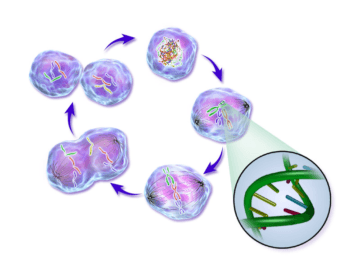 At the heart of all cancers is a fundamental problem: a cell—and eventually innumerable cells—that won’t stop dividing. This runaway growth is what forms a tumor, and the abnormal cellular processes that drive this growth can help tumors withstand the cancer treatments intended to kill them. Despite more than six decades of research into the mechanisms that cells use to divide, some of the nuts and bolts of the process remain a mystery. Scientists want to better understand these mechanisms in hopes of targeting them and potentially shutting down the uncontrolled growth of some tumors. New research from three collaborating teams of scientists in the United States and Europe appears to have found one of these mechanisms, uncovering a previously unknown check on dividing cells: a protein called AMBRA1. By limiting tumor growth, the researchers showed, AMBRA1 serves as an important tumor suppressor—as these types of molecules are often called—in healthy cells.
The new work shows that AMBRA1 marks other proteins involved in helping cells divide (known as cyclins) for destruction when cell division isn’t needed. When the gene that produces AMBRA1 is damaged and the protein is missing or doesn’t work properly, the cell cycle loses one of its main brakes, potentially letting cell division spiral out of control. The loss of the AMBRA1 protein, the researchers found, can drive tumor formation in mice and is linked with worse outcomes in some human tumors. They also reported that a lack of AMBRA1 may make some tumors resistant to drugs called CDK4/6 inhibitors, which are a promising new class of cancer treatments. The new research may point to potential strategies for blocking the runaway cell division caused by loss of AMBRA1 and for re-sensitizing cancer cells to CDK4/6 inhibitors. The results from all three studies were published on April 14 in Nature.
More here.
A New Era of Designer Babies May Be Based on Overhyped Science
Laura Hercher in Scientific American:
 For better or worse, genetic testing of embryos offers a potential gateway into a new era of human control over reproduction. Couples at risk of having a child with a severe or life-limiting disease such as cystic fibrosis or Duchenne muscular dystrophy have used preimplantation genetic testing (PGT) for decades to select among embryos created through in vitro fertilization (IVF) for those that do not carry the disease-causing gene. But what new iteration of genetic testing could tempt healthy, fertile couples to reject our traditional time-tested and wildly popular process of baby making in favor of hormone shots, egg extractions and DNA analysis?
A California-based start-up called Orchid Biosciences claims it has an answer to that question. The company offers prospective parents genetic testing prior to conception to calculate risk scores estimating their own likelihood of confronting common illnesses such as heart disease, diabetes, and schizophrenia and the likelihood that they will pass such risks along to a future child. Parents-to-be can then use IVF, along with Orchid’s upcoming embryo screening package, to identify the healthiest of their embryos for a pregnancy.
Orchid aims to use PGT and IVF to expand what is already a thriving marketplace in screening tests for prospective parents. Initially, the only people offered tests to prevent genetic disease in the next generation were those whose ancestry put them at higher risk for a specific condition, such as Tay-Sachs disease in the Ashkenazi Jewish population. The first genetic screen intended for universal use and covering a wide range of diseases was introduced by Counsyl (now part of Myriad Genetics) in 2010. Today carrier screening is a $1.7-billion industry. These tests search for genetic problems that otherwise come to light only after the birth of an affected child. But diseases caused by a single gene are rare. Most children are born healthy, and most couples who do carrier screening come away reassured.
More here.