
Sudipto Sanyal in The Smart Set:
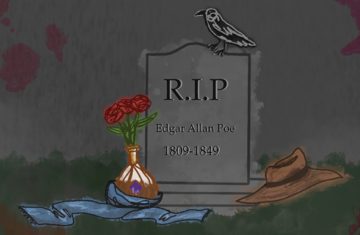 What is it about Poe that grips the popular imagination so, like the medieval Iron Shroud shrinking inward and threatening to crush the narrator of “The Pit and the Pendulum”? Who was he, and what strange Romantic resonances does he emit that continue to fascinate us?
“The oldest and strongest emotion of mankind is fear, and the oldest and strongest kind of fear is fear of the unknown,” wrote that other fantasist H. P. Lovecraft. In his stories — and even his poems — Poe brings forth, as if out of thin air, a grotesque world fully crystallized. It is utterly self-contained and frequently terrifying, a radical break from our mundane realities (also self-contained and terrifying, but in less unknowable ways). Reading Poe, we learn remarkably little of the New World in the middle of the 19th century — no Mexican-American War, no California Gold Rush, no westward ho!, no rumblings over slavery.
More here.
 Standing in the middle of a room previously inhabited by a now-absent figure can conjure an eerily potent atmosphere, traceable through sensations rather than words. Perhaps it’s because so much of what shapes the edges of any individual’s persona resides within the colors they prefer, their cooking and cleaning smells, or the sounds they regularly hear emanating from the pipes in their walls or a creak in their floorboards. When a person’s body exits their habitat, all the things that previously swirled in and around their tangible body remain, suspended in the air in a thick, viscous hum. These remnants permeate the objects the person leaves behind, too, charged with energy, appearing as sentient creatures rather than a lifeless pile of stuff.
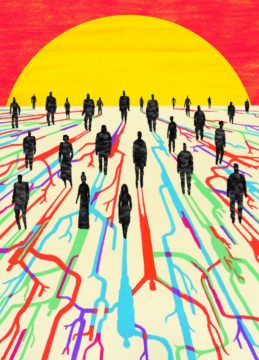 Moments of sociopolitical tumult have a way of generating all-encompassing explanatory histories. These chronicles either indulge a sense of decline or applaud our advances. The appetite for such stories seems indiscriminate—tales of deterioration and tales of improvement are frequently consumed by the same people. Two of Bill Gates’s favorite soup-to-nuts books of the past decade, for example, are Steven Pinker’s “
 T
T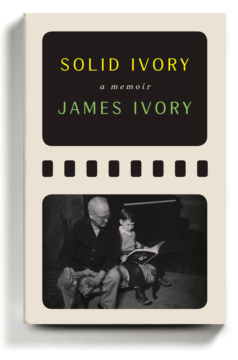 Merchant and Ivory, normally working with the writer Ruth Prawer Jhabvala, were one of the most dominant cinematic forces of the late 20th century, rolling out luxuriously appointed adaptations of E.M. Forster and Henry James novels, with the occasional more contemporary anomaly like Tama Janowitz’s “Slaves of New York.” Merchant died in 2005; Jhabvala in 2013. After decades conjuring the Anglo-American aristocracy clinking cups in gardens and drawing rooms, Ivory, the survivor, is ready to spill the tea.
 Benjamin Braun and Adrienne Buller also in Phenomenal World (image: Joëlle Tuerlinckx,
 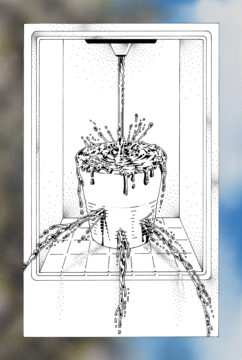 Ajay Singh Chaudhary in The Baffler (image
 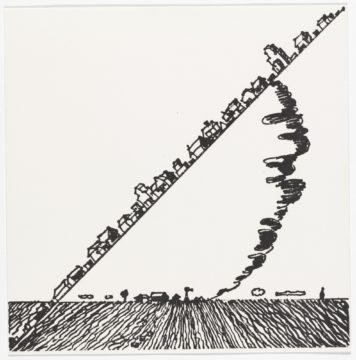 Herman Mark Schwartz in Phenomenal World:
 Something unnatural
 To be a literary biographer is to court the extravagant ridicule of the very people you write about. For all of the salutary services a writer’s biography can offer — the tracing of the life, the contextualizing of the work, the resuscitation of a reputation and the deliverance from neglect — the biographer has been derided as a “post-mortem exploiter” (Henry James) and a “professional burglar” (Janet Malcolm).
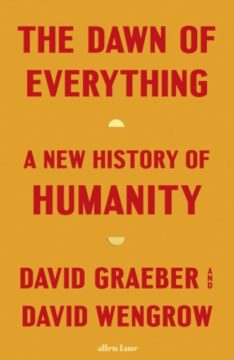 The standard history of humanity goes something like this. Roughly 300,000 to 200,000 years ago, Homo sapiens first evolved somewhere on the African continent. Over the next 100,000 to 150,000 years, this sturdy, adaptable species moved into new regions, first on its home continent and then into other parts of the globe. These early humans shaped flint and other stones into cutting blades of increasing complexity and used their tools to hunt the mega-fauna of the Pleistocene era. Sometimes, they immortalized these hunts—carved on rock faces or painted in glorious murals across the walls and ceilings of caves in places like Sulawesi, Chauvet, and Lascaux.