
Zaheer Kazmi at BISA:
 For over forty years, radical Islam has been one of the most clichéd expressions in Western political discourse. From around the time of the Islamic Revolution in Iran in 1979, it has been invoked habitually by policymakers, the media and academics alike. At the heart of justifications for war, it has also dominated analysis of global terrorism and political violence since 9/11. Yet it has often displayed a ‘we know it when we see it’ quality, evident not only in assumptions that underpin its usage in the lexicon of Western security policies but in settled genealogies of ‘Islamism’ or ‘jihadism’ recycled routinely by scholars across various disciplines. Rather than being self-evident, however, analysis of radical Islam functions more as a kind of Rorschach test onto which assorted interpretations of ‘radicalism’ and ‘Islam’ are projected. In my article for RIS, I address the vagaries of radical Islam’s widespread presence in the Anglophone academy by treating the labelling of Islam and Muslim actors as radical as a particular scholarly practice.
More here.
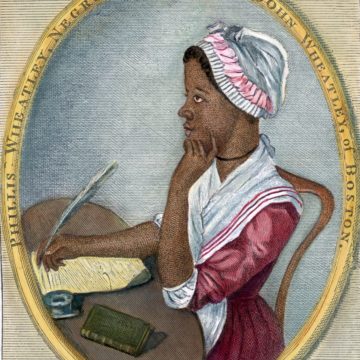 I told a colleague once that Wheatley is funny. We were making small talk at a conference in a middling New England town, likely not too far from where Wheatley’s friend, Obour Tanner, settled for a time—while her hometown was occupied by British soldiers—in 1778 and 1779. I saw my colleague’s surprise. I told her about Thornton’s absurd request and Wheatley’s joke. With a bit of concern, she asked me, “How do you know that it’s funny? How do you know Wheatley is joking? Maybe she’s articulating a kind of anxiety.” Because I didn’t have Thornton’s letter handy and couldn’t show her Wheatley’s “Now to be Serious,” I responded with my own questions: “Since when are anxiety and humor mutually exclusive? Aren’t some of the funniest people anxious?” We were left at an impasse. She was left with the implausibility of a funny Wheatley, and I was left with a nagging question: Why can’t we imagine that a twenty-one-year-old woman would tell jokes? The answer, I now suspect, is that it’s in part because of our dependency on Wheatley’s poetry. Her poems offer readers what they know to expect—references to Africa, enslavement, or even complicity and complacency, and at times, resistance. Her letters don’t. They aren’t extraordinary or unique. They don’t recount an escape, and they don’t always tell a compelling story. They do share in very quotidian ways what might annoy her, what she might love, and what makes her laugh.
 BIOGRAPHY AT ITS BEST
 Last week’s announcement by drug behemoth Pfizer that its 5-day pill regimen powerfully curbs many early SARS-CoV-2 infections opens a new chapter in the battle against the virus. In a clinical trial that an independent monitoring group halted early because the experimental therapy appeared so effective, it slashed hospitalizations by 89% among those treated within 3 days of symptom onset. If Pfizer’s drug candidate passes muster with regulators, it could join molnupiravir, a pill recently developed by Merck & Co. that received approval last week in the United Kingdom, as the first oral medications proved to stop COVID-19 from progressing to severe disease.
 When the interwar Conservative leader and three-time prime minister Stanley Baldwin was asked if any great thinker had influenced him, he replied: “Sir Henry Maine”. The Victorian jurist, Baldwin continued, interpreted the history of society as a grand advance from societies based on hierarchy and status to ones founded on contract and consent: an inspiring vision of human progress. Then, what looked like an expression of puzzlement came over the wily elder statesman’s face. “Or was it,” he asked, “the other way round?”
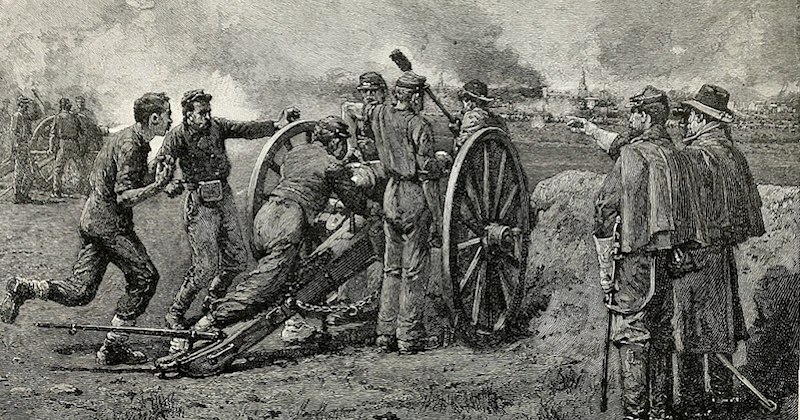 On the last day of October 1895, a letter was sent to Stephen Crane by the corresponding editor of The Youth’s Companion inviting him to submit work to the magazine: “In common with the rest of mankind we have been reading The Red Badge of Courage and other war stories by you… and feel a strong desire to have some of your tales.” Advertising itself as “an illustrated Family Paper,” the Companion was a national institution with an immense readership that began its life in 1827 and remained on the American scene for more than 100 years. Never more popular than in the 1890s, it published work by every important writer from Mark Twain to Booker T. Washington, and, as the corresponding editor pointed out in his letter to Crane, “the substantial recognition which the Companion gives to authors is not surpassed in any American periodical.” On top of that, it paid well.
 The major food staples are essential to human survival. Chocolate and coffee are not essential, but try to imagine a world without them. One of the numerous concerns with climate change is that many species will lose their habitats. Scientists are projecting that, in the coming decades, this could lead to the extinction of many crops, including cacao and coffee plants.
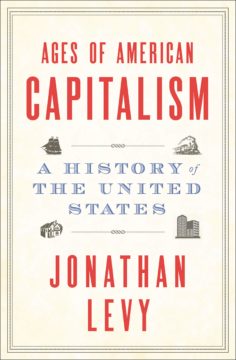 Capitalism has had a strange relation to the history of the United States. Whereas most societies of the Euro-Atlantic world have defined their histories at least in part around their transition from feudalism to capitalism or their complex (and often explosive) encounters with the latter, the history of the British North American colonies and then the United States has generally assumed a simultaneity in origins. The historian Carl Degler once wrote that capitalism came to North America “on the first ships,” and as simplistic as that might sound, he captured a wider sense that private property, acquisitiveness, and individualism were the foundations on which this country was built.
 Even within a single patient with cancer, there is a vast diversity of individual tumor cells, which display distinct behaviors related to growth, metastasis, and responses to chemotherapy. To carry out these behaviors, each cancer cell uses its genes to make the needed molecules in a unique way known as its “gene expression signature.” To correlate gene expression signatures with cancer progression and chemotherapy resistance, a team of scientists led by Rong Lu from USC and Akil A. Merchant from Cedars-Sinai have introduced a new genetic technology in a study published in Nature Communications.
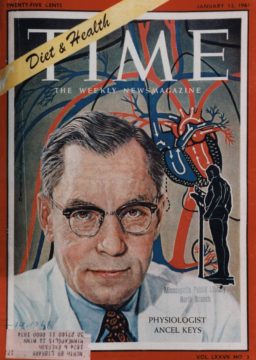 Landmark studies such as these laid the groundwork for the introduction of dietary guidelines in the United States and the United Kingdom during the 1970s and 1980s. The recommendations advised citizens to reduce their consumption of saturated fat to about 10% of their total energy intake, to lower cholesterol in the blood and therefore decrease the chances of a heart attack. In the public consciousness, a low-fat diet has been synonymous with good health ever since.
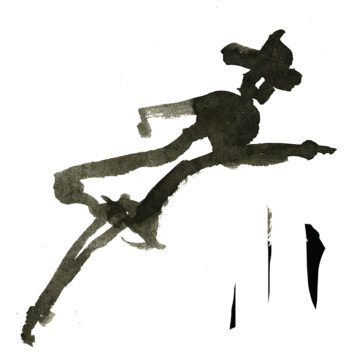 To understand how a frumpy, mustard-coloured, short-handled purse, which may or may not be leather, sold at auction in February for a whopping $32,000, it’s helpful to wander back to ancient Greece. According to Herodotus, the 5th century tyrant Histiaeus was the first to shave the head of an illiterate servant, have his scalp tattooed with a message, allow time for the hair to grow back, then send the poor fellow out to his destination, where a second head shaving waited.
 No woman could get away with it. Murdering her children is all she would ever be known for—ask Medea. Yet Herakles, often called by his Roman name, Hercules, is known for everything else: slaying the man-eating birds of the Stymphalian marsh, the multiheaded Lernaean Hydra, and the Nemean lion, with its Kevlar-strength fur; capturing the wild Erymanthian boar, the golden-antlered deer of Artemis, and the Minotaur’s father; stealing the girdle of Hippolyta, the golden apples from the garden of the Hesperides, the flesh-eating mares of Diomedes, and the red cattle of the giant Geryon; mucking the Augean stables in a single day; and kidnapping the three-headed dog Cerberus from Hades.
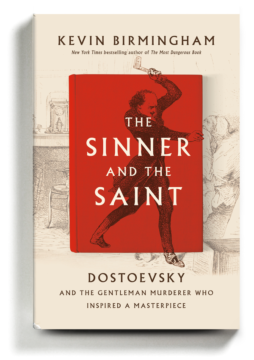 There’s nothing wrong, of course, with taking one’s Crime and Punishment neat, without footnotes, introduction or weighty biography, sans everything except Dostoevsky’s incandescent text (as recast by your pick of fourteen translators). Countless readers, and all good formalists, have done just that, not least because the old translations tended to have no notes. Why interrupt the spell, the morbid giddiness that overcomes the trusting reader almost as strongly as it does Rodion Raskolnikov, in whose garret and mind we perch throughout the most searing pages of the novel? What’s more, this is a book that many devour when they are roughly the same age as Dostoevsky’s murderer (twenty-three), if not several years younger. Raskolnikov, as we first meet him, is imprisoned by his internal, ever ‘relatable’ struggle with social conventions and family pressures, and his story is in one shocking sense a universal metaphor: we all have our crimes to commit. Who has time for footnotes if your main concern is to determine whether you are with the ‘Lycurguses, Solons, Muhammads, Napoleons’, with those who have the right to transgress and trample over others, or whether you are merely a ‘quivering creature’ or, still worse, a bookish ‘aesthetic louse’?