
Teju Cole at Bookforum:
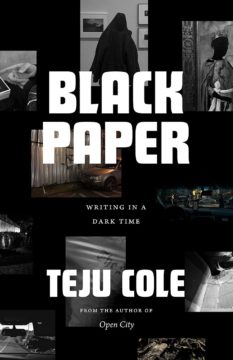 Edward Said loved music, and I loved his love of music as well as the musicality that characterized everything he did. Because of his writings on late style, I think of him in connection with Beethoven’s String Quartet no. 15, op. 132. This was Beethoven’s thirteenth quartet, but the fifteenth in order of publication. It’s the kind of work that tempts one to agree with the strange notion that there is such a thing as pure music, music better than any possible performance. This is a romantic idea, and it’s probably not true, since music exists in the hearing, not on the page. But listening to Beethoven’s Op. 132, you can see why people think so. Within the written tradition of Western classical music, as in all genres of music, there is music that exhausts superlatives. Late Beethoven emerges coherently out of mature Beethoven, and mature Beethoven is an extension and fulfillment of early Beethoven. These are major shifts and distinct modes of evolution, but they are not radical breaks.
more here.
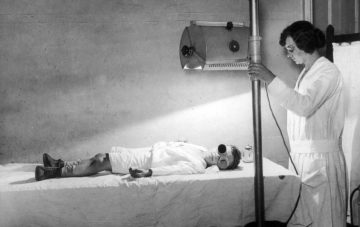 Any account of childhood written by an adult might quickly become a work of adult art, presenting the child’s world, its highlights and its shadows, with a sensibility foreign to the experiences of being young. With his intensely concentrated gaze and voluptuous yet exact prose style, however, Wollheim offers us a work of vivid immediacy. Reading it, one experiences the kind of embarrassment that the critic Christopher Ricks identified in Keats’s poetry: Brought this close up to what it feels like to be a child, or for that matter an adult, Wollheim helps us see with awful clarity what an emotional and moral predicament it is to be alive.
 Electric vehicles have the potential
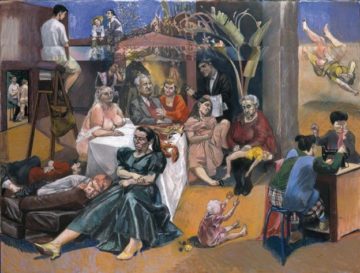 There’s a painting entitled Celestina’s House (2000-1). I count at least twenty-two figures in the painting. That’s a rough count. A few of these figures are sitting around a table, presumably eating a meal, though the only food on the table is a lobster and crab, maybe still alive. In front of the table, several figures nap awkwardly on pillows while, nearby, a tiny old woman sits on the floor, reaching up like a baby. Elsewhere, two women work, disconsolate, at a sewing machine, another woman falls down backward through the air, and a young fellow sits on a ladder with his back to us, as if he’s being punished. There is so much going on it is impossible to understand exactly what is going on. It is a scene, perhaps, showing us what would happen if the entire contents of many nights’ dreaming were smashed onto one canvas. The style is more or less realist, but not fastidiously so. We seem to be firmly in the realm of fantasy, memory, fable, and dream.
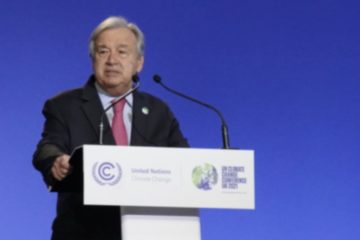 Dear Prime Minister Boris Johnson, I want to thank you and COP President Alok Sharma for your hospitality, leadership, and tireless efforts in the preparation of this COP.
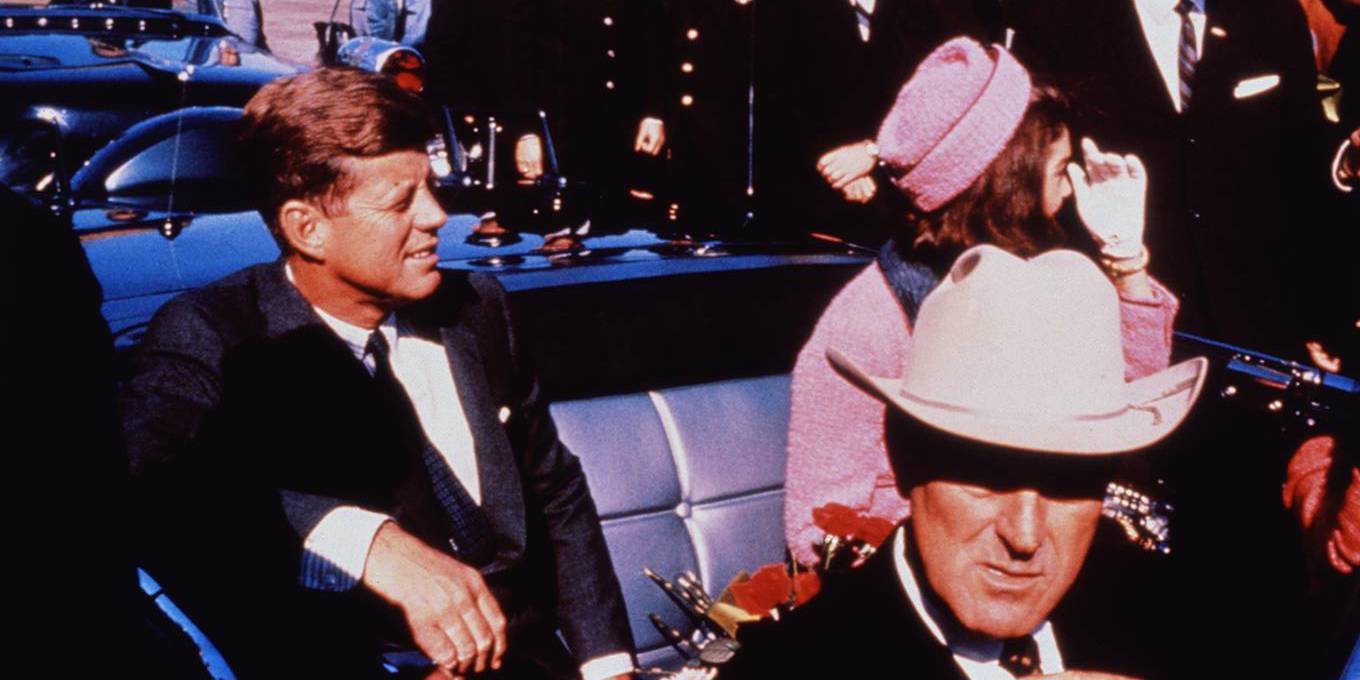 Brood with me on the latest delay of the full release of the records pertaining to the murder of President John F. Kennedy in Dallas on November 22, 1963. That was 58 years ago. More time has passed since October 26, 1992, when Congress mandated the full and immediate release of almost all the JFK assassination records, than had elapsed between the killing and the passage of that law.
 J
J GIDDY FROM SIPPING FLUTES of the de Young Museum’s prosecco, my friend Karen and I quickly realized that from the VIP section, the view of Judy Chicago’s smoke sculpture,
 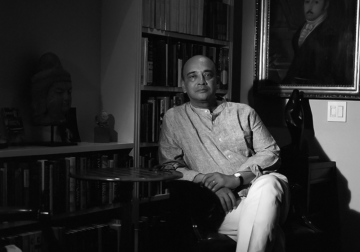 Fifty years ago, at a harp recital in Gloucestershire, a retired British military officer with a clipped aristo accent came across a brown-skinned teenager. “I say, old chap, do you speak English?” the officer said. As a story in Yale’s New Journal recounted, the young man—Kwame Anthony Akroma-Ampim Kusi Appiah—replied, “Why don’t you ask my grandmother?”
 Vaccine
 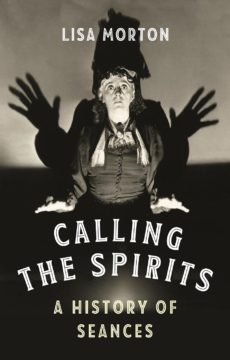 As Lisa Morton notes in Calling the Spirits: A History of Seances, there is not a shred of scientific evidence that proves the existence of spirits or any ability on our part or theirs, if they did exist, that we can communicate with them. (298) Despite this, there is hardly a culture or people on earth that has not or does not believe in a spiritual life of some sort after death and that does not have some sort of ritual conducted by a “specialist” to communicate with the dead. Human beings are convinced, and have been throughout history, that there is an afterlife, that death is not the end but simply a gateway to more life, and that this afterlife has some profound effect upon those still living this life. What this pervasive belief shows is:
 If my father occasionally enjoyed falsifying his ancestry for a bit of role-playing fun on the French Riviera (I don’t believe it ever went very far, though he may once have gained admission with this ruse to a party at the vacation home of Sally Jessy Raphael), I have tended to adopt the opposite evolutionary strategy as I move through rather different social circles than those I may once have been expected to end up in. When an animal is threatened, it can puff itself up to appear even more threatening than its adversary, as a cat does; or it can lie prostrate like an opossum, even generating from within its living body the stench of death itself. While I have never been so desperate as to slip into thanatosis, I have often gone out of my way to imply, in rarefied social settings, that my own origins “stink”, that I come from the pure stock of Dustbowl migrants, from a sort of topsy-turvy farce of aristocracy in which you convince others that you are somebody precisely by establishing that you are descended from absolutely nobody.
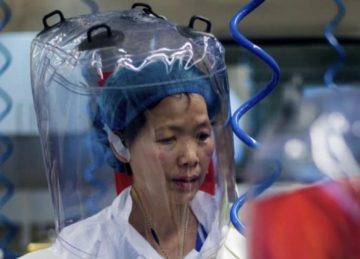 Many writers and researchers suggested that the presence of a high-containment laboratory in Wuhan, the Wuhan Institute of Virology, could point to a laboratory origin for the pandemic: a bioweapons experiment; or
  When journalist
 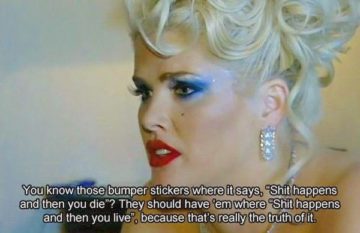 Here was a woman who had modelled her life so closely on Marilyn Monroe’s that doing so eventually helped drive her to her death – the blonde waves and the fake breasts; the pill addictions and the airheaded pronouncements about men and sex and diamonds; the years spent tumbling down the rabbit-hole in search of somebody with cash willing to play at being Daddy; the PLAYBOY cover and centrefold, and the unwise sexual exhibitionism, and the occasional moments of bleak honesty that nodded at some formative abuse – and yet still she achieved twice the thing that Monroe never did: for four days, from 7 September 2006 to 10 September 2006, Anna Nicole Smith was a mother to two children. As it had for Monroe, who confessed in her last year that she had wanted children ‘more than anything’, motherhood held as much significance for Smith as big-time fame did, her desire to be the world’s hottest chick only commensurate with her certainty that she should procreate. ‘I’m either going to be a very good, very famous movie star and model,’ Smith told ENTERTAINMENT WEEKLY at the height of her success, in 1994, ‘or I’m going to have a bunch of kids. I would miss having a career, but I’ve done my acting, and I’ve done my modelling. I’ve done everything I wanted to do.’ She did not become a great actor, even if for a short time she was one of the biggest models on earth. She did not make it to 40, even though she outlived Monroe by 3 sad, medicated years, dying at the Hard Rock Hotel in Florida at just 39 years old, in 2007.