
Paul Auster in Literary Hub:
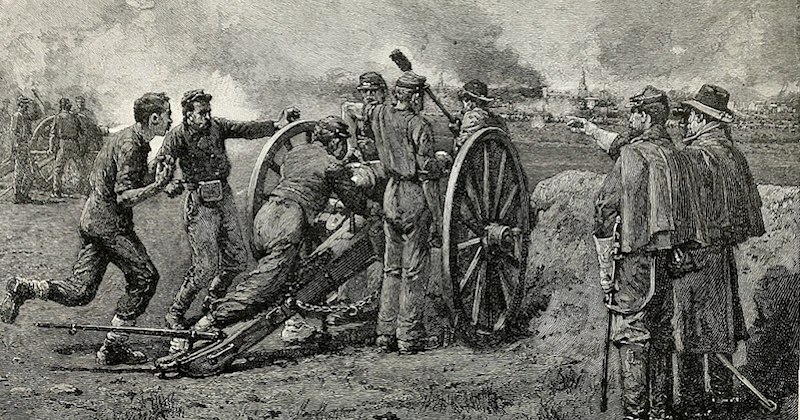 On the last day of October 1895, a letter was sent to Stephen Crane by the corresponding editor of The Youth’s Companion inviting him to submit work to the magazine: “In common with the rest of mankind we have been reading The Red Badge of Courage and other war stories by you… and feel a strong desire to have some of your tales.” Advertising itself as “an illustrated Family Paper,” the Companion was a national institution with an immense readership that began its life in 1827 and remained on the American scene for more than 100 years. Never more popular than in the 1890s, it published work by every important writer from Mark Twain to Booker T. Washington, and, as the corresponding editor pointed out in his letter to Crane, “the substantial recognition which the Companion gives to authors is not surpassed in any American periodical.” On top of that, it paid well.
Crane was hard at work on The Third Violet just then, but he wrote back on November fifth to say that he “would be very glad to write for the Companion” and promised to send them something “in the future.” The future arrived in March, when he mailed off the manuscript of “An Episode of War” to the offices in Boston, mentioning in the last line of his cover letter that “this lieutenant is an actual person”—possibly someone he had heard about from his uncle Wilbur Peck, who had served as an army doctor during the war.
The shortest of Crane’s Civil War stories from 1895–96, “An Episode” is also the strongest, the boldest, and the most moving—a thoroughly modern work that takes on the issue of war trauma with pinpoint clarity and perceptiveness.
More here.
 The major food staples are essential to human survival. Chocolate and coffee are not essential, but try to imagine a world without them. One of the numerous concerns with climate change is that many species will lose their habitats. Scientists are projecting that, in the coming decades, this could lead to the extinction of many crops, including cacao and coffee plants.
 Capitalism has had a strange relation to the history of the United States. Whereas most societies of the Euro-Atlantic world have defined their histories at least in part around their transition from feudalism to capitalism or their complex (and often explosive) encounters with the latter, the history of the British North American colonies and then the United States has generally assumed a simultaneity in origins. The historian Carl Degler once wrote that capitalism came to North America “on the first ships,” and as simplistic as that might sound, he captured a wider sense that private property, acquisitiveness, and individualism were the foundations on which this country was built.
 Even within a single patient with cancer, there is a vast diversity of individual tumor cells, which display distinct behaviors related to growth, metastasis, and responses to chemotherapy. To carry out these behaviors, each cancer cell uses its genes to make the needed molecules in a unique way known as its “gene expression signature.” To correlate gene expression signatures with cancer progression and chemotherapy resistance, a team of scientists led by Rong Lu from USC and Akil A. Merchant from Cedars-Sinai have introduced a new genetic technology in a study published in Nature Communications.
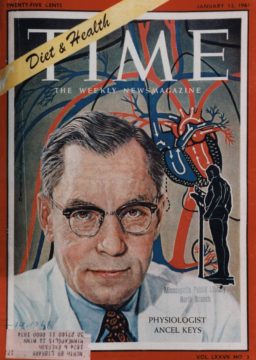 Landmark studies such as these laid the groundwork for the introduction of dietary guidelines in the United States and the United Kingdom during the 1970s and 1980s. The recommendations advised citizens to reduce their consumption of saturated fat to about 10% of their total energy intake, to lower cholesterol in the blood and therefore decrease the chances of a heart attack. In the public consciousness, a low-fat diet has been synonymous with good health ever since.
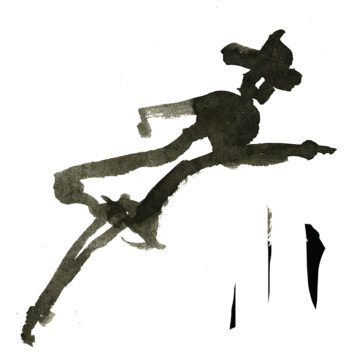 To understand how a frumpy, mustard-coloured, short-handled purse, which may or may not be leather, sold at auction in February for a whopping $32,000, it’s helpful to wander back to ancient Greece. According to Herodotus, the 5th century tyrant Histiaeus was the first to shave the head of an illiterate servant, have his scalp tattooed with a message, allow time for the hair to grow back, then send the poor fellow out to his destination, where a second head shaving waited.
 No woman could get away with it. Murdering her children is all she would ever be known for—ask Medea. Yet Herakles, often called by his Roman name, Hercules, is known for everything else: slaying the man-eating birds of the Stymphalian marsh, the multiheaded Lernaean Hydra, and the Nemean lion, with its Kevlar-strength fur; capturing the wild Erymanthian boar, the golden-antlered deer of Artemis, and the Minotaur’s father; stealing the girdle of Hippolyta, the golden apples from the garden of the Hesperides, the flesh-eating mares of Diomedes, and the red cattle of the giant Geryon; mucking the Augean stables in a single day; and kidnapping the three-headed dog Cerberus from Hades.
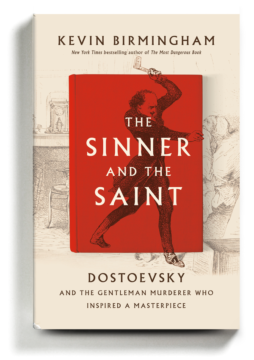 There’s nothing wrong, of course, with taking one’s Crime and Punishment neat, without footnotes, introduction or weighty biography, sans everything except Dostoevsky’s incandescent text (as recast by your pick of fourteen translators). Countless readers, and all good formalists, have done just that, not least because the old translations tended to have no notes. Why interrupt the spell, the morbid giddiness that overcomes the trusting reader almost as strongly as it does Rodion Raskolnikov, in whose garret and mind we perch throughout the most searing pages of the novel? What’s more, this is a book that many devour when they are roughly the same age as Dostoevsky’s murderer (twenty-three), if not several years younger. Raskolnikov, as we first meet him, is imprisoned by his internal, ever ‘relatable’ struggle with social conventions and family pressures, and his story is in one shocking sense a universal metaphor: we all have our crimes to commit. Who has time for footnotes if your main concern is to determine whether you are with the ‘Lycurguses, Solons, Muhammads, Napoleons’, with those who have the right to transgress and trample over others, or whether you are merely a ‘quivering creature’ or, still worse, a bookish ‘aesthetic louse’?
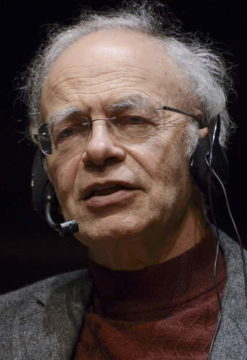 Peter Singer: I think utilitarianism—far from being a kind of dry economic science or anything like that—is actually a reforming impulse. That goes back a long way before Jeremy Bentham, but was certainly made explicit by Bentham. Bentham and [later] utilitarians have been against slavery, they’ve been for women’s rights. They’ve been for the rights of gay people long before anybody else dared to even talk about that. They’ve been against cruelty to animals. They’ve been for prison reform. There’s a long list of things that utilitarians have been trying to reduce the amount of suffering in relation to and I’m very happy to be part of that tradition and to think of utilitarianism not merely as something for philosophers to talk about, but something that motivates people to act.
 As the holidays approach, we are being reminded of the fragility of the global supply chain. But at the same time, the supply chain itself is a truly impressive and fascinating structure, made as it is from multiple components that must work together in synchrony. From building an item in a factory and shipping it worldwide to transporting it locally, processing it in a distribution center, and finally delivering it to an address, the system is simultaneously awe-inspiring and deeply dehumanizing. I talk with Christopher Mims about how things are made, how they get to us, and what it all means for the present and future of our work and our lives.
 Epistemology, the philosophical study of knowledge, belief and evidence, starts here, with our fallibility. And from this beginning, there are many paths for epistemology to take, and many sorts of questions to set us down these trails.
 Marcus du Sautoy was around 13 when the exploits of a 19th-century German math genius changed his life. According to legend, the young Carl Friedrich Gauss was asked to calculate the sum of the numbers from one to 100, but instead of adding up the digits one by one, he realized 50 pairs of numbers (one plus 100, two plus 99, and so on) all equaled 101. So, he simply multiplied 50 times 101 and dropped the correct answer, 5,050, on his teacher’s desk.
 Prof Crowther, who grew up in Prestatyn, Flintshire, is a professor of ecosystem ecology at ETH Zurich University in Switzerland and also chairs an advisory board for the United Nations on nature restoration. He warned blanket planting of trees was “hugely threatening”. “This is not about offsetting your guilt, that would be an absolutely devastating step for climate change,” he said. Speaking at