
Dylan Matthew in Vox:
 When people think of ways to help the world’s poor, a few obvious ideas come to mind: giving them cash; preventing diseases like malaria through the distribution of bed nets and pills; treating HIV/AIDS in areas ravaged by those conditions; and other tactics that take aim at economic privation and infectious diseases. That focus is understandable and necessary — but what if it elides a different way of thinking about easing suffering in the world? What if there was a real opportunity to improve the lives of low-income people by devoting resources toward their mental well-being, too?
A new report raises that intriguing prospect. Written by Michael Plant, Joel McGuire, and Barry Grimes of the Happier Lives Institute, a research center that aims to find evidence-based ways to improve happiness worldwide, the study looks at the role therapy can play in improving lives in the developing world.
To date, global health efforts have mostly focused on illnesses of the body: malaria, vitamin deficiency, HIV/AIDS prevention, tuberculosis. Obviously, such diseases can affect the mind, and canonically “mental” illnesses like depression can take a physical toll. But historically, mental well-being has simply never gotten equal billing. Until 2015, the UN’s Sustainable Development Goals didn’t even include benchmarks for mental health, even as they focused heavily on infectious diseases and markers of physical health. Through the increased use of tools like randomized controlled trials, policymakers have gotten better at understanding what really works in raising incomes and treating diseases among the world’s poorest people, and what doesn’t. That’s great, but it also may have led to some complacency — the idea that we already know what works.
More here.
 We will meet climate change with real change, and defeat the fossil-fuel industry in the next nine years.
 In dozens of laboratory freezers at Columbia University in New York City, 60,000 cancer specimens await testing that oncologist Azra Raza, M.D., anticipates will find “cancer’s first cell” — the earliest mutated cell that will eventually multiply to become a cancer — and lead to treatments that knock the disease out before it grows. The blood and bone marrow samples come from nearly every one of her patients of 35 years, provided as they moved through cancer treatment.
 The carceral system has become a vast debt machine. It creates a dizzying array of financial obligations for those unfortunate enough to be caught in its dragnet. The lowest hanging fruits are the traffic fines extracted from motorists who fall foul of a speed trap, carefully laid by officers assigned to do “
 CABINET:
  B
B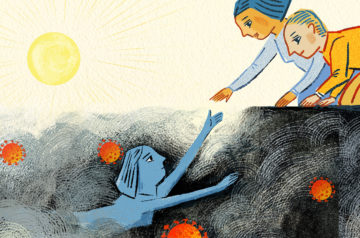 The tile floor was cold and hard against my knees, but I couldn’t move from my spot in front of the toilet. It was the third morning that week I had spent violently throwing up because of anxiety at the prospect of going into the lab. So far, I had been able to stay home without consequence. But that day I was scheduled to meet other lab members to work on an experiment essential for my Ph.D. project. At 5:45 a.m. I let them know I wouldn’t be coming in, feeling a wave of guilt. “How did I get here?” I wondered.
 It surprises us to learn how much literature was penned in the trenches of World War I. The poems of Wilfred Owen or the early tales of Tolkien, for example, are all the more exceptional when we consider that they were composed amid states of mortal terror. But the most incredible and most stupefying example perhaps is Ludwig Wittgenstein’s Tractatus Logico-Philosophicus. Less than a hundred pages long, it is a slender book that, according to its author, set about to find a “final solution” to the problems of philosophy (a phrase made even more cryptic by the knowledge that Wittgenstein and Hitler were once schoolmates). And indeed, when the Tractatus was published in the fall of 1921, Wittgenstein effectively “retired” from his trade, believing that he’d found the basement of Western philosophy and had turned off the lights when he left.
 A supply chain is like a Rorschach Test: each economic analyst sees in it a pattern reflecting his or her own preconceptions. This may be inevitable, since everyone is a product of differing educations, backgrounds, and prejudices. But some observed patterns are more plausible than others.
 We’re doing astonishingly well, and most environmental trends are going in the right direction. Carbon emissions have declined more in the United States than in any other country over the last twenty years, mostly due to fracking. Carbon emissions peaked in Europe in the mid-seventies, in the main European countries I should say. And some people think carbon emissions have peaked globally. I personally think they probably have another ten years of growth, but we’re close to global peak emissions, after which they will go down. We appear to be at peak agricultural land use, and that will go down. So Malthus was sort of spectacularly wrong, both on human progress, but also environmental progress.
 EARLY IN JULY 1958, the Japanese photographer Kikuji Kawada, then aged twenty-five and a staffer at the weekly magazine Shukan Shincho, visited Hiroshima for a cover story to run in the month following. He was there to photograph another photographer, Ken Domon, whose book Hiroshima had been published in the spring. Among Domon’s subjects: the scarred bodies of survivors of the atomic-bomb attack of August 6, 1945, and the skeletal dome of the city’s riverside industrial exhibition hall. When he had finished his assignment, Kawada lingered in the ruins below the Genbaku Dome, where brick and concrete walls were covered with stains composing, as he put it, “an audibly violent whirlpool.” Kawada took no photographs of the enigmatic markings, but returned two years later with a 4 x 5 view camera, and began making long exposures in “this terrifying, unknown place.”
 T
T