
Category: Recommended Reading
Nanci Griffith (1953 – 2021) singer-songwriter
Saturday, August 14, 2021
Beyond Neoliberal Trade
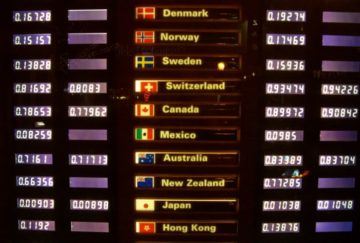 Arjun Jayadev and J.W. Mason in Boston Review:
In 1919 John Maynard Keynes, like many Europeans, looked back at the prewar era of free trade as a kind of golden age. “The inhabitant of London,” he recalled,
could order by telephone, sipping his morning tea in bed, the various products of the whole earth, in such quantity as he might see fit, and reasonably expect their early delivery upon his doorstep; he could at the same moment and by the same means adventure his wealth in the natural resources and new enterprises of any quarter of the world and share, without exertion or even trouble, in their prospective fruits and advantages.
In the wreckage of World War I, it was hard to imagine a return to this borderless “economic Eldorado.” But today, it’s the relatively self-contained national economies of the mid-twentieth century that may seem like a lost world. To access the products of the whole earth, you don’t even have to pick up the phone; you can just log onto Amazon.
This return to—and surpassing of—prewar levels of economic integration has been paralleled by a revival of pre-Keynesian ideas about the international economy. The vast expansion of international trade over the past forty years is often presented as the result of simply removing artificial constraints—that is, as a victory of “free trade” over “protectionism,” a realization of the cosmopolitan and liberal ideals of the nineteenth century after the aberrant nationalism and state direction of the economy of the twentieth. This victory is often claimed as one of the great successes of the neoliberal era, one whose benefits are so obvious as to hardly need stating. One of us recently attended a panel on trade at a meeting of the American Economic Association, where the chair opened the discussion by saying, “Obviously, if you are in this room then you are for free trade, as much as we can get.” No one in the room seemed to disagree.
More here.
Triptych for Lauren
 Virginia Jackson on the late Lauren Berlant, over at Critical Inquiry:
I. The Function of Criticism
In 2015, before she got sick and after they turned down an offer from my university, I wrote an essay about Lauren’s work and what it meant to me.
That essay was a poor rehearsal for an elegy, since all I was mourning then was the chance to have them as a colleague, the missed opportunity to have her close. I never imagined a world without her; instead, I selfishly and grandiosely thought that we could create a world together, and then I missed that fantasy world when it did not happen (they would have had a lot to say about that). I see now (as I think she saw then) that world would have been impossible, but that’s the kind of thing Lauren made you believe: that the sum of [nothing is impossible] + [everything is impossible] = {some things must actually be possible}. And they made you think that work—academic work!– could be a form of personally motivated communal expression, maybe even a way of making wishes come true. I needed that reassurance at the time (I still do), and maybe it is also reassuring to confess that Lauren answered that need, though honestly, I am embarrassed to write about my deep affection for and attachment to Lauren in Critical Inquiry, since such public testimony translates so immediately into cultural capital, given who Lauren was and will continue to become. They would have pointed that out, too. In fact, they would have said that may be all criticism ever is. Like that precarious sequence and like the pronouns in those sentences, my feelings then as now were and are a muddle of the personal and the professional: as everybody can’t seem to stop saying these days, in recent years, Lauren used “she” for personal stuff and “they” for professional stuff, but the problem with this separation is that she was terrible at telling the personal from the public, the personal from the professional, the personal from the academic, the personal from, well, anything. Whatever they did, there she was. Now that they are gone, and she is, too, I see that what I wrote six years ago didn’t even come close to measuring our loss.
Lauren was a public figure, so of course they had a mediated life that was very different than her life with her cats and Ian. That’s not what I’m saying. I was not one of her best friends, though I loved her dearly, but probably like a lot of people, what I loved most was their work.
More here.
Playing Nice With the Fossil Fuel Industry Is Climate Denial
 Kate Aronoff in The New Republic:
The Intergovernmental Panel on Climate Change has released the first, nearly 4,000-page installment of its Sixth Assessment Report. The report, from a working group of over 200 scientists, distills the current consensus about the physical science of climate change from 14,000 peer-reviewed studies. This consensus is grim: None of the emissions scenarios this report highlights see warming kept below 1.5 degrees Celsius (2.7 degrees Fahrenheit). Heat waves previously seen only twice in a century will soon hit every six years, along with a slew of vicious storms and droughts.
Atmospheric levels of carbon dioxide are at their highest point in two million years. We can no longer avoid some of the catastrophic warming coming our way. Avoiding the rest will entail “immediate, rapid, and large-scale reductions in greenhouse gas emissions,” per IPCC Vice Chair Ko Barrett. Most of those reductions need to come from polluting sectors the Biden administration continues to treat with kid gloves.
The point of this report is to identify “not just that it’s getting hot, but at what point things are unbearable,” Alex Ruane, a lead coordinating author on chapter 12 of the report and a research scientist at NASA’s Goddard Institute for Space Studies, told me by phone. That means exploring questions like, “At what point does the engineering of levees start to break?” and how hot airport runways can get before planes stop being able to take off. The report, he stressed, steers well clear of policy recommendations.
There are stark political implications, though. “There is no stable normal until we figure out a way of stabilizing the climate system,” Ruane told me.
More here.
Freedom’s Just Another Word
 Aziz Huq in the Los Angeles Review of Books:
ABOUT FOUR miles from where I live in Chicago is a nondescript office building where police take people to be held incommunicado and, according to press reports, tortured. The site is called Homan Square. It has long been notorious among activists and lawyers working on police brutality. It is, they say, a place where they take “black and brown and poor kids who can’t afford to hire private counsel while they’re in custody.”
Homan Square came to national attention in 2015 when journalist Spencer Ackerman of the UK newspaper The Guardian published a detailed story about prolonged detention and violence against suspects at the facility.
Homan Square has since played an ambiguous role in the city’s political life. In 2020, the Black Lives Matter movement called for its closure. At the same time, its specter likely enervates local democracy. Work by the political scientists Vesla Weaver and Amy Lerman has shown that police contact with Black and Latino communities, especially when it involves violence, doesn’t just instill a fear of the state on the street. It also makes people less likely to vote or otherwise participate later in the political process. Homan Square may provoke activism on the street, but its shadow probably also blocks the ballot box.
I find Homan Square a useful place to start thinking about the ambivalent and complex meanings of the word freedom. In part, this is because it’s very literally close to home, but also because it presents a particularly gripping instance of the loss of freedom. Indeed, it seems intuitive to me, and I suspect to many, to say that freedom of an important sort is at stake in Homan Square. But what kind of freedom?
More here.
‘Antwerp: The Glory Years’ by Michael Pye
Peter Frankopan at The Guardian:
 Antwerp is the star of this charming and rather lovely history. The “trade of the whole world”, wrote the Venetian ambassador and cardinal Bernardo Navagero in the middle of the 16th century, could be found in this city. It was hardly an exaggeration: all kinds of spices could be bought there; so too could books and art, produced by the score for all tastes and inclinations; when William Cecil wanted “little pillars of marble” for Burghley House – along with a ready-made classical gallery – it was to Antwerp that he turned.
It was not just goods and products that could be acquired, for in Antwerp everything had a price, including knowledge, information and secrets – although distinguishing truth from scurrilous rumours was not easy, especially when it came to sex.
more here.
A Forgotten Prophet Whose Time Has Come
Nathan Gardels at Noema:
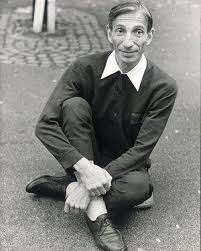 Illich was a purveyor of impossible truths, truths so radical that they questioned the very foundations of modern certitudes — progress, economic growth, health, education, mobility. While he was not wrong, we had all been riding on a train going in the opposite direction for so long that it was hard to see how, in any practical sense, the momentum could ever be stalled. And that was his point. Now that “the shadow our future throws” of which Illich warned is darkening the skies of the present, it is time to reconsider his thought.
Illich’s central contention was that persons are relational beings embedded in a matrix of the natural cosmos, convivial community with others and, as a fallen but still faithful priest, God’s grace. As the maverick thinker saw it, Western modernity rent asunder this multidimensional oneness of “Life.”
more here.
IVAN ILLICH – Un Certain Regard – A 1972 Interview
American Muslims Are 2 Times More Likely To Have Attempted Suicide Than Other Groups
Dalia Faheid on NPR:
 For an entire year that involved emergency room visits, legal proceedings, involuntary unemployment and the death of loved ones, Mehran Nazir struggled with a depressive episode. He would find his mind flooded with self-destructive thoughts. He’d faintly hope his plane from Newark to San Francisco would crash or that he would doze off at the wheel of his car and end up in a fatal accident. The normally extroverted Nazir would lie paralyzed in bed for hours doing nothing, not wanting to speak with family and canceling plans with friends. It came to a head when Nazir found himself on the brink of suicide. In his darkest moment, he drafted a will and decided where it would happen.
…Earlier this year, a murder-suicide involving a Muslim family in Allen, Texas, sent shock waves through the community. Brothers Farhan Towhid, 19, and Tanvir Towhid, 21, both of whom reportedly battled depression, made a pact to die by suicide and kill the rest of their family so they wouldn’t have to live with the grief. Since then, public discussions on mental health, trainings on suicide response and healing circles have taken on new urgency.
More here.
Malignant normality
Matthew Rozsa in Salon:
 There are many variations to Hans Christian Andersen’s classic literary folktale “The Emperor’s New Clothes,” but most have the same basic plot points: A vain emperor is duped by two con men into buying clothes that don’t exist. They trick him by saying that the non-existent fabric is actually visible, but only stupid and incompetent people can’t see it. The emperor pretends that he can see the clothes, and then ordinary people follow his lead — whether because they believe him, or because they are simply afraid to state otherwise. It is only when a child blurts out that he is naked that the illusion is shattered.
Andersen was unfamiliar with the psychological concept known as malignant normality, but his tale captures it perfectly. The folktale also teaches an important lesson about standing by one’s own common sense, even when social pressures are insurmountable, and remembering that confidence in your correctness is not enough on its own — particularly if those around you don’t buy in too. And the idea — of a narcissist with power and/or popularity normalizing an “alternate reality” that is patently absurd — clearly has analogues in schoolyard politics, global politics, and everything in-between.
The concept of malignant normality, as explained by psychiatrist Dr. Robert Jay Lifton, is rooted in history — specifically, in our understanding of Nazi Germany. Lifton argued that many Nazi doctors weren’t active ideologues, but were willing to send Jews to gas chambers because this was their job — even though they had taken a hippocratic oath.
The reality of institutionalized genocide, which had not seemed plausible to Germans only a dozen years earlier, had become a malignant normal. Not everyone had to buy into the ideas of Nazism, at least not in full. They simply had to live in a society where actions that would usually be considered atrocious are instead perceived as routine.
More here.
Saturday Poem
The Couple
for Ben, 1885-1971
for Sadie, 1888-1971
They died just months apart, made
twins by the desolate voyage, mariners
without a port, exiles together –
one pulled down into the end and then
the other, tethered as they were
to their damaged vessel, still somehow
afloat, barely, masts long-ago broken,
sails torn apart, something strange, slow
and powerful wearing away
even the dark polished oak, once thick
as elephant legs. And what they had left
was a leak-infested raft of a thing,
remnant, unsteerable, creature of tides
and storms. They roped themselves
to the hooks and rings that remained,
letting whatever prevailed take them,
surrendering to that fate, wasting, salt-encrusted.
Sixty-five years together in the silence.
Silence, silence, silence and the casual
passage of broken time.
The rabbi placed his hands on each
of their heads and spoke a blessing. She
the young redheaded immigrant, speaking
Hungarian, kosher, saying her prayers,
sweet faced, ambitious and afraid; and he,
the native-born poorboy, finding money
however, drinking, loving the racetrack
and the splendor of horses, singing
with the Irish in their bars. He fell in love
with her green eyes. Oceans, weren’t they?
by Lou Lipsitz
Friday, August 13, 2021
Daniel Mendelsohn on the Odyssey
From Octavian Report:
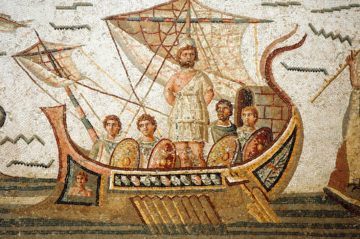 Octavian Report: Why should we read the Odyssey?
Daniel Mendelsohn: There’s a reason the classics are classics — and it’s not because they have better agents than books that aren’t classics. The classics are classics because they pose in a way that is lively and narratively interesting and challenging the most basic questions about human experience. The Greek and Roman classics are the foundation for our way of seeing the world. And therefore we read them because they tell us something true about life. In the case of the Odyssey, aside from everything else it is, it’s one of the great family dramas. It’s about homecoming, it’s about the meaning of home, it’s about how you know and how you prove your intimacy with members of your family. It’s about the bonds that connect family members over many years despite time and distance.
Beyond that, it’s in a certain sense the first science-fiction narrative. It envisions an adventurer who’s exposed to strange new civilizations (to quote the opening of Star Trek). Odysseus is the person from Greek civilization, from Western culture, touring abroad through alternative and new civilizations.
More here.
Turing Uncomputability
Jørgen Veisdal in Privatdozent:
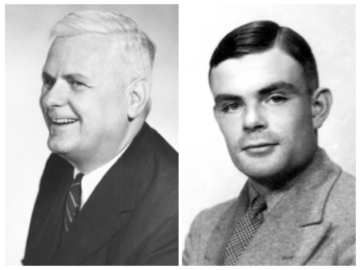 As Soare (2013) recounts, John von Neumann (1903–1957) happened to be in the audience as a representative of Hilbert’s program when Gödel, then 25 years old, took the podium to present his result. von Neumann immediately recognized that Hilbert’s program was over, and spent the next weeks preparing the proof of a related theorem. He had in mind an arithmetization of Gödel’s incompleteness result, to show that not only are formal systems incapable of proving every statement in them, they are also unable to guarantee proofs of their own consistency. He later presented his proof to Gödel, writing “using the methods you employed so successfully […] I achieved a result that seems to me to be remarkable, namely, I was able to to show that the consistency of mathematics is unprovable” (Dyson, 2005). Writing back, Gödel reportedly politely thanked the great man and informed him that he himself (Gödel) had written the same proof weeks earlier, and that it had already been submitted for publication.
More here.
Matches
Beyond Neoliberal Trade
Arjun Jayadev and J. W. Mason in the Boston Review:
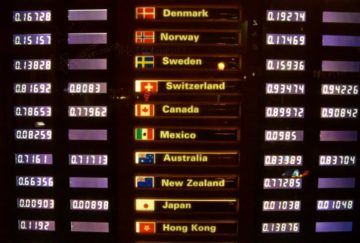 In the wreckage of World War I, it was hard to imagine a return to this borderless “economic Eldorado.” But today, it’s the relatively self-contained national economies of the mid-twentieth century that may seem like a lost world. To access the products of the whole earth, you don’t even have to pick up the phone; you can just log onto Amazon.
This return to—and surpassing of—prewar levels of economic integration has been paralleled by a revival of pre-Keynesian ideas about the international economy. The vast expansion of international trade over the past forty years is often presented as the result of simply removing artificial constraints—that is, as a victory of “free trade” over “protectionism,” a realization of the cosmopolitan and liberal ideals of the nineteenth century after the aberrant nationalism and state direction of the economy of the twentieth. This victory is often claimed as one of the great successes of the neoliberal era, one whose benefits are so obvious as to hardly need stating. One of us recently attended a panel on trade at a meeting of the American Economic Association, where the chair opened the discussion by saying, “Obviously, if you are in this room then you are for free trade, as much as we can get.” No one in the room seemed to disagree.
More here.
Introduction to Kabbalah and Jewish Mysticism – Part 1
On Didion’s “Let Me Tell You What I Mean”
Elroy Rosenberg at 3:AM Magazine:
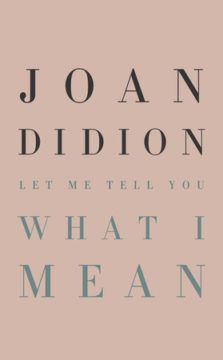 Naturally, there is something contradictory to be found in the emphasis on the “I” in Didion’s work and the supposed “sublime neutrality” which she represents. Considering the omnipresence of the former, the latter seems more or less unattainable. For many Didion readers, who simply cannot shake free of the need to label no matter how hard they wriggle, this paradox might seem unimportant. For me, it is the crux of her work, highlighted in her new collection of essays, Let Me Tell You What I Mean. Encapsulating many pieces from Didion’s emergence with her ‘Points West’ column which she shared with her husband, John Gregory Dunne, as well as later work for establishments like the New York Times Magazine and New Yorker, the collection is a continuation of Didion’s lifelong search for that meagre, almost incommunicable slice of the world where subjectivity and transparency live together hand in hand.
more here.
The Novels of Gwendoline Riley
Emma Garman at The Paris Review:

In 2007 Gwendoline Riley, then age twenty-eight and already the author of three acclaimed novels, described her writing life as lacking “any tremendous triumph or romance—I feel like I’m just always trying to be accurate, to get everything in the correct proportion.”
As literary aspirations go, it sounds modest. And by superficial measures, Riley’s novels are unambitious: light on conventional plotting, narrow in scope, and told from the perspectives of women close to herself in age and background. Riley has tried using the third person, she said in 2012, but it “always sounds so false.” As for adopting a male point of view: “Ugh, men’s brains! That vipers’ nest? No.” Her protagonists are writers, too, encouraging the frequent assumption that she draws directly from life. But to regard Riley’s fiction as titivated memoir is to misperceive what beguiles her readers: not barely mediated personal experience but its sedulous transmutation by a strange, rare talent. As Vivian Gornick wrote after reading the letters of Jean Rhys, a novelist with whom Riley shares some kinship: “The letters are the life, and the novels—there’s no mistaking it—are the magic performed on the life.”
more here.
Friday Poem
Fishing on the Susquehanna in July
I have never been fishing on the Susquehanna
or on any river for that matter
to be perfectly honest.
Not in July or any month
have I had the pleasure — if it is a pleasure —
of fishing on the Susquehanna.
I am more likely to be found
in a quiet room like this one —
a painting of a woman on the wall,
a bowl of tangerines on the table —
trying to manufacture the sensation
of fishing on the Susquehanna.
There is little doubt
that others have been fishing
on the Susquehanna,
rowing upstream in a wooden boat,
sliding the oars under the water
then raising them to drip in the light.
But the nearest I have ever come to
fishing on the Susquehanna
was one afternoon in a museum in Philadelphia,
when I balanced a little egg of time
in front of a painting
in which that river curled around a bend
under a blue cloud-ruffled sky,
dense trees along the banks,
and a fellow with a red bandana
sitting in a small, green
flat-bottom boat
holding the thin whip of a pole.
That is something I am unlikely
ever to do, I remember
saying to myself and the person next to me.
Then I blinked and moved on
to other American scenes
of haystacks, water whitening over rocks,
even one of a brown hare
who seemed so wired with alertness
I imagined him springing right out of the frame.