
Category: Recommended Reading
Louisa Lim’s “Indelible City”
Jennifer Szalia at the NYT:
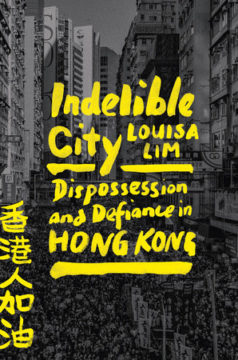 In “Indelible City,” Louisa Lim charts how her own identity as a Hong Konger had never been so clear until China’s brutal attempts to crush pro-democracy protests in 2019. She had been feeling increasingly alienated from a densely populated place where extreme inequality, soaring costs and shrinking real estate made “the very act of living” — even for “still very privileged” people like her — completely exhausting. Lim’s experience as a reporter amid a swell of protesters changed that. She could feel her face flush and her throat well up — not from the tear gas, of which there was plenty, but from a surge of emotions: “I’d fallen in love with Hong Kong all over again.”
Needless to say, this is an unapologetically personal book. For Lim, who worked as a correspondent for the BBC and NPR, the turmoil in Hong Kong made it ever harder “to safeguard my professional neutrality.”
more here.
A Conversation With Nan Z. Da
Nan Z. Da and Jessica Swoboda at The Point:
 JS: What do you see as the differences between academic writing and other forms of writing?
ND: There’s an oft-quoted line by Niklas Luhmann, an acute understanding of the endgame of social evolution in modernity. He posits that “humans cannot communicate; not even their brains can communicate; not even their conscious minds can communicate. Only communication can communicate.” You’re not supposed to think of this as writing advice. Nonetheless, things have to be primed for communication.
Academic writing has to look different than nonfiction writing, has to look different than journalism, and so forth, for much the same reason that interdisciplinarity means nothing if disciplines don’t have operational closure, don’t have integrity. You have to have categorical and systemic partitioning, even hard generic distinctions, in order to see curious crossings.
more here.
Saturday Poem
The Accolade of the Animals
All those he never ate
appeared to Bernard Shaw
single file in his funeral
procession as he lay abed
with a cracked infected bone
from falling of his bicycle.
They stretched from Hampton Court
downstream to Piccadilly
against George Bernard’s pillow
paying homage to the flesh
of man unfleshed by carnage.
Just shy of a hundred years
of pullets, laying hens
no longer laying, ducks, turkeys,
pigs and piglets, old milk cows,
anemic vealers, grain-fed steer,
the annual Easter lambkin,
the All Hallows’ mutton
ring-neck pheasant, deer,
bags of hare unsnared,
rosy trout and turgid carp,
tail-walking like a sketch by Tenniel.
What a cortege it was:
the smell of hay in his nose,
the pungencies of the barn,
the courtyard cobbles slicked
with wet, How we carnivores
suffer by comparison
in the jail of our desires
salivating at the smell of char
who will not live on fruits
and greens and grains alone
so long a life, so sprightly, so cocksure.
by Maxine Kumin
from Nurture
Viking Books, 1989
How Rumi Can Explain Why Nirvana is Samsara
From Networkologies:
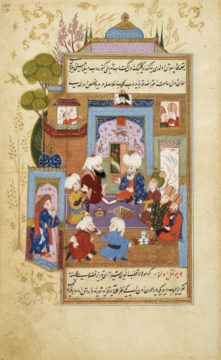 The notion of fana’, commonly translated from Arabic as annihilation or obliteration, provides a potential point of contact between Sufi practices and Buddhist notions of nirvana, a word which, in Sanskrit, derives from the type of extinction one sees when one snuffs out the flame of a candle. Are there similarities between these notions, ones which might be constructed without radically oversimplifying the issues at hand? On the surface, ‘annihilation’ and ‘extinction’ might seem similar. But what a Buddhist extinguishes is craving, while what a Sufi annihilates is themselves before God. And yet, as will become clear, there are crucial parallels that can help us see the ways in which what these traditions have to teach us today have crucial resonances within and through their very real differences.
How does one achieve fana’? One remembers, and this remembering, or dhikr, often also translated from Arabic as recitation, can take many forms. Essentially, one puts oneself into sync with some original pronouncement made by God, for the universe is the speech of God, God speaks the world into being (according to the Qu’ran, by the word “Be!”), and when we remember one of God’s actions, we do so by having our action in some way coming into sync with God’s, by repeating this aspect of his recitation. And since God is beyond time and space, while we are not, God’s action is always before, during, and after ours, our actions are never initiatory, but merely remembrances of God, the one who brought about all that is, even that which is in the future. All potentials are in God, as we were, and will be.
More here.
Nicholas Kristof’s Botched Rescue Mission
Olivia Nuzzi in Intelligencer:
 By the time I arrived in Yamhill, Oregon, Nicholas Kristof’s political career had already ended in a face-plant. “I didn’t feel any burning ambition to be a politician whatsoever,” he told me. Good thing. From start to finish, from his decision to quit the New York Times to the state Supreme Court decision that ruled him ineligible to hold the office, his campaign for governor lasted all of 114 days. Now he was no longer a columnist or a candidate, and about this outcome he claimed to be at peace.
It was the afternoon of Friday, March 25, and the sun lit up the hills around the Kristof family estate, accessed via a winding road over rolling fields, past neighboring dairies and a sharp turn up a steep dirt road leading to a keypad-protected gate. In friendly Kristof fashion, a sign posted at the entrance welcomes guests in a loopy font that spells out the passcode.
A Pulitzer Prize winner once described as the conscience of a generation of journalists, Kristof devoted his life to chasing stories of poverty and genocide in places like Darfur and Sudan before epidemics of addiction and homelessness called his attention back to his home state. “I spent so much time reporting abroad in Afghanistan and Iraq and thinking this is really important and trying to convince people in the U.S. that this is important. And I deeply believe it was,” he told me. “But last time I calculated, every three weeks in the U.S., we were losing more Americans to drugs, alcohol, and suicide than Americans who died in 20 years of war in Iraq and Afghanistan.”
More here.
Friday, April 22, 2022
Artificial intelligence is creating a new colonial world order
Karen Hao in the MIT Technology Review:
 Over the last few years, an increasing number of scholars have argued that the impact of AI is repeating the patterns of colonial history. European colonialism, they say, was characterized by the violent capture of land, extraction of resources, and exploitation of people—for example, through slavery—for the economic enrichment of the conquering country. While it would diminish the depth of past traumas to say the AI industry is repeating this violence today, it is now using other, more insidious means to enrich the wealthy and powerful at the great expense of the poor.
I had already begun to investigate these claims when my husband and I began to journey through Seville, Córdoba, Granada, and Barcelona. As I simultaneously read The Costs of Connection, one of the foundational texts that first proposed a “data colonialism,” I realized that these cities were the birthplaces of European colonialism—cities through which Christopher Columbus traveled as he voyaged back and forth to the Americas, and through which the Spanish crown transformed the world order.
More here.
Biotech firm announces results from first US trial of genetically modified mosquitoes
Emily Waltz in Nature:
 Researchers have completed the first open-air study of genetically engineered mosquitoes in the United States. The results, according to the biotechnology firm running the experiment, are positive. But larger tests are still needed to determine whether the insects can achieve the ultimate goal of suppressing a wild population of potentially virus-carrying mosquitoes.
The experiment has been underway since April 2021 in the Florida Keys, a chain of tropical islands near the southern tip of Florida. Oxitec, which developed the insects, released nearly five million engineered Aedes aegypti mosquitoes over the course of seven months, and has now almost completed monitoring the release sites.
More here.
Strandbeest Evolution 2021
The Russo-Ukrainian War and Global Order
John M. Owen in The Hedgehog Review:
 The war has exposed Russia as a conventional also-ran bristling with 4,500 nuclear warheads, but not a great power. The war has also unleashed a number of complications: it has heightened the dependency of Russia’s economy on energy exports; jeopardized those exports to the lucrative European market; affected Russia internally by making it more autocratic and opening a new brain drain; generated remarkable solidarity in the West, including a probable further expansion of NATO in the Nordic region and deployments of military assets to eastern members; and led those democracies to impose severe economic sanctions on Russia, including a freeze on Russia’s sovereign wealth deposits in their banks and a disabling of Russian banks from using the SWIFT system. Dozens of Western companies, under societal pressure, have closed down or suspended operations in Russia. (By “the West,” I mean, following convention, not only North America and Europe but also other wealthy democracies including Japan, South Korea, Australia, and New Zealand, all of which thus far have joined the sanctions against Russia.)
The war also has demonstrated that most of the rest of the world—that is, the great majority of the world’s population—is more ambivalent about the war than is the West. The war has put China on the spot.
More here.
Unbridled Romanticism – Fichte, Schelling, & Symbols (Isaiah Berlin 1965)
The Crypto-Secessionists
Isabelle Simpson at Cabinet Magazine:
 What makes Puerto Rico and the Marshall Islands attractive to crypto-entrepreneurs is how islands offer spaces where “empathy and control are simultaneously possible. … All that exists, whether cultural, economic or physical, can be observed and regulated, qualities that have ensured that islands have been both seen and used as laboratories and which have implied that, in isolation, utopian communities might exist, be established and evolve there.” Entrepreneurs and crypto-friendly politicians can present their fintech solutions as a form of benevolent capitalism, one that promises not only to fast-track the integration of Small Island Developing States in the global economy, but to create new wealth—magic internet money—that could be used to address complex socioeconomic issues and the existential threat of climate change. These ventures’ marketing typically implies that islanders’ way of life somehow prefigured the development of blockchain technology, which is then marketed as a logical next-step in the fight against climate change and cultural survival for these island nations.
more here.
Inventing Meat
Jenny Kleeman at The New Statesman:
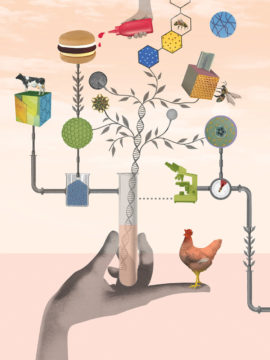 Even the most ardent carnivore might struggle to argue that meat is a force for good today. The global livestock industry produces more greenhouse gases than the exhaust from every form of transport on the planet combined. While doctors try to curb the prescription of antibiotics to slow the emergence of medicine-resistant superbugs, 80 per cent of the antibiotics used in the US are administered to healthy food-producing animals to minimise infections on crammed farms. Industrial animal agriculture is a major cause of deforestation, water waste, water pollution, eutrophication and outbreaks of diseases such as E coli and salmonella, not to mention a significant contributor to new zoonotic diseases and global pandemics. Every year, 70 billion animals are slaughtered to satisfy the global appetite for meat, their lives often miserable and artificially accelerated.
more here.
Friday Poem
Personal Helicon
As a child, they could not keep me from the wells
And old pumps with buckets and windlasses.
I loved the dark drop, the trapped sky, the smells
Of waterweed, fungus and dank moss.
One, in a brickyard, with a rotted board top.
I savoured the rich crash when a bucket
Plummeted down at the end of a rope.
So deep you saw no reflection in it.
A shallow one under a dry stone ditch
Fructified like any aquarium.
When you dragged out long roots from the soft mulch,
A white face hovered over the bottom.
Others had echoes, gave back your own call
With a clean new music in it. And one
Was scaresome for there, out of ferns and tall
Foxgloves, a rat slapped across my own reflection.
Now, to pry into roots, to finger slime,
To stare, big-eyed Narcissus, into some spring
Is beneath all adult dignity. I rhyme
To see myself, to set the darkness echoing.
by Seamus Heaney
from The Death of a Naturalist
Faber and Faber,1966
What happened to Jon Stewart?
Devin Gordon in The Atlantic:
 In march 2021, shortly after Jon Stewart joined Twitter, he tapped the microphone and used his new pulpit to make amends for an infamous act of aggression from his distant past. “I called Tucker Carlson a dick on National television,” Stewart tweeted. “It’s high time I apologize…to dicks. Never should have lumped you in with that terrible terrible person.” Stewart originally fired this shot 17 years ago, on October 15, 2004, but if you’re old enough, you surely remember what happened, in part because it was one of the first truly viral political videos of this century. Stewart was a guest on Tucker Carlson’s cacophonous CNN political-argument show, Crossfire, a half-hour nightly migraine of debate-club doublespeak, during which Stewart pleaded with Carlson to “stop hurting America.” “Wait, I thought you were gonna be funny,” Tucker sniffed. “No,” Stewart shot back, “I’m not gonna be your monkey.” Soon enough he was calling Tucker a dick on national television. “You’re as big a dick on your show,” he said, “as you are on any show.”
Tucker Carlson was actually the co-host of Crossfire, along with his left-leaning Clinton-era frenemy Paul Begala, but nobody remembers Begala, and why should they? The whole thing went down in history as Jon Stewart versus Tucker Carlson, with Stewart the champion by first-round knockout. Within months, CNN canceled Crossfire, hurtling Stewart into a position of political influence and superstardom that few comics in America have ever reached. Two weeks after Stewart humiliated Tucker on his own show, President George W. Bush won a narrow reelection over Senator John Kerry, and it would be no overstatement to say that, in the pre-Obama years that followed, the leader of Democratic resistance was Jon Stewart, and he was holding rallies weeknights at 11 p.m Eastern on Comedy Central.
More here.
Why Is Gut Health Taking Over TikTok?
Dani Blum in The New York Times:
 Every few months, like clockwork, hundreds of videos promising tips and tricks to “hack” your gut flood TikTok. In March, influencers pushed shots of aloe vera juice: “My digestive system, like my gut health? Never been better,” one gushed in a video with one million likes while tapping on a purple bottle of the drink. Another, with the username “oliveoilqueen,” advocated drinking extra virgin olive oil every day in a video viewed more than 3.5 million times, claiming that doing so cleared her skin, made her periods less painful and fixed her frequent bloating. Videos tagged with #guttok have garnered nearly 400 million views. They’re crammed with suggestions for cucumber-ginger juices and boiled apples, bone broth in the morning and sludgy sweet potato soups at night.
There’s not enough data to prove whether any of these supposed fixes improve digestive functions, gastrointestinal experts said. Some purported gut-health helpers, like coconut oil, have high fat content that can loosen stool and irritate your stomach, said Beth Czerwony, a registered dietitian with the Cleveland Clinic’s Center for Human Nutrition. Others, such as aloe vera juice, may cause diarrhea in some people. And since the Food and Drug Administration largely does not regulate supplements, gastroenterologists are reluctant to recommend the pills, powders and products promoted by influencers.
More here.
Thursday, April 21, 2022
Chatting With David Lynch
Josh Hitchens interviews David Lynch at The Believer:
 JH: What was Philadelphia like when you first arrived?
DL: Philadelphia, Pennsylvania was…a hellhole. It was filled with fear, and corruption, and it was filthy, there was soot on the buildings and there was a lot of kind of insanity and a feeling in the air that was very uneasy. But it was the greatest place for me, and I just loved it. And it was my biggest inspiration, this city of Philadelphia.
JH: What do you think it was about the atmosphere of Philadelphia at the time that became so inspiring for you and your work?
DL: Just what I said. The way the buildings were, the mood of the place, all these things feed into us, and our environment affects us a lot, and it sort of crept into me and like I said it made a huge impression and influence. And I always say – people say, “what was your greatest influence” and I always say, “the city of Philadelphia.” It a unique city.
more here.
Modern Medusas: Rethinking “Monsters,” Silence, and Cinema
Aimee Hinds Scott at the LARB:
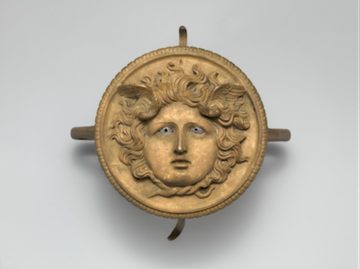 FEW MONSTERS HAVE had as many revamps as Medusa. For many, our first encounter with the gorgon was the fiery stare of Ray Harryhausen’s snake-bodied stop-motion creature, as Harry Hamlin’s Perseus took her head in 1981’s Clash of the Titans. Despite becoming a cultural touchstone for representations of Medusa, Harryhausen’s creation was innovative, a far cry from ancient depictions of Perseus’ prey in presenting a predatory gorgon who attacked back. But Medusa continues to be resurrected in new and varied forms, and the contemporary pop-culture Medusa has herself moved on from her depiction in Clash of the Titans. Shucking her monstrous form, she has been the subject of considerable feminist revision. This feminist vision recasts her as a quite human victim of patriarchy and rape culture. In the most well-known ancient versions of the myth, the mortal Medusa is raped by Poseidon in Athena’s temple, resulting in her punishment by monstrous transformation. This first injustice is then compounded by Perseus’ quest for her head. Following these tales from antiquity, many of which are deeply steeped in misogyny, feminist retellings have rehabilitated the gorgon by bestowing upon her agency expressed through anger.
more here.
The Restrained Romantics – Kant, Schiller & Fichte (Isaiah Berlin 1965)
Winston Churchill, Imperial Monstrosity
Alex Skopic in Current Affairs:
 In today’s Britain, the figure of Winston Churchill is all but deified. His face adorns the £5 note, where he glares sternly out at passersby, the only Prime Minister to be so honored; he is a perennial subject for BBC documentaries and high-budget biopics, and he even has his own series of Doctor Who radio dramas, where he routinely saves the world from alien invasion. (Yes, really.) To hear the cultural mainstream tell it, Churchill almost single-handedly defeated Nazi Germany with a few rousing speeches, and remained a beacon of British fortitude and “Blitz Spirit” throughout his public life. It’s an undeniably compelling image, but in the new book Winston Churchill: His Times, His Crimes, Tariq Ali argues that it’s also a carefully constructed falsehood.
One of Ali’s central premises is that a “Churchill Cult” has become entrenched in British society, inflating the memory of its subject beyond all reason and shutting down well-deserved criticism before it can begin.
More here.