
Morgan Meis in The Easel:
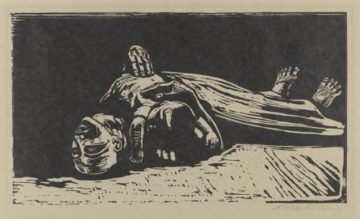 Betroffenheitskitsch. It is not an easy word to say. That’s because it is German and Germans love to make compound words. The core of the word is the adjective betroffen, which means ‘affected’, but also ‘concerned’, and even ‘shocked’ or ‘stricken’. Betroffenheit is the noun and can be translated as ‘shock’, ‘consternation’, ‘concern’. Finally, we add the word kitsch, which makes the whole thing, well, kitschy. Betroffenheitskitsch is shock or deep concern that has been taken to the level of kitsch.
I bring this up in reference to the art of Käthe Kollwitz (1867 – 1945), the great German printmaker (she also painted and made sculptures) of the late 19th and early 20th centuries. There is, indeed, quite a lot of Betroffenheit in the work of Kollwitz. In fact, it is almost all Betroffenheit. Take, for instance, a work like The Widow II (1922). The image is woodcut on paper. It has all the strong lines and simple composition one expects from a woodcut. It is from the War series that Kollwitz produced several years after the end of WWI. Kollwitz’s own son, Peter, was killed in the war, and Kollwitz produced this series partly in response to her own grief.
More here.
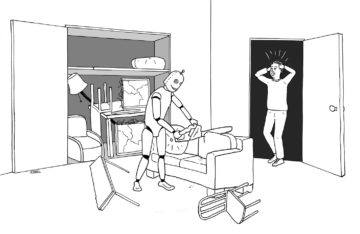 From a showmanship standpoint, Google’s new robot project
 There is no human endeavor that does not have a theory of it — a set of ideas about what makes it work and how to do it well. Music is no exception, popular music included — there are reasons why certain keys, chord changes, and rhythmic structures have proven successful over the years. Nobody has done more to help people understand the theoretical underpinnings of popular music than today’s guest, Rick Beato. His YouTube videos dig into how songs work and what makes them great. We talk about music theory and how it contributes to our appreciation of all kinds of music.
 However difficult it is to properly gauge the significance of historical events while still living through them, we can surely already state with confidence that the Covid pandemic and the Russian invasion of Ukraine together constitute a truly seismic and transformative sequence of years for the world.
 THE WRITER AND SCHOLAR
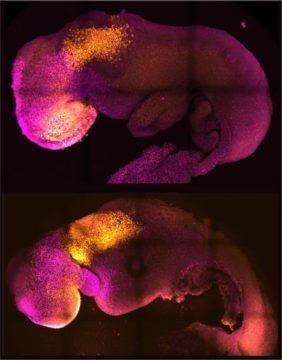 The recipe for mammalian life is simple: take an egg, add sperm and wait. But two new papers demonstrate that there’s another way. Under the right conditions, stem cells can divide and self-organize into an embryo on their own. In studies published in Cell and Nature this month, two groups report that they have grown synthetic mouse embryos for longer than ever before. The embryos grew for 8.5 days, long enough for them to develop distinct organs — a beating heart, a gut tube and even neural folds.
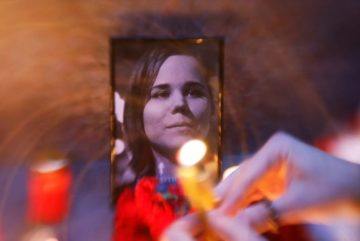 Masha Gessen in The New Yorker (Photograph by Maxim Shemetov / Reuters):
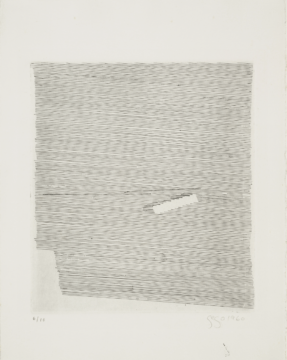 Fathimath Musthaq in Phenomenal World:
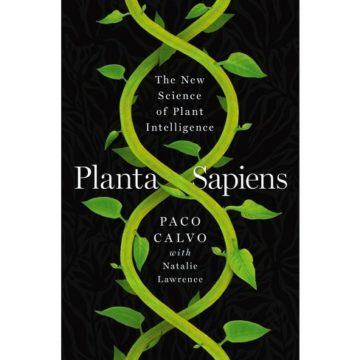 P
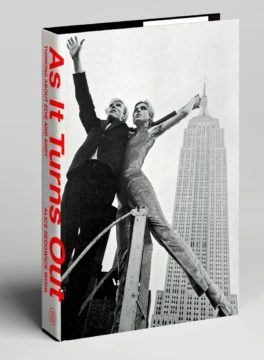 Naturalness is the muse’s great gift. Like Helga Testorf, who merely had to stand still for Andrew Wyeth to want to transpose her spirit, Sedgwick had only to walk and talk for Warhol to track her every move on film. “Andy always picks people because they have an amazing sort of essential flame, and he brings it out for the purposes of his films,” the curator Henry Geldzahler once said. “He never takes anybody who has nothing and makes them into something. What he did was recognize that Edie was this amazing creature, and he was able to make her more Edie so that when he got it on camera it would be made available to everybody.” Warhol’s movies captured Sedgwick just being herself: putting on makeup, lying in bed, perching on a couch arm while looking about the room. She appeared in more than a dozen films, such as “Face,” a seventy-minute-long closeup, and “Afternoon,” a scripted “chamber opera” in which Sedgwick and friends gas around in her apartment, high on amphetamines. Sedgwick Wohl, who has spent decades watching her sister on film, observes her as if looking through a high-powered telescope. “What they saw in her was not talent but simply the way she was, transcribed onto the screen,” Sedgwick Wohl writes.
 Are you prepared for a vision of sizzling sexuality? Picture this. A woman dressed in brown suede brogues and a below-the-knee skirt, her legs obscured by stockings. Sandy-gray hair. A discreet brooch pinned to her blouse, a formal manner of speaking, a keen interest in antiquity and a tendency to suffer from migraines. These qualities may not scream “racy” or “seductive” or “exotic” to you, but you are not the narrator of Julian Barnes’s 25th book.
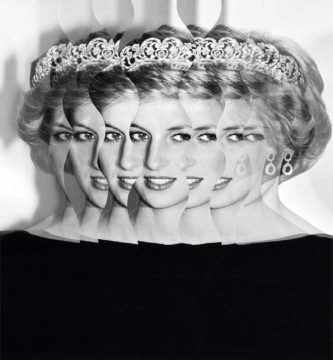 At Althorp, the Northamptonshire estate where she lived as a young woman, there is a drawing of Diana Spencer, round-faced and smiling. It was made when she was a child, and unhappy: her mother, Frances, had left the family. It is a private family artefact, and something else too: an early study in iconography, in making Diana something she was not. Her marriage to
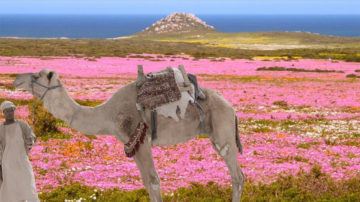 In the gulf, thirst is a paradigm: it is impossible to think about the desert without thinking about water. The Arabian Desert is also a peninsula, with countries formed from both deserts and ports. I propose thirst trap theory – derived from the slang for a selfie used to elicit an exchange between sexual bodies – as a way of reading this relation between desert and surrounding water, between drought and abundance, in cinema from the Gulf. Ranging from narrative cinema to experimental video, these films are as diverse – and extreme – as the landscape that inspired them.
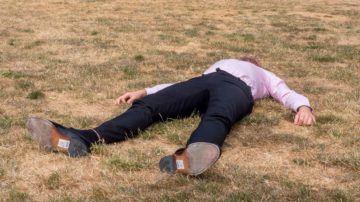 The lawns at Tusmore House, a neo-Palladian mansion 15 miles north of Oxford, are so perfectly flat and exactingly shorn that they induce a kind of vertigo. Unlike familiar grass, with its divots and erupting daisies, the grass here feels as though it might evaporate underfoot in a cloud of pixels. On a sticky afternoon last summer, David Hedges-Gower, a four-decade veteran of the turf industry and grass whisperer to the wealthy, inspected what looked to the layman like flawless green carpet and found it wanting.