
And the rest of the whole interview with John Chandos from 1961:
Category: Recommended Reading
Tuesday Poem
The Cupboard
broken glass is held together
with bits and pieces
of an old yellowed newspaper
each rectangle
of the doorframe
is an assemblage
insecure setsquares of glass
jagged slivers thrusting down
precarious trapeziums
the cupboard is full
of shelf upon shelf
of gold gods in tiny rows
you can see the golden gods
beyond the strips
of stock exchange quotations
they look out at you
from behind slashed editorials
and promises of eternal youth
you see a hand of gold
behind opinion
stiff with starch
as one would expect
there is naturally
a lock upon the door
by Arun Kolatkar
from Jejuri
New York Review Books, 1974
Very Cold People – chilly legacy of abuse
Lauren Elkin in The Guardian:
 Well into a career that encompasses poetry, memoir and projects such as her 2017 collection of quotable fragments 300 Arguments, the American author Sarah Manguso has turned to the novel. Very Cold People is also composed of short sections, compiled like witness testimony by a young girl called Ruthie, as she grows up in the fictional town of Waitsfield, Massachusetts, somewhere near Boston. Ruthie and her family don’t belong there, she tells us in the first sentence; it is a town for people whose ancestors came over with the pilgrims to settle in that violently snowy part of the new world.
The very cold people of the title refers not only to the inhabitants of this icy region, but to Ruthie’s own parents. At the outset they seem merely bohemian and thrifty, buying her toys secondhand and her clothes at factory outlets, but then we hear about Ruthie’s mother dredging a fancy wristwatch catalogue out of the dump, ironing its crumpled cover and displaying it on the coffee table, “just askew […] as if someone had been reading it and carelessly put it down, and she corrected its angle when she walked by”. This is something more than parsimony and closer to a pathological need, in the face of material want, to be perceived in a certain way – as offhandedly rich, casual. Her mother, the victim in her youth of some unspecified assault, “was the protagonist of everything”; Ruthie recalls being told of her own birth: “the doctor said Oh she’s beautiful […] and my mother had thought he was talking about her”.
More here.
Your Bosses Could Have a File on You, and They May Misinterpret It
Sarah Scoles in The New York Times:
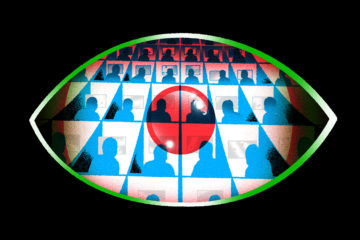 Are you an “insider threat?”
The company you work for may want to know. Some corporate employers fear that employees could leak information, allow access to confidential files, contact clients inappropriately or, in the extreme, bring a gun to the office. To address these fears, some companies subject employees to semi-automated, near-constant assessments of perceived trustworthiness, at times using behavioral science tools like psychology. Many employers are now concerned about retaining workers in the face of what has been called the Great Resignation. But in spite of worries that workers might be, reasonably, put off by a feeling that technology and surveillance are invading yet another sphere of their lives, employers want to know which clock-punchers may harm their organizations.
The language around this sort of worker-watching often mirrors that which is used within the government, where public agencies assess workers who receive security clearances to handle sensitive information related to intelligence collection or national security. Organizations that produce monitoring software and behavioral analysis for the feds also may offer conceptually similar tools to private companies, either independently or packaged with broader cybersecurity tools.
“When you think about insider risk in general, it probably emerges out of the government, and then makes its way into the private sector and commercial industry,” said Tom Miller, chief executive of Clearforce, which sells insider threat services to private clients.
More here.
Sunday, May 15, 2022
Ramez Naam on how to beat Putin, solve climate change, and build the future
Noah Smith in Noahpinion:
 When I want to know what the future is going to be like, I go ask Ramez Naam. Over the years, his spyglass has seemed to peer just a little farther into the future than other people’s.
My favorite example: In 2011 he wrote a guest post for Scientific American entitled “Smaller, cheaper, faster: Does Moore’s law apply to solar cells?” that alerted the world to the startling, consistent, and seemingly unstoppable cost declines for solar energy. This came at a time when almost everyone in public discourse still thought of solar as an unworkably expensive pipe dream. But Ramez (or “Mez”, to his friends) was right. Over the next decade, his prediction became conventional wisdom, not just for solar but for batteries as well. The resulting explosion in solar installation and electric vehicles has utterly changed scientists’ outlook for climate change — catastrophe may still strike, but the most apocalyptic scenarios now look distinctly unlikely. This isn’t Mez’ doing, of course, but he saw it before others did.
Why is Mez so good at predicting the future of technology?
More here.
Computer Scientists Prove That Certain Problems Are Truly Hard
Mordechai Rorvig in Quanta:
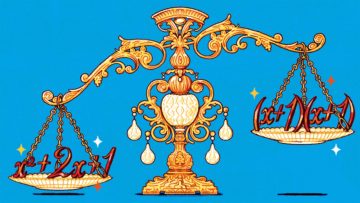 Last summer, three researchers took a small step toward answering one of the most important questions in theoretical computer science. To paraphrase Avi Wigderson of the Institute for Advanced Study, that question asks something simple but profound: Can we solve all the problems we hope to solve?
More precisely, computer scientists want to know whether all the problems we hope to solve can be solved efficiently, in a reasonable amount of time — before the end of the universe, say. If not, they are simply far too difficult.
Many problems seem to be this hard, but we won’t know for certain until we can mathematically prove their difficulty. And in a paper from last year, a trio of computer scientists showed that a broad category of problems are indeed too difficult to be solved efficiently, thereby providing one of the best examples yet of what the field has been seeking.
More here.
Are NFTs really art? A critic weighs in
Philippa Snow in The Guardian:
 The upside of many NFTs having a uniform visual style is that, theoretically, as many of the medium’s biggest fans will stress, there is something inherently democratic about their design and their acquisition. If not every NFT creator makes the kind of money Bored Ape Yacht Club makes, they still have a fairly equal opportunity to share their work. Searching OpenSea for pieces is still easier by far than buying physical work from a gallery or an auction, and the only barrier to entry is a working knowledge of cryptocurrency. Buyers and artists who grew up on the internet of the 00s, meanwhile, may experience deja vu when given the opportunity to customise what is effectively an avatar, harking back to online cartoons like Blingees or Dollz Mania. When a rash of articles appeared in 2021 suggesting NFTs might be the Beanie Babies of the 2020s, the comparison was meant to be an insult; still, it is hard to overestimate the power of nostalgia when it comes to millennials on the web.
More here.
The Master of the Nuclear War Machine
Gerald Early in The Common Reader:
 During his lifetime, there was a long line of people who thought Admiral Hyman Rickover was an insufferable son of a bitch, a contemptible ass, an overbearing, opinionated, power-hungry menace. Biographer Marc Wortman called him, “obstinate, egotistical, and abrasive…” (119)
Many in the upper echelons of the Navy command felt intense hatred for the Father of the Nuclear Navy, as he was called. They had endured his disdain for their authority, his “rebellion against the Navy’s chain of command, protocols, and culture.” (119) So did some corporate leaders who were tongue-lashed and bullied by Rickover’s insistence that they meet his deadlines on their contracts. Rickover felt that defense contractors were hustlers bloating themselves at the taxpayers’ trough and would sic his team of micro-managers on them to fulfill the terms of their contracts.
More here.
Sunday Poem
From Poem VI
Cruising back from 7-11
esta mañana
in my ’56 Chevy truckita,
beat up and rankled
farm tuck,
clanking between rows
of new shiny cars—
……………… “Hey fella! Trees need pruning
……………… and the grass needs trimming!”
A man yelled down to me
from his 3rd-story balcony.
……………… “sorry, I’m not the gardener,”
……………… I yelled up to him.
Funny how in the valley
an old truck symbolizes prestige
and in the Heights, poverty.
Worth is determined in the Valley
by age and durability,
and in the Heights, by newness
and impression.
In the Valley,
the atmosphere is soft and worn,
things are shared and passed down.
In the Heights,
the air is blistered with the glaze
of new cars and new homes.
How many days of my life
have I spent fixing up
rusty broken things,
charging up old batteries,
wiring pieces of odds and ends together!
Ah, those lovely bricks
and sticks I found in fields
and took home with me
to make flower boxes!
The old cars I’ve worked on
endlessly giving them tune-ups,
changing tires, tracing
electrical shorts,
cursing when I’ve been stranded
between Laguna pueblo and Burque.
It’s the process of making-do,
of the life I’ve lived between
breakdowns and breakups, that has made life
worth living.
I could not bear a life
with everything perfect.
by Jimmy Santiago Baca
from Paper Dance- 55 Latino Poets
Persea Books, 1995
How Fame Fed on Edna St. Vincent Millay
Maggie Doherty in The New Yorker:
 It was at a party in Greenwich Village, in the spring of 1920, that the critic Edmund Wilson first encountered Edna St. Vincent Millay in the flesh. Wilson, a well-bred graduate of Princeton, was a fan of the twenty-eight-year-old poet’s work—he’d taken to reciting one of her sonnets in the shower—but he was, in her physical presence, overcome. Years later, Wilson described the evening: “She was one of those women whose features are not perfect and who in their moments of dimness may not seem even pretty, but who, excited by the blood or the spirit, become almost supernaturally beautiful.” He remained in love with her for years, even after she’d refused his offer of marriage. It was as if he were enchanted, caught under the “spell” that she cast on “all ages and both sexes.”
This enchantress is the Millay whom many came to know. She was a siren, a seductress, a candle burning with a “lovely light” before being unceremoniously snuffed out. (Millay died at fifty-eight, of a heart attack, after falling down the stairs in her home.) Her appeal was legendary, as was her voice, which the poet Louis Untermeyer described as “the sound of the ax on fresh wood.” In her youth, she loved widely and shamelessly, and she was adored by a generation of young women for the verses she wrote about her transient attachments. Today, she is often remembered as the “poet-girl” of the Roaring Twenties, traipsing from bed to bed in downtown Manhattan, if she is remembered at all.
More here.
The Rich Are Not Who We Think They Are. And Happiness Is Not What We Think It Is, Either
Seth Stephens-Davidowitz in The New York Times:
 We now know who is rich in America. And it’s not who you might have guessed. A groundbreaking 2019 study by four economists, “Capitalists in the Twenty-First Century,” analyzed de-identified data of the complete universe of American taxpayers to determine who dominated the top 0.1 percent of earners. The study didn’t tell us about the small number of well-known tech and shopping billionaires but instead about the more than 140,000 Americans who earn more than $1.58 million per year. The researchers found that the typical rich American is, in their words, the owner of a “regional business,” such as an “auto dealer” or a “beverage distributor.”
…The most important happiness study, in my opinion, is the Mappiness project, founded by the British economists Susana Mourato and George MacKerron. The researchers pinged tens of thousands of people on their smartphones and asked them simple questions: Who are they with? What are they doing? How happy are they? From this, they built a sample of more than three million data points, orders of magnitude more than previous studies on happiness. So what do three million happiness data points tell us?
More here.
Jacques Perrin (1941 – 2022) French Actor, Producer, Filmmaker
Susan Jacks (1948 – 2022) Canadian Singer-Songwriter
Teresa Berganza (1933 – 2022) Opera Singer, Mezzo-Soprano
Saturday, May 14, 2022
‘Bittersweet’ by Susan Cain
Nicci Gerrard at The Guardian:
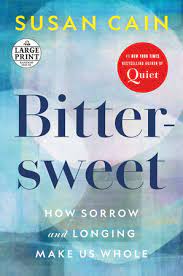 Now then, on a scale of 0 to 10: do you seek out beauty in your everyday life? Do you know what CS Lewis meant when he described joy as a “sharp, wonderful stab of longing”? Do you react intensely to music or art or nature? Are you moved by old photographs? Do you experience happiness and sadness simultaneously?
If your answer is emphatically yes to these and similar questions in Susan Cain’s Bittersweet Quiz (I came to a jarring halt at the one about being perceived as an “old soul”), then you will score highly and qualify as a “true connoisseur of the place where light and dark meet”. You are not sanguine (robust, forward-leaning, ambitious, combat-ready, tough), but bittersweet – and to be bittersweet means to be sensitive, creative and spiritual, with a “tendency to states of longing, poignancy and sorrow; an acute awareness of passing time; and a curiously piercing joy at the beauty of the world”.
more here.
John Waters’s First Novel
Molly Young at the NYT:
 What you get from John Waters is crotch punching, exploding televisions, geysers of blood, deviants, wackos and reprobates. You get phrases like “ridiculous genital display” and “penis probation”; scatology, tickle fetishes and satanic babies. You get teeming panoramas of freaks in thrall to their own depravity. (Another painter comes to mind: Hieronymus Bosch.)
Hyperbole is this writer’s native tongue. A man doesn’t get aroused; sexual adrenaline surges through his loins “like a tsunami wave ripping through a small Japanese village.” A woman doesn’t give birth; she endures a “saga of labor lunacy.” Waters writes toward the funny bone and the gag reflex. He is not at the mercy of political correctness or good taste or spelling conventions. Like any true weirdo, he seems to consider himself normal. When you read a book like this, you’re wandering into a maze of anarchy that is fully legible only to its creator.
more here.
I’ve Always Struggled With My Weight. Losing It Didn’t Mean Winning.
 Sam Anderson in the New York Times:
There were a few bad moments, over the course of a few bad months, that led me to download the weight-loss app. These will probably sound trivial to anyone who is not me, and of course they are trivial — but we are talking about bodies here, and about my body in particular, and one of the defining features of having a body is that it is a fire hose of tiny humiliations blasting you constantly in the face, never allowing you to look away, even when you most want to.
One bad moment happened in Los Angeles. I had flown out, during a lull in the pandemic, to visit my great friend Alan, a friend so close he is basically a reflection of my own soul — and as Alan and I wrapped each other in a big hug of ecstatic reunion, he suddenly reached down to my waist and playfully pinched my love handles, probed them in the way a fishmonger might assess a large hunk of priceless tuna, and he said: “What happened here? Did you eat my friend Sam?” I chuckled, but in a complicated key.
Like many Americans, I put on serious weight during the pandemic. How much? No idea. It had been years since I’d stepped on a scale. We were suffering a worldwide supertrauma, and my approach to calamities has always been extremely simple: I snack. Do you know the saying “Don’t fill up on chips?” That saying is about me. I am the guy who fills up on chips.
More here.
Gary’s Inferno
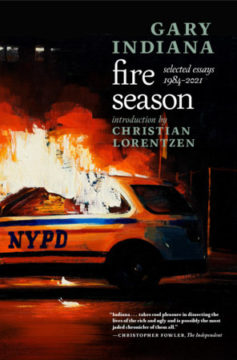 Ryan Ruby in The New Left Review’s Sidecar:
The sovereignty of the ‘average American’ is outbid by economic elites as a matter of course, not excluding those supposedly divisive issues (e.g., abortion, gun control, single-payer healthcare) on which there is in fact bipartisan consensus in the electorate, but that does not mean he has become depoliticized as a result. On the contrary, he is more politically engaged than ever before – only his political activities consist in impotently watching cable news, posting about it on social media, arguing with family and friends during the holidays, decking out his lawn and bookshelf with totemic merch and PayPaling donations to whatever politician or cause has most recently shoved its cup into his diminished span of attention. Yes, he sometimes goes to rallies, protests, city council meetings, or even the ballot box, but these activities, whatever he may believe, have become ends in themselves. ‘Politics is downstream from culture’, one of the more astute ghouls recently uncorked in America liked to say, and it is true that the country’s myriad cultural pathologies give its politics their particularly rancid flavour. But the real takeaway from the Princeton study is that, in the daily experience of the average American, politics is culture, culture is politics, and – with one class of exceptions – never the twain shall meet.
Best known for his tenure as the sharp-tongued, hard-to-impress art critic at the Village Voice during the last gasp of the counterculture, Gary Indiana’s insight into this state of affairs is that insofar as the US has become a ‘televised democracy’, it may, like any other aesthetic phenomenon, be reviewed.
More here.
Abandoning Defensive Crouch Conservatism
 Patrick J. Deneen over at his substack The Postliberal Order (photo by Matt Cashore/University of Notre Dame):
Mid-century conservatism arose as a defensive response to an advancing liberalism. It began as an effort to defend liberalism, the “good” liberalism constructed in mid-century and attributed to the Founding Fathers and the Constitution, a politics based upon as an avoidance of any idea of the Good in politics and economics. This stance attracted widespread support and donations, leading to the creation of countless institutions that were devoted to the protection of “good liberalism.” It was a defensive crouch conservatism, occupying the ground that was, until fairly recently, occupied by their opponents.
Consider the positions that the mainstream of American conservatism spends a great deal of its time and treasure defending today:
- Religious liberty
- “Limited” government
- The inviolability of private institutions (e.g., corporations)
- Academic Freedom
- Constitutional “Originalism”
- Free Markets
- Free speech and “expression”
Each of these positions was a creation of early modern liberalism, designed to overthrow a predominantly Aristotelian/Thomistic worldview. Each of these liberal features represent an aspect of what Alasdair MacIntyre has called “the privatization of the good.” Each was designed as a battering ram to demolish any prospect for a social, political, and economic order that – while never perfect – nevertheless understood that society must be ordered toward the end of advancing the telos of human beings.
More here. Also, find here Ezra Klein’s interview with Deneen.
Breakfast with the Panthers
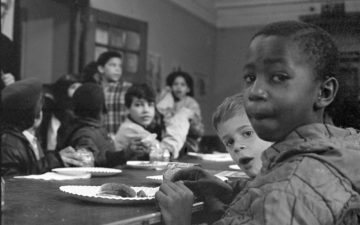 Suzanne Cope in Aeon:
Starting in 1969, and for several years afterwards, in church basements and community centre kitchens in cities and towns around the United States, thousands of kids sat around a table every school day morning, eating hot breakfast served by the young adults of the Black Panther Party. At each seat there was a plate and utensil setting, a cup and a napkin. The children learned to use their fork and knife properly, eating eggs and grits and bacon and toast, washed down by juice or milk or hot chocolate – whatever local businesses had donated that week.
The Panthers – most of them in their late teens and early 20s, and about two-thirds of them women – had arrived at these community kitchens before dawn to prepare this hot meal for the children, serving them and then checking homework, and giving PE (political education) lessons.
‘Who invented the traffic light?’ a Panther would call out.
‘A Black man!’ the children responded.
They also learned that eating a filling breakfast was a right, and that a full belly helped them pay attention in school. The children – most but not all of whom were Black and Hispanic – were taught about Black and Hispanic inventors and artists and leaders, the stories that were (and still are) so often left out of mainstream histories. For many children, this was the first time they learned that a Black or other person of colour could be an engineer or a scientist or an artist.
More here.