
Shamira Ibrahim in The Baffler:
 THE WRITER AND SCHOLAR Saidiya Hartman opens her 2008 essay “Venus in Two Acts” with an admission about the challenge she’s taken on: to give life to the story of the “Black Venus,” the “emblematic figure of the enslaved woman in the Atlantic world,” present in the archives in various forms, but never as a full person. “I want to do more than recount the violence that deposited these traces in the archive. I want to tell a story about two girls capable of retrieving what remains dormant—the purchase or claim of their lives on the present—without committing further violence in my own act of narration,” Hartman writes. “Listening for the unsaid, translating misconstrued words, and refashioning disfigured lives—and intent on achieving an impossible goal: redressing the violence that produced numbers, ciphers, and fragments of discourse, which is as close as we come to a biography of the captive and the enslaved.”
Hartman carefully details the process of archival discovery: while she has encountered her two Black Venuses in a legal indictment against a slave ship captain, many others can be found in ledgers, overseers’ journals, or in a traveler’s account of brothels. Circumstances notwithstanding, the end result is the same—an unnamed Black woman, deprived of the ability to tell her story, reduced by a white man to a commodity or a tawdry sexual exploit. Aiming to engage in a reparative exercise, Hartman asks: “How does one recuperate lives entangled with and impossible to differentiate from the terrible utterances that condemned them to death, the account books that identified them as units of value, the invoices that claimed them as property, and the banal chronicles that stripped them of human features?”
More here.
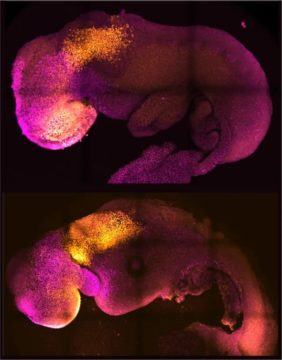 The recipe for mammalian life is simple: take an egg, add sperm and wait. But two new papers demonstrate that there’s another way. Under the right conditions, stem cells can divide and self-organize into an embryo on their own. In studies published in Cell and Nature this month, two groups report that they have grown synthetic mouse embryos for longer than ever before. The embryos grew for 8.5 days, long enough for them to develop distinct organs — a beating heart, a gut tube and even neural folds.
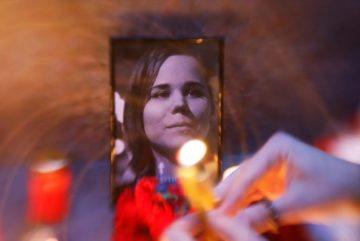 Masha Gessen in The New Yorker (Photograph by Maxim Shemetov / Reuters):
 Fathimath Musthaq in Phenomenal World:
 P
P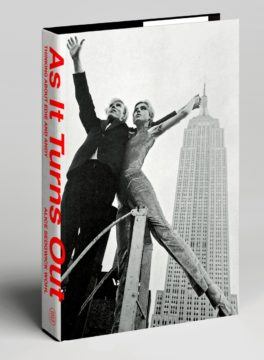 Naturalness is the muse’s great gift. Like Helga Testorf, who merely had to stand still for Andrew Wyeth to want to transpose her spirit, Sedgwick had only to walk and talk for Warhol to track her every move on film. “Andy always picks people because they have an amazing sort of essential flame, and he brings it out for the purposes of his films,” the curator Henry Geldzahler once said. “He never takes anybody who has nothing and makes them into something. What he did was recognize that Edie was this amazing creature, and he was able to make her more Edie so that when he got it on camera it would be made available to everybody.” Warhol’s movies captured Sedgwick just being herself: putting on makeup, lying in bed, perching on a couch arm while looking about the room. She appeared in more than a dozen films, such as “Face,” a seventy-minute-long closeup, and “Afternoon,” a scripted “chamber opera” in which Sedgwick and friends gas around in her apartment, high on amphetamines. Sedgwick Wohl, who has spent decades watching her sister on film, observes her as if looking through a high-powered telescope. “What they saw in her was not talent but simply the way she was, transcribed onto the screen,” Sedgwick Wohl writes.
 Are you prepared for a vision of sizzling sexuality? Picture this. A woman dressed in brown suede brogues and a below-the-knee skirt, her legs obscured by stockings. Sandy-gray hair. A discreet brooch pinned to her blouse, a formal manner of speaking, a keen interest in antiquity and a tendency to suffer from migraines. These qualities may not scream “racy” or “seductive” or “exotic” to you, but you are not the narrator of Julian Barnes’s 25th book.
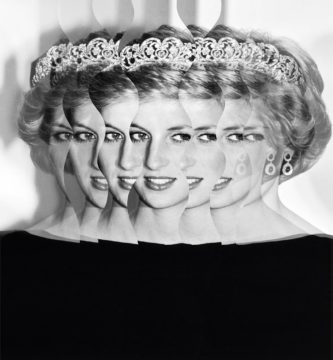 At Althorp, the Northamptonshire estate where she lived as a young woman, there is a drawing of Diana Spencer, round-faced and smiling. It was made when she was a child, and unhappy: her mother, Frances, had left the family. It is a private family artefact, and something else too: an early study in iconography, in making Diana something she was not. Her marriage to
 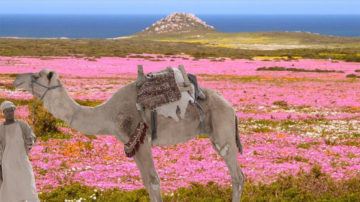 In the gulf, thirst is a paradigm: it is impossible to think about the desert without thinking about water. The Arabian Desert is also a peninsula, with countries formed from both deserts and ports. I propose thirst trap theory – derived from the slang for a selfie used to elicit an exchange between sexual bodies – as a way of reading this relation between desert and surrounding water, between drought and abundance, in cinema from the Gulf. Ranging from narrative cinema to experimental video, these films are as diverse – and extreme – as the landscape that inspired them.
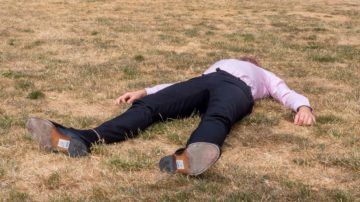 The lawns at Tusmore House, a neo-Palladian mansion 15 miles north of Oxford, are so perfectly flat and exactingly shorn that they induce a kind of vertigo. Unlike familiar grass, with its divots and erupting daisies, the grass here feels as though it might evaporate underfoot in a cloud of pixels. On a sticky afternoon last summer, David Hedges-Gower, a four-decade veteran of the turf industry and grass whisperer to the wealthy, inspected what looked to the layman like flawless green carpet and found it wanting.
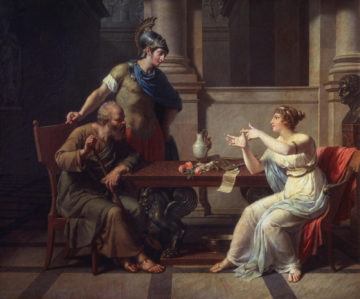 What if the secret of the Symposium was that it is not so much about love as breaking up? Just as we speak of Platonic love, so we should speak of the Platonic breakup, which is, of course, the ideal form of the breakup. Its formula, invented by Socrates, has two parts:
 My cat died in Germany once. In Cologne. I remember the city being very ugly and the famous cathedral being so black, completely covered in soot. I’m not against ugly cities and truth be told I rather enjoy them. Cities should be ugly. Of course, that’s an absurd thing to say. There’s nothing more lovely than a lovely city. I was reminded of this recently when I traveled from Berlin to Paris. Berlin is so ugly and Paris is so beautiful. Whatever doubts I might have had that Berlin is just really ugly, my father squashed them for me on a brief visit to the city while I was staying there. We were walking through the city, making our way from the Motel One he was staying at on Alexanderplatz to the little Airbnb where I was living in Prenzlauerberg with my old and assiduous friend Stevie and I was watching my father move ever so slowly through the not-so-interesting streets that connect the two neighborhoods and as we stopped at the second or third cafe for him to catch his breath and take a rest I realized that he is genuinely elderly now. It’s an indistinct threshold, being old. But he has become old. That is what happens, of course. There is no shame in it. Will Germany kill my father, just as it killed my cat, I wondered to myself. It was hot in Berlin that week. We should have taken the U-Bahn or even a cab. But I wanted to walk with my aging father through the streets of Berlin. I was feeling tenderly toward him, even though I, and simultaneously Berlin itself, were both trying to kill him.
 Low rainfall and record-breaking heat across much of China are having widespread impacts on people, industry and farming. River and reservoir levels have fallen, factories have shut because of electricity shortages and huge areas of crops have been damaged. The situation could have worldwide repercussions, causing further disruption to supply chains and exacerbating the global food crisis.
 Rumors of the death of neoliberalism are indeed
  Tucker Carlson, a political commentator on Fox News, has long assailed Anthony Fauci for his role in the U.S. government’s response to the COVID-19 pandemic during both former President Donald Trump’s and President Joe Biden’s administrations. But on 22 August, when Fauci announced he would be retiring from his jobs as director of the U.S. National Institute of Allergy and Infectious Diseases (NIAID) and chief medical adviser to the president at the end of year, the Tucker Carlson Tonight host laid into him like never before. Carlson asserted Fauci had committed “very serious crimes” and said he “apparently engineered the single most devastating event in modern American history.” Carlson, infamous for assailing people’s looks, also called Fauci a “an even tinier version of the Dalai Lama” and a “Stalinist midget.”