
Category: Recommended Reading
Thursday, August 25, 2022
A Pig and a Locust Get Into Serious Trouble With the Law: On Justice in Medieval Europe
Arran Lomas in Literary Hub:
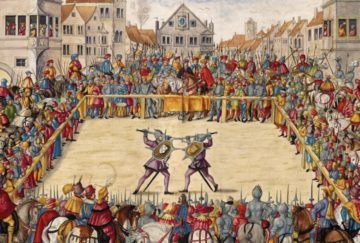 Up until the mid-thirteenth century, you would be fortunate if you were to be tried by a jury of your peers in the king’s court. Throughout the early Middle Ages, this particular court preferred trial by ordeal. The idea was that God favored the innocent, so the defendant would be put through an ordeal in which God would either help him prove his innocence or clarify his guilt. Commonly used methods were trial by cold water, in which the accused would have his hands and feet bound and be thrown into a body of water; if he floated, he was innocent, but if he sank, he was assumed guilty.
There was ordeal by hot iron or stone, in which the defendant was made to hold a lump of hot iron or plunge his hand into a pot of boiling water to fetch a stone. If his hand completely healed within three days, then, naturally, God had intervened, demonstrating his innocence. If scars still showed, he could expect a swift execution.
More here.
30 Years Ago Tonight, Sarajevo’s National Library Was Destroyed
Dan Sheehan at Lit Hub:
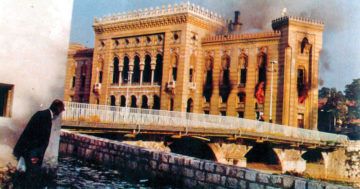 Located on the bank of the Miljacka river in the city’s old Turkish quarter, the beautiful pseudo-Moorish structure, known to locals as Vijećnica (City Hall), was a beloved symbol of the multiethnic, multicultural capital of Bosnia before the entire building, along with two million of the books it housed, went up in flames.
By August 25th, Sarajevo was suffering through the early days of a devastating four year siege (the longest in the history of modern warfare) by Bosnian Serb forces, one which would ultimately claim the lives of over ten thousand of its inhabitants. Every day, from the hills around the city and the windows of captured apartment blocks within it, shells and sniper fire rained down the trapped Sarajevan people—a people who had, only 8 years previous, joyously hosted the 1984 Winter Olympic Games.
more here.
A Sarajevo Diary – From Bad To Worse
We Need to Talk About How Good A.I. Is Getting
Kevin Roose at the NYT:
 “It feels like we’re going from spring to summer,” said Jack Clark, a co-chair of Stanford University’s annual A.I. Index Report. “In spring, you have these vague suggestions of progress, and little green shoots everywhere. Now, everything’s in bloom.”
In the past, A.I. progress was mostly obvious only to insiders who kept up with the latest research papers and conference presentations. But recently, Mr. Clark said, even laypeople can sense the difference.
“You used to look at A.I.-generated language and say, ‘Wow, it kind of wrote a sentence,’” Mr. Clark said. “And now you’re looking at stuff that’s A.I.-generated and saying, ‘This is really funny, I’m enjoying reading this,’ or ‘I had no idea this was even generated by A.I.’”
more here.
Why Do (Some) Humans Love Chili Peppers?
Gideon Lasco in Sapiens:
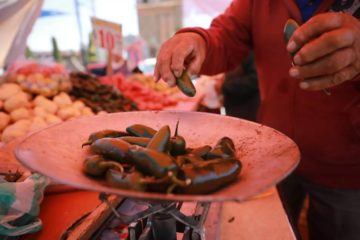 In fact, all of the world’s chili peppers—including the labuyo peppers that we typically use in the Philippines—likely came from the first domesticated chili plants (Capsicum annuum) in what is now Mexico. They were imported as part of the Columbian exchange, which saw the two-way transfer of ideas, animals, plants, diseases, and people between the Eastern Hemisphere and the Americas following Christopher Colombus’ first transatlantic voyage in the late 15th century.
Unthinkable as it may sound today, the cuisines we have come to associate with spiciness—Indian, Thai, Korean, and Chinese, among others—had no chili peppers at all before their introduction in the 16th century onward. Prior to that, those cuisines relied on other spices or aromatics to add heat to dishes, such as ginger, likely native to southern China, or black pepper, native to India.
How did chili peppers become part of the human diet beginning in the Americas an estimated 6,000 to 10,000 years ago? And why were they eventually embraced by the rest of the world?
More here.
Beneath the skin of our obsession with whiteness
Kenan Malik in Pandaemonium:
 It is Viktor Orbán’s worst nightmare: “One morning Anders, a white man, woke up to find he had turned a deep and undeniable brown.” It is the opening line to Mohsin Hamid’s new novel The Last White Man, a line that deliberately echoes the opening to Franz Kafka’s Metamorphosis.
Ever since he first bedazzled with his 2000 novel Moth Smoke, Hamid has shown himself willing and capable of tackling big, divisive subjects: the war on terror, immigration, identity, corruption, poverty. With his latest novel, he attempts to engage with another biggie: “whiteness”.
Whiteness is a condition that pleads to be given novelistic treatment and to be rendered through a Kafkaesque lens. It has become a kind of metaphor, a myth even, through which we project all manner of anxieties and fears about the world and our place in it. And this is true of all sides in the race debate. For racists, whiteness is an expression both of pride and of loss. An embodiment of a sense of superiority and specialness but also a rendering of a world that seems to be slipping away.
More here.
Steven Pinker: How Does The Brain Develop Language?
Could tiny blood clots cause long COVID’s puzzling symptoms?
Cassandra Willyard in Nature:
 Researchers are baffled by long COVID: hundreds of studies have tried to unpick its mechanism, without much success. Now some scientists, and an increasing number of people with the condition, have been lining up behind the as-yet-unproven hypothesis that tiny, persistent clots might be constricting blood flow to vital organs, resulting in the bizarre constellation of symptoms that people experience.
Proponents of the idea (#teamclots, as they sometimes refer to themselves on Twitter) include Etheresia Pretorius, a physiologist at Stellenbosch University in South Africa, and Douglas Kell, a systems biologist at the University of Liverpool, UK, who led the first team to visualize micro-clots in the blood of people with long COVID. They say that the evidence implicating micro-clots is undeniable, and they want trials of the kinds of anticoagulant treatment that Hawthorne is considering. Pretorius penned the Guardian article that caught Hawthorne’s attention. But many haematologists and COVID-19 researchers worry that enthusiasm for the clot hypothesis has outpaced the data. They want to see larger studies and stronger causal evidence. And they are concerned about people seeking out unproven, potentially risky treatments.
More here.
The Idea That Letting Trump Walk Will Heal America Is Ridiculous
Jamelle Bouie in The New York Times:
 The main argument against prosecuting Donald Trump — or investigating him with an eye toward criminal prosecution — is that it will worsen an already volatile fracture in American society between Republicans and Democrats. If, before an indictment, we could contain the forces of political chaos and social dissolution, the argument goes, in the aftermath of such a move we would be at their mercy. American democracy might not survive the stress.
All of this might sound persuasive to a certain risk-averse cast of mind. But it rests on two assumptions that can’t support the weight that’s been put on them. The first is the idea that American politics has, with Trump’s departure from the White House, returned to a kind of normalcy. In this view, a prosecution would be an extreme and irrevocable blow to social peace. But the absence of open conflict is not the same as peace. Voters may have put a relic of the 1990s into the Oval Office, but the status quo of American politics is far from where it was before Trump.
More here.
Thursday Poem
Under the Bo Tree
I bring you, Gautama, my empty hand,
which would have been full of figs
from a house that has never known death—
had there been one.
But there isn’t
so my palm is empty.
So I bring you, Gautama, my empty palm,
full of the days of my father’s house—
childhood books, summers staining the clothes green,
anxious to get out into that greater world
(convinced I would do better).
And then, later, the Fridays at Oaxaca Kitchen—
good beer, superb fajitas, the young
passing by, friends hilarious, everyone getting drunk,
my days full of useless work at a job,
the exhaustion found at my dusks,
the sweet ease of my sleep, my love of my bed,
blessed unconsciousness.
I bring you, Gautama, my open palm—
drop a blessing in it
so that I can touch the head of a bull
and ease its rage,
pat the head of a drunken monkey and say,
“I was where you are, my friend,”
or collect raindrops, my hand a bowl,
as we sit under the Bo tree,
just sitting, saying to the dissolving drops,
“You are my mind.”
An open palm to grab the days ahead,
take hold of what’s next,
open to sleep and a long work day
and the cycle of that worker’s life.
I bring you, Gautama, two hands, one heart,
one overused and, perhaps, useless mind—
human being, and human being only—
awaiting what’s next in a human being,
ready for more of what a human being is.
by Mark Fitzpatrick
from Rattle #76, Summer 2022
Wednesday, August 24, 2022
A Psychologist Plumbs the Cultural Roots of Emotion
Emily Cataneo in Undark:
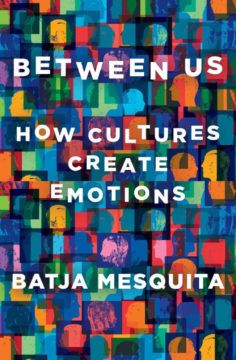 For many years, psychologists and other scientists believed that deep down, all of humankind experienced the same set of evolutionarily hard-wired emotions. Under this schema, anger, for example, was a concrete, immutable experience that happens deep inside all human beings, the same for a White American sipping coffee in Manhattan as for native Siberian herding reindeer. When Batja Mesquita, a key figure in the development of the field of cultural psychology, started researching emotion more than 30 years ago, she was confident that this model was correct. But Mesquita, who is today a distinguished professor at the University of Leuven in Belgium, has come to view emotions through a completely different lens. In her new book, “Between Us: How Cultures Create Emotions,” Mesquita makes a provocative argument that when it comes to emotions, we are not all the same. “Are other people angry, happy, and scared, just like you?” she queries. “And are your feelings just like theirs? I do not think so.”
More here.
Epigenetic ‘Clocks’ Predict Animals’ True Biological Age
Ingrid Wickelgren in Quanta:
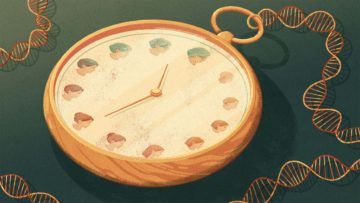 This time a year ago, Steve Horvath was looking for pangolin DNA. The ancient scaly anteater would be a first for his collection, which was then about 200 mammals strong. “I didn’t have any of that order, which is why I desperately wanted them,” he recalled.
Since the summer of 2017, Horvath, who until recently was an anti-aging researcher at the University of California, Los Angeles, has spent as much as 10 hours a day penning emails to zoos, museums, aquariums and laboratories. He has attended talks on bats and Tasmanian devils to meet their keepers. He has reached out to the far corners of the world, begging for the DNA of flying foxes, vervet monkeys, minipigs and bowhead whales.
With that vast menagerie of samples, he has built computational clocks that can calculate the age of creatures as diverse as shrews, koalas, zebras, pigs and “every whale you can name,” he said, just by looking at their DNA. But those were merely steps toward the completion of Horvath’s ambitious moonshot of a project: a universal clock that could measure the biological age of any mammal.
More here.
Not The Great American Novel But Its Jungian Shadow
Meghan O’Gieblyn at n+1:
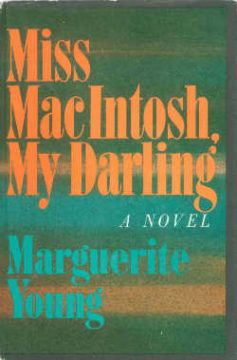 MARGUERITE YOUNG SPENT EIGHTEEN YEARS of her life writing Miss MacIntosh, My Darling, the amount of time it requires to raise a child. She began the novel in 1945, in the shadow of Hiroshima, and proceeded for the next two decades to work on it each day, putting in a reliable eight hours. She wrote in Iowa City, where she taught creative writing and often unnerved her students by pausing to invite Henry James or Emily Dickinson into the classroom. She wrote in New York, from a cramped Greenwich Village apartment filled with dolls, carved angels, and an antique carousel horse. She wrote at Yaddo, where she spent summer evenings drinking with Truman Capote and Carson McCullers and running wild through the moonlit rose garden. FDR gave way to Harry, to Ike, to JFK. She was working on Miss MacIntosh at the time of Jackie Robinson’s first game, and throughout the spring of the McCarthy hearings, and the winter the Beatles first arrived in the US. None of these events appear in the novel, which is not interested in cultural or political landmarks, or, for that matter, linear time.
more here.
Miss MacIntosh, My Darling by Marguerite Young
Against August
Haley Mlotek at The Paris Review:
 I am against August. When I try to explain this position, some people instinctively want to argue. These people seem to love the beach beyond all reason, to have never suffered a yellowed pit stain on a favorite white T-shirt in their life, and to eagerly welcome all thirty-one days of August as though they are a reward for a year well-lived rather than a final trial before the beginning of another. These are people who vacation with peace of mind. To them, I say: Go away. To the people who agree with me, I say: Go on.
Many friends who share my malaise compare the experience of the month to the Sunday feeling of knowing work or routine is imminent after a break. I don’t agree exactly, but I recognize the comparison. In August summer ends, and so whether or not you are done with it you must accept that it is finished.
more here.
What We Owe The Future
Scott Alexander in Astral Codex Ten:
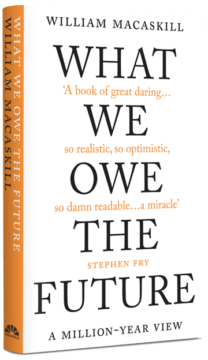 If the point of publishing a book is to have a public relations campaign, Will MacAskill is the greatest English writer since Shakespeare. He and his book What We Owe The Future have recently been featured in the New Yorker, New York Times, Vox, NPR, BBC, The Atlantic, Wired, and Boston Review. He’s been interviewed by Sam Harris, Ezra Klein, Tim Ferriss, Dwarkesh Patel, and Tyler Cowen. Tweeted about by Elon Musk, Andrew Yang, and Matt Yglesias. The publicity spike is no mystery: the effective altruist movement is well-funded and well-organized, they decided to burn “long-termism” into the collective consciousness, and they sure succeeded.
But what is “long-termism”? I’m unusually well-placed to answer that, because a few days ago a copy of What We Owe The Future showed up on my doorstep.
More here.
The Brilliantly Nightmarish Art & Troubled Life of Painter Francis Bacon
How women are banding together to change Japanese politics
Takehiko Kambayashi in The Christian Science Monitor:
 On a sweltering day in July, Yoshii Aya, still reeling from her bitter election defeat a few months prior, arrived in Kyoto with a stack of leftover business cards tailored for that bygone race. During a three-day political training camp for women trying to break into Japan’s male-dominated politics, she coyly passed them out as a “memento of my candidacy.” Had she won the April election, Ms. Yoshii would have become one of two women sitting on the 20-member city council in Miyoshi, Japan. Instead, she spent her summer reflecting on the loss, and learning campaign financing and social media strategy along with 15 other training camp participants. Ms. Yoshii says she felt empowered by connecting with like-minded women at the camp, which was organized by Tokyo’s Academy for Gender Parity.
The event comes less than a year before the 2023 local elections, and as Japan continues to exhibit one of the lowest rates of female legislature representation in the world. During last month’s upper house race, a record 35 women gained seats in Japan’s parliament, raising the overall ratio of women in the chamber to 25.8% from 23.1%. It’s the kind of incremental progress that has Japanese women’s patience wearing thin. Many point out that the United States now has its first female vice president, and New Zealand and Taiwan both have female heads of state.
Increasingly, women are channeling that frustration into cooperation, forming solidarity groups and campaigning for the advancement of fellow female politicians.
More here.
Psychotic symptoms in children may have a genetic cause
From Phys.Org:
 A 6-year-old boy began hearing voices coming from the walls and the school intercom telling him to hurt himself and others. He saw ghosts, aliens in trees, and colored footprints. Joseph Gonzalez-Heydrich, MD, a psychiatrist at Boston Children’s Hospital, put him on antipsychotic medications and the frightening hallucinations stopped. Another child, at age 4, had hallucinations with monsters, a big black wolf, spiders, and a man with blood on his face.
While children are known for their active imaginations, it’s extremely rare for them to have true psychotic symptoms. Through chromosomal array testing, both children were found to have copy number variants or CNVs, meaning deletions of duplications of chunks of their DNA.
More here.