
 Alice Crary in Boston Review:
By Michaelmas Term 1939, mere weeks after the United Kingdom had declared war on Nazi Germany, Oxford University had begun a change that would wholly transform it by the academic year’s end. Men ages twenty and twenty-one, save conscientious objectors and those deemed physically unfit, were being called up, and many others just a bit older volunteered to serve. Women had been able to matriculate and take degrees at the university since 1920, but members of the then all-male Congregation had voted to restrict the number of women to fewer than a quarter of the overall student population. Things changed rapidly after the onset of war. The proportion of women shot up, and, in many classes, there were newly as many women as men.
Among the women who experienced these novel conditions were several who did courses in philosophy and went on to strikingly successful intellectual careers. Elizabeth Anscombe, noted philosopher and Catholic moral thinker who would go on occupy the chair in philosophy that Ludwig Wittgenstein had held at Cambridge, started a course in Greats—roughly, classics and philosophy—in 1937, as did Jean Austin (neé Coutts), who would marry philosopher J. L. Austin and later have a long teaching career at Oxford.
More here.
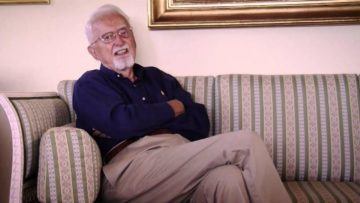 Lance Taylor over at INET:
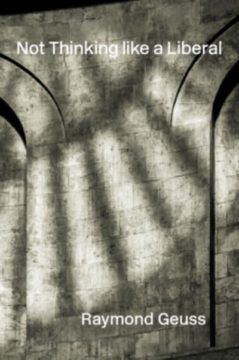 Robert Paul Wolff over at his website [h/t: Leonard Benardo]:
 1982 isn’t your typical war film.
 H
H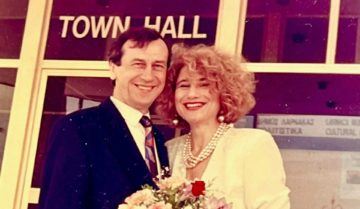 O’Dwyer had a great sense of humor,
  In 1990, at the Humanities Research Institute at University of California at Irvine, I found myself sitting next to Jacques Derrida at a lecture given by Ernesto Laclau. The topic was Antonio Gramsci. At the end of the talk, of which I understood frustratingly little, Derrida asked a question that took about 20 minutes to formulate. Laclau’s response was of equal length. This mattered, because the event was the only one open to the public (it was to be followed by an invitation-only seminar). Graduate students and professors packed the lecture hall and, like Laclau himself, deferentially hung on Derrida’s every word. But they never had time to speak. The episode struck me as symbolic of the reverence deconstruction commanded at the height of its influence — and also of the hierarchies, buoyed by awestruck puzzlement, upon which it rested.
 People mainly notice the Moon looking bigger and closer when it is full and near the horizon. This is because your mind judges how big or small an object like the Moon is
 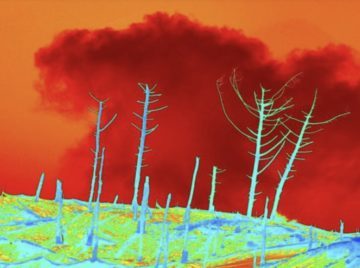 Ever since the notion of the “Anthropocene” was proposed by two scientists, Nobel Prize-winning chemist Paul Crutzen and marine scientist Eugene Stoermer, in a newsletter article published in 2000 by the International Council for Science, this label for the current geological epoch has led two distinct but related lives. Considered the successor to the Holocene Epoch, the Anthropocene is characterized by human harm to the earth system, including global warming and ocean acidification, the dissemination of synthetic chemicals, the redistribution of life forms across the planet, and a prospective sixth mass extinction event. In one life, the Anthropocene has been a lightning rod for questions of political economy and power. In its other, it has served as a useful scientific heuristic, assimilating mountains of measurements and calculations.
 Americans love to look on the bright side. We process our traumas and congratulate ourselves on our resilience. We like to crown ourselves winners, avoiding the stigma of the L-word deployed by a certain ex-president. The triumph of the therapeutic, as Philip Rieff called it, even applies to our anti-free-speech college students, who gain vituperative strength from the harm supposedly inflicted on them by other people’s disagreeable opinions.
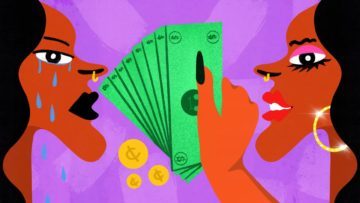 Financial literacy — the ability to understand how money works in your life — is considered the secret to taking control of your finances. Knowledge is power, as the saying goes, but information alone doesn’t lead to transformation. In putting financial literacy above all else, many in the personal finance industry have decided that repeating the same facts about how much money folks should have in their emergency savings account will, somehow, change people’s money habits. This approach doesn’t account for our human side: the parts of us that crave connection, new experiences, and fitting in as members of our communities. Most of our decisions around money are emotional; no amount of nitty-gritty knowledge about interest rates will change that.
 Let’s consider where AI poetry is in 2022. Long after Racter’s 1984 debut, there are now scores of websites that use Natural Language Processing to turn words and phrases into poems with a single click of a button. There is even a tool that takes random images and creates haikus around them. You can upload an image of – say, a tree – and the tool will create a simple haiku based around it.
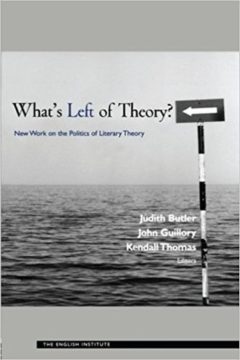 The only way to understand the “public sphere” today is by doing some historical reconstruction. Because what we’re really talking about with the history of literary criticism is an enormous shift between the nineteenth and twentieth centuries away from a media world at the center of which were the genres of periodical publication. The critics who wrote in that media sphere wrote about literature, but they were not professionalized in the way academics in the twentieth century became. This meant that they could write about pretty much anything, and they did. They won their audiences by the quality and force of their writing rather than by virtue of professional credentials. At the same time, these periodicals also published works of literature, serialized novels and other forms of literary writing, so people got a lot of exposure to literature through these periodicals, which had very large audiences. The connection between literature and public-sphere criticism was very close.
 Thomas O’Dwyer,
 A few years ago, my book Small Wrongs was published. It has been
  R
R