
Rafia Zakaria in The Baffler:
 PROMINENT WHITE FEMINISTS tend to stick together. I would know, after having written a book called Against White Feminism. I was criticized or dismissed by a good many of them, not least the former secretary of state Hillary Clinton, who was asked directly about my book last year and essentially declared that “complicated and difficult conversations” about racism and feminism are a distraction from the need to oppose draconian anti-women laws being pushed by Republicans. Similar furor erupted this week when New York Times journalist Alisha Haridasani Gupta wrote an article titled “The Sunsetting of the Girlboss Is Nearly Complete.” The main “girlboss” in Gupta’s article was Emily Weiss, the former CEO of a make-up company called Glossier. Gupta shows how Weiss—along with a few other female CEOs who have also stepped down from top jobs—represented a form of leadership that celebrated markedly un-feminist values: domination, hierarchy, and capitalist greed. Gupta suggests we’re seeing the demise of a certain kind of acquisitive, ruthless, and white female entrepreneur encapsulated in the girlboss ideal. Among the reasons that Gupta enumerated for the end of Weiss’s tenure was an internal memo in which retail employees complained of a “racist, toxic work environment.” One cited example was the company’s inability to handle situations such as when white teenagers used products in the “experiential” Glossier stores to emulate blackface.
Most millennial feminists have already denounced the girlboss label, which began as the title of a book written by a white woman who advocated a ruthless, “let’s beat the white men at their game” brand of feminism, a sort of younger version of what Sheryl Sandberg so skillfully sold in Lean In.
More here.
 Jim Al-Khalili has an enviable gig. The Iraqi-British scientist gets to ponder some of the deepest questions—What is time? How do nature’s forces work?—while living the life of a TV and radio personality. Al-Khalili hosts The Life Scientific, a show on BBC Radio 4 featuring his interviews with scientists on the impact of their research and what inspires and motivates them. He’s also presented documentaries and authored popular science books, including a novel, Sun Fall, about the crisis that unfolds when, in 2041, Earth’s magnetic field starts to fail. His latest book, The Joy of Science, is his response to a different crisis.
 Justin Vassallo in Phenomenal World:
 Nóra Schultz in Tocqueville 21:
 Kate Kirkpatrickis and Sonia Kruks in Aeon:
 I admit to having been skeptical, ahead of time, of the
 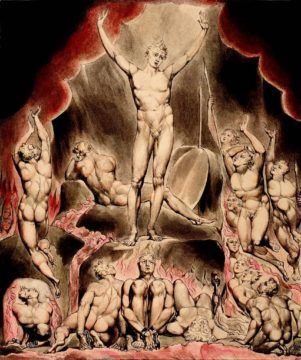 When the Restoration ended his career in Britain’s Commonwealth government in 1660, John Milton turned his full attention to the verse tragedy he’d started around 1640, then called “Adam Unparadised.” By now in his 50s, blind and ailing, Milton composed “Paradise Lost” aloud, in bed or (per witnesses) “leaning backward obliquely in an easy chair, with his leg flung over the elbow of it,” memorizing the stanzas to be transcribed in another’s hand.
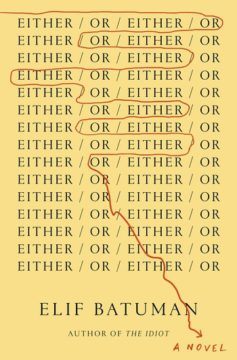 EARLY IN ELIF BATUMAN’S NEW NOVEL Either/Or, she quotes a blurb on the front of Kazuo Ishiguro’s An Artist of the Floating World, extracted from its 1986 review in the New York Times. “Good writers abound—good novelists are very rare,” the critic theorizes, deeming Ishiguro “not only a good writer, but also a wonderful novelist.” For Either/Or’s narrator, the distinction comes as a shock. Since she was young, Selin has aspired to become a novelist, and she views much of her life to date as training for that vocation. Assessing herself according to the reviewer’s implied rubric, Selin realizes that her facility with language, her sparkling insights and clever turns of phrase, may not be sufficient. “It was what I had been counting on,” she thinks. “My sense of being a good writer. My stomach sank with the knowledge of how wrong I had been.” This is in some sense the anxiety that haunts Either/Or: Batuman is demonstrably, incontrovertibly a good writer—but is she a good novelist? (And what is a good novel anyway?)
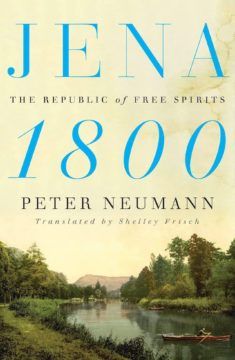 No wonder, too, then, that there is a current public of soi-disant intellectuals eager to learn about past experiments in living, especially those with a significant philosophical dimension. And so we have Peter Neumann’s Jena 1800: The Republic of Free Spirits (translated by Shelley Frisch), “a fascinating and highly readable story of ideas, art, love, and war,” as one blurb has it, and a picture of “a world intoxicated with the possibilities of thought,” according to another. Jena in 1798 to 1800 was a backwater provincial city of 5,000 residents, one-fifth of whom were students. Initially attracted by the presences at the university first of Karl Leonhard Reinhold and then J. G. Fichte, both of whom were associated with the free thinking of Kantianism and the French Revolution, a circle of intellectual friends, including women as equals as well as men, formed around the brothers August and Friedrich Schlegel.
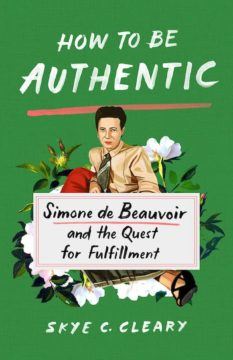 Although existentialist philosophers rarely labeled themselves as such or agreed on a definition of what they were doing, existentialism is a coherent and sound philosophy. It begins with the claim that “existence precedes essence,” meaning that people enter the world (they exist) before they can be said to have a fixed definition (or essence). They are free to create their own essence, and with this freedom comes responsibility. The contrast between how strange it is to exist and the reality that we are here is called “absurdity.” From absurdity, nihilists would avow that life is meaningless, and thus do whatever they want. Existentialists, however, typically reject nihilism and embrace authenticity. For Martin Heidegger, authenticity was related to our “being toward death.” For Friedrich Nietzsche, the “eternal return of the same” counsels us to live as if our life will repeat itself eternally.
 In my nine years of doing this work I have seen an increasing demonisation of the clients of sex workers, even while I’ve seen increasing support for sex workers themselves. Much of the discussion around sex-worker rights focuses on the workers, how often marginalised people enter the industry out of financial necessity, and how criminalising that only further marginalises them, by forcing them into more dangerous scenarios and punishing them for their need. All this is of course of pre-eminent importance. And I think that the rights of sex workers shouldn’t rely on the value or respectability of the work itself—it is simply a human rights and labour rights issue. Sex workers should be able to speak about exploitation and abuse in the industry without that being used against us to argue for the eradication of the industry itself—in the same way migrant workers are speaking about working conditions on Australian farms without it leading to a cry to shut down agriculture.
 They span three continents, but a trio of researchers who’ve never met share a singular focus made vital by the still-raging pandemic: deciphering the causes of Long Covid and figuring out how to treat it.
 On March 9, 1945, an armada of more than three hundred B-29s flew fifteen hundred miles across the Pacific to attack Tokyo from the air. The planes carried incendiary bombs to be dropped at low altitudes. Beginning shortly after midnight, sixteen hundred and sixty-five tons of bombs fell on the city.