Farming Ants Update Their Crops

From Science:

Ants Approximately 50 million years ago, some Amazonian ant species discovered that raising fungi could provide a more stable food source than just foraging on the rainforest floor. Thus, they became farmers. Now, more than 200 species of New World ants cultivate crops, fastidiously fertilizing, cleaning, and weeding delicate white fungal filaments in their underground lairs. And, like human farmers who exchanged ancient emmer wheat for modern varieties, these ants have updated the crops they grow over time, according to new research.

In an attempt to reconstruct the ant's and fungi’s evolutionary history, evolutionary biologist Alexander Mikheyev of the Okinawa Institute of Science and Technology in Japan and colleagues looked at molecular clocks—accumulations of mutations in short stretches of DNA that reveal when a species diverged from its ancestors—for both organisms. The team found that the fungi were evolving at vastly different times than the ants. For instance, leaf-cutter ants diverged from their ancestors 12 million years ago, but the fungus that they cultivate arose only 2 million to 3 million years ago. Rather than evolving in step, the ants must have domesticated a new fungal strain, which spread through the ants’ range and eliminated any trace of the previous cultivar, the researchers report in the June issue of The American Naturalist

More here.

A Middle East Peace That Could Happen (But Won’t)

Noam Chomsky in TomDispatch.com:

ScreenHunter_02 Apr. 28 11.02 The fact that the Israel-Palestine conflict grinds on without resolution might appear to be rather strange. For many of the world's conflicts, it is difficult even to conjure up a feasible settlement. In this case, it is not only possible, but there is near universal agreement on its basic contours: a two-state settlement along the internationally recognized (pre-June 1967) borders — with “minor and mutual modifications,” to adopt official U.S. terminology before Washington departed from the international community in the mid-1970s.

The basic principles have been accepted by virtually the entire world, including the Arab states (who go on to call for full normalization of relations), the Organization of Islamic States (including Iran), and relevant non-state actors (including Hamas). A settlement along these lines was first proposed at the U.N. Security Council in January 1976 by the major Arab states. Israel refused to attend the session. The U.S. vetoed the resolution, and did so again in 1980. The record at the General Assembly since is similar.

There was one important and revealing break in U.S.-Israeli rejectionism. After the failed Camp David agreements in 2000, President Clinton recognized that the terms he and Israel had proposed were unacceptable to any Palestinians. That December, he proposed his “parameters”: imprecise, but more forthcoming. He then stated that both sides had accepted the parameters, while expressing reservations.

Israeli and Palestinian negotiators met in Taba, Egypt, in January 2001 to resolve the differences and were making considerable progress. In their final press conference, they reported that, with a little more time, they could probably have reached full agreement. Israel called off the negotiations prematurely, however, and official progress then terminated, though informal discussions at a high level continued leading to the Geneva Accord, rejected by Israel and ignored by the U.S.

A good deal has happened since, but a settlement along those lines is still not out of reach — if, of course, Washington is once again willing to accept it. Unfortunately, there is little sign of that.

More here.

A Note on the Arizona Immigration Bill

Justin E. H. Smith in his eponymous blog:

ScreenHunter_01 Apr. 28 10.56 For a classic example of misplaced journalistic balance, read this New York Times article on the immigration 'debate' in Arizona. See how level-headed and concerned the supporters of the bill are! They don't hate Mexicans, see, it's just that they don't want them to be there illegally.

The problem with this is that the American West was only able to appear as Anglo territory, for a spell, as a result of a relatively recent (late 19th century) and concerted campaign of ethnic cleansing. It is astounding to me that people have to be reminded of the historical fact that in order for the American West to become white, other people had to be displaced. To the extent that Americans recognize this at all, they tend to remember the displacement as targeting Native Americans, in contrast with 'Hispanics'. But what this distinction misses is that the population of Mexico is somewhere between 60 and 80% Mestizo, and that for them the line drawn by the Gadsden Purchase of 1853 reflects no natural or deep-seated historical boundary.

Consider this map of the pre-contact distribution of the Uto-Aztecan languages: the colored parts on the US side correspond roughly to that region of the US with a significant Latino population today.

More here.

Confessions of a Poet Laureate

Charles Simic in the New York Review of Books:

Charles_simic_feature It never crossed my mind that I would become the poet laureate of the United States. The day I received the call from the Library of Congress, I was carrying a bag of groceries from the car to the house when the phone rang. They didn’t beat around the bush, but told me straight out that this was an honor and not a job they were offering to me. Of course, I was stunned, and without letting the groceries out of my hand, told them that I needed to think about it for a while and that I would call them back tomorrow. My first thought was, who needs this?

I’d heard about the endless reading tours of previous laureates, the elaborate projects they had devised and administered to make poetry more popular in United States, and none of it appealed to me very much. There’s a good reason why I have lived in a small village in New Hampshire for the last thirty-seven years. I like to hear roosters crow in the morning and dogs bark at night. “No way,” I told my wife. I was going to call them back and politely decline. But to my surprise, speaking to my children, I changed my mind. My son and daughter told me, separately, that if I refused this great honor I would come to regret my decision some day. I knew right away that they were right. I thought some more about it, but I kept going back to what they said. So, I accepted.

More here.

Tuesday, April 27, 2010

it’s on!

Ayaan-hirsi-ali

Return with me now to the lusty days of yore, when engagé public intellectuals battled it out over Trotskyism, anarcho-syndicalism, and just who betrayed whom in the bloody streets of Catalonia during the Spanish Civil War—and later in the savage pages of The Partisan Review, where those battles were refought. Sometimes the intense seriousness of the intellectual combat can sound overstrained in retrospect (cf. the Woody Allen joke about Commentary and Dissent merging to form Dysentery). But in fact these were foundational postwar arguments, waged by some of the sharpest thinkers in print as they clashed over urgent questions about the future of totalitarianism and democracy. The Flight of the Intellectuals, Paul Berman’s new 300-page polemic (to be published this spring), recalls these heady days in a book that is likely to provoke an intense controversy among public intellectuals. The most contentious assertion in Berman’s book is that some of the most prominent of these—people who rushed to the defense of Salman Rushdie when he was threatened with death for a novel deemed blasphemously irreverent to Islam—have failed to offer wholehearted support to Muslim dissidents today, people such as Ayaan Hirsi Ali, the Somali-born author and Muslim apostate, whose lives are similarly threatened. This failure, this “flight of the intellectuals,” Berman argues, represents a deeply troubling abandonment of Enlightenment values in the face of recurrent threats to freedom of expression.

more from Ron Rosenbaum at Slate here.

Tuesday Poem

Starfruit

If we could eat light, she says,
do you think it would all be spoiled by now?
Billions of years to reach us.
I squint into the night sky.
The stars could be blossoms,
unripe, white, months from harvest.
I know the ones that fall scatter pieces like petals,
but each piece is hard as seed.
What do you suppose they'd be
if they bloomed, she asks,
cherry or peach, death or immortality.
She snorts when I say, starfruit.
She's bloomed, my sister, lovely as lotus
floating on the water.
I dip my oar and push,
lift and try to read her future
in the pattern of salt and pyrite on wood.
It's not hard when we are all the people in the world,
two women on a slow boat to the end of time.
If you are what you eat, I say to make her smile,
would light make us stars?
Her eyes shine when she laughs,
more bracing than sea wind.
Here, she says, this one's ripe.
She reach up her hand to Venus,
plucks something from the sky.
She opens her fingers, petals around light,
offers me the first bite.
We share as sisters do,
death, immortality.

by J.C. Runolfson
from Astropoetica;
Volume 8.1, Spring 2010

Chimps face death in humanlike ways

From MSNBC:

Chimp From holding deathbed vigils to comforting the dying, chimpanzees face death in humanlike ways that indicate their awareness of death is probably much more developed than previously thought, suggest two new studies. The papers, both published in the journal Current Biology, provide rare, intimate glimpses of chimpanzees dealing with death. For the first study, scientists observed how three adult chimpanzees reacted when an elderly female, named Pansy, gradually passed away in an indoor enclosure at Blair Drummond Safari Park in Stirling, Scotland. The over 50-year-old Pansy had grown increasingly lethargic before lying down on the floor one day after eating.

“In the days before Pansy died, the others were notably attentive towards her, and they even altered their routine sleeping arrangements to remain by her, by sleeping on the floor in a room where they don't usually sleep,” lead author James Anderson told Discovery News. Blossom, another elderly female, and Pansy's daughter, Rosie, both stroked and groomed the dying Pansy, and sometimes just sat, subdued, beside the elderly female. Blossom's son Chippy checked to see if Pansy was alive by manipulating her arms and trying to open her mouth.

All of the chimps tossed and turned at night, much more than normal, during the dying female's final few days.

More here.

The Search for Genes Leads to Unexpected Places

Carl Zimmer in The New York Times:

Genes Edward M. Marcotte is looking for drugs that can kill tumors by stopping blood vessel growth, and he and his colleagues at the University of Texas at Austin recently found some good targets — five human genes that are essential for that growth. Now they’re hunting for drugs that can stop those genes from working. Strangely, though, Dr. Marcotte did not discover the new genes in the human genome, nor in lab mice or even fruit flies. He and his colleagues found the genes in yeast. “On the face of it, it’s just crazy,” Dr. Marcotte said. After all, these single-cell fungi don’t make blood vessels. They don’t even make blood. In yeast, it turns out, these five genes work together on a completely unrelated task: fixing cell walls. Crazier still, Dr. Marcotte and his colleagues have discovered hundreds of other genes involved in human disorders by looking at distantly related species. They have found genes associated with deafness in plants, for example, and genes associated with breast cancer in nematode worms. The researchers reported their results recently in The Proceedings of the National Academy of Sciences.

The scientists took advantage of a peculiar feature of our evolutionary history. In our distant, amoeba-like ancestors, clusters of genes were already forming to work together on building cell walls and on other very basic tasks essential to life. Many of those genes still work together in those same clusters, over a billion years later, but on different tasks in different organisms. Studies like this offer a new twist on Charles Darwin’s original ideas about evolution. Anatomists in the mid-1800s were fascinated by the underlying similarities of traits in different species — the fact that a bat’s wing, for example, has all the same parts as a human hand. Darwin argued that this kind of similarity — known as homology — was just a matter of genealogy. Bats and humans share a common ancestor, and thus they inherited limbs with five digits.

More here.

Maybe America doesn’t want an immobilized judicial branch

Dahlia Lithwick in Slate:

ScreenHunter_03 Apr. 27 10.46 The public conversation about the judiciary in recent decades has often conflated a broad fear of unelected judges with a clear definition of what judges should do. In the wake of the Jackson Pollock-style jurisprudence of the Warren Court, anxiety about overreaching judges morphed into a widespread sense that judges simply do too much. Conservative groups happily pushed the line that liberal judges were all merely unelected “activists” bent on “legislating from the bench.” But this says little about how a judge should decide cases and much about our fear of the bench. Originalism and textualism aren't the only way to constrain judges, but they dovetail nicely with the idea that if you confine yourself to what the framers would want, you can't make as much of a mess with the yellow paint.

That's how judicial “activism”—a word we all should acknowledge is meaningless—turned into a catchall term for judges who did anything one didn't like. They were, after all, acting. It's only in recent years that we've discovered that the opposite of an “activist” judge is, in fact, a deceased one.

When John Roberts captured the hearts of America during his confirmation hearing, with his language of “minimalism” and “humility” and “restraint,” he brilliantly reassured Americans that at his very best, he would do just about nothing from the bench.

More here.

The Pope, the Church, and skepticism

Phil Plait in Bad Astronomy:

Ratzinger Let me be as clear as I can here: if Pope Ratzinger in any way stalled or prevented an investigation, Church-based or otherwise, into any aspect of child molestation by priests, then he needs to be indicted and brought to trial; an international tribunal into all this is also necessary and should be demanded by every living human on the planet. Obviously, a very thorough and major investigation of the Catholic Church’s practices about this needs to be held. It is a rock solid fact that there are a lot of priests who have molested children, and it’s clear that the Church has engaged in diversionary tactics ever since this became public (like the abhorrent Cardinal Tarcisio Bertone who says homosexuality lies at the heart of this scandal).

The skeptic community has been up in arms about this, as one would expect, since organized religion is a major target of skeptical thinkers. There have been rumors and misinformation about all this, including a dumb article (one of Rupert Murdoch’s papers, natch) that said that Richard Dawkins and Christopher Hitchens — both noted skeptics and atheists — were going to try to arrest the Pope if he visited England. This has been debunked by Dawkins himself.

But the idea of Dawkins swooping in to arrest the Pope got a lot of people fired up, notably in the skeptic community. A lot of folks have sounded off about what the skeptic community should do about this as individuals, as organized groups, and as a whole.

But the ideas being tossed around, to me, are a bit confused. The bottom line is, what role does the skeptic movement, such as it is, have in all this?

More here.

At least we are not Dubai

George Fulton in The Express Tribune:

ScreenHunter_02 Apr. 27 10.06 We haven’t got a lot to be thankful for these days in Pakistan.

But at least we are not Dubai.

Fed up with loadshedding, bombs, and TV cynicism pervading Pakistan, I recently escaped to Dubai for a holiday. Big mistake. Huge. Ten days later I returned, gasping for Karachi’s polluted, but far sweeter, air. Dubai may have the world’s tallest building and the world’s largest shopping mall, but it also has the world’s tiniest soul. It’s a plastic city built in steel and glass.

It has imported all the worst aspects of western culture (excessive consumption, environmental defilement) without importing any of its benefits (democracy, art). This is a city designed for instant gratification a hedonistic paradise for gluttons to indulge in fast food, fast living and fast women. It’s Las Vegas in a dish dash. You want to eat a gold leaf date? Munch away.

You want to drink a Dhs 3,000 bottle of champagne? Bottoms up. You want a UN selection of hookers at your fingertips? Tres bien. Let’s start with the malls. These cathedrals of capitalism, these mosques of materialism are mausoleums of the living dead. Slack jawed zombies roam around consuming food, clothes and electronics in a desperate attempt to fill the emptiness of their existence.

More here. [Thanks to Ali Altaf.]

Monday, April 26, 2010

Sunday, April 25, 2010

Anderson’s Amphibologies: On Perry Anderson

1270737547-largeMark Mazower in The Nation:

As a student during the 1980s, I gave the “European Union” section in the library a wide berth. The pall of soporific technocracy that hung over it made the adjacent shelves of books on law and political science enticing by comparison. A lot more has been written on the EU since then, most of it perpetuating that same “mortal dullness,” to borrow a phrase from the historian Perry Anderson. Dullness, on the other hand, is one charge no one has ever levied at Anderson, whose new book, The New Old World, is as insightful, combative and invigorating as its illustrious predecessors. Given Anderson's long and intimate engagement with Europe, both as an editor of the New Left Review and a regular contributor to the London Review of Books for the past two decades, one looks forward to what one gets–a bracing assault from somewhere on the left on the conventional Europieties, and new perspectives on the evolution, and likely future trajectory, of one of the most important political and cultural experiments of our time.

Anderson states the fundamental analytical difficulty of his project at the outset. Europe appears to be an “impossible object,” constantly slipping among three quite distinct literatures. There are histories of the postwar continent, mostly written in the shadow of the cold war and paying little attention to the European Union; there is the vast outpouring of works, popular and scholarly, focusing not on Europe per se but on this or that European country. (The EU may be a polity of sorts, but the political and intellectual energies of most Europeans still flow at the national level.) Finally, there is what we might call professional EUrology: a series of interventions, chiefly by legal scholars and political scientists, on the technicalities of the integration process and its institutions. Given the amnesiac quality of much of this last in particular, Anderson's ability to move fluently among the three literatures, and above all to evaluate the EU as an ideology, is necessary and timely.

Anderson takes as his starting point a series of reflections on the work of the historian Alan Milward, who in The Reconstruction of Western Europe, 1945-51 (1984), The European Rescue of the Nation-State (1992) and The Frontiers of National Sovereignty (1993) demonstrated the degree to which the politics of the nation-state remained vital in explaining the postwar drive toward European integration.

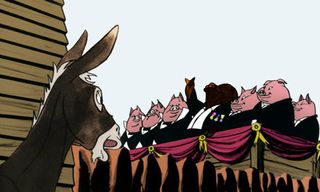
Christopher Hitchens re-reads Animal Farm

Animal-Farm-001 In the Guardian:

Like much of his later work – most conspicuously the much grimmer Nineteen Eighty-Four – Animal Farm was the product of Orwell's engagement in the Spanish civil war. During the course of that conflict, in which he had fought on the anti-fascist side and been wounded and then chased out of Spain by supporters of Joseph Stalin, his experiences had persuaded him that the majority of “left” opinion was wrong, and that the Soviet Union was a new form of hell and not an emerging utopia. He described the genesis of the idea in one of his two introductions to the book:

. . . for the past ten years I have been convinced that the destruction of the Soviet myth was essential if we wanted a revival of the socialist movement. On my return from Spain I thought of exposing the Soviet myth in a story that could be easily understood by almost anyone . . . However, the actual details of the story did not come to me for some time until one day (I was then living in a small village) I saw a little boy, perhaps ten years old, driving a huge carthorse along a narrow path, whipping it whenever it tried to turn. It struck me that if only such animals became aware of their strength we should have no power over them, and that men exploit animals in much the same way as the rich exploit the proletariat.

I proceeded to analyse Marx's theory from the animals' point of view.

The simplicity of this notion is in many ways deceptive. By undertaking such a task, Orwell was choosing to involve himself in a complex and bitter argument about the Bolshevik revolution in Russia: then a far more controversial issue than it is today. Animal Farm can be better understood if it is approached under three different headings: its historical context; the struggle over its publication and its subsequent adoption as an important cultural weapon in the cold war; and its enduring relevance today.

Our Giant Banking Crisis–What to Expect

Krugman_wells_1-051310_jpg_230x464_q85Robin Wells and Paul Krugman in the NYRB:

From an economist’s point of view, there are two striking aspects of This Time Is Different. The first is the sheer range of evidence brought to bear. Reading Reinhart and Rogoff is a reminder of how often economists take the easy road—how much they tend to focus their efforts on times and places for which numbers are readily available, which basically means the recent history of the United States and a few other wealthy nations. When it comes to crises, that means acting like the proverbial drunk who searches for his keys under the lamppost, even though that’s not where he dropped them, because the light is better there: the quarter-century or so preceding the current crisis was an era of relative calm, at least among advanced economies, so to understand what’s happening to us one must reach further back and farther afield. This Time Is Different ventures into the back alleys of economic data, accepting imperfect or fragmentary numbers as the price of looking at a wide range of experience.

The second distinguishing feature is the absence of fancy theorizing. It’s not that the authors have anything against elaborate mathematical modeling. Professor Rogoff’s influential 1996 book Foundations of International Macroeconomics, coauthored with Maurice Obstfeld, contains literally hundreds of fairly abstruse equations. But This Time Is Different takes a Sergeant Friday, just-the-facts-ma’am approach: before we start theorizing, let’s take a hard look at what history tells us. One side benefit of this approach is that the current book manages to be both extremely useful to professional economists and accessible to the intelligent lay reader.

The Reinhart-Rogoff approach has already paid off handsomely in making sense of current events. In 2007, at a time when the wise men of both Wall Street and Washington were still proclaiming the problems of subprime “contained,” Reinhart and Rogoff circulated a working paper—now largely subsumed into Chapter 13 of This Time Is Different—that compared the US housing bubble with previous episodes in other countries, and concluded that America’s profile resembled those of countries that had suffered severe financial crises. And sure enough, we had one too. Later, when many business forecasters were arguing that the deep recession would be followed by a rapid, “V-shaped” recovery, they circulated another working paper, largely subsumed into Chapter 14, describing the historical aftermath of financial crises, which suggested that we would face a prolonged period of high unemployment—and so we have.