Barack Obama and the question of race

Howard W French in The National:

ScreenHunter_03 Apr. 23 15.41 Just who is Barack Obama?

Fifteen months into his presidency, we may have acquired an intuitive sense of the answer to this question, and yet Obama remains elusive, like a fidgety subject posing for a daguerreotype. He nods and bobs forward and back, in and out of focus, never altogether fixed.

By now we have all been sufficiently exposed to the Obama act to suspect real method. The recent passage of major healthcare reform presents one case in point: early in his term, Obama placed healthcare at the centre of his domestic agenda, and yet he long seemed content to avoid defining his own parameters for the reform, or even, for that matter, establishing a bottom line.

Along the way, compromise with irredentist Republicans was treated as an almost sacred virtue – maddeningly so for Obama supporters, who began to suspect that he was weak, or worse, fired by insipid conciliatory instincts. Until, at the 11th hour, the president revealed a hitherto unseen mailed fist, and the bill was pushed through Congress without a single supporting vote from an opposition that had been marginalised by its very refusal to negotiate.

The key to this unusual style, if one is to be found, would seem to exist in Obama’s own life story, uncommonly rich in crossed genes and mixed signals. This story has now received its third major retelling, in the form of a massive new biography by the New Yorker editor David Remnick.
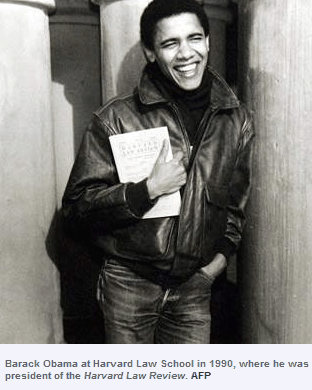
More here.


Cruel Ethiopia

Helen Epstein in the New York Review of Books:

ScreenHunter_01 Apr. 23 15.24 Parts of southern Ethiopia resemble the scenery in a Tarzan movie. When I was there last fall, the green forested hills were blanketed in white mist and rain poured down on the small farms and homesteads. In the towns, slabs of meat hung in the butchers’ shops and donkeys hauled huge sacks of coffee beans, Ethiopia’s major export, along the stony dirt roads. So I was surprised to see the signs of hunger everywhere. There were babies with kwashiorkor, a disease caused by malnutrition, which I’d assumed occurred only in war zones. Many of the older children were clearly stunted and some women were so deficient in iodine they had goiters the size of cannonballs.

This East African nation, famous for its ancient rock-hewn churches, Solomonic emperors, and seemingly intractable poverty, has a long history of famine. But I had always assumed that food shortages were more common in the much drier north of the country than in the relatively fertile south. Although rainfall throughout Ethiopia had been erratic in 2008 and 2009, the stunting and goiter I saw were signs of chronic malnutrition, which had clearly existed for many years.

What was causing it?

More here.

Sounds Make Memories Stick During Sleep

From Scientific American:

Sounds-make-memories-stick_1 MONTREAL—A good night's sleep, or even just a nap, can be an aid to memory. Psychologists have known for years that sleep solidifies what we've learned during the day, transforming tenuous associations into stable ones. Learning while you snooze seems supremely efficient, and so people have long dreamed of co-opting this process so that their dozing brain shores up what matters to them—say, material they've studied for a test or a talk, or verbiage in a foreign language they want to master. But until now there has been little support for the notion that studying in your sleep is useful. Psychology graduate student John Rudoy at Northwestern University in Illinois reported findings here on Monday at the Cognitive Neuroscience Society 2010 annual meeting that hint at a way to do that.

Rudoy, who works in neuroscientist Ken Paller's group, and his colleagues showed study participants 50 photographs and asked them to memorize where each one appeared on a computer screen. To help the participants remember the locations, the researchers asked them to practice moving each picture to where they thought it had appeared, and after they’d made their move, showed them the picture's correct location. In addition, the participants were taught to associate each photograph with a distinct sound—say, a chirp, ring, buzz or tone—that was related to the image. For example, the sound of an object hitting the water accompanied a picture of a splash. The participants then took a nap lasting for up to 90 minutes in an easy chair in the laboratory. As they dozed, the investigators exposed the subjects to 25 distinct sounds—the ones they had associated with half of the photographs. When the nappers woke up, they again tried to move each of the 50 photographs to its previously assigned spot on a screen.

More here.

Dreams Linked to Better Memories

From Science:

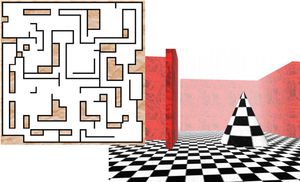
Sleep You probably don't need a neuroscientist to tell you that sleep helps your brain absorb new information. But what about dreams? Some researchers have speculated that they, too, might improve memory. Now, a new study provides some of the first experimental evidence: People who dreamed about a virtual reality maze they'd encountered a few hours earlier were quicker to find a way out when tested a second time. Lots of studies have suggested that our brains are busy while we sleep, consolidating memories of the day's events and putting them in the context of things we already know. In sleeping rodents, for example, neurons in the hippocampus fire in patterns remarkably similar to those recorded during a previous maze-running session—almost as if the animals replay the experience in their sleep. Some researchers wondered whether the rodents were dreaming of the maze, but of course there was no way to ask them.

So neuroscientists Erin Wamsley, Robert Stickgold, and colleagues at Harvard Medical School in Boston turned to a more verbal species: Harvard undergraduates. Participants in the study sat at a computer for 45 minutes and played with a virtual reality maze (see image). During this time, the researchers tested their memory by asking them to remember a particular object in the maze and find their way back to it from various starting points chosen at random. Fifty of the 99 participants then had the opportunity to take a nap while the others watched videos. The researchers used electroencephalography to monitor the brain activity of the napping students and either woke them once to ask about the content of any dreams or asked them at the end of their naps. Not surprisingly, people who took a nap improved more on the maze—as judged by the speed with which they found requested objects—than did those who stayed awake. But the four students who reported thoughts of the maze just as they were falling asleep or dreams of the maze during their nap improved on their previous performance about 10 times more, on average, than other nappers did, the researchers report online today in Current Biology.

More here.

Thursday, April 22, 2010

The Improbability Pump

Jerry A. Coyne in The Nation:

1271959587-large Imagine for a moment that a large proportion of Americans–let's say half–rejected the “germ theory” of infectious disease. Maladies like swine flu, malaria and AIDS aren't caused by micro-organisms, they claim, but by the displeasure of gods, whom they propitiate by praying, consulting shamans and sacrificing goats. Now, you'd surely find this a national disgrace, for those people would be utterly, unequivocally wrong. Although it's called germ theory, the idea that infections are spread by small creatures is also a fact, supported by mountains of evidence. You don't get malaria unless you carry a specific protozoan parasite. We know how it causes the disease, and we see that when you kill it with drugs, the disease goes away. How, we'd ask, could people ignore all this evidence in favor of baseless superstition?

But that's fiction, right? Well, not entirely, for it applies precisely to another “theory” that is also a fact: the theory of evolution. Over the past quarter-century, poll after poll has revealed that nearly half of all Americans flatly reject evolution, many clinging to the ancient superstition that the earth was created only 6,000 years ago, complete with all existing species.

More here.

Representing Mother******s

Representing-mother-s.4713962.40

In the year 867, a new portrait mosaic of the Virgin Mary & Son was unveiled in the apse of the Hagia Sophia — the seat of the Eastern Orthodox Catholic Church in Istanbul (then Constantinople) — homilized by the Armenian-born soon-to-be–Patriarch Photios as a victory over Iconoclasm: the almost-century-long proscription on depiction that had rocked the ages-old Byzantine art world to its foundations. This forbearance of graven images was (and remains) one of the most profound differences between Islam and its Great Satanic neighbors. At least until the advent of modernism, and the eruption of abstract painting — just about a century ago. The craving for persuasive facsimiles of human bodies has reached a recent epitome with James Cameron’s Avatar, a realization that makes one yearn for the rigorous formalism of the Taliban — or at least Clement Greenberg. Mid-20th-century critic Greenberg’s successful championing of the abstract expressionists and insistence on the transcendental flatness of the painterly medium have just reached an epitome of their own in the most awesome sheet of U.S. postage in recent memory, including dollhouse-ready reproductions of Jackson Pollock’s Convergence (1952), Willem de Kooning’s Asheville (1948) and eight other iconic images of the New York School.

more from Doug Harvey at the LA Weekly here.

shakespeare was shakespeare

TLS_Nicholl_709733a

What, aside from international fame, did Mark Twain, Helen Keller, Henry James, Sigmund Freud, Charlie Chaplin and Orson Welles have in common? The answer is that they all believed that the plays and poems attributed to William Shakespeare were really written by someone else. The first three belong to the classic “Baconian” era of the late nineteenth and early twentieth centuries, when the claims of Sir Francis Bacon’s authorship were uppermost; and were argued most vociferously in America. Freud and Welles were more modern “Oxfordians”, believing the true author to be Edward de Vere, 17th Earl of Oxford, as first proposed by J. Thomas Looney in 1920. Chaplin was a floating voter, a generic “anti-Stratfordian”. He did not know who wrote the plays, he explained in his 1964 autobiography, “but I can hardly think it was the boy from Stratford. Whoever wrote them had an aristocratic attitude”. These are essentially celebrity endorsements: none of the above, with the possible exception of Freud, could be called a Shakespeare scholar. It is an impressive list but also a very elderly one. One could continue it through to the present day (Malcolm X, Enoch Powell, Derek Jacobi, Mark Rylance, Jim Jarmusch . . .), but those early big names look back to the heyday of the authorship controversy, when the anti-Stratfordian cause seemed daring and even excitingly modern in its challenge to traditional (and, from the American point of view, to English) orthodoxy. And if to many it also seemed barmy, it was a flamboyant, newsworthy sort of barminess. Some of the frontline Baconian theorists were themselves minor celebrities, eccentric exemplars of the epoch’s passion for discovery, on a par with wild-haired inventors and staring-eyed explorers in search of lost cities.

more from Charles Nicholl at the TLS here.

Thursday Poem

Wicked Woman

If you come to my city
you are bound to find
my name in the roster
of wicked women
I have all that it takes
to be as wicked
as they come
I have a goblet
brimming over
in my hand
My laughter is known
for its abandon
Flames find a home
in my mouth
My heart beats and
every nerve does
a little dance
The road is at my feet
And just the sky above
I have the courage to bear
and express myself without fear

by Nirupama Dutt
Translation by author

Beyond the Brain

From The National Geographic:

Mind-brain-electrodes_8903_600x450 The ancient Egyptians thought so little of brain matter they made a practice of scooping it out through the nose of a dead leader before packing the skull with cloth before burial. They believed consciousness resided in the heart, a view shared by Aristotle and a legacy of medieval thinkers. Even when consensus for the locus of thought moved northward into the head, it was not the brain that was believed to be the sine qua non, but the empty spaces within it, called ventricles, where ephemeral spirits swirled about. As late as 1662, philosopher Henry More scoffed that the brain showed “no more capacity for thought than a cake of suet, or a bowl of curds.” Around the same time, French philosopher René Descartes codified the separation of conscious thought from the physical flesh of the brain. Cartesian “dualism” exerted a powerful influence over Western science for centuries, and while dismissed by most neuroscientists today, still feeds the popular belief in mind as a magical, transcendent quality.

A contemporary of Descartes named Thomas Willis—often referred to as the father of neurology—was the first to suggest that not only was the brain itself the locus of the mind, but that different parts of the brain give rise to specific cognitive functions. Early 19th-century phrenologists pushed this notion in a quaint direction, proposing that personality proclivities could be deduced by feeling the bumps on a person's skull, which were caused by the brain “pushing out” in places where it was particularly well developed. Plaster casts of the heads of executed criminals were examined and compared to a reference head to determine whether any particular protuberances could be reliably associated with criminal behavior.

More here.

Changing the Dating Game

From Scientific American:

Dating-style Women are much choosier than men when it comes to romance. This is well known, but the reason for this gender difference is unclear. Evolutionary psychologists think it is because back in prehistoric times “dating” was much riskier for women. Men who made an ill-advised choice in the ancient version of a singles bar simply had one lousy night. Women who chose unwisely could end up facing years of motherhood without the critical help that a stable partner would have provided.

That is less true today, yet women remain much more selective. Is this difference a vestige of our early ancestry? Or might it be totally unrelated to reproductive risk, the result of something more modern and mundane? A couple of Northwestern University psychologists, Eli J. Finkel and Paul W. Eastwick, decided to explore this question in an unusual laboratory: a real-life speed-dating event.

More here.

Meet the New Pakistan

Max Fisher in The Atlantic:

ScreenHunter_03 Apr. 22 11.20 Pakistani President Asif Ali Zardari signed a sweeping Consitutional amendment into law yesterday, transferring much of his own power to the nation's traditionally weak Parliament. The amendment, by decentralizing the government and strengthening the Parliament as well provincial governments, stands to bring much-needed stability and openness to a state long plagued by autocracy and by the military's heavy influence. Pakistan's secretive and self-interested military — long permiated by Islamist ideology and (until recently) driven by an agenda of dominating neighboring Afghanistan and Kashmir via insurgent proxies — has, as a rule either coerced the president or replaced him outright, as in the military coup that established the presidency of General Pervez Musharraf. As Pakistan's president and military have wrestled for power, they have dragged the state through periods of instability and corruption that has exaccerbated poverty and, at times, provoked domestic terror. Pakistan's volatility and political infighting also make it far more difficult for foreign diplomats to influence the state. As a lead player in the Afghanistan and Kashmir conflicts, Pakistan's international cooperation is essential. Today's amendment could bring new stability to the country, improving Pakistan's internal governance and ultimately aiding U.S. interests.

More here. [Thanks to Feisal H. Naqvi.]

astrobiologist Dirk Schulze-Makuch says that extraterrestrial life has already been found

Lee Billings in Seed:

WeAreNotAlone_INLINE Seed: Why did you write this book?

Dirk Schulze-Makuch: The evidence for life on Mars has recently been portrayed over-skeptically and negatively. As a scientist you have to be skeptical, but here we have many strong lines of evidence for microbial life, and if you put them all together you really have a very consistent picture. So my coauthor, David Darling, and I both feel very strongly that we really have to get the public very enthusiastic about this, in order for space agencies to move forward.

Seed: But scientists also make names for themselves by overturning flawed conclusions. If the evidence is so good, why aren’t more researchers lining up to say there’s life on Mars?

DS: Well, it depends on what kind of group you’re looking at. If you ask the public, they seem to think there’s life on Mars—at least microbial life. I don’t want to speak for all scientists, of course, but I think among those who are knowledgeable there’s also a tendency toward thinking life is there as well. This is especially true for those researchers who study extremophiles, Earthly microorganisms that flourish in extreme environments. Some planetary scientists are still quite skeptical.

Seed: Your argument seems to hinge, in large part, on the results from the Viking landers. Could you summarize why these results point to life?

DS: In some ways the timing was bad for Viking. A lot of progress was made after its life-detection experiments were already on or on their way to Mars: The discovery of all the ecosystems at undersea hydrothermal vents, and the extremophile research of the early 1980s really changed how we think about life and its limitations. The Viking researchers thought life on Mars would be heterotrophic, feeding off abundant organic compounds distributed everywhere all over the Martian surface. That picture was wrong, and studies of extremophiles on Earth have made us think differently about Mars.

More here.

Nobody loves spam. But what if the spam is to bring down Adolph Hitler?

Joel Whitney in Guernica:

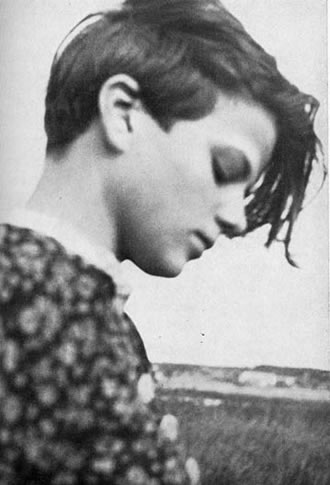
SophieScholl For the Scholls, the three Protestant siblings behind Germany’s short-lived White Rose movement, the choice to spam their fellow Germans was an easy one. Here’s what they told readers in the Fourth Leaflet:

And do not forget the petty scoundrels in this regime; note their names, so that none will go free! They should not find it possible, having had their part in these abominable crimes, at the last minute to rally another flag and then act as if nothing had happened!

To set you at rest, we add that the addresses of the readers of the White Rose are not recorded in writing. They were picked at random from directories.

We will not be silent. We are your bad conscience. The White Rose will not leave you in peace!They repeatedly warned Germans of the consequences of war crimes for years to come, and declared the war unwinnable. Here’s another chunklet from the First Leaflet (there were six in all, and a seventh was under way when the movement ended in arrest):

Isn’t it true that every honest German is ashamed of his government these days? Who among us has any conception of the dimensions of shame that will befall us and our children when one day the veil has fallen from our eyes and the most horrible of crimes—crimes that infinitely outdistance every human measure—reach the light of day?

Hans and Sophie Scholl were caught distributing the leaflets, and were executed (beheaded); it fell on Inge to tell her siblings’ story.

More here. [Photo shows Sophie Scholl.]

Wednesday, April 21, 2010

il divo

Rufus100426_1_560

Wainwright, his friends often say, can only be understood in the context of his family. “They just strike me as an aristocracy, a royal family,” says the musician Thomas Bartlett (who performs under the name Doveman), a collaborator who played at the Christmas show and recently recorded an album of Edith Piaf covers with Martha. “They’re usually the most compelling people in the room, and they know it.” His mother, Kate, came from the singing McGarrigles from Montreal, while his father, Loudon Wainwright III, was the Westchester-raised son of a longtime Life magazine editor. Loudon was once compared to Bob Dylan for his blunt, acerbic folk songs, but while he never became nearly that big, he’s still the only family member to have a single on the American pop charts: “Dead Skunk,” back in 1972. The couple divorced in the mid seventies, and McGarrigle raised Rufus and Martha. “We’d go out to a bar,” says artist Walt Cassidy, formerly the club kid Walt Paper, an early friend of Wainwright’s, “and Rufus’s mom and sister would be there, and if there happened to be a stage or a musical instrument, forget it—they’d kick the other band off the stage and take over the equipment and do a show.”

more from Tim Murphy at New York Magazine here.

a negativistic theory of progress

Hasok200

A distinctive characteristic of modernity is its belief in its special progressive trajectory. It was during the period of Enlightenment that this belief gained its most confident and theoretical articulations. The idea of progress was certainly no ancillary dimension of the Enlightenment. As, for example, Kant’s essays on the philosophy of history make clear, the essence of the self-understanding of the Enlightenment was progress, a distinctive historical period consciously reaching beyond what had gone before. What today might be considered the lasting legacies of the Enlightenment, such as the critique of superstition, the improvement of scientific method, or the rejection of irrational authority, were contributions to rather than the core of this process. The efforts of Condorcet – who was not alone in this – to develop a science of progress tell us how real the phenomenon of progress appeared to the intellectuals of the Enlightenment. In his Sketch for a Historical Picture of the Progress of the Human Mind he proposed that if “there is to be a science for predicting the progress of the human race, for directing and hastening it, the history of the progress already achieved must be its foundation.” This indeed was a quite unique form of science in that the science of progress might stimulate further progress, its apparently non-paradoxical aim being to promote the very thing it set out to verify. And with regard to historical advancement, Condorcet noted, the “present state of enlightenment assures us that this revolution will have a favourable result,” delivering eventually “the abolition of inequality between nations, the progress of equality within each nation, and the true perfection of mankind.”

more from Brian O’Connor at TPM here.

the copycat era

Copycat

The last decade has seen an explosion of copying in its various forms. Technology has made it easier to do everything from rip off a song to replicate the design of an engine, and rising powers like China and India are home to burgeoning industries dedicated to creating low-cost alternatives to cutting-edge, brand-name products, whether they’re cars, computers, or drugs. At the same time, researchers in the fields of biology, business, and economics are looking in detail at how and why and when copying works. What some are finding is that it is a strategy that works much better than we think — whether for businesses, people, or animals competing in the wild. At its best, copying spreads knowledge and speeds the process by which insights and inventions are honed, eliminating dead-end approaches and saving time, effort, and money. “We hear so much about innovation, I don’t know how many hundreds if not thousands of books, articles, and so forth,” says Oded Shenkar, a professor at Ohio State’s Fisher College of Business and author of the forthcoming book “Copycats: How Smart Companies Use Imitation to Gain a Strategic Edge,” “but imitation is at least as important as innovation if you really want to grow efficiently and make a profit.”

more from Drake Bennett at the Boston Globe here.

At Top University, a Fight for Pakistan’s Future

From The New York Times:

University LAHORE, Pakistan — The professor was working in his office here on the campus of Pakistan’s largest university this month when members of an Islamic student group battered open the door, beat him with metal rods and bashed him over the head with a giant flower pot. Iftikhar Baloch, an environmental science professor, had expelled members of the group for violent behavior. The retribution left him bloodied and nearly unconscious, and it united his fellow professors, who protested with a nearly three-week strike that ended Monday. The attack and the anger it provoked have drawn attention to the student group, Islami Jamiat Talaba, whose morals police have for years terrorized this graceful, century-old institution by brandishing a chauvinistic form of Islam, teachers here say.

But the group has help from a surprising source — national political leaders who have given it free rein, because they sometimes make political alliances with its parent organization, Jamaat-e-Islami, Pakistan’s oldest and most powerful religious party, they say. The university’s plight encapsulates Pakistan’s predicament: an intolerant, aggressive minority terrorizes a more open-minded, peaceful majority, while an opportunistic political class dithers, benefiting from alliances with the aggressors. The dynamic helps explain how the Taliban and other militant groups here, though small and often unpopular minorities, retain their hold over large portions of Pakistani society.

More here.

Satyabhama

Satyabhama
Chuckled on the window seat
of the bus, and then
Hid her face
In her hands

Was she shy?

Satyabhama
Faint, dark, like a slate,
Forgotten.

How could she
Have been otherwise?

It's two decades since
She was in class five
And I in two
In our village school.

On her cheek
The flush of self-confidence
To have learnt by rote
The alphabet.

Married to a dhoti-clad gentleman,
She is now in search
Of a suitable girl
For her son;

Persuaded by the villagers
She is now a candidate
In the local body election;

She said all this
Pressing her face
To the window-sill.

Satyabhama
Gives the feeling
Of someone intimate
Like the torn pages
of an old book

From childhood

When eating porridge together
She taught me the art
of sewing sal-leaf bowls.

There was nothing more
To share with Satyabhama.

By the time I was in class five
And she in class two
The bus had left.

I do not know
If I will meet her again.

If only I had had
A fleeting glimpse
Of her face.

by Basudev Sunani
from Karadi Haata;
publisher: Eeshan-Ankit Prakashani, Naupada, 2005