What a shoddy piece of work is man

From Nature:

Our genome won't win any design awards and doesn't speak well of the intelligence of its 'designer', as Philip Ball explains.

Philipball Helena

: They do say that man was created by God.

Domin: So much the worse for them.

This exchange in Karel Capek's 1921 play R.U.R., which coined the word “robot”, is abundantly vindicated by our burgeoning understanding of human biology. Harry Domin, director general of the robot-making company R.U.R., jeers that “God had no idea about modern technology”, implying that the design of human-like bodies is now something we can do better ourselves. Whether or not that is so, the human body is certainly no masterpiece of intelligent planning. The eye's retina, for instance, is wired back to front so that the wiring has to pass back through the screen of light receptors, imposing a blind spot.

Now John Avise, an evolutionary geneticist at the University of California at Irvine, has catalogued the array of clumsy flaws and inefficiencies at the fundamental level of the genome. His paper, published this week in the Proceedings of the National Academy of Sciences of the USA1, throws down the gauntlet to advocates of Intelligent design, the pseudo-scientific face of religious creationism. What Intelligent Designer, Avise asks, would make such a botch? Occasional botches are, by contrast, precisely what we would expect from Darwinian evolution, which is blind to the big picture and merely tinkers short-sightedly to wring incremental adaptive advantage from the materials at hand. Just as in technology, this produces 'lock-in' effects in which strategies that are sub-optimal from a global perspective persist because it is impractical to go back and improve them.

More here.
Tuesday, May 4, 2010

The goddess of Taliban country

H. M. Naqvi in the Global Post:

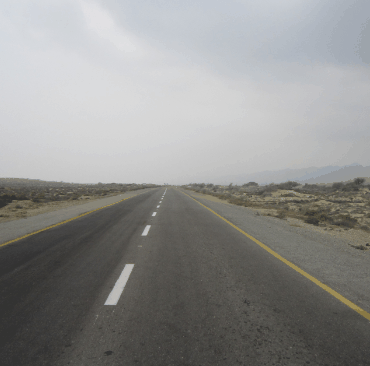
ScreenHunter_02 May. 05 12.14 The road into Baluchistan is dual carriage, the topography is flat. There are fronds in the sand, an occasional crooked tree and the intimation of the sea. Narrow scratched paths lead inland and close to the horizon, we can make out clusters of structures — mud rooms, thatched tents — and the local population: tanned fishermen and women and children.

Not more than two hours into the journey, we turn left at a solitary petrol pump attached to a roadside restaurant. After announcing ourselves at a checkpoint — hum Hingol ja rahay hain — we cruise down the Makran Coastal Highway.

I am riding shotgun in a Jeep with a mangy, taciturn, chain-smoking adventurer. He offers me a dry omelet-and-hunter-beef sandwich. I take a bite. It is difficult to swallow but I don’t protest. Who knows when sustenance will be offered next?

We have entered the badlands of Pakistan, the purported seat of the resurgent Taliban. Somewhere across the expanse lurks Mullah Omar, the murderous, indefatigable, one-eyed leader of the shura. Although there is strength in numbers — we are traveling in a caravan of 11 vehicles comprising the Off Roaders Club – we are only armed with poles, pegs, hammers and other camping equipment. I’m no outdoorsman, no adventurer. I wonder what the hell I am doing in Baluchistan.

More here.

British society is a three-party system stuffed into a two-party duopoly

Christopher Hitchens in Slate:

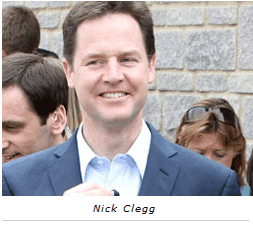
ScreenHunter_01 May. 05 12.02 An officer candidate being interviewed for a posting on the British general staff was once asked to define the role of cavalry in modern warfare. He replied that it was to lend some color and dash to what would otherwise be a somewhat dreary and sordid occasion. Nick Clegg, the leader of Britain's Liberal Democrats, is the equivalent of the cavalry in the case of Thursday's British general election. Until his eruption onto the scene, the muddy battlefield was a dull trench war between two heavily armored divisions, each of them wearily familiar with the tactics and strategy of the other.

Years ago, when I toiled as a columnist for The Nation, Nick Clegg was my intern. (So, for that matter, was Edward Miliband, Gordon Brown's minister for energy and climate change and brother of Brown's most likely replacement, Foreign Secretary David Miliband.) I have done my best to trade on this mentoring relationship with power, to little avail. Clegg worked for me in the magazine's New York offices while I was writing from Washington, so our direct contact was limited. What I chiefly remember, apart from his now-famous personal charm, was how “European” he was. His parentage was partly Dutch and partly Russian. He has since married a Spanish woman and has three children with Spanish names. And, of course, his party is the one most closely identified with the British aspiration to full British engagement in the European Union. This is the strength and the weakness of his position, and of his party.

More here.

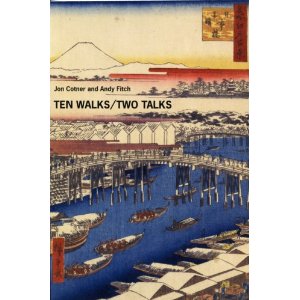
Ten Walks/Two Talks

Michael Schaub in Bookslut:

518gGHgHFKL__SL500_AA300_ In the eight months that I've lived where I live now, I've probably walked around my neighborhood hundreds of times. I have dogs; my neighbors all know their names, but not mine. I have memorized every front yard, every awning on every business, from the plumbing supply store (“The Water Heater King”) to the deli with the big Oregon Lottery sign in front to the punk-rock strip club I live behind. But I don't really remember these walks, or most of them. I remember walking back from buying cigarettes one night when a drunk old man in the Masonic lodge parking lot yelled, as I recall, “You're not the Scandihoovian!” to me. But every other one kind of blurs together. I haven't even lived here a year, but I have become automatic. I look down when I'm walking, and talking to people, and usually at pretty much all other times. I feel like I wasn't always this way. For the past several weeks I've been trying to reconstruct conversations with someone I used to know. I've been trying to remember the last one, in particular: What are the last words I said to this person who is now gone? What are the last words he said to me? So I look down and I walk down sidewalks I've memorized.

I've read Ten Walks/Two Talks three times now, once before something sudden and awful happened in my life, and twice after. I don't know if I would have even thought about how I walk in my city if I hadn't, or if I would have tried to commit every conversation with a friend I have to memory even while I'm talking, afraid I'll lose it like I've lost most of my first 32 years of conversation. This is a small book: ten brief accounts of walks in New York City by Fitch, and two transcribed conversations between Cotner and Fitch, the first in Central Park, the second in a grocery store.

More here.

Tuesday Poem

Concert in the Garden

It rained.
The hour is an enormous eye.
Inside it we come and go like reflections.
The river of music
enters my blood.
If I say body, it answers wind.
If I say earth, it answers where?

The world, a double blossom, opens:
sadness of having come,
joy of being here.

I walk lost in my own center.

by Octavio Paz
from The Collected Poems 1957-1987;
Carcanet Press Limited

Concierto en el Jardín

Llovío.
La hora es un ojo inmenso.
En ella andamos como reflejos.
El río de la música
entra en mi sangre.
Si digo: cuerpo, contesta: viento.
Si digo: tierra, contesta: ¿dónde?

Se abre, flor doble, el mundo:
tristeza de haber venido,
alegría de estar aquí.

Ando perdido en mi propio centro.

Octavio Paz

A spy novel for the 21st century

From Salon:

Md_horizI have been a kind of undercover person from birth almost,” says one of the two main characters in Michael Gruber's “The Good Son,” “and I am bound to offend those who like neat classifications.” Not an improbable statement, coming from a major player in a spy thriller — if “The Good Son” can be accurately described as a spy thriller. It is that, and yet it's a lot more. Like Theodore Laghari, the above-quoted “undercover person,” this novel slides in and out of conventional identities with a facility that would be disturbing if it weren't so damn smooth. Adeptly plotted yet philosophical, worldly yet preoccupied with moral truth, it's a book to provoke comparisons with John le Carré and Graham Greene, while at the same time eluding the ideological constraints that weigh so heavy on those masters.

Theo is the son of Farid, “a grayish presence who teaches the development of international law at Georgetown and spends a lot of time with his large collection of British Empire stamps,” and Sonia, a woman of infinite variety and a checkered past, currently working as a Jungian therapist. En route to a conference on the therapeutic aspects of regional conflict resolution in Kashmir, Sonia and her fellow luminaries are taken hostage by a band of mujahedeen in Pakistan's North-West Frontier Province. Theo — who works as a “shooter” for a semilegal special-forces outfit he describes as the U.S. Army's “own little CIA” — determines that the only way to save his mother is to engineer an incident that will trigger a U.S. attack on Pakistan, providing the cover for him to extract her from the village where she's being held.

Medical Graphology: Symptoms in Script

Meera Lee Sethi in Proto:

ScreenHunter_01 May. 04 12.35 It takes no handwriting expert to recognize the cramped, drooping, uncertain signature as a manifestation of the Führer’s cramped, self-centered approach to life,” concluded the graphologist Nadya Olyanova in 1939, six years before Hitler’s suicide, according to her 1991 obituary in the New York Times. Olyanova had studied with the Austrian psychoanalyst Alfred Adler, and she was a consultant to the psychiatric services of the Menninger Clinic in Topeka, reported the Times. But like the practice of phrenology—the notion that the bumps and indentations of the skull form a map of character—attempts to analyze one’s disposition through the curve of an o or the tail of a g are considered spurious.

How curious, then, is medical graphology: the use of handwriting to diagnose disease. In the 1950s, the Austrian-American graphologist Alfred Kanfer proposed the idea that because cancer affects the brain’s ability to manage fine motor control, early signs of the disease could be detected in the pauses between pen strokes. Most scientists demurred.

Still, diagnostic links between sickness and script seem to exist. “Writing is an exquisite fine motor skill—unlike brushing your hair, for instance,” explains José Contreras-Vidal, a neuroscientist at the University of Maryland’s School of Public Health. “People spend years practicing it, consolidating a very robust motor-control program in the brain.” So, he says, deterioration of that finely honed skill is a red flag that something may have gone awry in the brain’s ability to run the program.

More here.

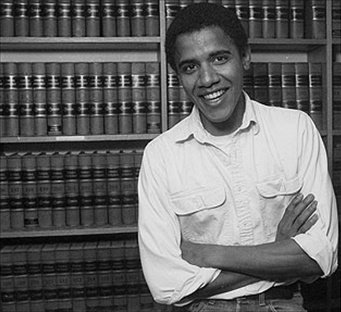
Portrait of the President as a Young Law Student

Barack Obama went to Harvard Law School to learn “power’s currency in all its intricacy in detail.” An exclusive excerpt from The Bridge: The Life and Rise of Barack Obama, David Remnick shows how much Obama learned in law school.

At the website of the Brennan Center for Justice at NYU Law School:

ScreenHunter_02 May. 04 11.40 By the time Obama arrived at Harvard, the law-school curriculum had grown much more flexible than in its early days and the student body more diverse, but the school was still a fractious place, riven by political conflict and intramural resentments. As if to flaunt its own unhappiness, the law-school community commonly referred to itself as a bastion of Levantine infighting—alternately “Beirut on the Charles” and “the Beirut of legal education.”

Obama said that Harvard Law School was the “perfect place to examine how the power structure works.” Indeed, the “power structure”—a phrase common in organizing circles—and how it is, or is not, examined by the likes of Harvard Law School was the focus of a battle that had already raged for a decade when Obama enrolled. In 1977, a group of legal academics—radicals, as most would readily have identified themselves—met at a conference in Madison, Wisconsin, to discuss a barely formed school of thought that was soon to be called Critical Legal Studies. Influenced by post-structuralism, the Frankfurt School of critical theory, and the Legal Realism of the nineteen-twenties, the scholars interested in Critical Legal Studies sought to demystify the law and the language of law and legal studies, to challenge its self-regard as a disinterested system of precedent. Critical Legal Studies posited that law is politics by other means, that the practice and discourse of law—and legal education—is merely another lever of entrenched power, a way of enforcing the primacy and perquisites of the wealthy, the powerful, the male, and the white.

According to the adherents of Critical Legal Studies, many of the conditions of the legal status quo—the high incarceration rates among people of color, the higher penalties for drugs used mainly among the poor—are inscribed in a legal system that only pretends to be consistent and nonideological.

By the time Obama appeared on campus, there had also appeared an increasing number of conservative and libertarian scholars centered on the Federalist Society, a many-branched group that had begun in 1982 at Harvard, Yale, and the University of Chicago.

More here. And a talk with David Remnick about all this, here.

Of Compost, Molecules and Insects, Art Is Born

Natalie Angier in The New York Times:

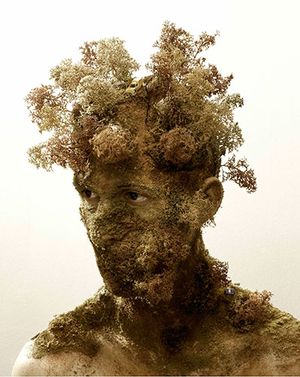
Ang The word organic means different things to different people. To the gardener it means compost heaps. To the chemist it means carbon compounds. To the artist Fabian Peña, it means American cockroaches, those chunky nocturnal charmers often seen skittering around drainpipes or on the street. “I have collected cockroaches from many different places,” Mr. Peña said. “From Cuba, Mexico, Miami, Houston, everywhere I travel.” He kills the cockroaches with a spray, pops them into a jar, takes them back to his studio in Florida, and then puts their parts to work in his art. He glues their legs together into long, lacy cylinders that look like giant larval casings. He arranges their wings into medically precise images of a human skull, foot bones and hand bones, all scaled to his own head and appendages.

Mr. Peña likes the medium of cockroach aesthetically, the way he can use the different tones in the wings as his palette to convey light and shadow. He likes it metaphorically, how we are disgusted by something with which we have so much in common — the same taste in foods, the same easy adaptability to every possible niche. “Cockroaches are a witness to our daily lives,” Mr. Peña said. He also likes his medium pragmatically. “It’s a material that I can easily find,” he said, “and it’s cheaper than buying paint.”

More here.

Linux Versus E. coli

Carl Zimmer in his excellent blog, The Loom:

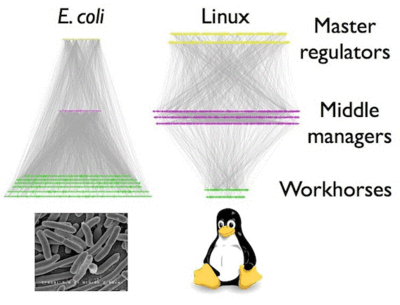
ScreenHunter_01 May. 04 11.08 Linux bears an uncanny resemblance to the genes in a living cell. Many genes make proteins that act as switches for other genes. The proteins clamp onto DNA near a target gene, allowing the cell to read the gene and make a new protein. And that new protein may, in turn, grab onto many other genes. Thanks to this hierarchy of switches, cells can respond to changes in their environment and quickly carry out complex behaviors, such as reorganizing themselves to feed on a new kind of food.

A number of scientists have begun to compare natural and manmade networks. A lot of the same rules appear to be at work in the growth of the Internet, airport connections, brain wiring, ecosystem food webs, and gene networks. But very often, scientists are finding, it’s the differences between natural and manmade networks that are most revealing, offering clues to the different ways in which people and evolution build complex things.

In the Proceedings of the National Academy of Sciences this week, Koon-Kiu Yang of Yale and his colleagues present the first detailed comparison of Linux’s network to a gene network. (The paper will be here.) Thanks to the open-source nature of Linux, the scientists could look at every line of code in every version of the system over the past two decades, from Torvald’s first primitive stab to its current sophisticated form. And for a living cell, Yang and his colleagues turned to the living equivalent of Linux–a biological network they could analyze from top to bottom. They chose E. coli. coli, since it is the best-studied species on Earth. (Why E. coli? There’s a certain book that will explain it to you.)

More here.

Monday, May 3, 2010

Sunday, May 2, 2010

Is Nuclear Detterence Obsolete?

Gettyimages_90769510Jeremy Bernstein in the New York Review of Books blog:

It should be noted that when nuclear weapons first began to be constructed in the early 1940s, no one thought of deterrence. The bomb was not designed to “deter” Hitler. It was to defeat him and his Axis allies. In the spring of 1943 the Columbia physicist Robert Serber gave a series of lectures to new recruits at Los Alamos. The opening lines of the printed version read: “The object of the project is to produce a practical military weapon in the form of a bomb in which energy is released by a fast neutron chain reaction in one of more of the materials known to show nuclear fission.”

As far as I can tell, the first suggestion that these weapons could be used for deterrence came from General Leslie Groves, who headed the Manhattan project. Some time after the defeat of Germany, but well before the first successful test of the bomb in July of 1945, he came to Los Alamos. At a small dinner he expressed the view that the Russians would have to be deterred by the bomb. He was sure that they had expansionist plans that included the domination of all of Europe and that nuclear weapons would be necessary to stop them. In fact, Soviet spies had already furnished Stalin with extensive knowledge of the US program well before it became public after Hiroshima; Stalin’s reaction was not to be deterred, but to start a crash program to build nuclear weapons of his own while at the same time occupying the countries of Eastern Europe.

Indeed, if you think about it, deterrence is an odd concept. It implies explicit or implicit negotiations between the deterrer and the deterree. How is one to know when deterrence has been successful? It is easier to know that it has not been when one is attacked. David tried to deter Goliath by invoking the God of the Israelites. Goliath had no interest. If David had shown Goliath his skills with a slingshot instead of attempting to deter him it would probably have provoked a better defense against sling shots. What does one expect a deterree to do, sign a document admitting that he/she is deterred? Would anyone trust such a document? Without such a document how much deterrence is enough? Is one atomic bomb enough? How about fifty or five hundred? Who is to decide? For many decades, the US and Russia were engaged in a policy of “mutually assured destruction”—MAD. How did we know that destruction of the other side was “assured?”

Group Think

02strogatzimg-custom1Steven Strogatz in the NYT:

My wife and I have different sleeping styles — and our mattress shows it. She hoards the pillows, thrashes around all night long, and barely dents the mattress, while I lie on my back, mummy-like, molding a cavernous depression into my side of the bed.

Bed manufacturers recommend flipping your mattress periodically, probably with people like me in mind. But what’s the best system? How exactly are you supposed to flip it to get the most even wear out of it?

Brian Hayes explores this problem in the title essay of his recent book, “Group Theory in the Bedroom.” Double entendres aside, the “group” in question here is a collection of mathematical actions — all the possible ways you could flip, rotate or overturn the mattress so that it still fits neatly on the bed frame.

By looking into mattress math in some detail, I hope to give you a feeling for group theory more generally. It’s one of the most versatile parts of mathematics. It underlies everything from the choreography of contra dancing and the fundamental laws of particle physics, to the mosaics of the Alhambra and their chaotic counterparts like this image.

The Fetishism of Morality

Ree200 Jonathan Rée in The Philosophers' Magazine:

One of the most intriguing questions about morality, it seems to me, is what happens when it changes. What happens, for example, when the subordination of women to men, or their exclusion from higher education or the professions, ceases to seem innocuous or natural, and starts to be regarded as a grotesque abuse? Or when corporal punishment goes out of style, and homosexuality comes to be tolerated or even respected, or when cruelty to animals arouses indignation rather than indifference, and recklessness with natural resources becomes a badge not of magnificence but of monstrous irresponsibility?

There is of course room for disagreement about such alterations of moral opinion. But no one could maintain that they are devoid of discussible intellectual content. No one would claim that – like, say, changing fashions in moustaches or skirt-lengths – they simply reflect the unaccountable gyrations of taste. Indeed it seems probable that moral change, over the long term, involves something like an expansion of horizons, a process of learning, or even – to use a dated word – something you might call progress.

It seems timely, therefore, to turn back to Immanuel Kant’s celebrated treatment of the question “whether the human race is continually improving”. Writing in the 1790s, Kant argued that the “moral tendency” of humanity was, like human knowledge as a whole, destined to carry on getting better till there was no room for further improvement: humanity was imbued, he thought, with a transcendental impulse to refine and clarify its moral opinions as time goes by, or to grow in moral intelligence.

Kant’s faith in moral progress was popular in the nineteenth century (think of Auguste Comte’s Positivism and various branches of Hegelianism), but it is not likely to be promoted with much conviction any more. If you were to show any signs of moral optimism today you would be mocked as the dupe of political boosterism or moral grade-inflation, and friends would try to re-educate you with a catalogue of ferocious wars, futile revolutions and murderous regimes, topped off with some sad sagacity about the destructiveness and deceitfulness of human nature. The old proverb about pride applies to moral optimism as well, or so you would be told: hope comes before a fall.

Left & Right: Prospects for Peace

Over at The American Conservative, a number of thinkers address the question (via bookforum). Paul Gottfried:

I have no hope for any alliance between the antiwar Right and any significant leftist force. Individual liberals may establish informal relations with self-identified conservatives, but one should avoid generalizing from this observation. Individual libertarians, like Bill Kauffman and Justin Raimondo, may get on well with maverick leftists Alexander Cockburn and Gore Vidal. But this does not foreshadow larger trends. During the Bush administration, the antiwar Right struggled to connect with leftist opponents of the war, and they received hardly any attention from their would-be partners in organizing antiwar activity.

The reasons for this non-recognition seem self-evident. First, the Left has no interest in being allied to social reactionaries by becoming identified with the antiwar Right. The Left is happier to deal with “conservatives” like David Frum and David Brooks, with whom they agree on most social issues, even if they remain apart on foreign policy. For those who consider gay marriage, unrestricted abortion, and special rights for minorities to be paramount issues, having Catholic traditionalists or paleolibertarians as allies is not a genuine strategic option.

Second, there is no recognizable advantage for the Left to be allied to marginalized people on the Right. As long as neoconservatives control the media and financial resources of the conservative movement, no one, except for hopelessly deluded antiwar rightists, would consider an alliance with our side to be a political coup. Unless the antiwar Right can push itself into public attention and counteract the neoconservative-fashioned image of “conservatives,” the Left can have no practical interest in reaching across the ideological chasm.