Do Brain-Training Programs Work?

From Science:

Brain y a computer game, boost your IQ—that's the claim made by some software companies peddling so-called brain-training programs. It's probably an empty promise, according to the largest study to date of brain-training software, which finds no evidence of general cognitive benefits. Yet the study's limitations give brain-training advocates plenty to gripe about. The idea for the study originated with a BBC science television show, Bang Goes the Theory. Producers contacted Adrian Owen at the MRC Cognition and Brain Sciences Unit in Cambridge, U.K., to help design an experiment to test the efficacy of computer brain training. Many of these programs are set up like a game, and playing along supposedly boosts memory, attention, and other cognitive functions. But few rigorous studies have been conducted on them, and many researchers question whether even the best programs do anything more than make people better at the game itself. For example, there's little solid research to suggest that using these programs has a beneficial effect on overall cognition that carries over into daily life.

In the new study, Owen and colleagues developed two online training programs and tested them in 11,430 healthy adults who registered on a Web site set up by the BBC. One group trained on a program that emphasized reasoning and problem-solving skills, and another group trained on a program that emphasized different skills, including short-term memory and attention. A third, control group, essentially did busywork, hunting for answers to general knowledge questions on the Internet. All participants were asked to “train” for at least 10 minutes, three times a week for 6 weeks, and all received a battery of cognitive tests before and after this 6-week period.

Not surprisingly, people in both training groups got better at the tasks they actually practiced. But that's as far as it went. “None of the brain-training tasks transferred to other mental or cognitive abilities beyond what had been specifically practiced,” Owen's co-author and MRC colleague Jessica Grahn said at a press conference this morning announcing the results, which are published online today in Nature.

More here.
Why suicide bombers are dying for revenge

Our own Kris Kotarski in the Calgary Herald:

Kris In 2006, psychiatry professor Anne Speckhard from Georgetown University and psychology professor Khapta Akhmedova from Chechen State University profiled the Chechen black widows like Dzhennet Abdurakhmanova, 17, and Markha Ustarkhanova, 20, who attacked the Moscow metro. Looking in depth at a sample of 26 female bombers, they concluded that the death of a brother, a father or the rape of a female relative at the hands of Russian soldiers had traumatized every woman in their sample, and formed the motivation for their behaviour.

“They do not appear coerced, drugged or otherwise enticed into these acts.

On the contrary, they are self-recruited on the basis of seeking a means of enacting social justice, revenge and warfare against what they perceive as their nation's enemy. All the women in our sample had been deeply personally traumatized and bereaved by violent deaths in their near families or all about them, and we believe this formed the basis for their self-recruitment into terrorist organizations.”

Another raid, this time in Paktia Province in Afghanistan, illustrates this dynamic as well. Here, NATO admitted earlier this month that its forces were responsible for a house raid that killed five civilians, a government official, his brother, and three female relatives, including two pregnant women and a teenager.

More here.

Beating Obesity: 10 Ideas to Solve the Problem

Marc Ambinder in The Atlantic:

ScreenHunter_02 Apr. 21 08.08 1. Universal access to quality pre-and-post-natal care for mothers in chronically stressed, underserved communities. The correlations between a mother's nutrition consumption and how a child is nourished for the first year of life and obesity are quite strong. Pregnant women, particularly younger pregnant women, don't experience their pregnancy with any significant degree of social or community support; they don't nurse their child with access to health care, or to a support system or feedback system that guides them.

2. Congress should ask the Federal Trade Commission to begin a rule-making process to ban food companies from advertising unhealthy food to kids under 10 or 12. The industry will probably respond by establishing (another set of) voluntary guidelines, which will progressively tighten as the rule-making progresses. Make the implementation of the rule contingent of the industry coming up and complying with its own set of rules, and perhaps monitored by an independent panel appointed by the Institute of Medicine. If the industry resists, ban all food advertising aimed at kids, and aggressively enforce the ban. Drawing lines with be difficult, because one person's advertising “aimed” at kids could easily be claimed to be “aimed” at teenagers or adults. Come down on the side of the kids. Prevent ads from airing during “family” hours. Be creative. Let's have this debate again. Marketing practices need to be revised.

3. The government already highly regulates foodstuffs and the content of school lunches. The political will exists to streamline and clarify these regs, and to prevent food companies from finding loopholes. No new regulations are needed; regulations that comport with the 21st century reality of education are required. We can regulate less, if we want to, but regulate better, if we want to.

More here.

A Wasp Finds the Seat of the Cockroach Soul

Carl Zimmer in his excellent blog, The Loom:

Ampulex%20stinging If blogs could have mascots, the Loom’s would be the Emerald Cockroach Wasp (Ampulex compressa). Back in 2006, I first wrote about the grisly sophistication of this insect, which turns cockroaches into zombie hosts to be devoured by their offspring. Since then I’ve blogged from time to time about new research on this parasite’s parasite. Last year I sang the praises of the Emerald Cockroach Wasp on the NPR show Radiolab, and, to my surprise, brought some peace of mind to a very scared kid.

Scientists still don’t understand the wasp very well, though, and so I decided last night to see if anyone had discovered something new about it recently. It turns out Ram Gal and Frederic Libersat, two scientists at Ben Gurion University in Israel, just published a paper in which they reveal one of the secrets to zombification. In effect, they identified the seat of the cockroach soul.

Before I describe the new results, let me just refresh your memory about what the Emerald Cockroach Wasp actually does.

Like many parasites, the Emerald Cockroach Wasp manipulates its host’s behavior for its own benefit. As I explain in Parasite Rex, parasites make their hosts do lots of different things (get them into the body of their next host, act as a bodyguard, or build them a shelter to name a few examples). The Emerald Cockroach Wasp needs a live, tame cockroach to feed its babies.

When the female wasp is ready to lay her eggs, she seeks out a cockroach. Landing on the prospective host, she delivers two precise stings.

More here.

Tuesday, April 20, 2010

In the Gloom the Gold

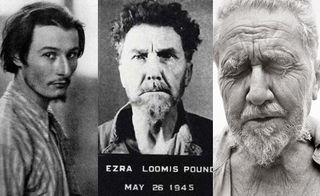
Pound-thumb-490x300-1181 Jamie James on Ezra Pound in Lapham's Quarterly:

Ezra Pound never made it easy. He was a poet who cared little about public success and not at all about money: he dedicated his life to art with the rapturous abandon of a bacchant. Pound saw himself as forging ahead on the path poets had pursued since the preclassical bards, toward deeper wisdom and a more perfect expression, in pursuit of the beautiful. In the years since his death, this perennial vision of an enlightened Republic of Letters, one of humankind’s greatest intellectual accomplishments, has quietly gone the way of falconry and intaglio carving. So impenetrable and taxing do Pound’s poems appear to most modern readers that the soaring ambition of his work has been eclipsed by the neatly plotted narrative of his life.

Everybody knows the story. Pound launched the Imagist movement, epitomized by that hardy perennial of poetry anthologies, “In a Station of the Metro” (in full: “The apparition of these faces in the crowd;/Petals on a wet, black bough”), and then played a decisive role in shaping T. S. Eliot’s epochal masterpiece The Waste Land. He devoted the rest of his life to composing The Cantos, a vast, unreadable epic left unfinished at his death in 1972. The story ends badly: he went off the rails during the war years, embracing fascism and anti-Semitism in broadcasts for Mussolini that got him arrested for treason, and was eventually committed to a mental hospital.

As conventional wisdom goes, the standard skinny on Pound is no worse than most. True to the genre it lacks nuance, emphasizing controversy over substance, but it isn’t actually wrong about anything—except the work. Pound’s Imagist poetry was revolutionary but by no means the best even of his early compositions, and The Cantos are called unreadable by the same people who call Tristram Shandy and Ulysses unreadable, those who haven’t read them. Many of the cantos are as deeply felt and exquisitely rendered as any verse in English. No poet has ever been so influential, so controversial, and so little read.

Walter Benjamin in Extremis

225px-Benjamin-sm Nikil Saval in n+1:

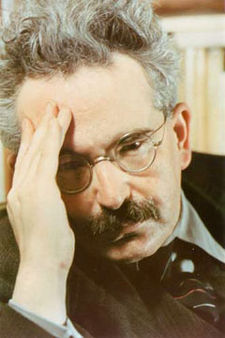
Walter Benjamin, or rather, the now-beloved figura of Benjamin—shuffling, myopic, mustachioed, fat, unhealthy, small round glasses glinting like flashlights—was largely unattractive in his own lifetime. Introducing Benjamin, a precis of his life and work in comic-book form, spends an inordinate amount of time demonstrating that Benjamin had no positive libido—and that, in fact, women just could not under any circumstances find him attractive. How strange is it now, then, to read in the Guardian that “as a teenager,” the novelist Nicole Krauss “had a crush on the German philosopher.” How odd to reflect upon the growth and consolidation of a veritable Benjamin industry in the sixty-five years since his death, an industry that extends well beyond the academy, to art-pop songs like Laurie Anderson's “The Dream Before (For Walter Benjamin),” and Jay Parini's embarrassingly unreadable “novel of ideas” Benjamin's Crossing. A movie must surely be on the way: can I start by suggesting Tim Robbins as Benjamin?

Such widespread reverence has been essential to the growth of Benjamin studies; but it has also served as a barrier to actual understanding and use of his thought. Franco Moretti, for one, leveled a bitter disparagement at academics for treating Benjamin as “the sancta sanctorum” of literary criticism, a pure soul from whose gloomy pen issued the true plash of ideas, protected from the reproof and constant reconsideration one expects from critics. Susan Sontag's “Under the Sign of Saturn,” (originally published in the New York Review of Books, with Sontag's characteristic vatic humorlessness, as “The Last Intellectual”) is symptomatic of this unreserved Benjamin adoration. She begins by lovingly—too lovingly, perhaps—describing photographic portraits of the man, how “the downward look through his glasses—the soft, day-dreamer's gaze of the myopic—seems to float off to the lower left of the photograph.” She goes on to discuss Benjamin's melancholia and saturnine disposition, glancingly using Benjamin's own highly interesting work on melancholy and German Baroque allegory to produce wan axioms and declarations: “precisely because the melancholy character is haunted by death, it is melancholics who best know how to read the world”; “only because the past is dead is one able to read it.” The presentation of Benjamin's ideas on allegory, collecting, and city life point continuously back to Benjamin the pudgy myopic. Using what is clearly an “erotics” of reading and not a hermeneutics, Sontag winds up arguing, however inadvertently, on behalf of the photographs, the image, the figure of Benjamin—as if to say: only because he is dead is one able to make love to him.

Tony Judt on What it Means to be Jewish

Judt_tony-20051103.2_gif_230x489_q85 Over at the NYRB blog:

I never knew Toni Avegael. She was born in Antwerp in February 1926 and lived there most of her life. We were related: she was my father’s first cousin. I well remember her older sister Lily: a tall, sad lady whom my parents and I used to visit in a little house somewhere in northwest London. We have long since lost touch, which is a pity.

I am reminded of the Avegael sisters (there was a middle girl, Bella) whenever I ask myself—or am asked—what it means to be Jewish. There is no general-purpose answer to this question: it is always a matter of what it means to be Jewish for me—something quite distinct from what it means for my fellow Jews. To outsiders, such concerns are mysterious. A Protestant who does not believe in the Scriptures, a Catholic who abjures the authority of the Pope in Rome, or a Muslim for whom Muhammad is not the Prophet: these are incoherent categories. But a Jew who rejects the authority of the rabbis is still Jewish (even if only by the rabbis’ own matrilineal definition): who is to tell him otherwise?

I reject the authority of the rabbis—all of them (and for this I have rabbinical authority on my side). I participate in no Jewish community life, nor do I practice Jewish rituals. I don’t make a point of socializing with Jews in particular—and for the most part I haven’t married them. I am not a “lapsed” Jew, having never conformed to requirements in the first place. I don’t “love Israel” (either in the modern sense or in the original generic meaning of loving the Jewish people), and I don’t care if the sentiment is reciprocated. But whenever anyone asks me whether or not I am Jewish, I unhesitatingly respond in the affirmative and would be ashamed to do otherwise.

The ostensible paradox of this condition is clearer to me since coming to New York: the curiosities of Jewish identity are more salient here.

The overpopulation myth

From Salon:

Md_horiz People have been worrying about the world’s pending overpopulation for more than two centuries. Robert Thomas Malthus sounded the alarm in 1797 with “An Essay on the Principles of the Population,” which predicted mass starvation and went on to influence the likes of Charles Darwin and Margaret Sanger. Paul Ehrlich’s 1968 book, “The Population Bomb,” forecast a similar fate; if the population kept rising unchecked, Earth’s resources would buckle. Many of today’s environmental thinkers, such as broadcaster (and “Planet Earth” narrator) David Attenborough, have called for drastic measures to limit the planet’s population before it’s too late.

But according to the veteran environmental writer Fred Pearce, they’re all wrong. In his latest book, “The Coming Population Crash: And Our Planet's Surprising Future,” Pearce argues that the world’s population is peaking. In the next century, we’re heading not for exponential growth, but a slow, steady decline. This, he claims, has the potential to massively change both our society and our planet: Children will become a rare sight, patriarchal thinking will fall by the wayside, and middle-aged culture will replace our predominant youth culture. Furthermore, Pearce explains, the population bust could be the end of our environmental woes. Fewer people making better choices about consumption could lead to a greener, healthier planet.

More here.

Sean Carroll Talks School Science and Time Travel

From The New York Times:

The world of science has two Sean Carrolls. One is an evolutionary biologist. The other is a cosmologist and theoretical physicist, an expert on time and the early moments of the universe. As it happened, the physicist stopped by the offices of The New York Times on a recent March morning. Dr. Carroll, a 43-year-old research professor at the California Institute of Technology, had come to New York for an appearance on “The Colbert Report.” He was in town promoting his meditation on the physics of time, a trade book with the clever title “From Eternity to Here.”

Sean Q. WHEN YOU GO TO A COCKTAIL PARTY, DO YOU TELL PEOPLE THAT YOU ARE A PHYSICIST? SOME PHYSICISTS WON’T.

A. I do! But I know what you’re talking about. Whenever you say you’re a physicist, there’s a certain fraction of people who immediately go, “Oh, I hated physics in high school.” That’s because of the terrible influence of high school physics. Because of it, most people think physics is all about inclined planes and force-vector diagrams. One of the tragedies of our educational system is that we’ve taken this incredibly interesting subject — how the universe works — and made it boring.

Q. LEON LEDERMAN, THE NOBEL PRIZE PHYSICIST, HAS PROPOSED THAT WE REFORM HIGH SCHOOL SCIENCE BY REQUIRING PHYSICS IN THE SOPHOMORE AND NOT THE SENIOR YEAR. WILL THAT HELP — OR IS IT REARRANGING DECK CHAIRS ON THE TITANIC?

A. I don’t think it’s the right solution. What we need to do is find a new way to teach the spirit of physics. What we do now is water down what professional physicists do and make it into this dry puzzle-solving thing with little pictures of pulleys and things like that. We ought to teach kids more about the Big Bang and entropy and particles. Every high school graduate should know that everything in the universe is made of a handful of particles. That’s not a hard thing to know. But that’s not what’s emphasized. Yes, there is a quantitative aspect to science that should not be denied, but it can be in the service of interesting rather than boring problems. Ten years after high school, most students are not going to solve a problem with pulleys and levers. But they still might want to know about the expansion of the universe and about cool things in atomic physics and lasers — which they’ll find interesting and fun.

More here.

The story of America’s greatest idea: Risk

John Dickerson in Slate:

ScreenHunter_01 Apr. 20 10.45 Risk has taken a beating recently, thanks to the financial crisis. Risk is supposed to be about choice and consequence. You take a chance and you win or you lose. But then banks and insurance companies found ways to pervert this. They devised ever more esoteric ways to pass risk on to others, so there was, in fact, no risk to them at all. In this distortion, insurance techniques, created to limit risk, exposed millions to it. The laws of probability, originally devised to solve a moral dilemma—how to equitably distribute winnings in a game of chance—wound up inequitably distributing losses to people who didn't even know they were at the table. The architects of these gambles left their jobs with enormous bonuses, and companies that helped cripple the financial system were repaid by the government bailout. They took a chance, and lost—but they still won.

In this series, I seek to reclaim risk. I want to remind myself—and you—of the buoyant, thrilling side of risk, and I will do it by telling the stories of people who embrace risk and who live with the fear, exhilaration, and ambiguity it creates without shirking. People engaged in every kind of human endeavor say that taking risks is the key to fulfillment and success. It is at the heart of our biggest thrills and proudest achievements. Ask someone when she felt most alive and she'll tell you a story about a risk she took. President Barack Obama talked about this in his inaugural address. “Greatness is never a given. It must be earned. Our journey has never been one of short cuts or settling for less. It has not been the path for the faint-hearted—for those who prefer leisure over work, or seek only the pleasures of riches and fame. Rather, it has been the risk-takers, the doers, the makers of things.”

This series presents the stories of those people.

More here.

A day in the life of Obama (as envisioned by a typical Republican)

Lewis Grossberger in True/Slant:

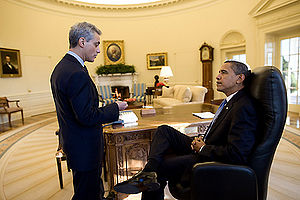
300px-Barack_Obama_and_Rahm_Emanuel_in_the_Oval_Office 6:30 AM: Obama awakened by clock radio tuned to NPR’s popular morning drive-time show, Kronsky the Bomb Thrower and His Anarcho-Syndicalist Zoo. “You know what would be fun?” Kronsky quips. “Getting the workers to seize the means of production and execute the blood-sucking capitalist bosses!” “If only,” mutters Obama.

7:30 AM: on way to Oval Office, Obama ducks into private chapel, slipping off shoes and prostrating self while facing Mecca. He chants high-pitched, ululating prayer to Allah in foreign tongue then before leaving, bows before busts of Marx, Lenin, Stalin, Mao, Hitler and Saul Alinsky.

7:40 AM: Rahm Emanuel enters Oval Office, gives Obama secret Illuminati handshake, says, “Good morning, Comrade President. The Iranian ambassador is here to discuss his scheme to undermine America’s security.” Obama says, “Show him right in.”

9:05 AM: Snack of sweetened camel milk served with dates, figs, pita and hummus. Then Iranian ambassador exits White House through secret tunnel so Fox News won’t see him.

9:30 AM: House Speaker Pelosi arrives to plot strategy for government takeover of lucrative garbage-collection industry. Obama gives her large suitcase full of cash for bribing Congressmen.

10 AM: Editors of New York Times, Washington Post, New Yorker arrive to receive weekly instructions.

11 AM: Daily intelligence briefing by CIA and Pentagon officials on activities of America’s enemies. Bored, Obama does crossword puzzle, then dozes off.

Noon: Lunch with leaders of world gay conspiracy, who lobby Obama to appoint a transsexual to Supreme Court.

More here. [Thanks to Tom Bissell.]

The iPad, the Kindle, and the future of books

Ken Auletta in The New Yorker:

100426_r19553_p233 Traditionally, publishers have sold books to stores, with the wholesale price for hardcovers set at fifty per cent of the cover price. Authors are paid royalties at a rate of about fifteen per cent of the cover price. On a twenty-six-dollar book, the publisher receives thirteen dollars, out of which it pays all the costs of making the book. The author gets $3.90 in royalties. Bookstores return about forty per cent of the hardcovers they buy; this accounts for $5.20 per book. Another $3 goes to overhead costs and the price of producing and shipping the book—leaving, in the best case, about a dollar of profit per book.

Though this situation is less than ideal, it has persisted, more or less unchanged, for decades. E-books called the whole system into question. If there was no physical book, what would determine the price? Most publishers agreed, with some uncertainty, to give authors a royalty of twenty-five per cent, and began a long series of negotiations with Amazon over pricing. For months before Sargent’s visit, the publishers had talked about imposing an “agency model” for e-books. Under such a model, the publisher would be considered the seller, and an online vender like Amazon would act as an “agent,” in exchange for a thirty-per-cent fee. Yet none of the publishers seemed to think that they could act alone, and if they presented a unified demand to Amazon they risked being charged with price-fixing and collusion.

More here.

Monday, April 19, 2010

Imaginary Tribes #7

The Taimyr Tlängit

Justin E. H. Smith

[Click on the numbers to read the earlier installations in the Imaginary Tribes series: #1, #2, #3, #4, #5, and #6.]

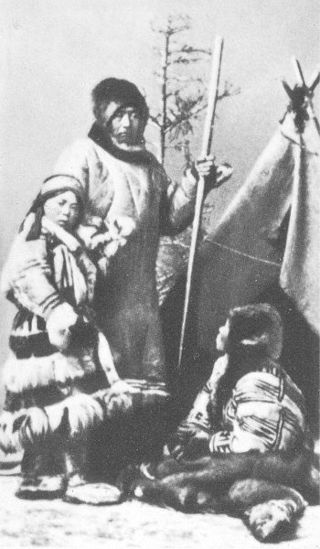
350px-Nenets_1860x_by_Denier Joan had her practical side. She warned me it's Indiana state law that you have to buy some kind of coffin or other, but she insisted under no circumstances should I buy one of those fancy models. It's going to be underground, anyway, she said, after just a few hours of display. They say the deluxe coffins are better at keeping out the elements, but so what? Who wants to stew in their own gasses for the next hundred years? I want the elements to rush in and I want to rot a.s.a.p., she said. I want to rot right back to the point where my body and the elements are the same thing. So get the cardboard.

She could also be horrifyingly cold, like when we moved down to Evansville to get away from the frat houses and the dumpy townies. She had just been promoted to regional director of Planned Parenthood for all of Southwestern Indiana, and I had only eight years left before moving to half-time teaching at Oahu, so we agreed that I'd be the one to make the hour commute, and we'd find the nice big house of our dreams in that modest metropolis on the Ohio River. We looked at some enormous Victorians across the river in Henderson, but Joan spent the whole day cringing. “I didn't work this hard just to get an address in Kentucky,” she exclaimed that evening as we strolled through the 'Fiesta' section of Tarzan and Cheetah's Global Grocery. Just like that.

Now here I am alone, Ken thought as he flipped through the latest issue of Jet, bought on a whim late last night during an antacid run to CVS, in our modest-sized but respectable brick two-story in Evansville. What did she mean, 'worked so hard'? Was she in it for the money? Was my castle built on the rotting bones of a million dead fetuses? Half of it, maybe. We always went fifty-fifty on everything. I paid half with my anthropologist's salary, and she paid half with her family-planner's salary. It's not much of a castle anyway, and family-planning is about a lot more than abortions. It's about education.

Read more »

Sunday, April 18, 2010

After the Smolensk Crash: “A New Community” of Poland and Russia?

220px-AdamMichnik01Mar2006 Adam Michnik in the NYRB blog:

Something touched our hearts.

Four days after the April 10 tragedy of Smolensk, the Russian President declared: “It is obvious that Polish officers were shot at the command of the then leaders of the USSR, including Joseph Stalin.”

The crime of Katyń has divided Poles and Russians more than any other event of the twentieth century. For the last twenty years in both of our countries an arduous search continued for the truth and for the remembrance of that crime of the totalitarian Stalinist regime. Right from the beginning, some of the most outstanding Russians were involved in this effort. They were statesmen, scientists, civil servants, and regular people, and to them many a time Poland expressed her gratitude and respect.

The Smolensk catastrophe broke something in our Polish and Russian hearts. In the hearts of the leaders and of regular people. It was as if a gigantic dam opened—a dam behind which unexpressed words and gestures were piled up. In the last days, the entire world learned about the Katyń crime. And, in the face of this new tragedy, Russian politicians decided to act in an unprecedented way, a way that will remain in history.

The showing of the film Katyń by Andrzej Wajda on the most viewed channel of the Russian television; the words of President Medvedev about the guilt of Stalin; the earlier gestures and words of prime minister Putin – these are the foundation for new relations between Poland and Russia. As are all the flowers and lighted candles on the site of the Smolensk tragedy, in front of the Polish embassy in Moscow, and Polish consular offices in other cities of Russia. And the openness of the Russian side in cooperating with the Polish experts in explaining the reasons of the catastrophe.