
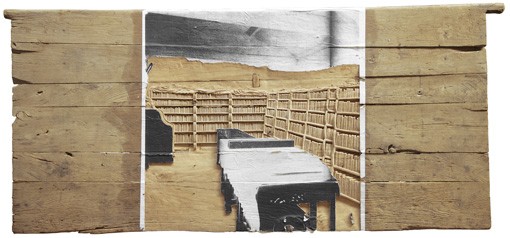
Zhang Huan. Memory Door Series. Library No 1. 2007.
Category: Recommended Reading
Caption Needed
Editor's Note: In the spirit of The New Yorker's popular caption contest, we will be presenting original cartoons done for 3QD by the very talented Robert Pichler. Unlike The New Yorker, we are not running a real contest, but just for fun, we encourage you to suggest captions in the comments area.
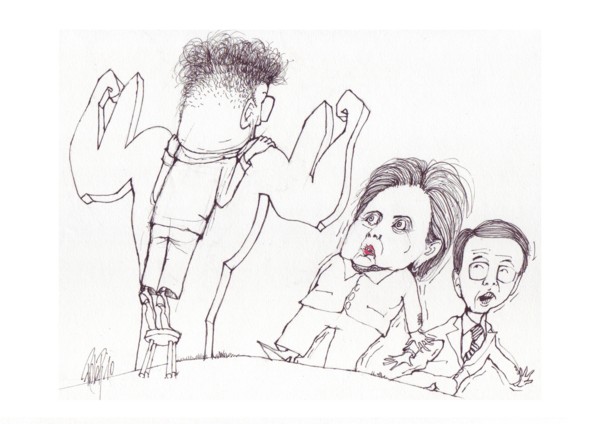
Sunday, May 30, 2010
Why are people so eager to invade their own privacy?
Rochelle Gurstein in The New Republic:
What astounds me about today's metaphorical glass-house dwellers—those people who eagerly publicize on websites every detail of their “health” (DNA profile), “finances” (shopping bills and consumer preferences), “family situation” (online dating profile)—is how cheerfully they participate in “one of the most horrifying aspects of modern life.” Self-invasions of privacy on the Internet now compete with “bureaucracy with its documents” and “the press with its reporters” for a place on Kundera's list of the institutionalization and I would add normalization of this “age-old form of aggression.” And so, too, it seems to me, do all those glass apartment houses which sprang up everywhere in New York City during the glory years of the last building boom. I am still baffled as to why architects thought it was a good idea to erect pricey, luxury apartments without solid, exterior walls on streets that are exposed not only to the casual glance of thousands of city walkers from below but also to the unavoidable notice of those who live or work in the many neighboring buildings, and that a new breed of fashionable New Yorkers couldn't wait to live in them.
More here.
In Between Layers
From Lensculture:
Diverse, affluent cultures around the world have recently embraced a mash-up of photography, trompe-l’oeil imagery, conceptual art and super-large-scale digital printing, to cloak the temporary “ugliness” of construction scaffolding with building-size outdoor art displays.
Photographer Han Sungpil has documented this trend worldwide, with an obsession for making large-format photos of these huge temporary installations from ideal viewing locations — precisely at the times of day when the light is perfect to make the illusions appear almost seamless.
More here.
Mating competition explains excess male mortality
From PhysOrg:
Researchers have long known that women outlive men on average, and more recently have discovered that men have higher mortality risks across the entire lifespan. University of Michigan researcher Daniel Kruger offers this explanation: It is all about sex. Women invest more physiologically in reproduction than men, thus men compete with other men for mating partners and try to make themselves attractive to women. This competition leads to strategies that are riskier for men both behaviorally and physiologically, and these result in higher levels of mortality.
“If mating competition is responsible for excess male mortality, then the more mating competition there is, the higher excess male mortality will be,” said Kruger, an assistant research professor in the U-M School of Public Health. In the current study, Kruger shows that two factors related to the level of male reproductive competition contribute to higher rates of risk-taking and mortality. The first factor is polygyny, the social situation in which one man maintains sexual relations with many women (the opposite is polyandry—one women and many men). Several species of primates show high levels of polygyny, where one dominant male mates with most of the females in the group, and other males are left out. Human cultures have varying degrees of polygyny, and Kruger found that the more prevalent the practice, the higher the rate of male mortality.
More here.
Sunday Poem
(intuition, black rose)
the city lay pressed together, steaming at the joints
the city, a rosebud composed of metal,
pressed together, steaming at joints,
it wheels its rose-head, sucks in a cold night, thick night
sucks in night like ink through a straw
my city is a rose-bud all cold metal
some nights i walked circles through her folds
shadows flapped and tore, broke loose like a storm
a dream made of black lace smothered my mouth
with the scent a man would chase through sheets
(which man? mine!)
a dream made of black lace come scratching my throat
i walk toward the man who loves with ice
lungs aching with a scent he’d chase through sheets
my heart, it twists like rope
but i walk toward the man who loves like ice
my sweetheart crush my bones at the steaming corner
but my heart, she twists quietly.
pressed to my ribs this man (my man!)
pressed to my ribs, ice, ice.
the dream clogs my throat with her careful lace
and my lips go off burning with his lips
the whole city wheels its head off
off comes the rose from its stalk of brute wanting.
see what you’ve done, i thought, when my city
loosed and split, folds cracked with ice
and streets fell away with buildings and night.
(we stood froze like a root, but twisting)
by Mara Jebsen
from Union Station Magazine
February 2010
habermas!
Audrey’s Dance
The Haunted House
Saturday, May 29, 2010
Terrorism, Shameless Religious Bigotry and Pakistani Mindset
Raza Habib Raja in Pak Tea House:
As I write these sentences, the details of the most shameful attack on the religious sites of Ahmedis in Lahore are unfolding. However, this is not new as Pakistan has been the victim of this brazen behavior repeatedly. The thirty years of state sponsored “true” Islam is showing its colors. In Pakistan all the minorities are constantly harassed and state’s protection has often proved completely ineffective when a serious attack occurs. Although the counterargument can also be made that state is not also able to protect even when Muslims are attacked.
In case of Ahmedis it is a well known fact that they have been victims of state induced discrimination also apart from being openly hated by the public. In fact even today as this most in human barbarity was unfolding I had the opportunity to actually hear people in my office saying that though terrorism is bad Ahmedis deserved it. Muslims are an extremely intolerant group and yet extremely sensitive when it comes to their own religious sensitivities. And when such minorities are under attack the state protection has often been particularly inadequate and public condemnation virtually absent.
More here. [Thanks to Mustafa Ibrahim.]
sarah!

If you want to watch Silverman’s TED routine, you can’t: It was never put online. So she tells me the joke. “The bit was tied into the theme of the conference, which was ‘What the World Needs Now.’ So I say I’d like to adopt a retarded baby because I don’t have this urge to have a little version of myself to get right this time.” She stops to explain her feelings about the word retard. “I don’t like it. I think it’s a negative bummer word. Retarded, however, technically means [mentally challenged].” She continues: “So I say I’m adopting a retarded baby and I’ll be worried about who will take care of my child when I’m gone. So, solution! I’m going to adopt one with a terminal illness. Now, you’re probably thinking, what kind of person looks to adopt a terminally ill retarded child? An amazing person! I don’t see those 9/11 firefighters adopting retarded children with terminal illnesses. I’m just saying. Of course, there’s going to be the uncomfortable, inevitable question in the adoption process: Are you sure there are absolutely no cures on the horizon?”
more from Will Leitch at New York Magazine here.
the larsson phenomenon

It’s an authentic phenomenon. As “The Girl Who Kicked the Hornet’s Nest,” the last of three posthumous thrillers by the Swedish writer Stieg Larsson, goes on sale this week in the United States, his books have already sold 40 million copies worldwide in a mere five years, while the modestly mounted movie version of his first title has already grossed something like $100 million, with talk of remaking these Swedish productions in Hollywood versions. There is simply no precedent for figures of that magnitude, especially in the mystery-thriller category, where authors become brand names only after they have patiently added many titles to their bodies of work. It’s possible, of course, that Larsson’s own rather dramatic story is helping to fuel the phenomenon. The writer was well-known as a crusading anti-fascist journalist and as a genial, rather careless man whose addiction to cigarettes and junk food might have hastened his premature demise (at age 50, of a heart attack), not long after delivering his three manuscripts to his publisher. The fact that he also left behind a widely reported controversy is also a good story. Larsson died without a will, meaning his fortune in royalties went to his family, a father and brother with whom he was not close, instead of to his helpmate of 30-odd years, whom he never married but whom everyone (except the lawyers) thinks deserves more than a grass widow’s mite of his earnings. But none of that quite explains the mystery that lies beneath the phenomenon.
more from Richard Schickel at the LAT here.
Central European classics
From The Telegraph:
Just as rich people assume that they have nothing to learn from poor people, big nations assume that they have nothing to learn from small nations. This is not true of scientists, nor does it apply to the super-educated in general, but the majority of big nations know very little of the wider world, starting with their ignorance of any language but their own.
Here it is possible to graduate from a top university without having read, even in translation, the classic authors of France and Russia, let alone of Central Europe. As the insights of small, poor, oppressed nations do not come naturally to the British, many aspects of life remain a closed book to them. Which is why this new series of Central European Classics is important well beyond simply providing 'good reads’.
More here.
Dispatches From the Other
From The New York Times:
In 1946, when Simone de Beauvoir began to write her landmark study of women, “The Second Sex,” legislation allowing French women to vote was little more than a year old. Birth control would be legally denied them until 1967. Next door, in Switzerland, women would not be enfranchised until 1971. Such repressive circumstances account for both the fierce, often wrathful urgency of Beauvoir’s book and the vehement controversies this founding text of feminism aroused when it was first published in France in 1949 and in the United States in 1953. The Vatican placed it on the Index of Forbidden Books. Albert Camus complained that Beauvoir made Frenchmen look ridiculous. On these shores, the novelist Philip Wylie eulogized it as “one of the few great books of our era,” the psychiatrist Karl Menninger found it “pretentious” and “tiresome,” and a reviewer in The Atlantic Monthly faulted it for being “bespattered with the repulsive lingo of existentialism.”
In her splendid introduction to this new edition, Judith Thurman notes that Blanche Knopf, wife of Beauvoir’s American publisher, heard about the book on a scouting trip to France and was under the impression that it was a highbrow sex manual. Knopf asked for a reader’s report from a retired zoologist, Howard M. Parshley, who was then commissioned to do the translation. Knopf’s husband urged Parshley to condense it significantly, noting that Beauvoir seemed to suffer from “verbal diarrhea.” Parshley complied, providing the necessary Imodium by cutting 15 percent of the original 972 pages. And so it was this truncated text, translated by a scientist with a college undergraduate’s knowledge of French, that ushered two generations of women into the universe of feminist thought, inspiring pivotal later books like Betty Friedan’s “Feminine Mystique” and Kate Millett’s “Sexual Politics.”
Constance Borde and Sheila Malovany-Chevallier’s new translation of “The Second Sex” is the first English-language edition in almost 60 years, and the first to restore the material Parshley excised. In this passionate, awesomely erudite work, Beauvoir examines the reasons women have been forced to accept a place in society secondary to that of men, despite the fact that women constitute half the human race. Supporting her arguments with data from biology, physiology, ethnology, anthropology, mythology, folklore, philosophy and economics, she documents the status of women throughout history, from the age of hunter-gatherers to the mid-20th century. In one of her most interesting chapters, “The Married Woman” (a chapter Parshley particularly savaged), she offers numerous quotations from the novels and diaries of Virginia Woolf, Colette, Edith Wharton, Sophia Tolstoy and others. She also scrutinizes the manner in which various male authors, from Montaigne to Stendhal to D. H. Lawrence, have represented women (and, in many cases, how they treated their wives). Urging women to persevere in their efforts at emancipation, she emphasizes that they must also do so for the sake of men: “It is when the slavery of half of humanity is abolished and with it the whole hypocritical system it implies that the ‘division’ of humanity will reveal its authentic meaning and the human couple will discover its true form.”
More here.
Saturday Poem
Storm on the Island
We are prepared: we build our houses squat,
Sink walls in rock and roof them with good slate.
This wizened earth has never troubled us
With hay, so, as you see, there are no stacks
Or stooks that can be lost. Nor are there trees
Which might prove company when it blows full
Blast:you know what I mean – leaves and branches
Can raise a tragic chorus in a gale
So that you listen to the thing you fear
Forgetting that it pummels your house too.
But there are no trees, no natural shelter.
You might think that the sea is company,
Exploding comfortable down on the cliffs,
But no: when it begins, the flung spray hits
The very windows, spits like a tame cat
Turned savage. We just sit tight while wind dives
And strafes invisibly. Space is a salvo,
We are bombarded by the empty air.
Strange, it is nothing that we fear.
by Seamus Heaney
from Death of a Naturalist,
Faber and Faber, 1999
Sister Margaret and the hierarchy of mostly aging men
Nicholas D. Kristof in the New York Times:
Sister Margaret made a difficult judgment in an emergency, saved a life and then was punished and humiliated by a lightning bolt from a bishop who spent 16 years living in Rome and who has devoted far less time to serving the downtrodden than Sister Margaret. Compare their two biographies, and Sister Margaret’s looks much more like Jesus’s than the bishop’s does.
“Everyone I know considers Sister Margaret to be the moral conscience of the hospital,” Dr. John Garvie, chief of gastroenterology at St. Joseph’s Hospital, wrote in a letter to the editor to The Arizona Republic. “She works tirelessly and selflessly as the living example and champion of compassionate, appropriate care for the sick and dying.”
Dr. Garvie later told me in an e-mail message that “saintly” was the right word for Sister Margaret and added: “Sister was the ‘living embodiment of God’ in our building. She always made sure we understood that we’re here to help the less fortunate. We really have no one to take her place.”
I’ve written several times about the gulf between Roman Catholic leaders at the top and the nuns, priests and laity who often live the Sermon on the Mount at the grass roots. They represent the great soul of the church, which isn’t about vestments but selflessness.
When a hierarchy of mostly aging men pounce on and excommunicate a revered nun who was merely trying to save a mother’s life, the church seems to me almost as out of touch as it was in the cruel and debauched days of the Borgias in the Renaissance.
More here.
Peter Beinart vs. the ADL
From the New York Review of Books:
Abraham H. Foxman:
Peter Beinart offers a conveniently impressionistic view of the American Jewish community to frame his critique of Israeli policy trends. He should know better than to fall into the trap of generalizing about the Jewish state without giving proper context for what is going on.
He sees an Israel that is clearly moving to the right, that has less regard for the “other,” no matter who that may be, and that is unwilling to take seriously efforts toward peace. Beinart seems to be suffering from the same problems we have seen in the Obama administration, ignoring what Israel has gone through over the last decade and thereby misreading what Israelis are thinking today.
Israelis, to a large extent, and this is shared by many in the American Jewish community (another of Beinart’s targets), feel frustrated that all their efforts toward changing the dynamic have been met with rejection and/or violence. Most Israelis understand that continuing to sit in the West Bank is not good
for the country. So at Camp David in 2000 they tried a solution of ending the conflict, which included withdrawing from 90 percent of the territories and eliminating the majority of settlements. They got a big no and suicide bombs…
Peter Beinart:
Abraham Foxman’s letter illustrates the problem my essay tries to describe: an American Jewish leadership that publicly defends the Israeli government, any Israeli government, rather than defending Israeli democracy, even when the former menaces the latter.
Obviously, as Foxman suggests, the Palestinians are not blameless. Yasser Arafat deserves history’s scorn for not responding more courageously to the chances for peace at Camp David and the much better ones put forward by Clinton in December 2000. And the election of Hamas was a tragedy, for both Israel and the Palestinians. But to suggest that Palestinian and Arab behavior fully explains the growing authoritarian, even racist, tendencies in Israeli politics is to don a moral blindfold, a blindfold that most young American Jews, to their credit, will not wear.
Firstly, Palestinian rejectionism cannot explain Avigdor Lieberman’s crusade to humiliate, disenfranchise, and perhaps even eventually expel Arab Israelis, the vast majority of whom want nothing more than to be accepted as equal citizens in the country of their birth. Lieberman is not a marginal figure. He was Benjamin Netanyahu’s chief of staff; he heads Israel’s third-largest party; he serves as foreign minister; and when Israel held mock elections in ten high schools last year, he won.
Nor are his views marginal. In 2008, in a poll cited by Yediot Ahronot, 40 percent of Jewish Israelis did not believe that Arab Israelis should be allowed to vote. Among Jewish Israeli high school students surveyed this March, the figure was 56 percent…
More here.
When the good amongst us go silent…
Adil Najam and Owais Mughal in All Things Pakistan:
There can be nothing but rage and loathing for those who kill for the pleasure of killing. Who kill for the purpose of spreading terror and mayhem. Who kill to hide their own inadequacies of faith. Who breed in the fires of hate and kill as an expression of hate. These are the enemies of Pakistan. The enemies of the very religion they think they are safeguarding with venomous hate. They are, indeed, the enemies of humanity.
Ultimately, the person who is killed is not a Pakistani or Indian or American or even Muslim or Jew or Christian or even Barelvi or Ahmadi or Wahabi. Ultimately, the person killed is just another human. And the person who kills, is not. Because in the very act of killing for hate he has stripped himself of that distinction, of his own humanity.
Words escape us, once again. What can we say that we did not say about Karachi, about Quetta, about Swat, about Peshawar, about Islamabad, about Kohat – indeed about Lahore itself, again and again.
What can one add except to wipe the tears from ones eyes, to say a silent prayer – a silent prayer that society’s silence over these atrocities may break. Because when the good amongst us go silent, then only the hate of the bad resounds.
More here.
Why Pakistan needs the Separation of Religion and State
Juan Cole in Informed Comment:
The Pakistani military has been conducting a military campaign against the Pakistani Taliban in the northern tribal area of South Waziristan since last fall, provoking retaliatory terrorist attacks by Pakistani Taliban on the cities of Peshawar, Rawalpindi and Lahore.
What Friday’s attack suggests, if Geo is right, is that small networks of Punjabi fundamentalist vigilantes had gathered in Waziristan, from which they are now being expelled by the Pakistani military. They are attempting to take their revenge by destabilizing Pakistan. Hitting the Ahmadis, considered heretics by most Muslim Pakistanis, puts Pakistan’s politicians in the awkward position of having to defend them, and so cleverly tars the government with the brush of heresy itself.
Geo quoted a prominent Muslim cleric, Mufti Munib-ur-Rahman, who underlined that in a Muslim nation, the lives and property of non-Muslim citizens are sacrosanct. On the one hand, if this atrocity pushes the Pakistani elite to admit this crucial principle, that would be all to the good. On the other, the militants will use such statements to stir up fanatics.
The horrifying assault on the Ahmadi congregations underlines why Pakistan needs a separation of religion and state. The problem with using Islam as the state ideology (as the country’s founder, Muhammad Ali Jinnah clearly foresaw) is that there is no generic Islam.
More here.