danto sits with Abramovic

23stone1-custom1

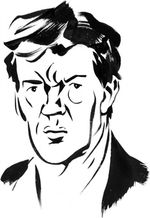
At this point, something striking took place. Marina leaned her head back at a slight angle, and to one side. She fixed her eyes on me without — so it seemed — any longer seeing me. It was as if she had entered another state. I was outside her gaze. Her face took on the translucence of fine porcelain. She was luminous without being incandescent. She had gone into what she had often spoken of as a “performance mode.” For me at least, it was a shamanic trance — her ability to enter such a state is one of her gifts as a performer. It is what enables her to go through the physical ordeals of some of her famous performances. I felt indeed as if this was the essence of performance in her case, often with the added element of physical danger. The question was how long to sit. On the one hand, I thought I could sit there interminably. For a wild moment I thought my physical ailments would fade away, as if I were at Lourdes. I don’t really believe in miracles, but I do believe in courtesy. After 10 minutes I decided that it would have been inconsiderate to take much more time away from the other visitors, who had waited their turns so patiently. I held out my arm as a signal, and someone wheeled me away.

more from Arthur Danto at The Opinionater here.

iskokotsha

Aut_Brian_Chikwava_(Simon-Day)_2

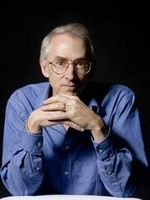
It was 1979 and I had just started primary school. That summer was the first time I witnessed what later became known as iskokotsha, a craze that would, in the euphoria of a newly independent Zimbabwe, trigger the focus of motion in popular dance to snake decisively, seductively, up the body, from the feet to the hips – a sex pantomime of outrageously suggestive moves that enthralled our young nation for the decade to come. Being onomatopoeic, iskokotsha is derived partly from the beat of the snare-drum rim and the appropriate twirling of the body to that rhythm. The dance takes on a fuller character when understood by its other name, kongonya, which alludes to the carefree, if not contemptuously deliberate, rhythm in the gait of a large stubborn animal. The day I first saw the dance was the day we had expected to end with the execution of my maternal grandfather.

more from Brian Chikwava at Granta here.

globish

100531_r19675_p233

The story of English in India epitomizes its strange history. English has been a language of occupiers and imperialists, but also one of insurgents and democrats. It has often been shaped by populations upon whom it was imposed; a large number of common English words (“jungle,” “nirvana,” “bungalow”) were, for instance, taken from Indian languages. English has also become, as Robert McCrum asserts in “Globish” (Norton; $26.95), the “world’s language,” and it is a merit of his book that he is alert to the many dichotomies of English’s rise. “Is this revolution a creature of globalization,” he asks, “or does global capitalism owe some of its energy and resilience to global English in all its manifestations, cultural as well as linguistic?” “Globish” is not quite the same as global English. The term was coined by Jean-Paul Nerrière, a French former I.B.M. executive, who noted that non-native English speakers were able to communicate with a minimal, “utilitarian” vocabulary of English words. McCrum, a British author and editor who has co-written several editions of “The Story of English,” explains that Globish is an overwhelmingly economic phenomenon—the language of Singaporean businessmen closing deals with the help of a small arsenal of English words, and of European officials calming financial markets by uttering stock phrases on television. He offers a journalistic account of its worldwide use in tandem with a historical one of the development of English as it made its way around the world. This history shows the depth and complexity of the role of English in the political and cultural evolution of the societies to which it spread. Globish’s influence is unlikely to be as revolutionary or as lasting.

more from Isaac Chotiner at The New Yorker here.

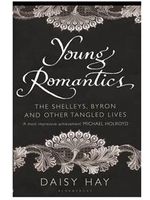
Young Romantics

From The Telegraph:

Book Visiting Rome on her honeymoon, an enthusiastic young academic whisked a fond husband off to view that little oasis of serenity, the Protestant Cemetery, in which lie the remains of two of England’s most celebrated poets.

What struck her then – as Daisy Hay reveals in the Preface to her immensely accomplished first book – were the claims of the two friends who lie buried, respectively, beside Keats and Shelley. Joseph Severn, the artist who accompanied Keats to Rome and nursed him through his final illness, was content to be recorded as the poet’s ‘‘devoted friend and death-bed companion’’. Edward Trelawny, the Cornish raconteur who travelled to Italy to meet Byron and fell, instead, under Shelley’s spell, made a bolder claim. ‘‘These are two friends whose lives were undivided,’’ proclaims his epitaph, conveniently failing to add that Trelawny’s unsevered bond with Shelley had lasted for only a bit less than a year (admittedly, the crucial one preceding, in the summer of 1822, Shelley’s death at sea).

More here.

All evolution, all the time

From Nature:

Evo Endlessly energetic scholar David Sloan Wilson is best known for his work on group selection — the idea that natural selection can operate on traits that improve the success of groups rather than individuals. As well as running a cross-disciplinary evolutionary studies programme from his home institution of Binghamton University in New York and opening the Evolution Institute think tank to inform public policy, he recently began studying altruism in Binghamton neighbourhoods and is promoting the field of evolutionary religious studies. He took time to talk to Nature at a philosophy of biology conference last week in Madison, Wisconsin, where he spoke about using evolutionary thinking as a tool for good.

You wrote a book called Evolution for Everyone. Why is it important to you that the public understand evolution?

Because it is useful. The way most people understand evolution, it is not consequential, and so they don't need to believe it. The 50% figure — how many people in the US don't accept evolution — doesn't impress me. Close to 100% of people don't connect it to matters of consequence in their own lives.

More here.

Wednesday Poem

Oxbow Lake

From Lesotho to Sullivan's Quay,
Maurice Scully inscribed in his book
of poetry to me. Because I caught
wind of him mentioning a Basotho blanket
in one of his poems. We got
talking—how we both went to Lesotho:
seeking adventure, growing our hair.
And we ran through places
we visted there, like a river snaking down
the mountains, till our paths
criss-crossed here—converging
like an oxbow lake. From the Kingdom in the
Sky
to the People's Republic of Cork
below the sea. And under his signature
X marked the spot to me.

X marked the spot to me
below the sea, and under his signature,
to the People's Republic of Cork.
Like an oxbow lake. From the Kingdom in the
Sky,
criss-crossed here—converging
the mountains. Till our paths
we visted there, like a river snaking down.
And we ran through places,
seeking adventure, growing our hair.
Talking—how we both went to Lesotho
in one of his poems. We got
wind of him mentioning a Basotho blanket
of poetry to me. Because I caught
Maurice Scully—inscribed in his book
From Lesotho to Sullivan's Quay.


by Adam Wyeth
from Landing Places: Immigrant Poets in Ireland
Dedalus Press, Dublin, 2010

Oil Shocks

Elizabeth Kolbert in The New Yorker:

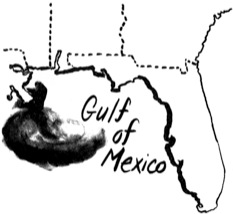
100531_talkcmmntillus_p233 The news out of the Gulf continues to range from grim to grimmer. Recently, it was revealed that the spill has created an undersea plume of oil ten miles long, and that some of the oil has already entered the loop current and is being carried toward Florida. Then the federal government doubled the area of the Gulf that had been closed to fishing. On Friday, the government increased that area again, to forty-eight thousand square miles. President Barack Obama has called the spill a “massive and potentially unprecedented environmental disaster,” a characterization that, if anything, probably understates the case.

In an immediate sense, the causes of the catastrophe are technical. Apparently, the Deepwater Horizon well was inadequately sealed, and natural gas built up inside it. When workers on the rig tried to activate the well’s blowout preventer, it failed. An attempt to activate the blowout preventer after the fact, using undersea robots, also proved unsuccessful. Another effort to cap the leak, by using what amounted to a hundred-ton steel funnel, flopped as well. Last week, BP finally succeeded in inserting a mile-long tube into the riser leading from the well. The company said that it was capturing a thousand barrels of oil a day, which is what it originally claimed that the well was leaking; nevertheless, crude continued to pour into the Gulf. (In a recent column in the Miami Herald, the author Carl Hiaasen joked that BP’s next move would be to try to seal the well with thousands of tons of instant oatmeal.)

But the real causes of the disaster go, as it were, much deeper.

More here.

Who will win the World Cup?

From CNN:

Soccer-ball Although many consider football to be a global sport, a look at the history of the World Cup shows only a handful of nations have mastered it. FIFA – the game's world governing body – recognizes 208 national associations but just seven have celebrated having the best team on the planet.

South Africa 2010 will be the 19th football World Cup. Of the previous 18 tournaments, five have been won by Brazil, four by Italy and three by Germany. Argentina and Uruguay have claimed two each and France and England one apiece. So, four European and three South American countries have triumphed but the world champions have never come from North America, Asia or Africa.

It is hard to see that record changing this time, although Africa's contenders will be bolstered by the first ever World Cup on their home continent. Ghana and Ivory Coast are arguably the strongest of those countries.

More here.

Tuesday, May 25, 2010

Douglas Hofstadter on Martin Gardner

From Scientific American:

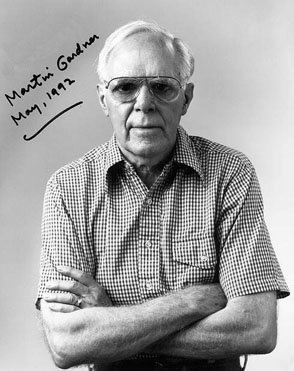
Martin-gardner-aut-ab I've been trying to reconstruct how I first encountered Martin Gardner. It may have happened in 1959, when at age 14 I happened to visit the home of a boy a couple of years older than myself, who I thought was extremely smart (and indeed he was—he later became a well-known mathematician on the Princeton faculty). While scanning his bookshelves, I noticed a Dover paperback with the curious title Fads and Fallacies in the Name of Science. I pulled it out and my curiosity was further aroused by the front cover, which mentioned such things as flying saucers, human gullibility, strange cults, pseudoscience, and so on. I had of course heard of things like telepathy, ESP, and such, but didn't know what to make of them. Though they seemed a bit far-fetched, they also appealed to my romantic nature. The year before, I had even half-convinced myself that I could discover my romantic fate by spinning a top and seeing where it fell on a marked board; I also enjoyed the thought that maybe, just maybe, the first initial of the girl I would someday marry was revealed by reciting the alphabet as I twisted an apple stem and stopping at that letter when the stem broke off. Why not? At that tender and rather gullible age, I had never devoted much thought to the demarcation line between sense and nonsense, science and silliness.

But in this book, somebody—clearly somebody very intelligent—was tearing one oddball belief system after another to shreds in a lucid, acerbic, yet at the same time humorous way. This “Martin Gardner” person was wielding common sense as a surgeon wields a knife—and occasionally twisting the knife with glee. It was probably the first time I had realized that systematic and critical thinking could extend beyond such precise domains as math and physics, and could demolish ideas in far hazier fields with great power. It was also the first time I had realized how very many crazy belief systems there are out there in the world, and how important it is to recognize this fact and to combat them.

More here. And also see a good obituary of Gardner in the NYT here.

Rare: Portraits of America’s Endangered Species by Joel Sartore

ScreenHunter_03 May. 25 17.42

ScreenHunter_04 May. 25 17.42
 

From Neatorama:

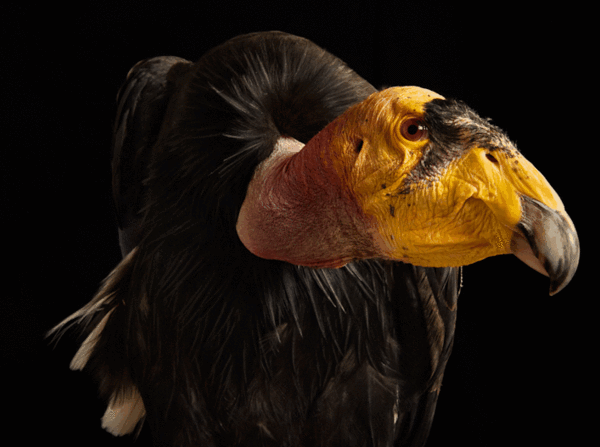
The first thought that ran across my mind when I read Joel Sartore’s book Rare: Portraits of America’s Endangered Species was that it’s a gorgeous book. Joel, a National Geographic photographer, has been on a 20-year personal mission to photograph examples of the world’s most endangered species, so you’d kinda expect that out of him.


There are currently about 1,500 known species in the world that are endangered – Joel presents 68 of them in his book, ranging from wolves to wolverines, pitcher plant to pineapple cactus; all exquisitely photographed. As an amateur point-and-shoot photographer (erhm, that’s being generous – I mostly take blurry photos of my kids), I can only imagine how long it took him to get that Eastern Hellbender photo!

The second thought that ran across my mind was that it’s a rather sad book. One of the last two Columbia Basin pygmy rabbits in the world died a few months after Joel took its photograph (you’ll read more about this below).

It took me a while, however, to realize just what Joel’s book actually meant. For me, that meaning can be summed up in just one word: hope.

More here.  And two bonus videos:

RARE from Joel Sartore on Vimeo.

Speak, Memory: Can digital storage remember for you?

Evgeny Morozov in the Boston Review:

ScreenHunter_02 May. 25 17.34 In 2006 Stacy Snyder, a 25-year-old student at Millersville University in Pennsylvania, was denied a teaching degree just days before graduation. University officials had discovered a photo of her, captioned “Drunken Pirate,” on MySpace. The photo showed Snyder wearing a pirate hat and drinking from a plastic cup, and the university accused her of promoting underage drinking. As Viktor Mayer-Schönberger tells the story in his new book Delete: The Virtue of Forgetting in the Digital Age, Snyder lost control over the photo when it was indexed by Google and other search engines: “the Internet remembered what Stacy wanted to have forgotten.”

Snyder’s story, and others like it, motivate Delete’s plea for “digital forgetting” (though it turned out that the university had other reasons to deny Snyder her certificate, including poor performance). According to Mayer-Schönberger, we have committed too much information to “external memory,” thus abandoning control over our personal records to “unknown others.” Thanks to this reckless abandonment, these others gain new ways to dictate our behavior. Moreover, as we store more of what we say for posterity, we are likely to become more conservative, to censor ourselves and err on the side of saying nothing.

For people like Snyder, Mayer-Schönberger proposes a creative remedy: enable users to set auto-expiry dates on information.

More here.

Philosophy question? There’s an app for that

From the Amherst College website:

ScreenHunter_01 May. 25 17.27 The world’s leading online resource for questions about the meaning of life, ethics and other existential matters has now launched an app for mobile devices such as the iPhone and Android phones.

AskPhilosophers.org, which was founded in 2005 by Alexander George, a philosophy professor at Amherst College, will now broaden its reach to include those who are pondering the big questions without easy access to a PC. (The app’s development was covered recently by the New York Times’ Arts Beat blog and the AppsScout website.)

“People don’t stop thinking when they leave their computer terminals,” George says. “When philosophical questions occur to people away from their desks or computer screens they’ll now have the opportunity through their mobile devices to see quickly whether other people have already asked that question and whether it’s received interesting responses.”

AskPhilosophers.org’s simple mission – to deploy a virtual team of professional philosophers to tackle the questions that have been vexing mankind for generations – has yielded more than 3,000 responses, archived on the website and arranged according to categories that include ethics, love and rationality.

More here.

eric hobsbawm, jazz man

Eric-hobsbawm-002

I owe my years as a jazz reporter to John Osborne’s Look Back in Anger, which made the British cultural establishment of the mid-1950s take notice of a music so evidently dear to the new and talented Angry Young Men. When, needing some money, I saw that Kingsley Amis wrote in the Observer on a subject about which he obviously knew no more and possibly less than I did, I called a friend at the New Statesman. He arranged a meeting with the editor, Kingsley Martin, then at the peak of his glory, who said ‘Why not?’, explained that he conceived his typical reader as a male civil servant in his forties, and passed me on to the commander of the (cultural) back half of the mag, the formidable Janet Adam Smith. Her interests ranged from mountaineering to poetry, but did not include jazz. As ‘Francis Newton’ (named after a Communist jazz trumpeter who played on Billie Holiday’s ‘Strange Fruit’), I wrote a column every month or so for the New Statesman for about ten years.

more at the LRB here.

all hail the weed

Building539__1274451903_4347

What makes a plant worth our admiration? Peter Del Tredici, a senior research scientist at the Arnold Arboretum, walks up a short grassy hill near the South Street Gate and points to what he considers to be the Arboretum’s most amazing tree: the dwarf beech, a tree seemingly born from a German expressionist landscape, its knobby branches folded into a series of right angles that create a canopy resembling barbed wire. It’s one of many impressive trees in the Arboretum’s 265 acres in Jamaica Plain, which are carefully managed by a team of professional horticulturists. But on this sunny spring afternoon, Del Tredici is interested in a far less spectacular destination: an area just outside the gate across South Street known as Stony Brook Marsh, where untamed vegetation grows atop an abandoned trash heap. On one side, a brackish pond is filled with invasive phragmitis reeds. On the other, a hillside of rubble has been colonized by a haphazard forest of thin trees. Along the path, stalks of Japanese knotweed poke insistently from the ground. It’s filled with species that are often called “invasive,” “noxious,” and “weed,” the kinds of plants that conservationists rail against and homeowners consider unsightly.

more from Courtney Humphries at The Boston Globe here.

Tuesday Poem

This Side

There is light. We neither see nor touch it.
In its empty clarities rests
what we touch and see.
I see with my fingertips
what my eyes touch:
………………………….shadows, the world.
With shadows I draw worlds,
I scatter worlds with shadows.
I hear light beat on the other side.

by Octavio Paz
translation: Eliot Weinberger
from The Collected Poems 1957-1987
Carcanet Press Ltd, 1988

Este Lado

Hay luz. No la tocamos ni la vemos
En sus vacías claridades
reposa lo que vemos y tocamos.
Yo veo con las yemas de mis dedos
lo que palpan mis ojos:
…………………………….sombras, mundo.
Con las sombras dibujo mundos,
disipo mundos con las sombras.
Oigo latir la luz del otro lado.

Ways with Words 2010: The Ghosts of Vita Sackville-West

From The Telegraph:

Inheritancestory_1640859f On display in the Great Hall is a facsimile of the bound manuscript of the novel Orlando, dedicated to Vita by the author, her lover Virginia Woolf. Vita is the eponymous hero or heroine Orlando (Orlando changes sex over the four centuries in which the novel is set) and Orlando’s ancestral home is a house, like Knole, with 365 rooms. The pages are threaded through with specific references to Knole and to its past and present incumbents: the head gardener Stubbs, Vita’s father’s elkhound Canute, and so on. Vita’s husband, Harold Nicolson, features as Marmaduke Bontrol Shelmerdine, Esquire. One of Vita’s former lovers, Violet Keppel, later Trefusis, was the Russian Princess. “She talked so enchantingly, so wittily, so wisely,” is how Virginia Woolf describes Princess Sasha in Orlando. In a letter to Vita, she wrote of Violet: “I still remember her, like a fox cub, all scent and seduction.”

Orlando also nurtured the literary associations that have become interwoven with the house’s story. Orlando (or Vita) strides into the Poets’ Parlour, our dining room today, where “her old friends Dryden, Pope, Swift, Addison regarded her demurely at first” [from their portraits on the walls]. But when they learnt that Orlando had just won a prize for a poem [Vita won the Hawthornden Prize for her poem The Land], “they nodded their heads approvingly”.

Orlando was published in 1928, the year Vita’s father died; and the novel, which ends with Orlando returning to Knole, allows Vita – as Orlando – to take possession in fantasy of the house that she had been denied in fact. As Harold described Orlando to Vita: it is a “book in which you and Knole are identified forever, a book which will perpetuate that identity into years when both you and I are dead”. Vita’s mother, Lady Sackville, on the other hand, pasted a photograph of Virginia Woolf into her copy of Orlando and wrote beside it: “The awful face of a mad woman whose successful mad desire is to separate people who care for each other. I loathe this woman for having changed my Vita and taken her away from me.”

More here.

Migrating Thousands of Miles With Nary a Stop

Carl Zimmer in The New York Times:

Bird In 1976, the biologist Robert E. Gill Jr. came to the southern coast of Alaska to survey the birds preparing for their migrations for the winter. One species in particular, wading birds called bar-tailed godwits, puzzled him deeply. They were too fat. “They looked like flying softballs,” said Mr. Gill. At the time, scientists knew that bar-tailed godwits spend their winters in places like New Zealand and Australia. To get there, most researchers assumed, the birds took a series of flights down through Asia, stopping along the way to rest and eat. After all, they were land birds, not sea birds that could dive for food in the ocean. But in Alaska, Mr. Gill observed, the bar-tailed godwits were feasting on clams and worms as if they were not going to be able to eat for a very long time.

“I wondered, why is that bird putting on that much fat?” he said.

Mr. Gill wondered if the bar-tailed godwit actually stayed in the air for a much longer time than scientists believed. It was a difficult idea to test, because he could not actually follow the birds in flight. For 30 years he managed as best he could, building a network of bird-watchers who looked for migrating godwits over the Pacific Ocean. Finally, in 2006, technology caught up with Mr. Gill’s ideas. He and his colleagues were able to implant satellite transmitters in bar-tailed godwits and track their flight.

More here.