On a Train

Justin E. H. Smith

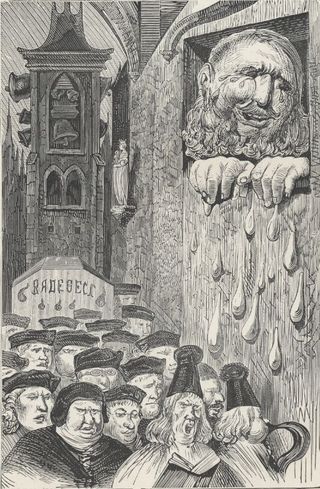
Gargantua21171707680 It's Sunday afternoon, I'm on a so-called bullet train from Lyon to Paris, tomorrow's the Pentecost, Abbas was a bit late in getting me the reminder that I'm 'up this Monday', our trusty editor-in-chief claiming that this has been a 'weird week', and for the life of me I can't think of anything to write about. To tell the truth, it's been a weird week for me too. For one thing, I've been travelling, and when I'm travelling the ordinary functioning of my vegetative soul (which recent authors have started calling 'the autonomic nervous system') breaks down entirely. That is to say that the peristaltic motion of my intestine (which used to be an adjective meaning both 'internal' and 'internecine', and was often brought up in connection with the English civil war) switches from the biological to the geological clock, and meanwhile I start to feel like a basalt-plugged volcano.

But I'm opposed to everything the word 'gonzo' stands for, so I can't just crank out some typo-filled incoherent bullshit about n'importe quoi (already I feel uncomfortable with the dangling 'about' and 'for' I've managed to let slip by). In Marseille a few days ago I had wanted to write something about the way fashion is best analyzed not as a national phenomenon, but as a sea-based phenomenon –fashion being not haute couture, but just the general way people look, perhaps something not entirely unrelated to the lost art and science of physiognomy–, the basic fashion zones of the world being the Aegeo-Adriatico-Mediterranean, the Sargasso-Caribbean, the Balto-Norwegian, the Michigano-Ontarian, and the Pacific Rim. But then we left Marseille and I was no longer seeing so many Ed Hardy-bedecked goons, whom I had taken to calling 'meatheads', and even, in my own private French, têtes de viande (which in turn made me think of the Roma beggar-woman I saw at the Place de Clichy eating pâté de tête or headcheese with her fingers, straight from the plastic packaging), so that idea for an essay just sort of evaporated. I next thought about writing something on the future of that ill-defined activity we call 'writing' in the age of social networking, as if anyone needed to see more of that sort of stuff.
Read more »

Sunday, May 23, 2010

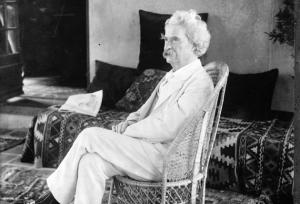
Mark Twain left instructions not to publish his autobiography until 100 years after his death, which is now

Guy Adams in The Independent:

Twain_378726t Exactly a century after rumours of his death turned out to be entirely accurate, one of Mark Twain's dying wishes is at last coming true: an extensive, outspoken and revelatory autobiography which he devoted the last decade of his life to writing is finally going to be published.

The creator of Tom Sawyer, Huckleberry Finn and some of the most frequently misquoted catchphrases in the English language left behind 5,000 unedited pages of memoirs when he died in 1910, together with handwritten notes saying that he did not want them to hit bookshops for at least a century.

That milestone has now been reached, and in November the University of California, Berkeley, where the manuscript is in a vault, will release the first volume of Mark Twain's autobiography. The eventual trilogy will run to half a million words, and shed new light on the quintessentially American novelist.

Scholars are divided as to why Twain wanted the first-hand account of his life kept under wraps for so long. Some believe it was because he wanted to talk freely about issues such as religion and politics. Others argue that the time lag prevented him from having to worry about offending friends.

One thing's for sure: by delaying publication, the author, who was fond of his celebrity status, has ensured that he'll be gossiped about during the 21st century. A section of the memoir will detail his little-known but scandalous relationship with Isabel Van Kleek Lyon, who became his secretary after the death of his wife Olivia in 1904. Twain was so close to Lyon that she once bought him an electric vibrating sex toy.

More here. [Thanks to David Schneider.]

Sunday Poem

“The human capacity to stain cannot be overcome by Mr. Clean.”
……………………………………………….R–Raul Dorset

A Diver for the NYPD Talks to His Girlfriend

I can't even see my hands in front of my face
through the darkness—mud, raw sewage,
black clouds of who knows what,
gas and oil leaking out of all the cars
that have been shoved into the river.
But my hands have learned to see,
sliding sideways down wrinkled concrete,
over slime coated rocks, broken glass, plastic bags,
barbed wire, as if there were a tiny eye
at the end of each finger. There are sponges down there
shaped like puffed-up lips, with silky tentacles
that retract at my touch. For some reason all the grocery carts
in the city are making their way to the bottom of the river.
Did I tell you about the body wrapped in plastic
and chains, and the pile of pistols, rifles,
enough to start a gun shop? Once, looking for a missing
Piper Cub, we found it next to a trainer
from World War Two, both parked side by side
as if waiting for permission to take off.
People throw strange things in the river,
I don't know, some kind of voodoo—jars
filled with pig eyes, chickens with their throats slit
stuffed into burlap sacks. Everything—TVs, couches,
lamps, phone books—is down there—if we ever grow gills
and live in the river we'll have whatever we need.
Today it was a fishing boat missing five days.
Easy to find now by a certain odor that seeps
through our wet suits that we call corpse soup.
The fishermen were sitting in the cabin, bloated hands
drifting as if they were swapping stories.
We tied them together and rose toward the surface
in a slow spiral. Once, I was feeling around in the dark
for this drowned lady, I was about to go back,
to call it a day, when her arms shot up
and grabbed me tight, round my waist.
Even when we're out of the river there's more water,
bath, shower, bath, shower, disinfectant, rinse—
but I never feel clean. Everything seems dirty: crowds
in the market, car horns, alarms, the barking of dogs.

by Richard Garcia
from Touching the Fire;
Doubleday, NY, 1998

How Much Oil’s Spilling? It’s Not Rocket Science

John Allen Paulos in his excellent Who’s Counting column at ABC News:

How much oil has leaked into the Gulf of Mexico? Many, including BP, have made estimates and remarked on the difficulty of determining the answer.

As Steve Wereley, an engineering professor at Purdue University, has shown, however, and as many others would have shown had pictures of the leak been released earlier, an approximate estimate is quite easy to come by and indicates a vastly greater oil spill than BP has admitted.

Wereley and a few other scientists, who have come to the same general conclusions, have performed a public service.

Basically, the method for determining oil spillage boils down to common sense and high school (or even middle school) geometry, specifically the formula for the volume of a cylinder.

More here.

Why she abandoned Islam

Theodore Dalrymple in The Globe and Mail:

Nomad_jpg_658022gm-a All men are created equal, perhaps, but they do not by any means lead lives of equal interest. Ayaan Hirsi Ali, who is still only in her later 30s, has already ensured her place in history and is undoubtedly one of the most remarkable people in the world. Her linguistic abilities alone would be more than enough to satisfy most people: Having learned Somali (her native tongue), English, Amharic, Arabic and Swahili, she learned Dutch sufficiently well in a couple of years to be able to stand for the Dutch parliament.

But, of course, it is her public and uncompromising repudiation of Islam for which she is best known. The brutal murder of Theo van Gogh, with whom she had made a brief film denouncing the treatment of women in Islam, brought her to world fame. In this book, which one might describe as a philosophical memoir, she describes and explains her intellectual journey from pious, veiled Muslim woman to proselytizer for the European Enlightenment view of the world.

More here.

How Many Cancers Are Caused by the Environment?

From Scientific American:

Cancer Traces of chemicals known to cause human cancer lurk everywhere. But after decades of research, figuring out how many people might contract cancer because of them remains an elusive goal. More than 60 percent of U.S. cancer deaths are caused by smoking and diet. But what about the rest?

A report by the President's Cancer Panel, released earlier this month, reignited a 30-year-old controversy among cancer experts and environmental epidemiologists about how large a role environmental factors play in the No. 2 killer of Americans. Some experts, including the President’s panel, say a decades-old estimate that six percent of cancer deaths are due to environmental and occupational exposures is outdated and far too low. But scientists most likely will never be able to tease out the true role of environmental contaminants because environmental exposures, genetics and lifestyle seem to all intertwine.

More here.

Christopher Hitchens talks about old arguments and his new memoir

Decca Aitkenhead in The Guardian:

ScreenHunter_03 May. 23 11.02 I'm not sure what a legend should look like exactly, but I'm pretty sure it's not this. The paunchy, middle-aged figure who opens the door at 10am has a crust of dried toothpaste around his mouth, an air of bleary dishevelment and the stooped shuffle of a man just out of bed and wishing he'd postponed the appointment to a less ungodly hour. Expecting to meet a sort of rakish Russell Crowe, I appear to have found a hungover Timothy Spall.

Where is the celebrated rhetorician, famed for speaking in perfect paragraphs sculpted from flawless sentences? Gruff, vague and nursing a cup of tea, he clasps one hand discreetly over the other in a manner suggestive of some practice in taming the morning shakes. Having flown in from America only the previous afternoon, he explains that he had been out with his old friend Martin Amis until 3am. Gradually – fortified by two packets of cigarettes – he begins to reconstitute himself, looking less and less like Spall but, strangely, more and more like Terry Wogan. He can't really manage eye contact. Once noon arrives, though, he brightens up, proposing the first scotch of the day with one of those bluff jokes about rules for drinking so dear to saloon bar bores the world over.

This, then, is the legendary Hitch – one-time titan and hero of the left, latterly post-9/11 neocon turncoat – the man who took on Henry Kissinger, Mother Teresa, George Galloway, God and Saddam Hussein. Really? This guy?

More here.

Martin Gardner, math and science writer, dies at 95

From the Associated Press:

Profile-of-martin-gardner_1 Prolific mathematics and science writer Martin Gardner, known for popularizing recreational mathematics and debunking paranormal claims, died Saturday. He was 95.

Gardner died Saturday after a brief illness at Norman Regional Hospital, said his son James Gardner. He had been living at an assisted living facility in Norman.

Martin Gardner was born in 1914 in Tulsa, Okla., and earned a bachelor's degree in philosophy at the University of Chicago.

He became a freelance writer, and in the 1950s wrote features and stories for several children's magazines. His creation of paper-folding puzzles led to his publication in Scientific American magazine, where he wrote his “Mathematical Games” column for 25 years.

The column introduced the public to puzzles and concepts such as fractals and Chinese tangram puzzles, as well as the work of artist M.C. Escher.

Allyn Jackson, deputy editor of Notices, a journal of the American Mathematical Society, wrote in 2005 that Gardner “opened the eyes of the general public to the beauty and fascination of mathematics and inspired many to go on to make the subject their life's work.”

More here. And see a profile in Scientific American here.

Saturday, May 22, 2010

James Joyce’s Words Come To Life, And Are Promptly Desecrated

Carl Zimmer in his excellent blog, The Loom:

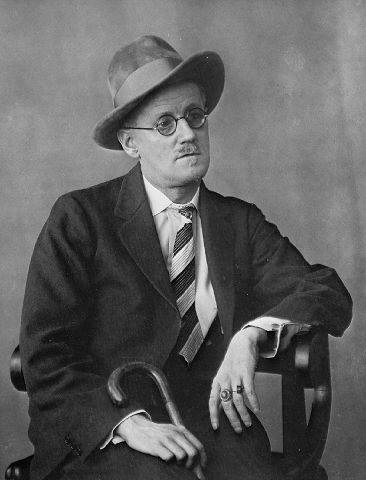
Jamesjoyce This old English major’s heart is warmed by the news that the new synthetic cell carries a line from James Joyce, inscribed in its DNA: “To live, to err, to fall, to triumph, to recreate life out of life.”

What would Joyce have thought if someone had told him that one day the synthesized genome of a goat pathogen would carry his words? I would hope that whoever told him would make sure that he did not think this moment marked his literary immortality. In fact, his deathless prose is probably being desecrated by the relentless erosion of evolution right now.

The scientists who produced the new synthetic cell copied the genome of a microbe, letter for letter, and then inserted the synthetic version into a host cell. To determine that their experiment worked, they needed a way to tell the genomes of their synthetic cells from the natural genomes that were their model. So they inserted “watermarks” into the artificial genome. These sequences of DNA (which spelled out the work of Joyce and others through the genetic code) sit in non-coding regions of the microbe’s DNA. As a result, these watermarks cannot disrupt any essential protein-coding genes or stretches of DNA that are vital for switching genes on and off.

More here.

the limestone formed by whatever volcanic calamity brings our particular puppet show to an end

07b2a468-6471-11df-8cba-00144feab49a

Like most Englishmen, I have been brainwashed by William Wordsworth. Although I don’t much like walking, I love seeing the landscape but if I spot a person, then that “spoils” it. We all want to wander lonely as clouds. Given that there will be more than 70m lonely clouds in this archipelago by 2050, the prospects for Wordsworthianism do not seem very good. Yet the strange fact is that in Britain we can still “get away from it all” with ease. From the strange, bleak, featureless isles of North and South Uist in Scotland, which contain some of the oldest geological formations in this complicated, beautiful archipelago, down to the crags and coves of Cornwall; from the deserted Borders between Scotland and England to the Lincolnshire wolds, which roll for seemingly endless miles beneath the huge sky; from the deeply green valleys of unvisited mid-Wales to the great cornfields of Suffolk, the British landscape is both varied and, for so many miles, awe-inspiringly unwrecked. It is still possible to drive through these landscapes and pass scarcely another car.

more from AN Wilson at the FT here.

heidegger’s secret lecture

Heideggerzwei

Now everyone can read for themselves what, according to student transcripts, Martin Heidegger lectured on between November 1933 and February 1934 under the title “On the Essence and Concepts of Nature, History and the State”. In April 1933, he became rector of the Albert Ludwig University and in 1934, he handed in his resignation. During his year in power he applied himself single-mindedly to organising the university’s Gleichschaltung (bringing into line). All the documents from his rectoral term are now all being published together. The lack of empathy in their tone stands in contrast, for example, to his speech honouring the the Nazi martyr figure Albert Leo Schlageter from May 1933. The documents show that during the one year intermezzo, the new masters could rely on Heidegger. He cancelled the evening readings in January 1934, so that the “swearing in of People’s Chancellor” could be celebrated in style. He called upon people to make donations to the Winterhilfswerk so that it might become a “visible demonstration of the Volksgemeinschaft” (people’s community). He arranged, “after consultation with leaders of the student body” that the hand should only be raised for the fourth verse of the Horst Wessel Lied.

more from Albert Kissler at Sign and Sight here.

The lips of time leech to the fountain head

Dylan-thomas-2

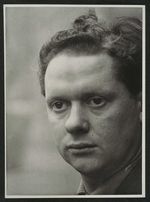
The Welsh poet Dylan Thomas died in New York on Nov. 9, 1953, at age 39. Already a celebrity, Thomas was turned into a legend. Did he die as a result of 18 double whiskies drunk neat in the White Horse Tavern? Or was the cause half a grain of morphine (enough to lay out a horse) administered by an incompetent physician? Did another doctor really say that the poet was dying of “a serious insult to the brain”? Reports conflict, myth balloons. Thomas’ put-upon physique took several days to finally give up its ghost, time enough for hundreds to flock to the doors of his hospital ward, to pay their respects, perhaps, or to glimpse the roaring boy in his ruin, and for his glamorous and equally tempestuous wife, Caitlin ( Uma Thurman and Lindsay Lohan are among the actress who have down the years been slated to play her, in bio-pics that — this being the story of a great love, and Dylan Thomas — always seem to fall apart at the last minute), to fly in from England, freak out and almost get herself committed to Bellevue. Thus was enacted a tragic death, which had been preceded by a life of fame, love, booze, debts.

more from Richard Rayner at the LAT here.

Saturday Poem

The Wall – 122 AD

Hadrian
Where are you?Hadrian's wall
As I walk upon your wall
Of tumbled stone
Across the land
With my gps
And mobile phone

Hadrian
Where are you?
With your bright red plume
Of eagle feather
As I stagger through
Your ruined dream
In nasty English weather

Hadrian
Where are you?
Now that time has done
Its caustic deeds
And left you here
Nothing but crumbled rock
and withered weeds

You thought empire
…..unconquerable
…..You thought wall
…..impenetrable
…..You thought power
…..invincible

But even stone
brick and mortar
even you . . .
Hadrian

By Bill Schneberger, May 2010

Mary Blood Mellen’s ”Field Beach”

Our own Morgan Meis in The Smart Set:

Morgan-Karate-Pose In the 19th century, Americans really turned to the business of thinking about themselves. “What have we got here, anyway?” was the operational question. They came up with two big answers. The first answer was that America is nothing. The second answer was that America is everything. Simple and obscure all at once, just like so many Americans.

The nothing part was about wiping the slate clean. European civilization had come to America to be obliterated, and America happily obliged. The everything part was about what you're left with after the obliteration. For 19th-century America, the everything was in Nature, which you spelled with a capital “N” and then let Ralph Waldo Emerson do the rest. Ralph would write sentences like, “The moral influence of nature upon every individual is that amount of truth which it illustrates to him.” We had lost the culture of Europe, but we had gained a relationship with Nature that gave us direct access to Truth, Beauty, and God.

This exchange of culture for truth did, however, generate a sense of anxiety. There was the feeling that it might not last, that American purity would be lost with the onward march of civilization just as it had all gone wrong in Europe. Paradise, after all, has been known to lead to The Fall.

More here.

BEFORE THEY WERE FAMOUS

From Literary Review:

Wall_05_10 The best biographies, like some of the best novels, are packed with subjunctives. They are alive with a persistent, muted sense of what might have been. The lives of educated, imaginative, middle-class, mid-nineteenth century women were often tragically packed with subjunctives. Excluded from the public sphere, these women were further constrained by a scarcely figurative matrimonial corset, that patriarchal contraption so lovingly tightened of late. Subject to such chronic restriction, a young woman might take refuge in illness and romantic fiction or, more audaciously, adultery and suicide. Emma Bovary, that small-town extremist, exhausts both possibilities. For those more fortunate than her, there might be a carefully chaperoned excursion to somewhere far away – to Egypt, for example.

Anthony Sattin's A Winter on the Nile contains the story of one such exceptional nineteenth-century journey. The book is one part travel writing, one part cultural history, and one part biography. It's a delicious mix, skilfully blended. There are two travellers, an English woman and a French man, both in their late twenties. They are eloquently self-aware and profoundly unhappy. They are hoping to find a new purpose to their lives. They arrive in Egypt in November 1849, within days of each other. They stay in adjacent hotels. They travel along the same river, and they visit the same places at the same season of the year. They confide their secrets to their journals. They write vivid letters home. For two days they are to be found on the upper and the lower decks of the same steamship, plodding along the lower Nile from Alexandria to Cairo.

These two young travellers, so nicely oblivious of each other, are Florence Nightingale and Gustave Flaubert. Within seven years of their journey along the Nile both will be famous, she as the saviour of the wounded soldiers of the Crimean War, he as the author of Madame Bovary. His novel will be the classic description of the subjection of women. Her mission to the Crimea will foreshadow their emancipation. At this point in their lives, though, their primary creative energies are paralysed. Egypt may transform them.

More here.