Why Conservatives Should Read Marx

Jonny Thakkar in The Point:

Thakkar If they want to be consistent, conservatives ought really to be anti-capitalist. This may be a little surprising, but in point of fact conservatism has always been flexible as far as particular policies are concerned. In the U.S. conservatives oppose universal healthcare as an attack on freedom; in the U.K. they defend it as a national tradition. Both positions count as conservative because, as Samuel Huntington argues, conservatism is a “situational” ideology which necessarily varies from place to place and time to time: “The essence of conservatism is the passionate affirmation of the value of existing institutions.” It follows that conservatives can seek to conserve all manner of institutions, including those designed to fight inequality, safeguard the environment, tame market forces, and so on.

But the potential for such reversals is by no means restricted to the Right. When Leftists reflect on their opposition to the free market, they will find that their reasons are–at least in part–conservative. And why not? If conservatism is indeed situational then its rightness or wrongness must depend entirely on the situation, and the value of what is to be conserved. One trope of “utopian” literature from Plato’s Republic to Aldous Huxley’s Island is the fear of adulterating perfect arrangements. Even radicals sometimes have to be conservative.

This is more than mere semantics. Successful political movements successfully incorporate divergent elements; moribund ones don’t. Every so often tensions are simply too great to bear, and something snaps. Political constellations shift. Parties emerge. Coalitions form. Southern Democrats defected to the GOP in 1960s America; Britain has just seen the Liberal Democrats ally with the Tories. These things can happen. Left conservatism can happen.

More here.

Wednesday, August 25, 2010

A debate on Cartesian dualism has led to radically differing approaches to the treatment of depression

Jerome Burne in the Times Literary Supplement:

ScreenHunter_03 Aug. 25 17.47 Sixty years ago, the philosopher Gilbert Ryle published his famous attack on Cartesian dualism, The Concept of Mind, which claimed to find a logical flaw in the popular notion that mental life has a parallel but separate existence from the physical body. Among other effects it provided sophisticated support for the psychological behaviourists, then in the ascendant, who asserted that since we could not objectively observe mental activity it was not really a fit subject for scientific investigation.

Nowhere was the notion of banning mental states taken up more enthusiastically than by the emerging discipline of neuropsychiatry. If consciousness and all its manifestations were “merely” the firing of neurons and the release of chemicals in the brain, what need was there to focus on mental states? Once the physical brain was right, the rest would follow.

It was an approach that has spawned a vast pharmaceutical industry to treat any pathological psychological state – anxiety, shyness, depression, psychosis – with a variety of pills. The underlying promise is that scientifically adjusting the levels of various brain chemicals will bring relief and a return to normality. The biggest-selling class of these drugs are the anti-depressant SSRIs – brands include Prozac, Seroxat and Lustral. A recent report revealed that they were the most widely prescribed drugs in America, with an estimated global market value of over $20 billion.

However, as is set out calmly and clearly in Irving Kirsch’s The Emperor’s New Drugs, it would seem that the whole golden edifice is based on a lie.

More here.

Wednesday Poem

i carry your heart with me

i carry your heart with me (i carry it in
my heart) i am never without it (anywhere
i go you go, my dear; and whatever is done
by only me is your doing, my darling)
………………………………………………………….. i fear
no fate (for you are my fate, my sweet) i want
no world (for beautiful you are my world, my true)
and it's you are whatever a moon has always meant
and whatever a sun will always sing is you

here is the deepest secret nobody knows
(here is the root of the root and the bud of the bud
and the sky of the sky of a tree called life; which grows
higher than soul can hope or mind can hide)
and this is the wonder that's keeping the stars apart
i carry your heart with me (i carry it in my heart)

by e.e. cummings,
from Complete Poems 1904-62.
Liveright Publishing, 1994

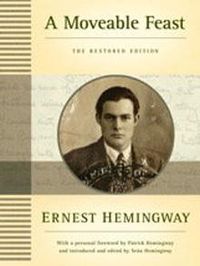
A Moveable Feast: The Revised Edition

From The Telegraph:

Hemingway_main_1695531f Next year marks the 50th anniversary of Ernest Hemingway’s suicide, a ghoulish landmark that may prompt reconsideration of the writer but is unlikely to restore the reputation he once had as America’s greatest novelist. His most famous books, A Farewell to Arms and For Whom the Bell Tolls, today seem mawkish rather than moving. His reputation has been further eroded by the posthumous appearance of writing that doesn’t show him at his best. A Moveable Feast, which first appeared in 1964, three years after Hemingway’s death, is an exception. It is a series of sketches set in Paris in the early Twenties, where Hemingway lived for five years as a struggling writer. He knew most of the luminaries there – Pound, Madox Ford, Joyce, Stein and Scott Fitzgerald are all brought to life.

The Hemingway of Paris days was little more than a teenager, yet already showed a mature talent for disparagement, which receded in later years as his own persona, inflated by fame, pushed other characters off centre stage in his work. His early novel The Sun Also Rises (1926) starts with a subtle character assassination: “Robert Cohn was once middleweight boxing champion of Princeton. Do not think that I am very much impressed by that as a boxing title, but it meant a lot to Cohn.” Three decades later, Hemingway was happy to dispatch most of his famous contemporaries with equal ruthlessness and the portraits in A Moveable Feast are made deadlier by Hemingway’s half-hearted disclaimers. He tells of overhearing Stein addressed (presumably by Alice B Toklas) “as I had never heard one person speak to another; never, anywhere, ever” – the sinister effect magnified by Hemingway’s tantalising refusal to repeat the words he heard. Madox Ford is depicted, unfairly but hilariously, as a preposterous stuffed shirt, while Pound is a gentle, comical figure, rushing round raising funds to free “Mr Eliot” in London from his bank job. Notoriously, Scott Fitzgerald, despite Hemingway's repeated protestations of friendship, is portrayed at length as a whiny, sexually inadequate weakling. Although Hemingway blames Zelda for her husband’s troubles, he did enough damage to change popular perceptions of Fitzgerald for years. A Moveable Feast is a masterpiece of malice.

More here.

Russia in color, a century ago

From the Boston Globe:

With images from southern and central Russia in the news lately due to extensive wildfires, I thought it would be interesting to look back in time with this extraordinary collection of color photographs taken between 1909 and 1912. In those years, photographer Sergei Mikhailovich Prokudin-Gorskii (1863-1944) undertook a photographic survey of the Russian Empire with the support of Tsar Nicholas II. He used a specialized camera to capture three black and white images in fairly quick succession, using red, green and blue filters, allowing them to later be recombined and projected with filtered lanterns to show near true color images. The high quality of the images, combined with the bright colors, make it difficult for viewers to believe that they are looking 100 years back in time – when these photographs were taken, neither the Russian Revolution nor World War I had yet begun. Collected here are a few of the hundreds of color images made available by the Library of Congress, which purchased the original glass plates back in 1948.

P25_00021886

More photos here.

Can Exercise Make You Feel More Full?

From Scientific American:

Exercise-decreases-hunger_1 By a simple food-in/energy-out model, a run on the treadmill or swim in the pool should make you want to eat more. But recent findings have suggested that exercise can actually help to slow overeating. And a new study presents evidence that the body's physiologic response to exercise can help retune the nervous system's cues and make the body feel less hungry, rather than more so. Hunger is a complex sensation, but it is determined in part by neurons located in the hypothalamus, which send signals to the brain telling it that you're either hungry or sated. Those neurons get their message from hormones, including insulin and leptin. When the body develops a resistance to these messengers, people become more prone to overeating and weight gain. And scientists have begun to suspect that cellular inflammation might be at least partly responsible for allowing these signals to get out of whack.

Researchers behind the new work found that “physical activity reorganizes the set point of nutritional balance through anti-inflammatory signaling,”

More here.

cordoba

Alg_cobra_initiative

Two weeks ago, I wrote that the arguments against the construction of the Cordoba Initiative center in lower Manhattan were so stupid and demagogic as to be beneath notice. Things have only gone further south since then, with Newt Gingrich’s comparison to a Nazi sign outside the U.S. Holocaust Memorial Museum or (take your pick from the grab bag of hysteria) a Japanese cultural center at Pearl Harbor. The first of those pseudo-analogies is wrong in every possible way, in that the Holocaust museum already contains one of the most coolly comprehensive guides to the theory and practice of the Nazi regime in existence, including special exhibits on race theory and party ideology and objective studies of the conditions that brought the party to power. As for the second, there has long been a significant Japanese-American population in Hawaii, and I can’t see any reason why it should not place a cultural center anywhere on the islands that it chooses. From the beginning, though, I pointed out that Imam Feisal Abdul Rauf was no great bargain and that his Cordoba Initiative was full of euphemisms about Islamic jihad and Islamic theocracy. I mentioned his sinister belief that the United States was partially responsible for the assault on the World Trade Center and his refusal to take a position on the racist Hamas dictatorship in Gaza.

more from Hitch at Slate here.

a great american pessimist

Hopper100830_370

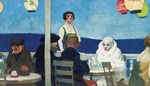
Edward Hopper, viewed a certain way, becomes a dear old chestnut. Rooftops, lonely girls, railroad tracks, gas stations (those queer old pumps), soda fountains, spooky-quaint houses. A melancholy Norman Rockwell. He can be used to conceal a cranky dislike for abstract, modern, and contemporary art—Hopper himself didn’t think much of the Picassos and Pollocks of the world—and he remains, as always, good box office. The Whitney, often rebuked for being trendily obscure, all but owns the Hopper franchise. Shouldn’t the museum enjoy a moment of rest, reputation, and the elderly paying customer? Inevitably “Modern Life: Edward Hopper and His Time,” organized by Barbara Haskell and Sasha Nicholas, will have something of this cozy old-movie feel. Drawn almost entirely from the Whitney’s collection, the show is constructed around Hopper, but includes work from 34 other well-known artists who made their names before World War II and whose imagery is fairly realistic. (They range from John Sloan of the Ashcan School to the Precisionist Charles Sheeler.) The show intends to have a jangly urban emphasis, but the “modern life” invoked in the title obviously refers to a different modern than the one we know today. This is a survey of another, earlier America.

more from Mark Stevens at New York Magazine here.

suffering and frightfulness and ugliness and detestableness

BG-150x150

Thomas Bernhard is certainly one of the major, titanic writers of any era, any country. Enormously influential, unremittingly bleak and pessimistic but never without a sense of humor, his style evolved into single-paragraphed philosophical rants extending hundreds of pages, the best of which are Woodcutters, ‘Walking’ (from Three Novellas), and Gathering Evidence. I have finally accumulated what I believe are all the publications translated into English. His books have been translated and published by a variety of presses from the major (Knopf) to the tiny (Ariadne), across decades, with many of them out of print for long stretches, so I thought it would be helpful to those interested in Bernhard to see everything in one place.

more from Scott Bryan Wilson at The Quarterly Conversation here.

Tuesday, August 24, 2010

The Crisis in a Nutshell: An Islamic Center Downtown?

From The New Yorker:

Islam A digest of last week’s prophetic and interpretive thought

“I was not commenting and I will not comment on the wisdom of making a decision to put a mosque there. I was commenting very specifically on the right that people have that dates back to our founding.” —Barack Obama

“We all know that they have the right to do it, but should they?” —Sarah Palin

“Where the ‘Ground Zero mosque’ is concerned, opposition is roughly proportional to distance, even in New York.” —Hendrik Hertzberg

“I believe that this is an important test of the separation of church and state—as important a test as we may see in our lifetimes—and it is critically important that we get it right.” —Michael Bloomberg

More here.

Lessons from the Weimar Republic

Stephen M. Walt in Foreign Policy:

ScreenHunter_01 Aug. 24 17.31 I decided to become a political scientist in the spring of 1976, while I was attending the Stanford-in-Berlin overseas study program. I had already declared an International Relations major, but was trying to decide between going to law school (the supposedly safe option) or pursuing a Ph.D. in Political Science (looked risky). While in Berlin, I took Professor Gordon Craig's course on German history, and one lecture — on the role of intellectuals in the Weimar Republic — finally tipped the balance for me.

In that particular class, Craig argued that one of the many forces that doomed the Weimar Republic was the irresponsible behavior of both left-wing and right-wing intellectuals. The German left was contemptuous of the liberal aspirations of the Weimar Constitution and other bourgeois features of Weimar society, while right-wing “thinkers” like Ernst Junger glorified violence and disparaged the application of reason to political issues. So-called “liberal” intellectuals saw politics as a grubby business unworthy of their refined sensibilities, and so many just disengaged from politics entirely. This left the field to rabble-rousers and extremists of various sorts and helped prepare the ground for Nazism. (You can read Craig's account of this process in his book Germany 1866-1945, chapter 13, on “Weimar Culture”).

The lesson I took from Craig's lecture was that when intellectuals abandon liberal principles, disengage from politics, and generally abdicate their role as “truth-tellers” for society at large, it is easy for demagogues to play upon human fears and lead a society over the brink to disaster. So I decided to forego a legal career and get a Ph.D. instead, hoping in some way to contribute to more reasonable discourse about issues of war, peace, and politics.

Whether I succeeded in that aspiration I leave for others to decide, but I've been thinking about that episode as I contemplate the current state of American political discourse.

More here.

The ventious crapests pounted raditally

Ben Zimmer in Language Log:

But what about sentences that use pure nonsense in place of “open-class” or “lexical” morphemes, joined together by inflectional morphemes and function words? This characterizes nonsense verse of the “Jabberwocky” variety ('Twas brillig and the slithy toves did gyre and gimble in the wabe). One commenter recalled a classic of the genre, The ventious crapests pounted raditally, which was introduced by the cognitive scientist Colin Cherry in his 1957 book, On Human Communication: A Review, Survey, and a Criticism.

Here's the relevant passage (pieced together from snippet view on Google Books):

It is essentially experience with our own language that ensures this identification of “parts of speech”; familiarity with common types of sentences and with the ways in which different semantic categories are built into them. Indeed, so deeply engrained is our knowledge of such conventional forms and of word affixes that we have no difficulty in analyzing “nonsense” sentences of simple types:

The ventious crapests pounted raditally.
(adjective) (noun) (verb) (adverb)

We can readily translate this into French:

Les crapêts ventieux pontaient raditallement.

but we cannot carry over these parts of speech, or the sentence structure, to more remote languages any more than we can translate each word into a word. Thus, this nonsense sentence could not be put into, say, a Chinese dialect!

More here.

The eyes have it for techno fascists

Our own Kris Kotarski in the Calgary Herald:

Images Every once in a while you come across a story that will make the hair on the back of your neck stand on end as soon as you read the first couple of paragraphs. Sadly, this is one of those stories.

Last week, business and technology journal Fast Company reported that a U.S. company named Global Rainmakers Inc. is embarking on a grand techno-fascist project in Leon, Mexico, where it will roll out iris-scanning technology to create what it calls “the most secure city in the world.”

When the million-plus residents of Leon go to the bank, get on a bus or walk into a medical clinic, their eyes will be scanned by machines that can handle up to 50 people per minute in motion, automatically entering the information into a central database monitored by the police.

Jeff Carter, the CDO of GRI, is enthusiastic.

“In the future, whether it's entering your home, opening your car, entering your workspace, getting a pharmacy prescription refilled, or having your medical records pulled up, everything will come off that unique key that is your iris,” he told Fast Company.

“Every person, place, and thing on this planet will be connected (to the iris system) within the next 10 years,” he added.

More here.

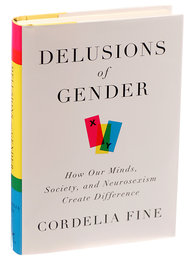
Peeling Away Theories on Gender and the Brain

From The New York Times:

Book These days gender inequality is commonly explained by neurological differences, most popularly the notion that the surge of testosterone that occurs in the eighth week of fetal development affects the relative size of the right and left hemispheres of the brain, and of the corpus callosum, the bundle of neurons that connects the two. In the 1980s Norman Geschwind proposed that the surge results in a smaller left hemisphere for males, leaving them with greater potential for right-hemisphere development, which, as he put it, results in “superior right-hemisphere talents, such as artistic, musical, or mathematical talent.” In female brains the hemispheres are more collaborative, explaining women’s superior verbalizing skills.

There are two problems here, Dr. Fine says. First is that several studies have found no difference in hemispheric size in neonates. The supposedly larger female corpus callosum is also in dispute. But even if size difference does exist (as it does in rats), she says, “getting from brain to behavior has proved a challenge.” Given that there may be sex differences in the brain, “what do they actually mean for differences in the mind?” Dr. Baron-Cohen builds on this theory, suggesting that low levels of testosterone result in a female, “E type” brain (for empathy); medium levels yield a balanced brain; and high levels a male, “S type” brain (for systemizing). Medium levels account for the fact that some girls are systemizers and some boys are empathizers.

More here.

Monday, August 23, 2010

Akeel Bilgrami to Judge 2nd Annual 3QD Philosophy Prize

September 22, 2010, UPDATE: The winners have been announced.

September 10, 2010, UPDATE: See list of nine finalists here.

September 9, 2010, UPDATE: Voting round closed. See list of twenty semifinalists here.

September 3, 2010, UPDATE: Nominations are now closed. Go here to see the list of nominees and vote.

Dear Readers, Writers, Bloggers,
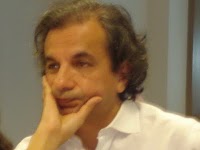
2009_10_AKU-ISMC_Akeel_Bilgrami_&_Ursula_GuntherWe are very honored and pleased to announce that Professor Akeel Bilgrami has agreed to be the final judge for our 2nd annual prize for the best blog writing in philosophy. (Details of last year's inaugural prize, judged by Professor Daniel C. Dennett, can be found here.) Akeel is the Johnsonian Professor of Philosophy at Columbia University as well as the Director of the Heyman Center for the Humanities there. He has two relatively independent sets of intellectual interests–in the Philosophy of Mind and Language, and in issues of Political Philosophy and Moral Psychology especially as they surface in politics, history, and culture. He teaches courses and seminars regularly in the department on Philosophy of Mind and Language and also in the Committee on Global Thought and Political Science on issues in Politics and Rationality as well as Religion and Politics in Global Context. For the last 17 years, I am proud to say, Akeel has also been my teacher and friend.

As usual, this is the way it will work: the nominating period is now open, and will end at 11:59 pm EDT on August 31, 2010. There will then be a round of voting by our readers which will narrow down the entries to the top twenty semi-finalists. After this, we will take these top twenty voted-for nominees, and the four main editors of 3 Quarks Daily (Abbas Raza, Robin Varghese, Morgan Meis, and Azra Raza) will select six finalists from these, plus they may also add up to three wildcard entries of their own choosing. The three winners will be chosen from these by Akeel.

The first place award, called the “Top Quark,” will include a cash prize of one thousand dollars; the second place prize, the “Strange Quark,” will include a cash prize of three hundred dollars; and the third place winner will get the honor of winning the “Charm Quark,” along with a two hundred dollar prize.

(Welcome to those coming here for the first time. Learn more about who we are and what we do here, and do check out the full site here. Bookmark us and come back regularly, or sign up for the RSS feed.)

Details:
PrizePhilosophyAnnounce2The winners of this philosophy prize will be announced on September 22, 2010. Here's the schedule:

August 21, 2010:

  • The nominations are opened. Please nominate your favorite philosophy blog entry by placing the URL for the blog post (the permalink) in the comments section of this post. You may also add a brief comment describing the entry and saying why you think it should win. (Do NOT nominate a whole blog, just one individual blog post.)
  • Blog posts longer than 4,000 words are not eligible.
  • Each person can only nominate one blog post.
  • Entries must be in English.
  • The editors of 3QD reserve the right to reject entries that we feel are not appropriate.
  • The blog entry may not be more than a year old. In other words, it must have been written after August 20, 2009.
  • You may also nominate your own entry from your own or a group blog (and we encourage you to).
  • Guest columnists at 3 Quarks Daily are also eligible to be nominated, and may also nominate themselves if they wish.
  • Nominations are limited to the first 200 entries.
  • Prize money must be claimed within a month of the announcement of winners.

August 31, 2010

  • The nominating process will end at 11:59 PM (NYC time) of this date.
  • The public voting will be opened soon afterwards.

September 8, 2010

  • Public voting ends at 11:59 PM (NYC time).

September 22, 2010

  • The winners are announced.

One Final and Important Request

If you have a blog or website, please help us spread the word about our prizes by linking to this post. Otherwise, post a link on your Facebook profile, Tweet it, or just email your friends and tell them about it! I really look forward to reading some very good material, and think this should be a lot of fun for all of us.

Best of luck and thanks for your attention!

Yours,

Abbas

3 Quarks Daily Ball 2010: Alpine Edition

3QD-Ball-2010

NOTE: Please see updates and more info at the bottom of this post.

Ladies and Gentlemen,

Quite a few people have been writing to ask me why we don't do the annual 3QD Ball anymore. Well, the main reason is that I moved from New York City to a slightly smaller city in the Italian Alps a couple of years ago, so I wasn't around to arrange it. But given the interest, I have decided to revive our annual party right here in Brixen. And this year, it will be part of a grand two-day event, jointly hosted by 3 Quarks Daily and the well-known Südtirolean artist Hartwig Thaler. The detailed plans are yet to be completely finalized, but I am giving early notice here so that people who want to come can book cheap flights soon. The dates are now carved in stone. Here's what's on the program:

  • Hartwig-Opening,-etc-015 Thursday, August 26, Evening: Welcoming drinks in beautiful outdoor cafe. Guests get settled in their hotels.
  • Friday, August 27, Morning: Two hour hike through the mountains, led by my friend Greg Segraves and me. It is not difficult terrain, and can be done in sneakers or other comfortable walking shoes.
  • Friday Afternoon: Time for you to walk around in this 1100 year-old city, look at shops, etc.
  • Friday Evening: Art show/Performance arranged by Hartwig Thaler.
  • Saturday, August 28, Morning: We go to the Aquarena, the most beautiful and amazing complex of swimming pools and saunas in all of Italy.
  • Saturday Evening: 3QD Ball. This means drinks/dancing. There will be a live band and a DJ. Chief event planner for the ball is Margit Oberrauch.

3QD BallWe expect a small but very international crowd. There is a $100 fee (per person) to register for the whole two-day event, and this includes entry to, and free bar at the ball. All other expenses are your own. If you would like to come, and are pretty sure about it, RSVP in the comments section of this post. I particularly urge all our own writers to come!
I myself will be traveling outside of Italy until only just before the event, and am busy immediately afterwards, so will not be available to meet with anyone outside of the times for the event.

I'll be providing more details as they become available. I will also make a list of hotels available soon, ranging from about 30 to 90 Euros per night per person.

In future you can check for updates on this post by clicking the 3QD Ball icon in the right-hand column, just above the “recent comments” section.

Yours,

Abbas

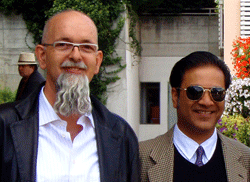
P.S. I took the photo at the top not far from where I live a while ago. It really is quite beautiful around here! And the photo of Hartwig and me is from the opening ceremony of Hartwig's 56 foot X 52 foot sculpture, Flügel der Versöhnung. The 3QD sign for our last ball (3rd photo) was made by Alta Price.

UPDATE, June 21, 2010:

RSVP in the comments area of this post as soon as possible.

Read more »

Sunday, August 22, 2010

After the Postsecular

Picture-7 Scott McLemee in Inside Higher Ed:

Call it a revival, of sorts. In recent years, anyone interested in contemporary European philosophy has noticed a tendency variously called the religious or theological “turn” (adapting a formulation previously used to describe the “linguistic turn” of the 1960s and '70s). Thinkers have revisited scriptural texts, for example, or traced the logic of seemingly secular concepts, such as political sovereignty, back to their moorings in theology. The list of figures involved would include Emmanuel Levinas, Jacques Derrida, Gianni Vattimo, Alain Badiou, Giorgio Agamben, Slavoj Žižek, and Jürgen Habermas — to give a list no longer or more heterogenous than that.

A sampling of recent work done in the wake of this turn can be found in After the Postsecular and the Postmodern: New Essays in Continental Philosophy of Religion, a collection just issued by Cambridge Scholars Publishing. One of the editors, Anthony Paul Smith, is a Ph.D. candidate at the University of Nottingham and also a research fellow at the Institute for Nature and Culture at DePaul University. The other, Daniel Whistler, is a tutor at the University of Oxford, where he just submitted a dissertation on F.W.J. Schelling's theology of language. I interviewed them about their book by e-mail. A transcript of the discussion follows.

Q: Let’s start with one word in your title — “postsecular.” What do you mean by this? People used to spend an awful lot of energy trying to determine just when modernity ended and postmodernity began. Does “postsecularity” imply any periodization?

APS: In the book we talk about the postsecular event, an obvious nod to the philosophy of Alain Badiou. For a long time in Europe and through its colonial activities our frame of discourse, the way we understood the relationship of politics and religion, was determined by the notion that there is a split between public politics and private religion. This frame of reference broke down. We can locate that break, for the sake of simplicity, in the anti-colonial struggles of the latter half of the 20th century. The most famous example is, of course, the initial thrust of the Iranian Revolution.

It took some time before the implications of this were thought through, and it is difficult to pin down when “postsecularity” came to prominence in the academy, but in the 1990s a number of Christian theologians like John Milbank and Stanley Hauerwas, along with non-Christian thinkers like Talal Asad, began to question the typical assumption of philosophy of religion: that religious traditions and religious discourses need to be mediated through a neutral secular discourse in order to make sense. Their critique was simple: the secular is not neutral. Philosophy is intrinsically biased towards the secular. If you follow people like Asad and Tomoko Masuzawa, this means it is biased toward a Christian conception of the secular, and this hinders it from appreciating the thought structures at work in particular religions.