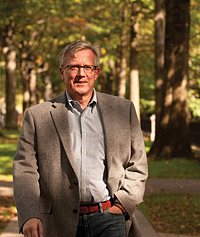
Interview with Gary Gorton

Gorton1 Over at the Minneapolis Fed's The Region (via brainiac):

After listening to Yale finance economist Gary Gorton deliver a talk on “shadow banking” and the recent financial crisis, Randy Wright, a brilliant monetary theorist, was both perplexed and intrigued. Region readers may well have the same reaction after dipping into the following interview with Gorton.

Shadow banking—the intricate web of financial arrangements and techniques that developed symbiotically with the traditional, regulated banking system over the past 30 or so years—is territory Gorton has studied for decades, but it (and he) have been largely on the periphery of mainstream economics and policy.

That all changed in mid-2007, when panic broke out in the subprime mortgage market and financial institutions that support it. Expressions like “collateralized debt obligation” and “repo haircut” escaped the confines of Wall Street and business schools, and began to fill the airwaves. We’re still struggling to come to terms—and few are in a better position to help than Gorton…

Region: Why don’t we begin with some background on so-called shadow banking—the factors behind its enormous growth, and then its collapse during the financial crisis? Do you prefer a different term? You use “securitized banking” in some of your papers.

Gary Gorton: The term shadow banking has acquired a pejorative connotation, and I’m not sure that’s really deserved. So let me provide some context for banking in general.

Banking evolves, and it evolves because the economy changes. There’s innovation and growth, and shadow banking is only the latest natural development of banking. It happened over a 30-year period. It’s part of a number of other changes in the economy. And let me give even a little more context, historical context. I want to convince you that shadow banking is not a new phenomenon, in a sense—that we have had previous “shadow banking” systems in the past—and that there is an important structure to bank debt that makes it vulnerable to panic. So, the crisis is not a special, one-time event, but something that has been repeated throughout U.S. history.

Before the Civil War, banking involved issuing private money—that is, banks issued their own currency or bank notes. And this system worked in the way economists would expect it to work. The private bank money did not trade at par when it circulated any significant distance from the issuing bank. Instead, it was subject to a discount, so that a bank note issued by a New Haven bank as a $10 note might only be worth $9.50 at a store in New York City, for example.

Such discounts from par reflected the risk that the issuing bank might not have the $10—redeemable in gold or silver coins—by the time the holder took the note back to New Haven from New York. The discounts from par were established in local markets. But you can see the problem of trying to buy your lunch when the cook has to figure out the discount. It was simply hard to buy and sell things in such a world.
Why Dire Climate Warnings Boost Scepticism

News701-i1.0 Matt Kaplan in Nature News:

A few psychologists have explored the psychology of climate-change belief, with some work revealing that climate scepticism relates to peoples' tendency to defend the status quo, but little else has been done. “We saw a giant hole in the literature when it came to looking at psychological responses to global-warming messages,” says Feinberg.

So Feinberg and his colleague Robb Willer, also at Berkeley, asked 45 online participants spread across 15 cities in the United States to engage in what was ostensibly a sentence-unscrambling activity.

Half of the volunteers were asked to unscramble sentences such as “Somehow justice will always prevail”, whereas the others were given sentences such as “Often, justice will not prevail”. This activity primed them to have either a strong or weak belief in a just world. The participants then completed a survey that measured their scepticism over climate change, asking questions such as “How solid is the evidence that the earth is warming?” and requiring participants to rate their answers on a six-point scale, in which six was not at all solid and one very solid.

Next, participants watched two short global-warming warning videos created by the Environmental Defense Fund, a charity based in New York that campaigns on green issues. The first showed a train speeding towards a small girl as a metaphor for the impending catastrophe that awaits the world's children (see video). The second showed anxious children verbally simulating a clock ticking while describing the climate devastation that is coming (see video). After watching, participants again had their degree of scepticism over climate change measured. They were also asked to rate how willing they were to take action to reduce their carbon footprints.

Off-target?

Feinberg and Willer found that participants primed to have a stronger belief in a just world reported levels of scepticism that were 29% higher, and a willingness to reduce their carbon footprint that was 21% lower, than those primed to see the world as an unjust place.

For Tolstoy and Russia, Still No Happy Ending

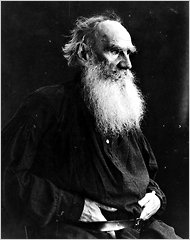
Tolstoy-1-articleInline Ellen Barry and Sophia Kishkovsky in the NYT:

A couple of months ago one of Russia’s elder statesmen set out on a paradoxical mission: to rehabilitate one of the most beloved figures in Russian history, Tolstoy.

This would have seemed unnecessary in 2010, a century after the author’s death. But last year Russians wrestled over Tolstoy much as they did when he was alive. Intellectuals accused the Russian Orthodox Church of blacklisting a national hero. The church accused Tolstoy of helping speed the rise of the Bolsheviks. The melodrama of his last days, when he fled his family estate to take up the life of an ascetic, was revived in all its pulpy detail, like some kind of early-stage reality television.

And in a country that rarely passes up a public celebration, the anniversary of his death, on Nov. 20, 1910, was not commemorated by noisy galas or government-financed cinematic blockbusters. Officially speaking, it was barely noted at all.

With this in mind Sergei V. Stepashin, a former prime minister here, sat down to write to the head of the Russian Orthodox Church, which has become an arbiter of politics and culture. In painstakingly diplomatic language, acknowledging “the particular sensitivity” of “this delicate theme,” Mr. Stepashin asked forgiveness on behalf of Tolstoy, who was excommunicated 110 years ago.

The impulse had swelled up during a lonely visit to an unmarked mound of earth where Tolstoy is buried. Mr. Stepashin described the visit — made while he was director of the Federal Security Service, successor to the K.G.B. — as an emotional experience that he has never been able to shake off.

“You look at the house where he lived and worked, where he created his works, and then you come to a place where there is nothing but this small hill,” said Mr. Stepashin, who has close ties to the church. “It was puzzling, on a human and a moral plane. And then I decided to write this letter.”

Ambivalence toward Tolstoy is new in Russia.

six types of clarity

William-empson1-1

It is an irony of William Empson’s Seven Types of Ambiguity that it finds the definition of ambiguity itself somewhat elusive. That title makes it sound like the author already knows what he’s looking for, but Empson figures out what he means by the term as he goes along. In the revised edition, he starts with this: “any verbal nuance, however slight, which gives room for alternative reactions to the same piece of language.” (The first edition defines ambiguity in the negative, relative to prose.) Already in that phrase “alternative reactions” there is enough room to drive a truck through. Interestingly, though, in laying store by the way real readers respond or could respond, and not by self-contained features of the text, Empson skews toward the empirical, communal, and provisional, and away from the purely analytical. For one of the core books of the New Criticism, this is an out-of-character approach. I wondered briefly why Empson did not do the opposite and identify instances of passages giving no room for alternative reactions, as on the face of it this would seem to allow for more definiteness. When I tried to identify a few such instances, the answer became evident quickly: in order to show the presence of ambiguity under his definition, it is enough to give two or more readings for a passage. In order to show the presence of clarity, you have to supply the reading and show that no other readings exist. Since this task is practically impossible, clarity seems doomed to be a comparatively wishy-washy concept. Literature has played a trick on us: clarity is murky, and ambiguity is clear. But clarity’s virtues are so taken for granted that the question of how those virtues might be demonstrable seems like it ought to be within reach.

more from D. H. Tracy at Poetry here.

cute for the revolution

Article_unferth

In El Salvador there hadn’t been anyone like me and George. We’d been alone, going around on the streets. In Nicaragua there were hundreds of us, thousands, so many we had a special name: we were called Internacionalistas, and we came from all over the world—Europe, Africa, all the Americas. We had professors and scientists among our ranks, and farmers and newspapermen and a brigade of artists, all trooping around. We converged on the capital and trucked out to the towns, to Granada, León, Estelí, carrying every kind of equipment—hoes and seeds and cisterns and books. We were ready to scrape up whatever was there and pat down a nice new revolutionary version instead. Since I was the youngest and spoke Spanish, the Internacionalistas could tell me to do anything and I would. Every day there was something for me and George to do. On Thursdays we went to the U.S. embassy to protest U.S. support of the Contras, the reactionary group trying to take down the Sandinistas. (Their very name annoyed us: Contrarrevolución—who would want to be against the revolution?) A hundred Internacionalistas or more showed up each week at the embassy gates and waved signs and shouted.

more from Deb Olin Unferth at The Believer here.

small bites are good for you

Dukakis

But new research suggests that the specter of the shrinking sound bite is anything but new. In fact, quotations from politicians have been getting shorter for more than a century. According to a new article in the academic journal Journalism Studies by David M. Ryfe and Markus Kemmelmeier, both professors at the University of Nevada, newspaper quotations evolved in much the same way as TV sound bites. By 1916, they found, the average political quotation in a newspaper story had fallen to about half the length of the average quotation in 1892. One way to interpret this, of course, is that we’ve been getting dumber since 1892 instead of since 1968. But Ryfe and Kemmelmeier also suggest that the truth is more complicated. The sound bite, they argue, stems less from a collapse in standards or seriousness than from the rise of a more sophisticated and independent style of journalism — which means the sound bite might not be such a bad thing. Letting politicians ramble doesn’t necessarily produce a better or more informative political discourse. Daniel Hallin, the professor behind the original study on TV sound bites, actually made the same point back in 1992, but Dukakis and his fellow critics passed right by it in their excitement over those ugly statistics. And that’s one of the ironies here: The best research on sound bites was itself turned into a sound bite.

more from Craig Fehrman at the Boston Globe here.

Tuesday Poem

Ledge

Birds that love
high trees
and winds
and riding
flailing branches
hate ledges
as gripless
and narrow,
so that a tail
is not just
no advantage
but ridiculous,
mashed vertical
against the wall.
You will have
seen the way
a bird who falls
on skimpy places
lifts into the air
again in seconds—
a gift denied
the rest of us
when our portion
isn't generous.

by Kay Ryan
from The Best of It
Grove Press, 2010

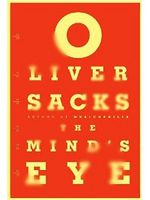
The Mind’s Eye

From The Telegraph:

Mindstory_1793532f Late in 2005, the writer and neurologist Oliver Sacks, then aged 72, began to notice something odd during his habitual daily swim. While he did the backstroke, a pattern of close-set wavy lines and starry coruscations played on the ceiling above him. Sacks dismissed them as artefacts of his visual cortex, lingering symptoms from his frequent migraines. But a week before Christmas, as he entered a cinema, a more pronounced fluttering started up in his right eye.

By the time the film began, a quivering scotoma, or blind spot, had flared up before him “like a white-hot coal, with spectral colours”. Two days later he was diagnosed with a malignant melanoma behind the retina, and he wrote in his journal: “I am in the best possible hands, but I feel a terrified child, a child screaming for help, inside me.” Sacks’s own adventure at the edges of seeing – the cancer itself proved curable, but his vision was permanently impaired – forms the core of The Mind’s Eye. It is a reflection, in seven essays, on the optical effects of certain neurological disasters and on the response of the brain to partial or complete blindness.

More here.

Searching for the Source of a Fountain of Courage

Natalie Angier in The New York Times:

Courage Courage is something that we want for ourselves in gluttonous portions and adore in others without qualification. Yet for all the longstanding centrality of courage to any standard narrative of human greatness, only lately have researchers begun to study it systematically, to try to define what it is and is not, where it comes from, how it manifests itself in the body and brain, who we might share it with among nonhuman animals, and why we love it so much. A new report in the journal Current Biology describes the case of a woman whose rare congenital syndrome has left her completely, outrageously fearless, raising the question of whether it’s better to conquer one’s fears, or to never feel them in the first place. In another recent study, neuroscientists scanned the brains of subjects as they struggled successfully to overcome their terror of snakes, identifying regions of the brain that may be key to our everyday heroics.

Researchers in the Netherlands are exploring courage among children, to see when the urge for courage first arises, and what children mean when they call themselves brave. The theme of courage claims a long and gilded ancestry. Plato included courage among the four cardinal or principal virtues, along with wisdom, justice and moderation. “As a major virtue, courage helps to define the excellent person and is no mere optional trait,” writes George Kateb, a political theorist and emeritus professor at Princeton University. “One of the worst reproaches in the world is to be called a coward.”

More here.

Monday, January 3, 2011

Motorcycle Meditations / Bali

By Aditya Dev Sood with photographs by Nita Soans Sood

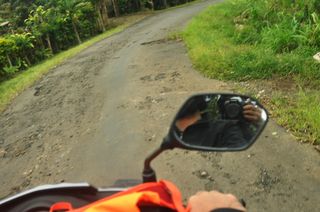
Orange bag on road copy My knees are spread wide, my arms loose and ready, back supple and straight. Walls of green moss on black stone, flurries of fern and plant, the waving arms of trees fly by on the right. Sheets of terraced paddy step carefully down and into the ravine on the left, giving way to distant valleys, lake, and mountain. My mind is alert but high, this is not a normal kind of wakefulness, not a dream, and not slumber. It is a different, fourth kind of consciousness, a flow state, a murmuring of interior thoughts that I seem to be pulling in and out of, pitched to the drone of the bike, the winding of the road.

Nita and I had imagined this road trip through Bali a couple of years ago, the last time we were here. Then we were weighed down with luggage and hotel bookings and yearned to be able to be able to just ride out and find ourselves in a new part of the island whenever we wanted. This time, we’ve got one rucksack, now between my knees, and a smaller backpack, slung from the handlebars, and Nita has her camera bag under one arm, and we’re off and about, on the road in Bali.

Stepped terraces copy

Read more »

Sunday, January 2, 2010

Why Criticism Matters: Translating the Code Into Everyday Language

02anderson-articleInline Sam Anderson on the issue, in the NYT:

I tend to shy away from big, sweeping, era-defining statements. It’s the fastest possible way to be wrong about the world, and usually just an excuse for various forms of sloppy thinking: cherry-picking, scapegoating, doomsaying, fear-mongering, sandbagging, arm-twisting, wool-gathering, leg-pulling. And yet it would be hard to dispute that over the last 5 or 10 years, the culture’s relationship to time has changed pretty drastically. The shift is so obvious that it’s boring, by now, even to name the culprits: Google, blogs, texting, tweets, iPhones, Facebook — a little army of tools that have given rise to (and grown out of) radically new habits of attention. Many of us are now addicted, on the dopamine-receptor level, to a moment-by-moment experience of life that’s defined by a behavior sometimes referred to as “time slicing”: jumping every few seconds between devices or windows or tabs, constantly swiveling the periscope of our attention around and around the horizon to see where the latest relevant data-burst might come from.

Whether this shift is good or bad or neutral is a cripplingly complex question, and very hard to discuss without falling into clichés about the Death of Literature and the Extinction of Humanity and How Google Is Stealing Everybody’s Grandmother’s Favorite Jewelry. (It helps to remember, when you start having these thoughts, that every era in the history of humanity has lamented the rise of whatever technology it happened to see the rise of.)

What we can say, for sure, is that sustained exposure to the Internet is changing the way many readers process the written word. Texts are shorter and more flagrantly interconnected, with all kinds of secret passageways running into and out of one another. This has already changed the way we produce, read, share and digest our writing. Inevitably, it will also redefine what it means to practice book criticism, at least for those of us who aspire to write for something like a general audience.

Mr. Borges’s Garden

Windowsimg-custom1 MÁRIA KODAMA and MATTEO PERICOLI in The New York Times:

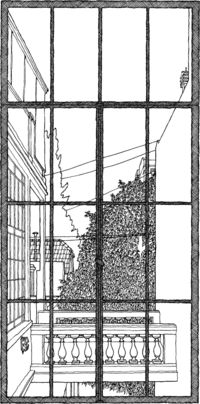
A certain house in the Buenos Aires neighborhood of Recoleta has a window that is doubly privileged. It overlooks a courtyard garden of the kind known here as a pulmón de manzana — literally, the lung of a block — which affords it a view of the sky and an expanse of plants, trees and vines that meander along the walls of neighboring houses, marking the passage of the seasons with their colors. In addition, the window shelters the library of my late husband, Jorge Luis Borges. It is a real Library of Babel, full of old books, their endpapers scribbled with notes in his tiny hand. The window has one more surprise. From it, I can see the garden of the house where Borges once lived, and where he wrote one of his best-known short stories, “The Circular Ruins.’’

As afternoon progresses and I look up from my work to gaze out this window, I may be invaded by springtime, or if it’s summer, by the perfume of jasmine or the scent of orange blossom, mingled with the aroma of leather and book paper, which brought Borges such pleasure.

More here.