Open Books: The E-Reader Reads You

Tumblr_legmc4iQR21qzll1y Rob Horning in The New Inquiry:

It’s fitting that at the end of this essay about the proliferation of e-readers, Scott McLemee invokes critic Franco Moretti, who has devoted the past decade to deromanticizing literary criticism and reconfiguring serious study of the novel as a bloodless, quasi-objective matter of empirical data analysis. In this New Left Review essay, which touches on his idea of “distant reading” — the opposite of close reading, the careful scrutiny of particular works— Moretti declares, “We know how to read texts, now let’s learn how not to read them.” If e-readers live up to their potential, he just may get his wish.

McLemee rightly cautions against making e-books vs. their printed and bound counterparts an either-or proposition: “I am biased in favor of reading itself, rather than towards one format,” he explains. In the aggregate, more reading will likely happen thanks to e-readers. As they become more prevalent, they will make more books accessible to more readers. Books will become cheaper, and as standardized digitization will make them easy to copy and circulate, most will be available free to those willing to test the piracy waters. And just as the advent of the mp3 led to heretofore impossible-to-hear music becoming available to anybody willing to search for it, long out-of-print books will probably end up being shared on niche blogs and torrent sites. No book need ever become lost. It will be like a library fire in reverse.

That said, the nature of the format nevertheless certainly affects the reading experience and the specific qualities of works that end up being tailored to it. The iPod, which helped establish the feasibility of similar gadgets for books, has certainly changed the production of pop music, which is now mastered with earbuds in mind. Singles once again dominate the market; compiling songs into albums has become more nostalgic than necessary or economically warranted. And I still vividly remember throwing out my entire CD collection — for me, a drastic, dramatic act of severance with material things that seemed unthinkable right up to the moment I was doing it. I can’t yet imagine doing such a thing with my books, glossed as they are with my precious marginalia, but objects can be swiftly desacralized. Changes are sure to come to how we buy and keep books, and because of the nature of e-readers and our established ideas about the sanctity of reading, those changes may be more profound than anything that has happened to music.

Ten Years After Bush v. Gore

Pamela S. Karlan in Boston Review:

Ten years ago the Supreme Court stepped in to decide the presidential election. The Court halted Florida’s recount and announced that the state’s method of reviewing ballots violated the equal protection clause of the Fourteenth Amendment. Although the Justices had found a constitutional violation, they weren’t interested—as the Court’s unsigned 2000 opinion in Bush v. Gore made clear—in vindicating equality more broadly. Their decision, they wrote, “is limited to the present circumstances, for the problem of equal protection in election processes generally presents many complexities.”

The Court’s interest in leveling the political playing field waned as quickly as it waxed. Since Bush v. Gore, the Court has consistently refused opportunities to make the electoral process fairer. Consider gerrymandering: nothing makes ballots more worthless than having the election results foreordained by sitting politicians’ artful jiggering of the district lines. Yet the Supreme Court has refused to do anything about the increasingly aggressive and sophisticated means by which officeholders pick their constituents rather than the other way around. Moreover, the Court has turned a purported concern with voter chicanery into a green light for draconian voter-identification laws, despite virtually no evidence of voting fraud perpetrated through impersonation of registered voters at the polls. The Court also has responded to the Voting Rights Act—Congress’s most notable and successful attempt to promote equality within the political process—by adopting the narrowest possible construction of the Act and expressing skepticism about its constitutionality. Most notoriously, the Court has dismissed the very idea that equalizing chances for political influence is a legitimate value when it comes to campaign-finance regulation.

But Bush v. Gore casts a shadow far beyond the Court’s election-law docket. At the time of the decision, many observers—including Justices John Paul Stevens, Ruth Bader Ginsburg, and Stephen Breyer in dissent—warned that the Court might lose the nation’s confidence in its role as an impartial guardian of the law. That didn’t happen, but the Court apparently did gain a disturbing degree of confidence in itself. Having decided in 2000 that Congress could not be trusted to have the final word in the presidential election—even though the Twelfth Amendment establishes Congress, not the Supreme Court, as the ultimate arbiter—a number of justices have been making a habit of expressing distrust for Congress in other areas.

The War and Peace of Hindi Literature

Yashpal_24540Daisy Rockwell in Bookslut:

I read War and Peace a number of years ago in Allahabad, India, in March or April, when the temperatures begin to soar. Our roof-top apartment, so delightfully airy during other months, slowly transformed into an oven. This was how we learned why no landlord in India lives in the top floor of their house if they can avoid it. Frequent power outages exacerbate the situation, and by mid-day each day, the best course of action was to lie in the dark as immobile as possible and read. Napoleon's ill-advised campaign into Russia, the arrival of winter and the freeze-out of the French army provided a cooling balm to my imagination, if not my body.

I was reading War and Peace so that I might be able to continue to say, with confidence, that the Hindi novel Jhootha Sach, which means “False truth,” was “the War and Peace of Hindi literature.” It was a claim that was often thrown around, and one that I had carelessly made myself. Reading one book to find out if it can be used as an exemplar of another one has already read is ostensibly going about things backwards. But I had a particular motivation: Jhootha Sach was untranslated and I wanted to make the case that this fact was a tragedy for literature lovers around the world. Just imagine if War and Peace was sitting around in Russia, untranslated, and no non-Russian readers were able to access it? How culturally impoverished we would be if that were the case, even those of us who had never bothered to read it because of its notorious heft?

To the naked eye, it is this heft that is the most obvious shared characteristic between Jhootha Sach and War and Peace. The new English translation of Jhootha Sach (titled This is not that Dawn) is 1119 pages. Translations of War and Peace generally weigh in at around 1400+ pages. After size, there is their common theme: both novels are set during an Important Historical Event. Jhootha Sach is set during the 1947 Partition of India and Pakistan; War and Peace is set during the Napoleonic wars. But how does this make them different from, say, Cold Mountain? To answer that, I would have to read Cold Mountain, and, following William Shatner, I wonder if that’s just too long. Instead I will speculate: along with its zippy plot, several romances, sex, violence and a beautiful heroine, Jhootha Sach is a very serious novel. To paraphrase Virginia Woolf’s assessment of Middlemarch, it is a magnificent book that, with all its imperfections, is one of the few novels in the world written for grown-up people.

But after this, the comparison begins to break down.

Cheer the assassin!

Khurram Husain in The Express Tribune:

ScreenHunter_03 Jan. 06 13.49 Cheer on my friends! Cheer on the assassin! Smile and clap your hands, chant odes to the ghazi’s bravery! Go ahead, applaud the darkness that is coming your way, because once it has taken you into its embrace, there’ll be no cheer left in your life.

Hail the assassin as your hero! Lift him up on your shoulders and show his brave deed to your children! Tell them to emulate his example and follow his footsteps! Kiss the ground he walked on! Congregate outside the prison that holds him and shout slogans so he hears your support through the walls. Because soon, the only heroes left in your life will be those with blood on their hands and death in their hearts.

Denounce the fallen governor! Denounce his licentious ways! Mock his speeches and drag his grieving wife and children through the dirt that is in your mind, your eyes! Question his faith: Was he a secret atheist? Fling all manner of filth and dirt on his name and his ways, for soon there’ll be nothing left in your minds, other than the filth of a faithless piety and the dirt of prejudice.

Sanctify the assassin’s bullet! Distill all your hatreds and frustrations into it! Place it on a pedestal and recite psalms of solemn servitude to it! Let it be the one fixed point in your life, your north star by which you navigate yourself towards your destiny! Let its line of travel, from muzzle to victim, be the straight and narrow path you seek to your salvation.

More here. [Thanks to Batool Raza.]

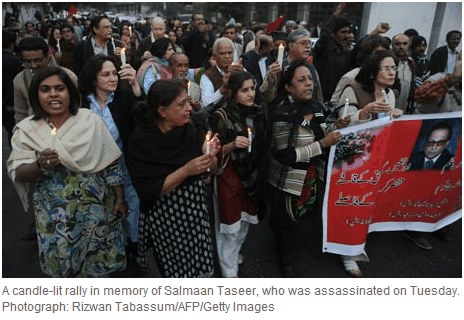
How Pakistan responded to Salmaan Taseer’s assassination

Many in Pakistan felt that the governor's critique of blasphemy laws made his death, if not justifiable, understandable – and others went even further.

Mohammed Hanif in The Guardian:

ScreenHunter_02 Jan. 06 13.37
Minutes after the murder of the governor of Pakistan's Punjab province Salmaan Taseer I saw a veteran Urdu columnist on a news channel. He was being what, in breaking news jargon, is called a “presenter's friend”. “It is sad of course that this has happened but . . .”

I watched in the desperate hope that he wouldn't go into the ifs and buts of a brutal murder in the middle of Pakistan's capital. By this time we knew that Governor Taseer had been shot dead by a man in police uniform, probably one of his own police guards. The news ticker on screen informed us that the postmortem was under way. Later we would find out that he took 27 bullets. Not a single shot was fired by his security detail. It seemed too early for analysis, but the presenter's friend looked mildly smug, as if he had been mulling over arguments in his head long before the governor was shot. Although it wasn't required, the presenter egged him on. “But you see these are sensitive matters. He should have watched his words. He shouldn't have spoken so carelessly.”

What were the late governor's words? I knew about his outspoken stance on the case of Asia Bibi, a Christian woman sentenced to death in a blasphemy case. In a village near Lahore, she served water to some Muslim women who refused to drink it from her glass. (This is quite a common expression of prejudice against lower-caste Christians in Pakistan.) They argued. A couple of days later, the village mullah filed a case saying she had insulted our Prophet.

I knew about his habit of making fun of his political foes, mostly through Twitter. But I still wanted to find out what his exact words were. If a billionaire who is also a governor and enjoys the highest level of security imaginable in Pakistan, can be shot for saying something, it's in everyone's interest to find out what those words were. I mean what if you were to utter those words by mistake?

The presenter chipped in helpfully. “Yes, he did call our blasphemy law a black law.” Thoughtfully, the presenter's friend nodded his head in agreement.

Murder solved.

More here.

This Man Will Pay You $6,000 To Commit Murder

To understand the atmosphere of criminal incitement which has led to the assassination of the progresive governor of the Punjab in Pakistan, this is worth looking at.

Adil Najam in All Things Pakistan:

ScreenHunter_01 Jan. 06 13.24 This man is Yousaf Qureshi of Peshawar and he has publicly offered a reward of Rs. 500,000 (Rs. 5 Lacs; US$5880) to anyone who murders Aasiya Bibi of Nankana.

Yousuf Qureshi has never met or seen Aasiya. Yet, his heart is so full of hatred that he is willing to give anyone, even you, Rs. 500,000 to kill her. By the way, he does not seem to hold you in very high esteem either; he believes that you will be willing to commit murder for him for less than US$6,000. And if you will not, he calls upon the Tehrik-i-Taliban (TTP) to do the killing for him. For around the price of a new Suzuki Mehran VX he wants you to commit murder, make three children orphans, and take a human life. All reports suggest that he is mighty proud of what he is trying to do!

It is incidental to the story that the man who is providing this incitement to murder happens to be a so-called “Maulana” and the khateeb of the historic Masjid Mahabat Khan in Peshawar. It is incidental because at the end of the day neither of those facts are ‘material’ (in a legal sense). What is material is that this man, Yousaf Qureshi, is a criminal (incitement to murder is a crime) and he is providing material incentive to turn others into criminals (killing others is murder, a crime).

It should not matter what you think of Asiya Bibi, or about what should happen to her, or of the Blasphemy law, or indeed of Masjid Mahabat Khan. What matters is that murder is a crime. Inciting others to commit this crime is a crime. Paying or promising to pay others to commit this crime is a crime.

This here is not a matter of theology, it is a matter of the law. And not a matter of constitutional law, but of criminal law. This is a test of our society’s appetite for tolerating criminality in the name of morality.

More here.

Thursday Poem

How The Other Half Files Its Teeth

Turns out the whole time I was on the wrong veranda,
the wrong island, with the wrong crew,
swamped by low grade talk about high grade bonds.
The porch steps swarmed with Italian leather.
A band of natives navigated the lawn in bare feet
so as not to disturb the plantings.

A splinter had announced itself to my palm
and I worked with nearly biblical stoicism
to dislodge it. An overweight mime appeared
and, without glancing up or speaking a word,
ate a heaping plate of tangible pasta, then left.
A congressman juggled chainsaws until the burnt
gasoline became an irritant and he was bullied back
to his yacht. A set of unicyclists in leathers
rode past, making infantile frowns.

Meanwhile, the splinter. I went indoors
seeking implements, iodine, a liquor chest,
& found myself before a phalanx of photoed
and portraitured family that to me meant squat.
Fireworks came to fruition at the window,
on a nearby island, and it occurred to me—
my island, my pyrotechnics lay elsewhere.

This has happened before, when I, carting
letters from the mailroom, am stopped
by a pinstriped suit with a topknot of grayish hair.
The suit smells of currency and wears on its wrist
a timepiece that mocks me with its accents.
I am asked to golf or to a cigar-smoking fete.
I stand there producing the face of a spearfish
lying dockside, an expression mainly
taken for yes. Then the inevitable clap on the back,
the click of the roulette trigger.

by Dan Pinkerton
from The Boston Review
November/December 2010

To see Muslim discourse in politics as a vicious anachronism is to see very little

Pankhaj Mishra in The Guardian:

Nurul-izzah-2 Last month in Kuala Lumpur I met the Malaysian politician Nurul Izzah Anwar. Just 30 years old, and formidably well-educated, Nurul Izzah is an MP as well as the mother of two children. Thrown into the political fray by the persecution of her father – Anwar Ibrahim, Malaysia's former deputy prime minister – Nurul Izzah has risen rapidly within the opposition People's Justice party. Admiring glances and whispers from other diners bounced off our table at a fusion restaurant in the smart suburb of Damansara Heights as she spoke frankly and persuasively about Malaysia's frustratingly racial politics, its restless youth population, the changing role of Islam, and the country's foreign relations.

Towards the end of our conversation, she said: “You haven't asked me the big question.” Puzzled, I asked: “About what?” Laughing, she replied: “Many western journalists only want to know why I wear a headscarf.”

More here.

More Than Meets the Mirror

From Scientific American:

Heartbeat-body-image_1 With all of the New Year's diet ads claiming you can lose dozens of pounds in seemingly as many days, you probably are not alone if you looked in the mirror this morning and saw a less than ideal body. Or maybe you just picked up a new magazine in which already thin models have their remaining flesh scavenged by Photoshop to make them appear even slimmer. With all of these unrealistic promises and images, it can be hard to gain an accurate sense of one's own body. But the disjunction for some people might go deeper than manipulated photos.

A new study shows that the way people perceive their external appearance is likely linked to how they experience their bodies internally. Researchers found that people who had greater difficulties sensing their own internal bodily states were also more likely to be fooled into believing a rubber hand was part of their own bodies. These results, published online in the January 5 issue of Proceedings of the Royal Society B: Biological Sciences, may one day help scientists understand how body image can become so distorted in disorders like body dysmorphia and anorexia nervosa, says lead author Manos Tsakiris of Royal Holloway, University of London.

More here.

Wednesday, January 5, 2011

On the State of Criticism in 2011

ID_IC_MEIS_NYTIM_AP_001 Morgan Meis in The Smart Set:

Never before has the general public had access to such an array of tools by which they can pre-sort the entirety of the world's cultural production along the lines of what they already like and dislike. Let us put aside whether this is a good thing or a bad thing. It has elements both of goodness and badness, as do all such sweeping changes. What it surely does, however, is to further isolate the poor critic. The authority of the critic is diminished to near zero when, with the touch of a button, anyone can find out what millions of people with tastes just like them already feel about artist X. For what purpose is the lonely judgment of our critic, our petulant voice from a lost time? She is, increasingly, a voice shouting in the wilderness, except that the wilderness is fully peopled, the wilderness is cacophonous with voices that utterly drown her out, our little critic from another age.

Some lament this situation; they rail against the coming darkness. That is a legitimate option. Others, though, take a different approach. They face the oblivion with joy, knowing that with death comes freedom. Some critics seem to know instinctively, to feel it in their very critical bones, that the death of the critic-as-authority is the birth of another kind of criticism.

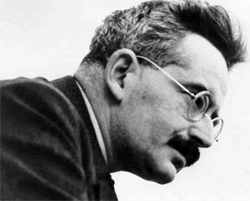
I call that other kind of criticism, the kind that doesn't rely on authority and judgment, Romantic criticism. I call it that because of what I learned, long ago, from that melancholic and suicidal German, Walter Benjamin. Early in his career, Benjamin wrote a typically esoteric and maddeningly impenetrable essay called “The Concept of Criticism in German Romanticism.” There is much in that essay that I take to be wrong. There is something in it that I suspect to be crazy. But there is an important idea in it, too, an idea that took its first form in the ramblings of men like Friedrich Schlegel and the poet Novalis. The idea is that criticism does not stand outside the work of art, but stands alongside, maybe even inside, the work of art, participating in the work in order to further express and tease out what the artist already put there. In this theory of criticism, we don't need the critic to tell us what is good or bad, to tell us what to like and dislike. We need the critic, instead, to help us experience. We need the critic in the way that we need a friend or a lover. We need the critic as a companion on a journey that is a love affair with the things of the world. Benjamin once referred to this form of criticism as “the first form of criticism that refuses to judge.” The primary virtue of this kind of criticism is its inherent generosity. It wants to make experience bigger, it wants to make each work of art as rich as it can possibly be. Its sole medium, as Benjamin put it, is “the life, the ongoing life, of the works themselves.”

Just this Sunday past, the New York Times—that venerable institution of public record — put out an edition of its Sunday books section with the stated purpose of figuring out the current state of criticism. They asked six critics (Stephen Burn, Katie Roiphe, Pankaj Mishra, Adam Kirsch, Sam Anderson, and Elif Batuman) to weigh in on the matter. I found it particularly pleasing, moving even, to note that a Benjaminian attitude, consciously or less so, is alive and well in most of the responses (even if such an attitude is rarely to be found at a books section in which the “thumbs up, thumbs down” school of criticism is by far the majority voice).

Why Are Thousands of Dead Birds Suddenly Falling from the Sky?

500x_deadbirdslouisiana Alasdair Wilkins in io9:

We're still waiting on analyses of the dead birds that will solve the mystery, but there are already several theories to account for the deaths. So far all we know for sure is that the Arkansas birds showed signs of blunt-force trauma, although it's possible that was just caused by slamming into the ground.

Weather could be the culprit. High-altitude hail or lightning might have hit the birds, which caused them to fall from the sky. Arkansas Game and Fish Commission ornithologist Karen Rowe says a severe weather system did move through Arkansas on New Year's Eve, so it's not impossible. The only problem is the birds don't seem to have any of the telltale bruises or injuries that a weather-related explanation would cause.

Thankfully, we can probably rule out disease and toxins. Arkansas experts say a disease would take down a lot more than just one isolated flock – and no, the second group of dead birds in Louisiana isn't enough to make disease seem like a viable possibility. The same thinking goes for poisoning – if that were the case, birds would be falling all over Arkansas, and that just isn't the case. The Arkansas Department of Environmental Quality tested the area for any air toxins, but the skies are officially clean.

One thing to remember is what day and time the incident occurred: near midnight on New Year's Eve.

Magnum Opus

Cezanne Card Players Jed Perl in TNR:

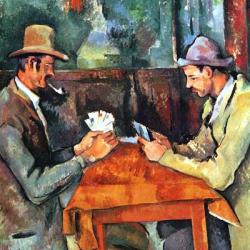
I am besotted with a new book that is also an old book. This is The H.D. Book, by Robert Duncan, a wild, dazzling, idiosyncratic magnum opus that the poet composed between 1959 and 1964 and that is only now being published in its complete form, by the University of California Press. What began with a request for a brief birthday homage to the American poet known as H.D.—she had been born Hilda Doolittle—morphed into one of the greatest of all meditations on the nature not only of modern poetry but of the modern artistic imagination in its bewitching complexity. Art, Duncan exclaims, makes “what is not actual real.” I am glad to be reading Duncan’s text as we head into 2011—the second decade of the century after the modern century. There is no nostalgia in The H.D. Book. Duncan’s modernism is at once lofty, optimistic, activist, and open-minded. Published a half-century after it was written, The H.D. Book reads like a clarion call. At a time such as ours, when artists are either embattled or co-opted, either locked away in some ivory tower of their own invention or overtaken by market forces and political forces, Duncan argues for the most strenuous artistic ambitions as a dynamic democratic possibility.

In The H.D. Book the great enemy is T.S. Eliot. Although Duncan cannot but admire The Waste Land, he will never forgive Eliot for being so quick to isolate tradition from the present, for giving art, as Duncan puts it, “a histrionic remove.” While Duncan welcomes all the difficulties and obscurities of modern art, he sees them as inextricably related to the pluralism of modern experience. This, I believe, could be Duncan’s great contribution to the arguments that are going on in the art world and the literary world right now.

A rare breed of politician who fought for tolerance

Omar Waraich in The Independent:

Salmaan-Taseer-EPA-640x480 “Who the hell are these illiterate maulvis to decide whether I'm a Muslim or not?” Salmaan Taseer asked me, a month before he was brutally assassinated outside his Islamabad home by his own bodyguard. Taseer, the governor of Punjab, never shrank from speaking out.

When Asia Bibi, the Christian woman accused of blasphemy, was sentenced to death, he was the first to visit her in prison and call for her release, earning fatwas against his life.He was also an usual politician. The son of a poet, Taseer was a rare example of a self-made man who first succeeded in becoming one of the country's wealthiest businessmen and, later, one of its most high-profile politicians.Having endured torture and solitary confinement under the military dictatorship of Gen Zia-ul-Haq in the grim 1980s for supporting Benazir Bhutto, he said he had decided that Pakistan could not afford to suffer under religious hardliners.”You have to have zero tolerance when it comes to militancy,” I recall him insisting time and again. He was constantly frustrated by the state's failure to prosecute those responsible. “When they went after the mafia in Italy,” he said, “the prosecutor, the judge, and witnesses all wore a mask. You can't just wish them away.”It was hardly a popular position to uphold. When two Ahmadi mosques were attacked by terrorists last May, killing over 100 worshippers, he was savaged by the religious right and its supporters in the local media for expressing solidarity.

More here.

huck finn and the ‘n’ word

MarkTwainsSawyerHuck

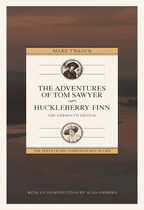
Yesterday, I wrote about the latest flap over Mark Twain’s use of the n-word in Huckleberry Finn. NYC Councilman Charles Barron apparently thinks the book should be banned: “I find it interesting that Huckleberry Finn is a classic when it says [the n-word] 200 times,” he said. Barron is not alone in his reservations. Poet and professor Sam Gwynn made this comment on yesterday’s post: “Frankly, I just can’t teach it any longer. I know it’s great, and I can lecture for a day or so about how Twain is being faithful to the dialects and to the way that people spoke back then. But trying to lecture about its literary merits takes a back seat when I see how African American students (I’m talking about teenage sophomores, taking the class for core credit) are reacting to the iterations of THAT WORD. The problem is that Twain doesn’t distinguish between those who are using the word in a “kindly” manner (we could probably assume that this is the only word for black people that Huck has ever heard) and those who are using it an an epithet. Used indiscriminately in these ways, it just makes everyone in a classroom uncomfortable. Maybe if I were a better (or younger) teacher I could use this book to challenge all kinds of assumptions about language and art. I just don’t find myself up to the fight anymore, at least at the sophomore level. I think this is a pretty good 2/3 of a novel, but I really wonder why it has become canonized as the GAN.” [That’s the Great American Novel for the uninitiated.]

more from Cynthia Haven at Book Haven here.

Now one ruin envelops everything

Article00

Giacomo Leopardi may be the most erudite, philosophically astute, and linguistically refined poet you’ve never heard of. Part of the blame lies in Leopardi’s historically inclined vocabulary and style, which draw heavily on Greco-Roman authors ranging from Theocritus to Virgil as well as early Italian masters, especially the fourteenth-century Tuscan poet who was the preeminent model for Renaissance lyric, Francis Petrarch. But Leopardi was no antiquarian: His synthesis of past literary forms and experimental poetics makes his work a daunting mix of erudition and inventiveness. It would be an oversimplification to call Leopardi’s language Italian, because, like Italy itself, such a thing did not yet exist in his brief lifetime (1798–1837). Italian unification, and with it the standardization of the national tongue, didn’t occur until the 1860s. He would never see the official Italy whose cause absorbed a great deal of his career. Leopardi’s nearly “inexhaustible energies,” as Jonathan Galassi describes them in the introduction to his new translation of the Canti, fueled such projects as a massive philosophical notebook called the Zibaldone, a series of operette morali (moral tales) on issues ranging from the necessity of illusion to the nature of literary fame, and seminal essays on Italian Romanticism and the character and customs of the Italians. But it was his poetry that earned Leopardi immortality in Italy—a Janus-faced poetry that presents the translator a grim set of challenges.

more from Joseph Luzzi at Bookforum here.

the lost canadians

Lostcanadians

One of the most striking things separating the United States and Canada is the line that divides the United States from Canada. While oceans, lakes, rivers, drainage basins, deserts, mountain ranges, and valleys dictate the size and shape of many nations, the pin-straight border running from Lake of the Woods to the Pacific Ocean is nothing if not completely and utterly arbitrary. The western half of the world’s longest land border was laid down in three stages: In 1783, an understandably cocksure Benjamin Franklin won British acceptance of a border extending from the “northwesternmost point” of Lake of the Woods to the Boundary Waters laid out in the Treaty of Paris, the denouement of the United States’ fight for independence. This border would have made much more sense if the source of the Mississippi River had been where both parties suspected, but then it was a botanist, not a professional cartographer, who had created the map negotiators were working from. In the aftermath of the second, wholly less conclusive war with Britain (the War of 1812), the forty-ninth parallel was established in the Anglo-American Convention of 1818 as the border between Lake of the Woods and the Stony [Rocky] Mountains. In this agreement, the point identified by Franklin was linked to the slightly more southerly forty-ninth parallel by a north-south line that would later form the boundary between present-day Manitoba and Ontario.

more from Grant Stoddard at The Walrus here.

The Greatest Japanese Writer You’ve Never Heard of

S

The luminous, gentle tone of these passages is central to Inoue’s art. Leon Picon, in his 1965 introduction to The Counter­feiter and Other Stories, says that “human pathos and suffering, loneliness and isolation, oriental fatalism and Buddhistic concepts of predestination form dominant strands in the fabric of virtually all of the writing of Yasushi Inoue,” and while I can’t exactly disagree, I am certainly dissatisfied with the dated cliches, and suspicious of the capitalized Orientalisms on display here. The note in The Sh̄wa Anthology is surely closer to the center of the truth, characterizing Inoue’s work as “the examination of the faintest ripples of cultural interchange between Japan and the outside world, ripples often created by lonely individuals who remain essentially nameless and faceless in the annals of official history.” I would say—aware that my own reflections will no doubt seem time bound and off-key in a few decades, not to mention the centuries that are Inoue’s usual time scale—that Inoue’s great theme, spanning his historical, contemporary, and autobiographical works, is how the life you lead is not your real life. What we think of as our personal struggles—our decisions, desires, deliberations, the choices we make and the things we do—are less real, less to be trusted, and perhaps ultimately less important than the wider forces of historical destiny or the cultural past or the way we started to feel as a child, or simply the fact that other people are not who we think they are, and nor are we.

more from Damion Searls at The Quarterly Conversation here.

Why do they pick on us Pakistanis?

Pervez Hoodbhoy in The Express Tribune:

ScreenHunter_01 Jan. 05 15.00 My green passport requires standing in a separate immigration line once my plane lands at Boston’s Logan airport. The ‘special attention’ from Homeland Security, although polite, adds an extra two to three hours. I belong to the fortunate few who can get a visa, but I am still annoyed. Having travelled to the US frequently for forty years, I now find a country that once warmly welcomed Pakistanis to be strangely cold. The reason is clear.

Foreigners carrying strong negative feelings — or perhaps harmful intentions — are unlikely to find enthusiastic hosts. I know that the man who tried to bomb Times Square, Faisal Shahzad, a graduate of the University of Bridgeport, is my compatriot. So is Aafia Siddiqui, our new-found dukhtur-e-millat (daughter of the nation). Another Pakistani, Farooque Ahmed, with a degree from the College of Staten Island, made headline news in November 2010 after his abortive attempt to blow up DC Metro trains.

If such violent individuals were rarities, their nationality would matter little. But their actions receive little or no criticism in a country consumed by bitter anti-Americanism, which now exceeds its anti-Indianism.

Example: after the Faisal Shahzad news broke in early May 2010, TV channels in Pakistan switched to denial mode. Popular anchors freely alleged conspiracies against Islam and Pakistan. None revisited their claims after Shahzad proudly pleaded guilty in June. Calling himself a “Muslim soldier”, he read a prepared statement: “It’s a war … I’m going to plead guilty a hundred times over”.

More here.

Wednesday Poem

—an excerpt from
A Herbal

What was better then

Than to crush a leaf or a herb
between your palms,

Then wave it slowly, soothingly
Past your mouth and nose

And breathe?

*

If you know a bit
About the universe

It's because you've taken it in
Like that,

Looked as hard
As you look into yourself,

Into the rat hole,
Through the vetch and dock
That mantled it.

Because you've laid your cheek
Against the rush clump

And known soft stone to break
On the quarry floor.

*

Between heather and marigold,
Between sphagnum and buttercup,
Between dandelion and broom,
Between forget-me-not and honeysuckle,

As between clear blue and cloud,
Between haystack and sunset sky,
Between oak tree and slated roof

I had my existence. I was there.
Me in place and the place in me.

*

Where can it be found again,
An elsewhere world, beyond

Maps and atlases,
Where all is woven into

And of itself, like a nest
Of crosshatched grass blades?

by Seamus Heaney
from Human Chain
publisher: Farrar, Straus and Giroux, 2010

The surprising usefulness of sloppy arithmetic

From PhysOrg:

Math Ask a computer to add 100 and 100, and its answer will be 200. But what if it sometimes answered 202, and sometimes 199, or any other number within about 1 percent of the correct answer? Arithmetic circuits that returned such imprecise answers would be much smaller than those in today’s computers. They would consume less power, and many more of them could fit on a single chip, greatly increasing the number of calculations it could perform at once. The question is how useful those imprecise calculations would be.

If early results of a research project at MIT are any indication, the answer is, surprisingly useful. About a year ago, Joseph Bates, an adjunct professor of computer science at Carnegie Mellon University, was giving a presentation at MIT and found himself talking to Deb Roy, a researcher at MIT’s Media Lab. Three years earlier, before the birth of his son, Roy had outfitted his home with 11 video cameras and 14 microphones, intending to flesh out what he calls the “surprisingly incomplete and biased observational data” about human speech acquisition. Data about a child’s interactions with both its caregivers and its environment could help confirm or refute a number of competing theories in developmental psychology. But combing through more than 100,000 hours of video for, say, every instance in which either a child or its caregivers says “ball,” together with all the child’s interactions with actual balls, is a daunting task for human researchers and artificial-intelligence systems alike. Bates had designed a chip that could perform tens of thousands of simultaneous calculations using sloppy arithmetic and was looking for applications that leant themselves to it.

More here.