3 Quarks Daily 2011 Arts & Literature Prize: Vote Here

ScreenHunter_08 Mar. 04 17.11 Dear Reader,

Thanks very much for participating in our contest. For details of the prize you can look at the announcement here, and to read the nominated posts you can go here for a complete list with links.

If you are new to 3 Quarks Daily, we welcome you and invite you to look around the site after you vote. Learn more about who we are and what we do here, and do check out the full site here. Bookmark us and come back regularly, or sign up for the RSS feed. If you have a blog or website, and like what you see here, we would very much appreciate being added to your blogroll. Please don’t forget!

Results of the voting round (the top twenty most voted for posts) will be posted on the main page on March 11, 2011. Winners of the contest, as decided by Laila Lalami, will be announced on March 21, 2011.

Now go ahead and submit your vote below!

Cheers,

Abbas

P.S. If you notice any problems, such as a nominee is missing from the list below, please leave a comment on this page. Thanks.

BEWARE: We have various independent ways of keeping track of attempts at voting multiple times, which I am deliberately not revealing publicly. Any attempts at fraud will be thoroughly investigated, and anyone caught trying to vote multiple times will be instantly disqualified. I don’t think I really need to say this, but there are always a couple of bad eggs who will try!

Friday Poem

Besides the Bible
there are other books
Besides the Koran


It's not good to be cooped-up in any one book during the winter
of our discontent: cabin fever.
………………………………… –Roshi Bob
Dreamtime

The first homo sapiens is
we aborigines.
The different ideas ’bout origins
only you running human like people
present state
This old naturally wise earth
not their scientific knowledge
Brothers million love remains
outside nowadays
But savage are there commonly believed
Theory of evolution we developed
things living as original forms of lifes.
Sisters modern human existence
not in there mixed.
Come brief kindly born earth
making scientist naive
the related common ancestors.
WE NOT APES
maps are in your sapiens
unwise species.
Don’t we create spirits
the first and everlasting two
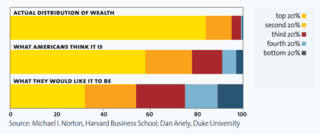
every Murri distribution of wealth
we done in this country
so we mustn’t pay tax
on our homing wealth
that stays within.
We are the first or last
human being
homo sapiens, aborigines
Well tell we deep
private thoughts.

by Lionel Fogarty
from Ngutji
publisher: Cheryl Buchanan, Brisbane, 1984

Adrienne Rich on ‘Tonight No Poetry Will Serve’

From The Paris Review:

Rich-Adrienne-credit-Robert-Giard_BLOG Adrienne Rich needs no introduction. One of the twentieth century’s most exhaustively celebrated poets and essayists, she counts among her many honors a National Book Award, a Book Critics Circle Award, and the Lannan Lifetime Achievement Award. Robert Hass has ascribed to her work the qualities of salt and darkness, praising its “relentless need to confront difficulty.” But Rich’s latest collection, Tonight No Poetry Will Serve, ranges from dismay to joy, the outraged to the erotic. Over e-mail, Rich shared her thoughts on poetry and power, the search for a more nuanced wartime aesthetic, and the meaning of the “woman citizen.”

Let’s start with the title, Tonight No Poetry Will Serve.

The book has an epigraph from Webster’s Dictionary: definitions of the verb “to serve.” It’s an interesting range of meanings, from the idea of obedient servitude to the authoritative (from law, the military, a prison sentence), to the meeting of another’s needs, to being of use. The title poem begins with an erotic moment registered in a world of torture and violence. It turns, midway, from the sensual and “poetic” to an official grammar, parsing violent policies as you might diagram a sentence in a classroom. The poem was inflected, you could say, by interviews I was hearing on Amy Goodman’s program, Democracy Now!—about Guantánamo, waterboarding, official U.S. denials of torture, the “renditioning” of presumed terrorists to countries where they would inevitably be tortured. The line “Tonight I think no poetry will serve” suggests that no poetry can serve to mitigate such acts, they nullify language itself. One begins to write of the sensual body, but other bodies “elsewhere” are terribly present.

More here.

Beautiful theory collides with smashing particle data

From Nature:

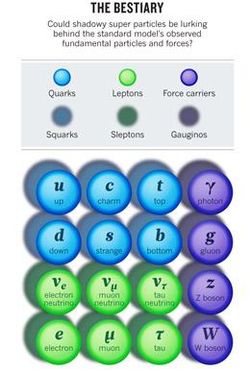
Parts “Wonderful, beautiful and unique” is how Gordon Kane describes supersymmetry theory. Kane, a theoretical physicist at the University of Michigan in Ann Arbor, has spent about 30 years working on supersymmetry, a theory that he and many others believe solves a host of problems with our understanding of the subatomic world. Yet there is growing anxiety that the theory, however elegant it might be, is wrong. Data from the Large Hadron Collider (LHC), a 27-kilometre proton smasher that straddles the French–Swiss border near Geneva, Switzerland, have shown no sign of the 'super particles' that the theory predicts13. “We're painting supersymmetry into a corner,” says Chris Lester, a particle physicist at the University of Cambridge, UK, who works with the LHC's ATLAS detector. Along with the LHC's Compact Muon Solenoid experiment, ATLAS has spent the past year hunting for super particles, and is now set to gather more data when the LHC begins a high-power run in the next few weeks. If the detectors fail to find any super particles by the end of the year, the theory could be in serious trouble.

Supersymmetry (known as SUSY and pronounced 'Susie') emerged in the 1970s as a way to solve a major shortcoming of the standard model of particle physics, which describes the behaviour of the fundamental particles that make up normal matter (see 'The bestiary'). Researchers have now found every particle predicted by the model, save one: the Higgs boson, theorized to help endow other particles with mass.

More here.

When will North Africa’s revolutions spread south?

Our own Tolu Ogunlesi at CNN:

Tzleft_tolu_ogunlesi_cnn Nigerians, masters of the art of self-flagellation that they are, waste no time proclaiming that Tunisia or Egypt will never happen here; we are too cowardly, too obsessed with self-comfort. This revolution will not be coming to a city near you anytime soon, we gleefully tell ourselves.

But the more I think about it, the more I become convinced that the answer to that question should be: “Why would anyone imagine that Nigeria needs a Tahrir-Square-style uprising at this time?”

Anyone following the protests in North Africa will realize that what is at stake is freedom. After decades of iron-handed rule, the Tunisians, Egyptians and Libyans deserve “freedom.”

Since democracy is supposed to guarantee this freedom (which is actually a melange of freedoms: of speech; of association; of having a say in the way one's country is being run and its wealth distributed), clearly what is happening across North Africa can be summarized as a push for democracy.

The only sub-Saharan African countries, therefore, that should be seeking to replicate Tahrir Square are those still in the grip of Egypt-style tyranny: for example Equatorial Guinea (where Teodoro Obiang has ruled since 1979), Gabon and Cameroon (where Paul Biya keeps altering the constitution.)

More here.

Uniting Pakistan’s minority and majority

Mohsin Hamid in The Express Tribune:

ScreenHunter_03 Mar. 04 11.00 There’s a nurse I know in Lahore. She’s tall and stocky, middle-aged. She is on call 24 hours a day and works six days a week. She’s also a freelance headhunter, placing cooks and drivers and maids. She sleeps little. She has five children she hopes to give better lives. Last year, she donated time and money to flood victims.

She is a Pakistani Christian. And on Wednesday, I saw her weep.

She was staring at a TV set. It was reporting the assassination of Shahbaz Bhatti, Pakistan’s federal minister for minorities, a Roman Catholic. “What’s going to happen to Christians in this country?” she asked me.

I had no answer. But her question is searingly important. A country should be judged by how it treats its minorities. To the extent it protects them, it stands for the ennobling values of empathy and compassion, for justice rooted, not in might, but in human equality, and for civilisation instead of savagery.

More here.

An Army Without a Country

Ahmed Rashid in the New York Review of Books:

ScreenHunter_02 Mar. 04 10.54 The assassination on Wednesday of Shahbaz Bhatti, Pakistan’s Federal Minister of Minorities, killed in broad daylight in Islamabad by four gunmen, is one of the most shameful acts of political violence committed by Pakistani extremists. That it comes just two months after the murder of Salman Taseer, the Governor of Punjab and one of the country’s leading liberal voices makes it all the more chilling. Yet the government and state’s reaction to the two killings has been even more shameful—raising the disturbing possibility that extremism is still being used by the security services in its efforts to oppose Western policies in the region.

The 40-year-old Bhatti was a Roman Catholic and the only Christian member of the cabinet of Prime Minister Yousf Reza Gailani. It was a death foretold. Taseer had been assassinated for his courageous struggle to amend Pakistan’s blasphemy law, which has been used to persecute minorities—a struggle to which Bhatti had also dedicated himself. Bhatti made a videotape some months ago that he wanted released to the BBC if he was killed. In it he said he would carry on the campaign to amend the blasphemy law.

“I will prefer to die for the cause [of defending] the rights of my community rather than to compromise on my principles,” Bhatti said in the tape. “The forces of violence, militants, banned organizations, Taliban and al-Qaeda, want to impose their radical philosophy in Pakistan and whosoever stands against it, they threaten him.”

More here.

Thursday, March 3, 2011

Eat Your Good Lamb

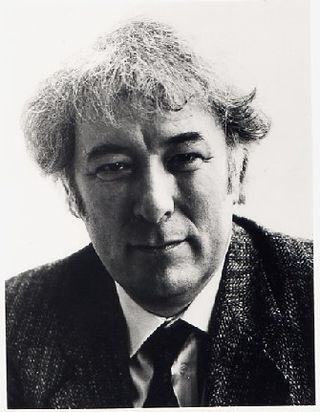
SBHeaney Daniel Picker on Seamus Heaney, in The Oxonian Review:

This past August, the Pulitzer Prize-winning biographer Justin Kaplan asked me, “What was it like to study with Seamus Heaney?” I fell silent for a bit, just as I often did around Heaney. Even now, it remains a difficult question to answer.

I first met Seamus Heaney in January in Warren House, the graduate English office at Harvard University in Cambridge, Massachusetts. I was about 22 years old.

I recall hearing him speak to the gathered crowd of students with his distinctive Irish accent. “I will be teaching two poetry writing classes: RBR and SBR. If you are interested, you should submit a manuscript of poems.” I very clearly recall first hearing him say, “RBR and SBR” (the course identification codes). With his accent, those letters sounded sort of thick and rubbery. He probably specified how many poems we should submit, perhaps around five.

In a brief letter of introduction I included with my poems, I’m sure I mentioned that, “I met with William Alfred, and he had read my poems.” Alfred suggested I mention his name in my letter. I had told Alfred in one of our informal conversations in his parlor at his house on Athens Street, “My mother’s maiden name is Haney.”

Alfred said, “Put that in your letter to Heaney, too.”

Hugh Mellor on Frank Ramsey

Over at Philosophy Bites:

Frank Ramsey, who died aged 26, made important contributions to philosophy, economics and mathematics. In this episode of Philosophy Bites Hugh Mellor discusses Ramsey's approach to truth.

Listen to Hugh Mellor on Frank Ramsey on Truth

Listen to 'Better than the Stars' (a radio programme Hugh Mellor made in 1978 about Frank Ramsey and which includes interviews with A.J.Ayer and Richard Braithwaite. Transcript also provided).

Enid Blyton inspires Blue Peter Book Award winner

From The Telegraph:

Lauren_1838100c Dead Man's Cove by Lauren St John is the story of an 11-year-old orphan sent to live with an uncle in Cornwall, where she turns amateur sleuth. It is the first in a series called The Laura Marlin Mysteries. St John, 44, who was born and raised in Africa, said the book was a tribute to the Enid Blyton stories she loved as a child. “I grew up on a game reserve in Zimbabwe and from a very young age I was obsessed with mysteries and adventures, particularly the Famous Five and Secret Seven books,” she said. “It's funny because I lived in an amazing place yet I was constantly wishing I lived in England so I could get lost in pea-soup fog and sleep in heather beds on the moors and encounter smugglers, just like those characters did. “I suppose Dead Man's Cove is a tip of the hat to the kind of books I loved.”

St John's first children's novel, The White Giraffe, was published in 2007. Her then agent had told her it was unpublishable and she suffered 18 months of rejection letters before it was taken up. Now her books are best-sellers. “I suppose a lot of parents are my age and grew up loving the same kind of mysteries and adventures that I did,” St John said. “The feedback I get from librarians is that there are not enough straightforward adventure stories out there. There is so much magic and fantasy, and these books maybe make people a bit nostalgic.” The Blue Peter judges praised Dead Man's Cove as “an absolutely enthralling and entertaining read that keeps the reader guessing with every page turn”.

More here.

Gauguin’s Bid for Glory

From Smithsonian:

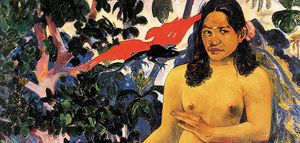
Gauguin-Te_Nave_Nave_Fenua-1892-631 Paul Gauguin did not lack for confidence. “I am a great artist, and I know it,” he boasted in a letter in 1892 to his wife. He said much the same thing to friends, his dealers and the public, often describing his work as even better than what had come before. In light of the history of modern art, his confidence was justified.

A painter, sculptor, printmaker, ceramist and writer, Gauguin stands today as one of the giants of Post-Impressionism and a pioneer of Modernism. He was also a great storyteller, creating narratives in every medium he touched. Some of his tales were true, others near-fabrications. Even the lush Tahitian masterpieces for which he is best known reflect an exotic paradise more imaginary than real. The fables Gauguin spun were meant to promote himself and his art, an intention that was more successful with the man than his work; he was well known during his lifetime, but his paintings sold poorly. “Gauguin created his own persona and established his own myth as to what kind of a man he was,” says Nicholas Serota, the director of London’s Tate, whose exhibition, “Gauguin: Maker of Myth,” traveled last month to Washington’s National Gallery of Art (until June 5). “Gauguin had the genuine sense that he had artistic greatness,” says Belinda Thomson, curator of the Tate Modern’s exhibition. “But he also plays games, so you are not sure whether you can take him literally.”

More here.

Thursday Poem

Uluru was built up during the creation period by two boys who played in the mud after rain. When they had finished their game they travelled south to Wiputa … Fighting together, the two boys made their way to the table topped Mount Conner, on top of which their bodies are preserved as boulders.
………………………………………………………………….. –Australian Aborginal Legend

Uluru/Ayers Rock

old Mr Uluru
a proud man
the day the Rock
was handed back
sits waiting

old Mr Walkabout
a proud man
at the twenty-fifth
anniversary of the
hand back
sits waiting

in the Red Rock tavern
the old men sit
waiting

yous wanna beer
the barman yells

he comes over
whatcha waiting for

the old men stare out
over their Country
waiting

waiting
for recognition
as Traditional Owners

more than just
a few days
in their life time.

by Ali Cobby Eckermann
publisher: PIW, 2011

Without Intervention, Lions Heading For Extinction

From NPR:

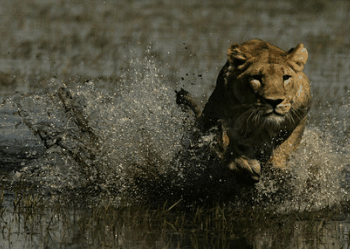
ScreenHunter_01 Mar. 03 13.10 In 1960, there were 400,000 lions living in the wild. Today, there are just 20,000.

“That represents a 90 to 95 percent decline,” says National Geographic explorer-in-residence Dereck Joubert. “Unless we start talking about this, these lions will be extinct within the next 10 or 15 years.”

Joubert and his wife, Beverly, have lived among populations of big wild cats for decades. Based in Botswana, the filmmakers and conservationists have spent much of their career documenting Africa's animal population for National Geographic. In their latest documentary project, The Last Lions, the Jouberts follow the dwindling lion population living in Botswana's Okavango Delta as they battle their prey — the buffalo — as well as rival prides.

“Marauding lions [come] in from the outside into their territory and fight with them,” says Dereck Joubert. “These territorial battles are dramatic and often end up in death one way or another.”

But obtaining dramatic footage of lions battling each other in the murky, swamplike Okavango Delta is not easy, even for seasoned documentarians like the Jouberts. They followed lions across river systems, pushing their car into chest-height water while driving — and they often had a front-row seat to heated attacks.

More here.

Diplomat: I can no longer represent Israel

Veteran diplomat Ilan Baruch quits, says he can no longer represent government; Israel's foreign policy is 'wrong,' he says, adds that blaming global anti-occupation views on anti-Semitism is 'simplistic, artificial'.

From Ynet News:

26539 A veteran diplomat says he has resigned from his post because he had a hard time defending the policies of Israel's current government, Yedioth Ahronoth reported Wednesday.

Ilan Baruch says he quit because “Israel's foreign policy is wrong,” pointing to the Palestinian issue.

Should this trend continue, he warned, Israel will turn into a pariah state and face growing de-legitimization.

Baruch told Israel TV Wednesday that Israel's standing was in danger because of its policies, which he said were “difficult to explain.”

“I can no longer honestly represent this government,” he said earlier. “As (Foreign Minister) Lieberman was elected by a large public in a legitimate manner, I cannot question him – but I don't have to serve him, and therefore I'm quitting.”

More here.